

TL;DR:
- Most SME cross-border banking risks stem from disconnected compliance and cash flow management.
- Implementing an integrated, flexible checklist covering documentation, security, and operational standards is essential.
One missed document. One failed AML check. One unmonitored SWIFT control. Any of these can trigger regulatory penalties, freeze your payments, or sever a supplier relationship overnight. For SMEs operating across European borders, the gap between a structured banking process and a reactive one can cost thousands in fines, days in payment delays, and months rebuilding trust with counterparties. This guide gives you a practical, integrated checklist for b2b banking for SMEs that covers compliance, payment controls, security frameworks, and the operational flexibility you actually need.
Table of Contents
- Essential criteria for your B2B banking checklist
- Key controls: SWIFT CSCF v2025 and annual attestation
- Cross-border payment compliance: What every SME must check
- Standards and exemptions: PSD2 SCA and operational flexibility
- What most SME banking checklists miss: Integrating compliance and cash flow
- Next steps: Level up your B2B banking with the right provider
- Frequently asked questions
Key Takeaways
| Point | Details |
|---|---|
| Prioritize compliance and transparency | B2B banks using SWIFT or cross-border tools must follow security frameworks and maintain updated documentation for each transaction. |
| Monitor PSD2 SCA exemption use | Keep a close eye on fraud and approval rates to avoid regulatory revocation of SCA exemptions. |
| Leverage modern standards | Adoption of ISO 20022 and SWIFT gpi dramatically boosts cross-border payment traceability and speed. |
| Anticipate and manage FX costs | FX volatility typically adds 4 to 6 percent to cross-border payments—transparent banking partners help reduce these expenses. |
| Integrate compliance with cash flow | Maintain a dynamic checklist that aligns regulatory steps and critical payment timelines for operational resilience. |
Essential criteria for your B2B banking checklist
Every B2B banking review starts with a question: are we actually ready to move money across borders legally, efficiently, and at acceptable cost? Most SMEs assume the answer is yes until a payment gets flagged or a regulator asks for documentation that nobody can locate.
Here are the non-negotiable criteria your checklist must include:
- Document compliance: Keep current copies of your tax registration certificate, company incorporation papers, and updated beneficial ownership records. These documents are requested during onboarding, periodic reviews, and transaction disputes. Outdated files cause delays at the worst possible moments.
- AML/CTF policies: Implement written anti-money laundering (AML) and counter-terrorist financing (CTF) procedures. These are not one-time tasks. Review them at minimum annually, or whenever regulations change in your operating jurisdiction.
- Technical payment standards: ISO 20022 and SWIFT gpi provide payment transparency and traceability that older formats cannot match. Ensure your banking provider supports these standards so you can track payments end to end.
- FX cost management: Cross-border FX volatility can add 4 to 6% in hidden costs to international transactions. Know your provider’s exchange rate policy, conversion fees, and cut-off times for same-day transfers.
- Payment speed and reconciliation: Understand your provider’s batch processing windows, cut-off times, and reconciliation cycle. A payment submitted five minutes late can mean a one-day delay, which cascades into supplier penalties or missed discount windows.
- Compliance dashboards and FX tools: Real-time visibility into your compliance status and FX exposure is not a luxury. It is a operational baseline. Streamlining banking workflows through integrated dashboards reduces manual errors and response time when issues arise.
Pro Tip: Ask your banking provider specifically whether their platform offers a combined view of compliance alerts and live FX rates. If they offer these as separate portals or worse, not at all, that is a sign of infrastructure that will slow you down.
The goal here is not to build the longest checklist possible. It is to build the right one. A focused list with clear ownership for each item, whether that is your finance lead, legal counsel, or operations manager, gets executed. A sprawling document that nobody owns gets ignored until a regulator forces the issue.
Key controls: SWIFT CSCF v2025 and annual attestation
If your business moves money through SWIFT, whether for supplier payments, international settlements, or correspondent banking, you are subject to the Customer Security Controls Framework. SWIFT CSCF v2025 is not optional reading. It is a mandatory compliance layer with real consequences if ignored.
The framework covers 32 security controls, structured across three operational objectives:
| Objective | Focus area | Control type |
|---|---|---|
| Secure your environment | Data protection, system configuration | Mandatory |
| Know and limit access | User access management, privilege controls | Mandatory + advisory |
| Detect and respond | Monitoring, incident response, anomaly detection | Mandatory + advisory |
Of the 32 controls, 24 are mandatory and 8 are advisory. The advisory controls are worth implementing even if not strictly required because they directly reduce the risk of fraud and unauthorized access, which are the scenarios that damage your business most.
What changed in 2025? No new mandatory controls were introduced, but SWIFT tightened scope clarifications and increased its emphasis on independent evaluations. The KYC-SA (Know Your Customer Security Attestation) process, which is the annual self-attestation all SWIFT users must complete, now requires documented evidence from an independent assessment rather than just internal sign-off.
Here is what that means in practice:
- You cannot simply have your IT team attest to their own controls. An external or genuinely independent internal party must verify the assessment.
- Evidence must be documented and retained. Verbal confirmation does not meet the standard.
- Failure to submit an accurate annual KYC-SA attestation can result in restricted access to the SWIFT network, which effectively shuts down your international payment capability.
For SMEs using SWIFT indirectly through a financial institution, you still need to confirm your provider’s CSCF compliance status. Ask for their attestation status and whether they apply the framework’s controls to your transaction environment.
A practical tip for your B2B payments checklist: schedule the CSCF attestation review six to eight weeks before the annual deadline. Independent evaluations take time, and last-minute reviews often surface gaps that require remediation before the attestation can be submitted accurately. If you use a provider offering faster SWIFT transfers with built-in compliance infrastructure, confirm they pass through CSCF compliance documentation you can use in your own records.

Cross-border payment compliance: What every SME must check
Structured criteria and security controls set the foundation. But compliance in cross-border payments is ultimately about executing specific steps in a consistent sequence every time a transaction occurs. Here is a practical workflow:
- Collect and verify documentation before the transaction: tax registration, beneficial ownership declaration, and the payment contract or invoice that justifies the transfer.
- Screen the counterparty against relevant sanctions lists, including EU consolidated lists, OFAC, and UN Security Council lists, before authorizing payment.
- Verify IBAN and BIC codes for the receiving account. An error here can route funds to the wrong institution, and recovery is slow and costly.
- Apply AML transaction monitoring at the point of instruction. Flag any payment that deviates from established patterns in amount, destination, or frequency.
- Confirm FX rate and total cost before execution. Lock in rates where possible to prevent slippage on high-value transfers.
- Execute and retain confirmation records. Every cross-border payment should generate a confirmation reference that includes timestamp, exchange rate applied, and counterparty details.
- Post-payment reconciliation: Match the payment confirmation to your accounts receivable or payable ledger within 24 hours. Unreconciled payments create blind spots in cash flow reporting.
FX volatility is not just a treasury concern. For SMEs running on tight margins, a 4 to 6% cost swing on a €100,000 cross-border payment represents €4,000 to €6,000 in unplanned cost. That can wipe out the margin on a single contract.
Technology plays a significant and growing role in this process. AI in sanctions compliance can pre-screen transactions against hundreds of lists in real time, reducing manual review burden while improving accuracy. Analytics tools can detect behavioral anomalies in payment patterns before they escalate into compliance incidents.
For the IBAN for international payments step specifically, do not rely on counterparties to self-certify their banking details without verification. Use a bank validation tool or request a recent bank statement. Fraudulent IBAN substitution (where criminals intercept invoices and swap the payment details) is one of the most common and financially damaging B2B fraud vectors in Europe.
Pro Tip: Build your compliance checklist as a live digital document, not a static PDF. Every time your operating countries, transaction volumes, or banking providers change, the checklist should be updated to reflect new regulatory obligations and procedural requirements. A checklist that is six months out of date is worse than no checklist because it creates false confidence.
Standards and exemptions: PSD2 SCA and operational flexibility
PSD2’s Strong Customer Authentication (SCA) requirement is widely known. What is less well understood is how to manage SCA exemptions without creating regulatory exposure. Exemptions exist to reduce friction for low-risk, recurring payments, but they come with conditions.
Here is a side-by-side breakdown of when SCA applies versus when it can be exempted:
| Payment scenario | SCA required? | Key consideration |
|---|---|---|
| First-time payment to a new payee | Yes | No exemption available for unknown recipients |
| Recurring fixed-amount subscription | No (exemption available) | Must be pre-authorized; amount and payee must be consistent |
| Low-value transactions (under €30) | No (subject to cumulative limits) | Limit resets after 5 transactions or €100 total |
| Trusted beneficiary on whitelist | No | Payee must be previously whitelisted by the payer |
| Corporate payment via dedicated channel | May be exempt | Depends on channel and fraud rate data |
The risk in this picture is not missing an exemption opportunity. It is over-relying on exemptions without monitoring what happens afterward. Overusing SCA exemptions creates a specific regulatory vulnerability: if your fraud rate on exempted transactions climbs above the thresholds set by EBA guidelines, your payment service provider can have those exemptions revoked. That revocation creates immediate friction across all your previously smooth payment flows.
What you need to actively track:
- Approval rate per exemption type: A drop in approval rates signals that issuing banks are declining the exemption, which indicates elevated risk signals they are detecting.
- Fraud rate on exempted transactions: Keep this well below EBA thresholds. For transaction risk analysis exemptions, the fraud rate ceiling is 0.01% for payments under €100.
- Volume of exempted transactions: If exempted payments represent a growing share of your total outgoing volume, review whether the underlying risk profile still justifies the exemption.
For open banking control and compliance, the exemption management question connects directly to your open banking provider’s fraud monitoring capabilities. A platform that gives you granular visibility into exemption usage and fraud statistics puts you in control. One that does not leaves you exposed to a revocation you never saw coming.
What most SME banking checklists miss: Integrating compliance and cash flow
Here is something most banking guides do not say plainly: the biggest compliance risk for SMEs is not fraud, and it is not a missing document. It is treating compliance and cash flow as two separate problems managed by two separate people who never talk to each other.
When compliance lives in legal and cash flow lives in finance, the checklist becomes a box-ticking exercise for legal and a frustration for finance when payments get held. But the actual cost of a compliance delay hits cash flow directly. A cross-border payment held for three days due to incomplete AML documentation can trigger a late payment clause in a supplier contract. That is a financial cost, not just a compliance footnote.
The smarter framing is to treat your banking checklist as a cash flow protection tool, not just a regulatory one. Every compliance step has a cash flow implication. Document verification delays slow payment release. FX rate locks protect margin. Proper reconciliation prevents payment disputes that freeze accounts receivable cycles.
Build what we call a “living checklist” that runs both tracks in parallel. It should list the compliance step, the responsible owner, the deadline relative to payment execution, and the cash flow impact if that step is delayed. Update it every time your operating context changes, whether that is a new banking provider, a new operating market, or a change in regulation.
Business banking efficiency trends are moving clearly in this direction: platforms that combine compliance tracking and real-time cash flow visibility into a single interface are replacing the patchwork of disconnected tools that most SMEs still rely on. The question is not whether to make the shift. It is how quickly you can make it before the next compliance gap costs you.
Next steps: Level up your B2B banking with the right provider
Understanding your checklist is the first step. Executing it consistently across every cross-border transaction, every SWIFT transfer, and every exempted payment is where most SMEs need structural support. A banking provider that bundles compliance controls, real-time FX visibility, and fast payment infrastructure into a single platform eliminates the coordination gaps that create risk.
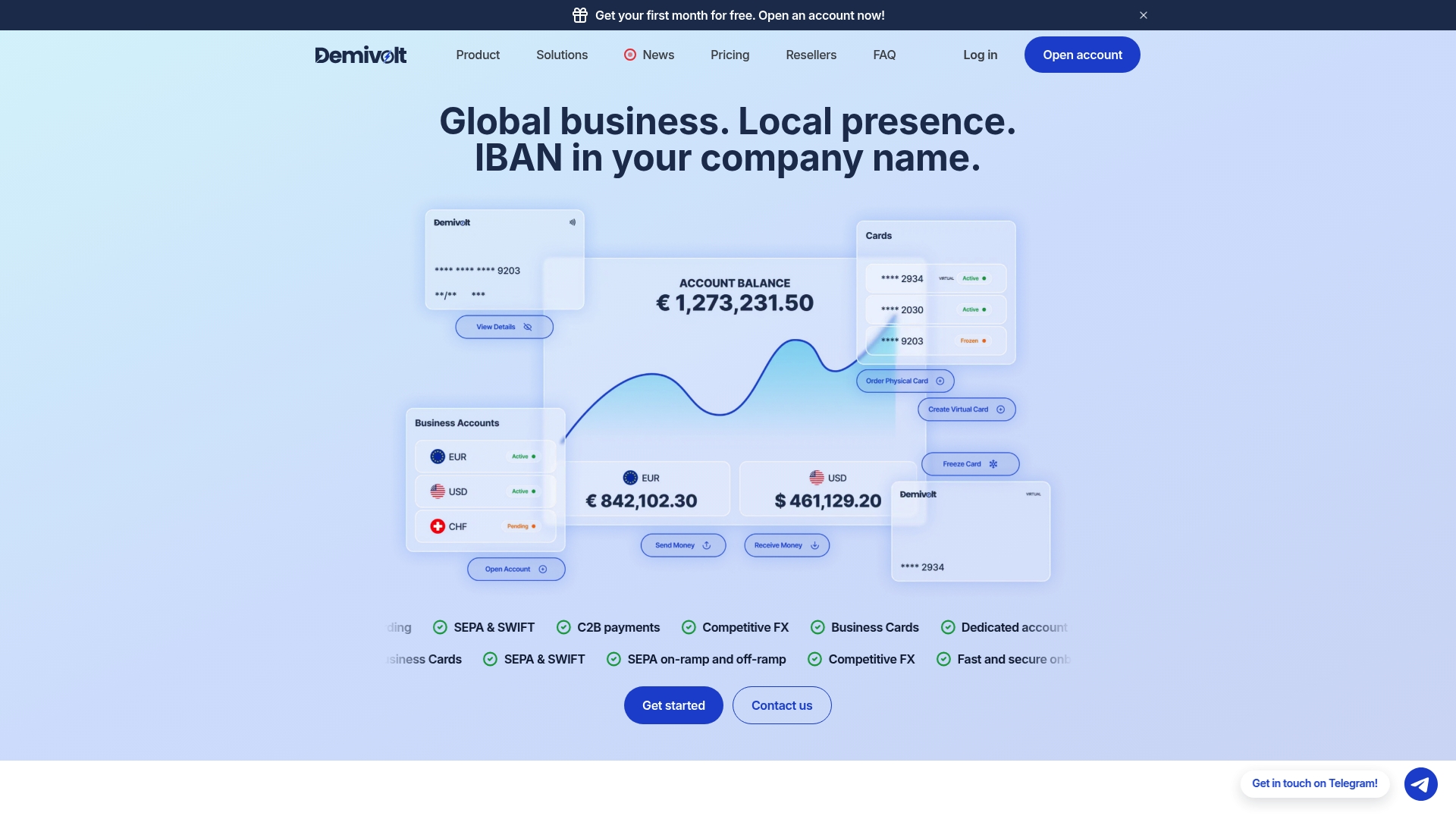
Demivolt is built specifically for this challenge. The platform provides dedicated IBAN accounts, SEPA and SWIFT payment management, role-based user access, and compliance-ready onboarding, all in a digital-first environment designed for business banking made clear. Whether you are managing cross-border supplier payments, handling multi-entity structures, or simply trying to bring your compliance documentation into one place, Demivolt’s infrastructure gives you the control and transparency your banking operations require. Explore how the platform can centralize your compliance, cut FX costs, and streamline your payment workflows from day one.
Frequently asked questions
What documents are essential for cross-border B2B payments in Europe?
Essential documents include current tax registration certificates, beneficial ownership declarations, AML policy documentation, and the underlying payment contract or invoice. Keeping these updated prevents holds during compliance reviews or counterparty verification checks.
How often must B2B banks complete SWIFT CSCF attestation?
SWIFT CSCF attestation is required annually, and from 2025 onward, the KYC-SA self-attestation must be backed by an independent evaluation rather than internal sign-off alone.
What happens if PSD2 SCA exemptions are overused?
Overusing SCA exemptions triggers revocation risk if fraud rates exceed EBA thresholds, which removes the efficiency benefit and forces full SCA authentication on previously exempt payment flows.
How do ISO 20022 and SWIFT gpi help in B2B banking?
ISO 20022 and SWIFT gpi standardize payment message formats and enable real-time tracking of cross-border transfers, reducing settlement delays and improving reconciliation accuracy for finance teams.
Recommended
- Demivolt | Blog – How to streamline your digital business banking workflow
- Demivolt | Blog – Business banking for SMEs: services, compliance & cross-border
- Demivolt | Blog – Modern business banking trends: boost efficiency & compliance
- Demivolt | Blog – Business payments checklist: compliance & cash flow 2026