

SMEs represent 99% of EU businesses and generate over half of all private-sector turnover, yet millions still struggle with fragmented banking, compliance rejections, and costly cross-border payments. If you run a small or medium-sized business in Europe, your banking setup is not just a back-office detail. It directly affects your cash flow, your legal standing, and your ability to grow internationally. This guide breaks down everything you need to know: what business banking actually includes, how compliance works, what cross-border payments cost you, and how to choose the right solution for your company in 2026.
Table of Contents
- Business banking essentials: What sets it apart
- Core services and features: What SMEs can expect
- Regulations and compliance: Navigating the European landscape
- Business banking for cross-border and multi-currency operations
- Choosing the right business banking solution
- Ready to take your business banking to the next level?
- Frequently asked questions
Key Takeaways
| Point | Details |
|---|---|
| Business accounts essential | A dedicated business account is required for legal, tax, and operational reasons in Europe. |
| Compliance is non-negotiable | Strict EU rules mean AML/KYC checks are standard for all SME accounts. |
| Digital options solve cross-border challenges | Fintech solutions often provide faster onboarding and better rates for SEPA/SWIFT transfers. |
| Hybrid approach maximizes value | Combining traditional banks with fintechs can optimize costs and compliance for SMEs. |
| Compare approvals and fees | SME bank account approval rates and costs vary widely—evaluate all providers carefully. |
Business banking essentials: What sets it apart
Business banking is not simply a personal account with a different label. It is a specialized financial infrastructure built around the needs of companies, not individuals. The core difference lies in purpose: business accounts are designed to handle commercial transactions, separate company funds from personal assets, and support regulatory compliance.
Key services include business current accounts, loans, payment cards, payroll processing, credit checks, and accounting integrations, with SEPA and SWIFT being critical for European transactions. SEPA (Single Euro Payments Area) enables fast, low-cost euro transfers across 36 European countries. SWIFT handles international payments in any currency, connecting banks worldwide.
For most EU-registered companies, using a dedicated business account is not optional. It is a legal and compliance requirement. Mixing personal and business funds creates audit risks, complicates tax filings, and can trigger regulatory scrutiny. A proper business banking platform gives you clean records, clear accountability, and the tools to scale.
- Current accounts for daily transactions and reconciliation
- Business loans and overdrafts for working capital
- Payment cards (virtual and physical) for expense control
- Payroll processing to pay staff accurately and on time
- Accounting software integrations to reduce manual errors
- SEPA and SWIFT access for domestic and international transfers
Pro Tip: Open your business account before you register for VAT. Many EU tax authorities require a dedicated business IBAN to process refunds and direct debits correctly.
Core services and features: What SMEs can expect
Knowing what business banking means sets up a deeper look at the concrete services available to you. Not all providers offer the same depth of features, and the gap between a basic account and a full-service platform can be significant.
Business banking includes daily transaction support, lending solutions, payment cards, payroll, partner credit checks, and direct integration with accounting systems. Each of these serves a distinct operational need.
Here is a quick breakdown of what to expect from each core service:
- Current accounts: Handle incoming payments, outgoing transfers, and daily reconciliation. Look for multi-account structures if you manage multiple revenue streams.
- Business loans and overdrafts: Provide short-term liquidity and longer-term investment capital. Approval depends on your trading history and credit profile.
- Payment cards: Debit and credit cards tied to your business account simplify purchasing and give you real-time expense visibility.
- Payroll services: Automate salary payments, tax deductions, and compliance filings. Errors here are costly and time-consuming to fix.
- Credit checks: Run checks on new suppliers or partners before committing to contracts. This reduces financial exposure significantly.
“A business account is not just a place to store money. It is the operational backbone of your company’s financial health.”
| Feature | Traditional bank | Digital fintech |
|---|---|---|
| Account opening time | 2 to 6 weeks | 1 to 5 days |
| SEPA transfers | Yes | Yes |
| SWIFT transfers | Yes | Often yes |
| Accounting integration | Limited | Strong |
| Multi-account support | Rare | Common |
| Virtual cards | Rarely | Standard |
| 24/7 support | No | Often yes |
When evaluating a comparison of digital fintech solutions, pay close attention to fee structures and integration depth. A platform that connects directly to your accounting software saves hours every month.
Regulations and compliance: Navigating the European landscape
With the core services in mind, it is vital to recognize that accessing those features comes with serious regulatory expectations throughout Europe. Compliance is not a one-time checkbox. It is an ongoing obligation.
Three frameworks govern business banking compliance across the EU:
- AML (Anti-Money Laundering): Banks must verify that funds entering and leaving your account are legitimate. Unusual transaction patterns trigger reviews.
- KYC (Know Your Customer): Before opening an account, providers must verify your identity, your business structure, and your beneficial owners. This includes passports, company registration documents, and proof of address.
- PSD2 (Payment Services Directive 2): This EU regulation governs how payment services operate, requiring strong customer authentication and opening the door to open banking.
Skipping or delaying these steps does not just slow down your application. It can result in rejected accounts, frozen funds, or sudden account closures. EU regulations impose strict AML/KYC rules; high-risk sectors see approximately 7% rejection rates, and de-banking risk is real, with 140,000 UK account closures recorded in 2023 alone.
Sectors facing higher scrutiny include: crypto businesses, online gaming, money services, and certain import/export operations. If your company operates in one of these areas, expect more documentation requests and longer review times.
The good news is that digital-first business banks often handle compliance checks faster and more transparently than traditional institutions. They use automated verification tools that reduce waiting times without cutting corners on regulatory standards. Staying ahead of current compliance hurdles means preparing your documents in advance and choosing a provider with clear onboarding communication.

Business banking for cross-border and multi-currency operations
With compliance covered, it is time to address a high-priority concern for growth-oriented European SMEs: managing cross-border payments and currencies efficiently. For any company selling to or buying from partners outside its home country, payment infrastructure is a competitive advantage.
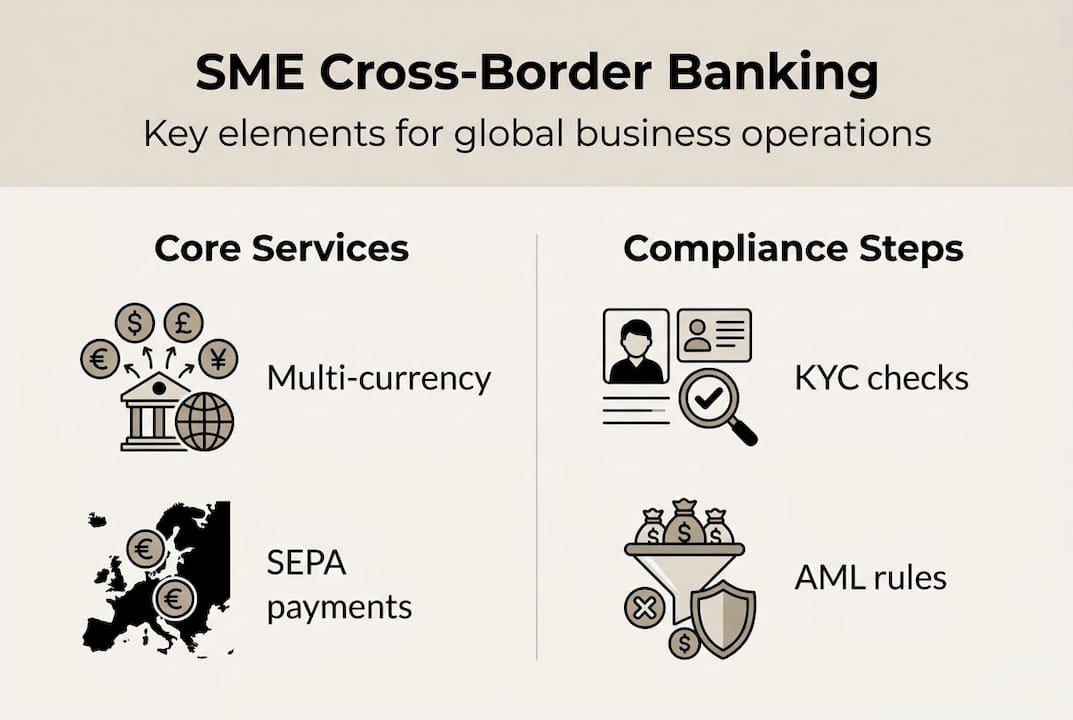
SEPA is your first tool. It covers 36 countries and enables euro transfers that typically settle within one business day at very low cost. For payments outside the eurozone or in non-euro currencies, SWIFT is the standard. SWIFT transfers are slower and more expensive, but they reach virtually every bank in the world.
The SME financing landscape shows that cross-border payment costs remain a significant barrier for smaller exporters. A hybrid approach using traditional banking for loans and compliance, combined with fintechs for business banking for cross-border payments, can save 3x versus banks on international transaction fees.
| Payment type | SEPA | SWIFT via traditional bank | SWIFT via fintech |
|---|---|---|---|
| Speed | Same or next day | 2 to 5 days | 1 to 3 days |
| Cost | Very low | High | Low to medium |
| Currency | Euro only | Multi-currency | Multi-currency |
| Coverage | 36 countries | Global | Global |
Multi-currency accounts are particularly valuable for SMEs that invoice in multiple currencies. Instead of converting every payment at unfavorable rates, you hold balances in different currencies and convert only when the rate is favorable.
Pro Tip: If you regularly receive payments in USD or GBP, open a multi-currency account and set a target exchange rate. Many fintech platforms let you automate conversions when your preferred rate is hit, saving you money without constant monitoring.
Choosing the right business banking solution
Now that you understand all your options, the final step is evaluating which providers and configurations will actually deliver on your unique business requirements. There is no single right answer. The best setup depends on your company’s size, sector, transaction volume, and international exposure.
Here is a practical framework for making your decision:
- Assess your international exposure. Do you send or receive payments in multiple currencies? If yes, prioritize multi-currency accounts and low FX fees.
- Map your compliance profile. Are you in a high-risk sector? If so, choose a provider with transparent onboarding and dedicated compliance support.
- Evaluate fee structures. Compare monthly account fees, per-transaction costs, FX margins, and card issuance fees. Small differences compound quickly at scale.
- Check accounting integrations. A direct connection to your accounting software eliminates manual reconciliation and reduces errors.
- Consider a hybrid setup. Use a traditional bank for credit facilities and a fintech for daily operations and cross-border payments.
Bank approval rates vary widely, from 56% in the UK to 96 to 98% in France, which means your home country and sector affect your options more than you might expect. Meanwhile, ECB data shows that while banks are more willing to lend in 2026, SMEs still face tighter conditions and benefit from diversifying their banking relationships.
| Priority | What to look for | Red flags |
|---|---|---|
| Compliance | Clear KYC process, fast onboarding | Vague documentation requests |
| Cost | Transparent fee schedule | Hidden FX margins |
| Cross-border | SEPA and SWIFT access | Euro-only transfers |
| Integration | Accounting software sync | Manual export only |
| Support | Dedicated account manager | Email-only support |
A digital business bank comparison should always include real user reviews, not just feature lists. Ask specifically about how the provider handles compliance queries and what happens if your account is flagged for review.
Ready to take your business banking to the next level?
Choosing the right banking partner is one of the most impactful decisions you will make for your company’s financial operations. Once you have assessed your priorities, the right platform removes friction and gives you room to focus on growth.
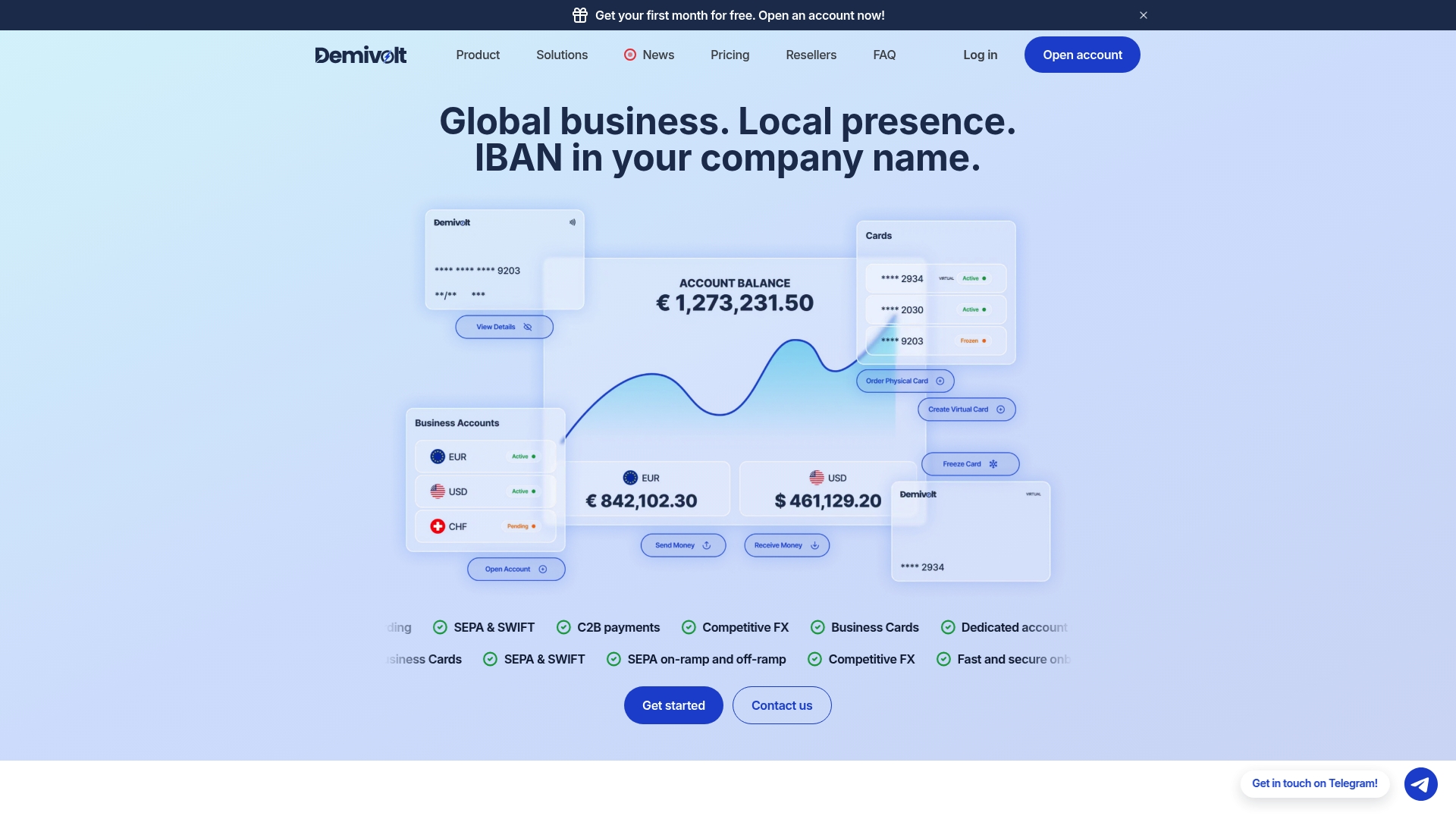
Demivolt offers SME business banking solutions built specifically for European companies managing complex payment flows, compliance requirements, and cross-border transactions. With dedicated IBAN accounts, SEPA support (SWIFT coming soon), role-based user management, and business cards in development, Demivolt gives your team the tools to operate efficiently and stay compliant. Onboarding is fast, transparent, and designed to meet EU regulatory standards from day one. If you are ready to move beyond outdated banking infrastructure, Demivolt is built for exactly that.
Frequently asked questions
What is a business bank account and why do I need one?
A business bank account is dedicated to company finances and required for proper record-keeping, compliance, and professional transactions. Separating personal and business funds is often a legal obligation for EU-registered companies.
What compliance checks are required to open a business account?
All business accounts in the EU must pass AML, KYC, and PSD2 checks before approval. High-risk sectors see roughly 7% rejections, so preparing your documentation in advance significantly speeds up the process.
Are digital or fintech business banks safe and compliant?
Yes. Reputable fintechs in Europe must follow the same compliance standards as traditional banks. Digital options maintain SEPA compliance and offer secure euro and cross-border payment access for de-banked or underserved SMEs.
How can I make inexpensive cross-border business payments?
SEPA enables fast, low-cost euro payments within Europe. For global transfers, fintechs typically offer better FX rates and lower SWIFT fees. A hybrid approach saves 3x compared to relying solely on traditional banks for international transactions.