

TL;DR:
- Getting a new hire from signed offer to full productivity requires a comprehensive onboarding process that spans all phases, assigns clear ownership, and goes beyond compliance to include cultural integration. SMEs should focus on structured, phase-based checklists with named owners, written milestones, and compliance tracking, while leveraging automation only for high-volume, deadline-driven tasks. Success depends on active management engagement beyond HR and adapting onboarding to remote or hybrid work setups to ensure retention and strong employee integration.
Getting a new hire from signed offer to fully productive team member is harder than most SME owners expect. A solid business onboarding checklist is what separates companies that retain great people from those that lose them in the first 90 days. Miss an I-9 deadline and you’re looking at fines up to $2,789 per violation. Skip the cultural integration steps and you lose the employee anyway. This guide gives you a structured, phase-by-phase checklist with named owners, compliance checkpoints, and the cultural pieces most SMEs ignore.
Table of Contents
- Key takeaways
- What makes a business onboarding checklist actually work
- The essential checklist by phase
- Manual vs automated onboarding: what SMEs need to know
- Practical tips for implementing your onboarding plan
- My honest take on why most SME onboarding fails
- How Demivolt supports SMEs beyond the checklist
- FAQ
Key takeaways
| Point | Details |
|---|---|
| Cover all four phases | Build your checklist across preboarding, Day 1, first week, and 30/60/90-day milestones. |
| Name an owner for every task | Missing task owners is the single biggest cause of checklist failure in small businesses. |
| Compliance alone is not enough | The 4 C’s framework adds Clarification, Culture, and Connection to keep new hires engaged past Day 1. |
| Automate only after mapping | Automating a broken process accelerates problems; fix workflows before deploying any onboarding software. |
| Shift paperwork to preboarding | Sending forms before Day 1 prevents I-9 deadline pressure and administrative overload on arrival. |
What makes a business onboarding checklist actually work
Most SME onboarding checklists fail not because they are too short, but because they are incomplete in the wrong places. They cover the paperwork and forget everything else. A checklist that works has four defining qualities.
1. It spans all phases. Your onboarding process steps need to start before Day 1 and run through the 90-day mark. Preboarding, Day 1, the first week, and monthly milestones are all distinct stages with different goals and owners.
2. Every item has a named owner. Not “HR” in the abstract, but a specific person. Ambiguity is where tasks go to die. Assign your HR manager, the direct manager, an IT contact, and a peer buddy, then map each checklist item to one of them.
3. It goes beyond compliance. Structured 30-60-90-day onboarding improves new hire satisfaction by 2.6x. That does not happen from paperwork alone. Role clarity, team introductions, and cultural engagement all belong in your business onboarding plan.
4. It accounts for legal deadlines. I-9 Section 1 must be completed on or before Day 1. Section 2 must be completed by the employer within 3 business days. State new hire reports carry their own deadlines, typically within 20 days, with penalties up to $25 per employee.
Pro Tip: Create a master checklist template with owner columns and due-date fields, then duplicate it for each new hire. This gives you an audit trail and eliminates the risk of skipping steps during busy hiring periods.
The essential checklist by phase
A phase-based approach transforms your new hire onboarding guide from a flat task list into a structured program with clear goals at each stage.
Preboarding (before Day 1)
- Send offer letter, W-4, direct deposit form, and any non-I-9 paperwork digitally. Separating I-9 from other forms and sending the rest in advance is a proven best practice for reducing Day 1 congestion.
- Order and configure equipment. Ship or prepare laptop, access badges, and any tools required for the role.
- Set up system accounts. Email, HR software, project management tools, and communication platforms should all be live before the hire walks in.
- Send a welcome message from their direct manager. Not HR. The manager. This sets the tone for who owns their experience.
- Share the first-week schedule so the new hire arrives knowing what to expect.
Day 1
- Complete I-9 Section 1 with the employee and verify original documents for Section 2. Do not delay this beyond 3 business days.
- Introduce the new hire to their buddy or peer mentor.
- Walk them through their workspace, tools, and key contacts.
- Hold a 30-minute welcome meeting with their direct manager to cover role expectations, team structure, and immediate priorities.
Pro Tip: Do not let Day 1 become a paperwork marathon. If you handled W-4, direct deposit, and benefits enrollment during preboarding, Day 1 can focus on connection and orientation instead of forms.
First week
- Conduct a company orientation. Cover mission, values, key policies, and how decisions get made.
- Schedule introductions with cross-functional team members, not just the direct team.
- Assign a small, meaningful task. Early wins matter for confidence and engagement.
- Hold a Friday check-in between the manager and new hire to surface any friction before it becomes a problem.
Days 8 to 30
- Begin role-specific training. Use your employee training checklist to track completion of required courses or certifications.
- Set 30-day performance milestones with the manager. These should be specific and measurable, not vague.
- Confirm all compliance items are closed. I-9 in the file, state new hire report filed, benefits elections submitted.
Days 31 to 90
- Hold formal 60-day and 90-day check-ins between the manager and new hire with documented notes.
- Introduce performance feedback mechanisms so the employee understands how they will be evaluated going forward.
- Assess cultural integration. Is the hire building relationships? Do they understand the norms of how your team operates?
- Collect feedback from the new hire on the onboarding experience itself. This is how you improve the process for the next hire.
Manual vs automated onboarding: what SMEs need to know
The appeal of onboarding software is real. Automation can reduce paperwork processing time from multiple days down to under 10 minutes. But the choice between manual and automated is not simply about budget. It is about process maturity.

| Factor | Manual onboarding | Automated onboarding |
|---|---|---|
| Setup cost | Low | Medium to high |
| Error risk | High (human-dependent) | Low (system-enforced) |
| Compliance tracking | Spreadsheet or paper | Automated alerts and audit logs |
| Scalability | Limited | High |
| Personalization | Easy with small teams | Requires deliberate configuration |
| Audit readiness | Manual file pulling | Centralized, instant retrieval |
| Best for | Fewer than 5 hires per year | 6 or more hires per year, or distributed teams |
The table above shows that automation earns its cost when hiring volume or complexity increases. For SMEs hiring infrequently, a well-built manual checklist with a named owner for every item performs well. The danger is automating a broken process. If your manual workflow has gaps, undocumented handoffs, or unclear ownership, software will not fix that. It will move you through the broken process faster.
Tasks most suited for automation include I-9 verification reminders, W-4 and direct deposit collection, new hire state reporting, equipment provisioning requests, and training completion tracking. These are high-volume, deadline-driven tasks where human memory is an unreliable system.
Practical tips for implementing your onboarding plan
Knowing the checklist phases is one thing. Running them without dropping tasks is another. These are the implementation points that separate SMEs with high retention from those constantly recycling the same roles.
-
Avoid Day 1 paperwork overload. Move every form that does not legally require in-person verification to preboarding. Your new hire’s first experience should not be 90 minutes of PDF forms.
-
Use one person as the checklist coordinator. Even if multiple people own individual tasks, one person should hold the master checklist and be accountable for tracking completion. In most SMEs, this is the HR manager or office manager.
-
Build 30, 60, and 90-day milestones into the checklist itself. Vague goals like “settle in” or “get up to speed” are not milestones. Write them as measurable outputs: “Complete product training module 1-3,” or “Lead first client call independently.”
-
Prepare separately for remote and hybrid hires. Equipment shipping timelines, virtual workspace access, and digital introductions need their own sub-checklist. Remote onboarding fails most often because physical-world assumptions are baked into a checklist designed for in-office hires.
-
Review the checklist after every hire. Set a calendar reminder for 95 days post-hire start date. Interview the manager and the new hire separately. Ask what was missing, what was redundant, and what caused friction. Update the checklist before the next hire.
-
Never backdate I-9 forms if Section 2 is completed late. Backdating is treated as fraud and carries steeper penalties than an honest late completion with a written explanation attached.
For SMEs with cross-border compliance needs, a compliance-first onboarding approach can help you think through jurisdiction-specific requirements that a generic checklist will not catch.
My honest take on why most SME onboarding fails
I have worked with enough small and mid-sized businesses to say this with confidence: onboarding is not an HR process. It is a management process. HR can build the checklist, configure the software, and file the paperwork. But if the direct manager is not engaged and present in the first 90 days, the new hire does not stay. An engaged manager is the most critical variable in new hire retention. No software replaces that.
What I see most often is SMEs treating onboarding as a compliance exercise. Get the I-9 done, get the W-4 filed, check the boxes, and declare success. But focusing only on compliance while skipping Clarification and Connection is exactly what drives early departures. The employee got their paperwork processed and still has no idea what winning looks like in their role or whether they belong at the company.
Here is the contrarian view that I think more SMEs need to hear: small companies actually have an advantage here. You can personalize onboarding in ways that large enterprises cannot. A founder coffee chat, a handwritten welcome note, a tailored first-week project. These cost nothing and signal to the new hire that they are joining something real, not just starting a job. Use that advantage deliberately. It does not show up on any checklist template, but it is often what makes the difference.
— dd
How Demivolt supports SMEs beyond the checklist
Onboarding does not happen in isolation. New hires need payroll accounts set up, expense cards issued, and banking workflows in place from day one. Demivolt’s business banking platform helps SMEs set up IBAN accounts, issue virtual and physical business cards, and manage SEPA and SWIFT payments without the administrative delays that slow onboarding momentum.
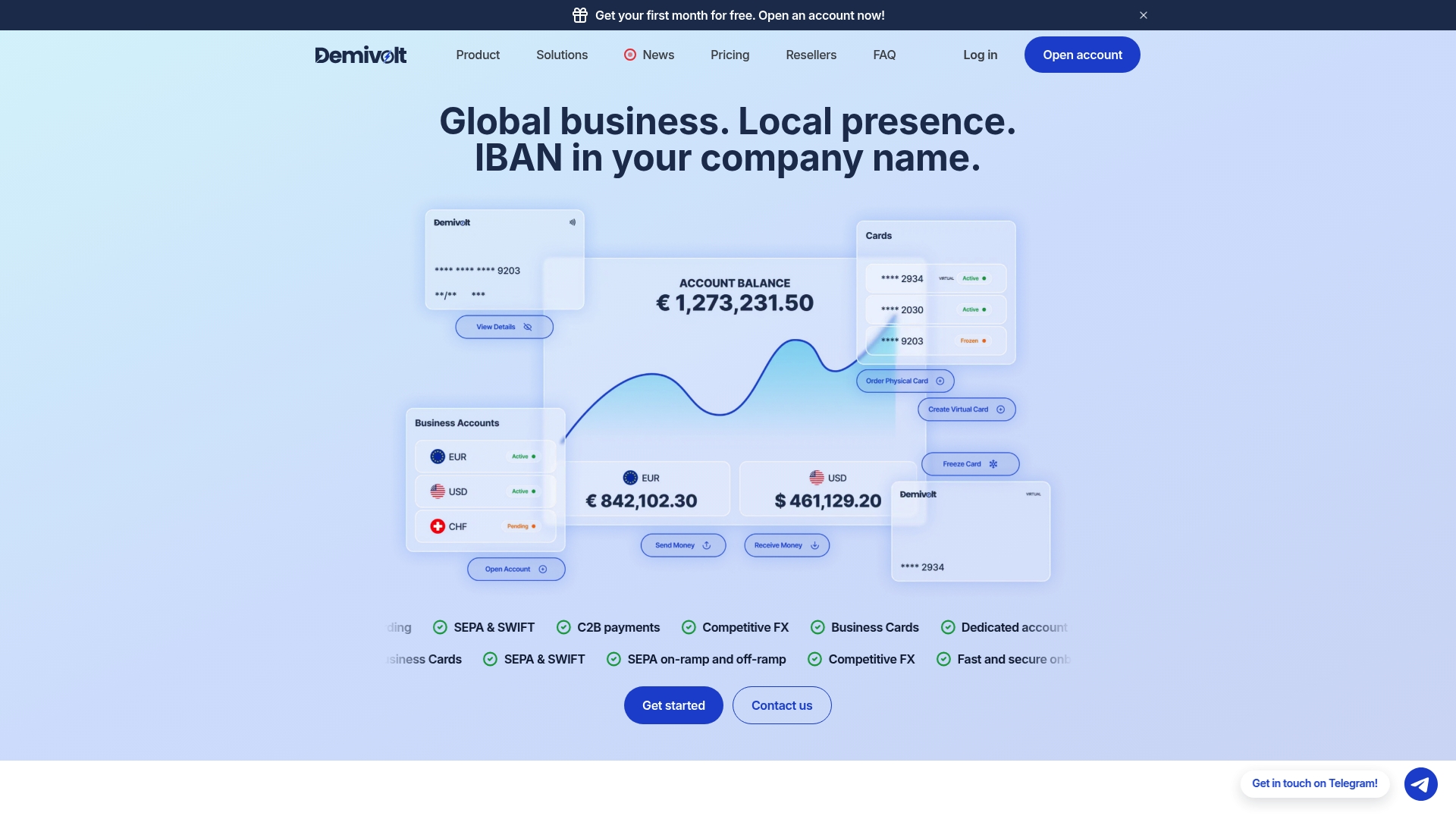
If your onboarding plan includes financial account setup for employees or new entities, Demivolt’s business banking gives you a compliant, digital-first infrastructure that fits directly into your onboarding timeline. For SMEs operating across borders, Demivolt also covers the fintech onboarding compliance considerations that generic checklists miss entirely.
FAQ
What should a business onboarding checklist include?
A business onboarding checklist should cover preboarding tasks, Day 1 compliance steps (including I-9 completion), first-week orientation, and 30/60/90-day milestones. Each item should have a named owner and a specific due date.
How long should the onboarding process take?
Effective onboarding runs through at least 90 days. Research shows that structured 90-day programs improve new hire satisfaction by 2.6x compared to onboarding that ends after the first week.
What happens if you miss the I-9 Section 2 deadline?
If you miss the 3-business-day deadline for I-9 Section 2, complete it immediately and attach a signed written explanation. Never backdate the form. Backdating is treated as fraud and carries higher penalties than a late, honest completion.
When should onboarding tasks be automated?
Automate tasks that are deadline-driven and high-volume, such as I-9 reminders, document collection, and state new hire reporting. Before deploying any software, map your existing process and fix unclear handoffs first. Automating a flawed process makes it faster but not better.
Who is responsible for employee onboarding?
Responsibility is shared. HR owns compliance tasks and checklist coordination, IT owns system access, and the direct manager owns cultural integration, role clarity, and milestone check-ins. Assigning a named person to every item prevents tasks from falling through the gaps.