

TL;DR:
- Managing cross-border payments for European SMEs involves addressing compliance, security, and governance challenges simultaneously. A comprehensive digital banking checklist helps identify gaps in workflows, authentication, and fraud prevention, ensuring platforms support control, connectivity, and compliance automation. Internal payment workflow governance is crucial to reducing fraud risk, surpassing the importance of cosmetic platform features or mere SCA compliance.
Managing cross-border payments as a European SME is not just a logistics problem. It is a compliance, security, and governance challenge running simultaneously. A well-built digital banking checklist does more than help you pick a platform. It forces you to examine your payment workflows, authentication controls, fraud response procedures, and integration requirements before a costly mistake reveals the gaps. This guide walks you through every essential criterion, from evaluating platforms to hardening daily operations, so your digital banking setup actually holds up under real-world pressure.
Table of Contents
- Key criteria for evaluating digital banking solutions
- Implementing strong customer authentication and fraud controls
- Operational security controls for daily banking activities
- Monitoring payment fraud trends and intelligence sharing challenges
- Comparing digital banking features with a focus on SME cross-border needs
- The overlooked truth about SCA and fraud governance in SME digital banking
- Explore Demivolt: tailored digital banking solutions for European SMEs
- Frequently asked questions
Key Takeaways
| Point | Details |
|---|---|
| Comprehensive criteria | SMEs need a checklist covering compliance, security, operational controls, and integration when choosing digital banking. |
| SCA governance | Strong customer authentication must be applied to every payment initiation with careful management of exemptions and factor reuse. |
| Operational controls | Daily banking security relies on alerts, dual control, transaction limits, scheduled updates, and user training. |
| Fraud monitoring | Active monitoring of evolving fraud trends and internal incident procedures is essential given GDPR constraints on data sharing. |
| Workflow fraud | Most fraud occurs via internal payment process vulnerabilities, so strict approval workflows are critical alongside authentication. |
Key criteria for evaluating digital banking solutions
Having established why a checklist is vital, let’s dive into the key evaluation criteria SMEs should prioritize.
When European SMEs evaluate digital banking platforms, the conversation too often starts and ends with fees. That is the wrong starting point. The questions that actually protect your business are about control, connectivity, and compliance automation. A 2026 core banking evaluation checklist confirms that open-API connectivity and compliance automation are non-negotiable features in any serious banking stack evaluation.
Here is what belongs on your digital banking checklist when assessing platforms:
- Open API connectivity: Can the platform connect to your ERP, accounting software, or payment gateway without custom workarounds? API integration is the difference between a banking tool and a banking ecosystem.
- Automated compliance and reporting: Does the platform handle AML (anti-money laundering) checks, transaction reporting, and audit trails automatically? Manual compliance creates error risk and burns finance team hours.
- Fraud monitoring and alerts: Real-time fraud detection built into the platform reduces your dependency on reacting after the fact.
- Operational controls: Transaction limits, multi-user role assignments, and administrative permission tiers are not optional features. They are your first line of defense against internal misuse and external fraud.
- Segregated accounts and fund protection: Especially for cross-border operations, confirm that client funds are held in segregated accounts in compliance with EU regulatory requirements.
A cross-border compliance checklist adds another lens. Cross-border specifically requires platforms that handle SEPA and SWIFT natively, provide dedicated IBAN accounts per entity or project, and maintain clear audit logs for multi-jurisdiction transactions. If your platform cannot provide these out of the box, you are building compliance workarounds from day one. For broader context on SME banking compliance services, the expectations go further than most SMEs initially realize.
Implementing strong customer authentication and fraud controls
With evaluation criteria clear, let’s explore how to implement strong authentication and fraud controls effectively.
Strong customer authentication (SCA) under PSD2 is the regulatory minimum, not the ceiling. SCA requires at least two independent verification factors from three categories: something you know (a PIN or password), something you have (a device or token), and something you are (a biometric). SCA under PSD2 significantly reduces fraud, but it requires careful governance of exemptions and factor reuse, especially for every payment initiation, including open-banking flows.
Your operational checklist for authentication should follow this sequence:
- Verify SCA applies to every payment initiation, including API-triggered payments from connected accounting tools or open-banking flows, not just manual portal entries.
- Audit your exemption usage. Low-value transaction exemptions and trusted-beneficiary exemptions reduce friction but create vulnerability if not monitored. Map every exemption your platform applies automatically.
- Confirm dynamic linking is in place. Each payment authorization must be cryptographically linked to a specific amount and recipient. If your provider cannot confirm this, that is a red flag.
- Review factor reuse policies. Reusing an authentication factor across multiple sessions is only acceptable if dynamic linking remains fully intact for each transaction.
- Test your authentication flows. Run simulated payment journeys quarterly to verify that SCA triggers correctly at every required step and that no exemptions are being over-applied.
A joint EBA and ECB report on payment fraud confirms that SCA reduces fraud rates, but fraudsters adapt quickly, shifting tactics toward remote payment initiation and social engineering to bypass authentication entirely. This is why authentication alone is insufficient.
Pro Tip: Assign a dedicated person or team to review SCA exemption logs monthly. Fraudsters actively probe for soft spots in exemption governance. Your secure payment workflow should include this review as a standing agenda item, not an annual audit.
Review your client onboarding compliance approach alongside authentication. Onboarding is where identity verification sets the tone for every subsequent transaction.
Operational security controls for daily banking activities
Beyond authentication, these daily operational controls form the backbone of secure SME banking.

Authentication handles the front door. But fraud often walks in through the side window after gaining some level of legitimate access. Your financial security checklist must cover the daily operational layer that most SMEs underprioritize.
According to the Online Banking Security Best Practices Checklist, SMEs should implement account alerts, dual control, transaction limits, scheduled security updates, and routine user training to strengthen their banking security posture across all touchpoints.
Put these controls in place as standard practice:
- Account alerts: Configure real-time notifications for large outbound transfers, low-balance thresholds, new payee additions, and login attempts from unrecognized devices.
- Dual control for high-value payments: Require two separate authorized users to approve any transaction above a defined threshold. This single control blocks the majority of internal fraud scenarios.
- Least-privilege administration: Every user should have only the permissions their role requires. A marketing coordinator does not need payment approval rights. A junior accountant should not have admin access to banking roles.
- Daily transaction limits: Set per-user and per-day caps on outbound payments. These limits contain the damage window if credentials are compromised.
- Scheduled security scans: Enforce automatic OS and anti-virus updates on every device used to access your banking platform. Malware-infected devices have bypassed SCA before.
- Regular employee security training: Phishing simulations and social engineering awareness sessions, run at minimum quarterly, dramatically reduce the human-error vector.
Pro Tip: When streamlining your banking workflow, map each control to a specific job role. Vague policies get ignored. Role-specific guidance gets followed. For a broader view of how these controls apply to cross-border finance, the stakes of getting them right multiply with each jurisdiction you operate in.
Monitoring payment fraud trends and intelligence sharing challenges
Understanding fraud threats helps shape robust internal monitoring and response practices.
Fraud is not static. The attack patterns targeting European SMEs in 2026 look different from those of three years ago, and your digital banking audit process needs to account for that evolution.
The 2025 Payments Threats and Fraud Trends Report from the European Payments Council identifies social engineering attacks and CEO fraud as rising threats, particularly for SMEs. The same report highlights that fraud intelligence sharing remains constrained by GDPR, making internal incident response plans critical rather than optional.
“The effective sharing of fraud intelligence across borders is limited by data protection law, meaning each organization must develop its own internal incident response capabilities rather than relying on ecosystem-wide early warning systems.”
What this means practically for your checklist:
- Build an incident playbook. Define exactly what happens when a suspected fraud event occurs: who is notified, in what order, how long until a transaction can be reversed, and which regulator gets informed.
- Set escalation paths. A finance manager should not have to improvise when a CEO fraud email lands. Pre-defined escalation paths cut response time when every minute matters.
- Educate on CEO fraud specifically. This attack typically involves a spoofed executive email directing an employee to transfer funds urgently. Training staff to verify all such requests through a second, out-of-band channel (a phone call, not a reply email) is the most effective defense.
- Monitor emerging vectors. Deepfake audio, AI-generated phishing, and SMS spoofing are already being used against European businesses. Your fraud awareness training needs to address these explicitly.
Track cross-border payment fraud developments actively, and stay updated on how fintech fraud trends are reshaping the threat landscape for SMEs specifically.
Comparing digital banking features with a focus on SME cross-border needs
Now that we’ve outlined features, let’s compare how leading platforms meet these SME cross-border needs in practice.
Not every platform built for businesses is built for your business. The gap between a consumer-grade banking app and a platform designed for European SME cross-border operations is significant. Banks that offer omnichannel self-service account management and privacy controls improve customer experience and reduce onboarding friction, which matters when every day of delayed account access costs operational time.
Use this comparison framework when evaluating platforms for your cross-border digital banking needs:
| Feature | What to look for | Red flags |
|---|---|---|
| SEPA and SWIFT support | Native, not third-party reliant | Delays or intermediary fees |
| Dedicated IBAN accounts | One per entity or project | Shared or pooled IBANs |
| SCA compliance | PSD2-aligned with dynamic linking | No exemption visibility |
| API connectivity | Open APIs with documentation | Closed systems, no sandbox |
| Dual control | Configurable per transaction type | Binary on/off only |
| Onboarding speed | Digital, under 48 hours | Paper-based or slow KYC |
| Audit trails | Real-time, exportable | Delayed or manual logs |
| Role-based access | Granular permission tiers | Admin or nothing |
Beyond the table, consider these factors that often get missed in initial evaluations:
- Privacy and consent controls: Can your clients or users manage their own data and marketing preferences? This matters for GDPR compliance and building trust.
- Self-service account opening: Platforms that allow finance teams to open sub-accounts or project accounts without contacting support save hours of operational overhead.
- Transaction alert customization: Generic alerts are noise. Granular, configurable alerts are signal.
For guidance on fintech onboarding solutions that work at scale, the right platform reduces your compliance burden rather than adding to it.
The overlooked truth about SCA and fraud governance in SME digital banking
Here is the opinion that most digital banking guides will not share: SCA compliance is not your biggest fraud risk. Your payment workflow is.
Fraudsters have adapted. The biggest fraud exposure for SMEs now comes from workflow fraud, specifically CEO fraud and social engineering attacks that target internal processes after gaining partial legitimacy. An attacker does not need to break your authentication if they can convince your accounts payable employee to approve a fraudulent transfer manually.
This is the uncomfortable reality: most SMEs spend disproportionate time selecting platforms with strong SCA and almost no time auditing their own internal approval workflows. They assume that once the login is secure, the payment is secure. That assumption is what attackers count on.
The fix is not more technology. It is governance. Your secure payment workflow needs mandatory dual authorization for any new beneficiary, automatic holds on first-time recipients above a threshold, and verified callback procedures for any payment instruction received by email or phone. These are process controls, not platform features, and they require deliberate implementation by your finance leadership.
Client onboarding governance is where this mindset needs to start. If your internal processes for adding new payees are as casual as adding a contact to a phone, your fraud exposure is significant regardless of how strong your SCA setup is.
The SMEs that genuinely reduce fraud are the ones who treat their internal payment workflow as a control environment with the same seriousness they give to their external authentication layer. Building that culture is harder than buying a platform. It is also far more effective.
Explore Demivolt: tailored digital banking solutions for European SMEs
Every item on this checklist points toward the same requirement: a banking platform that is built for compliance, designed for control, and capable of supporting real cross-border operations without constant manual intervention.
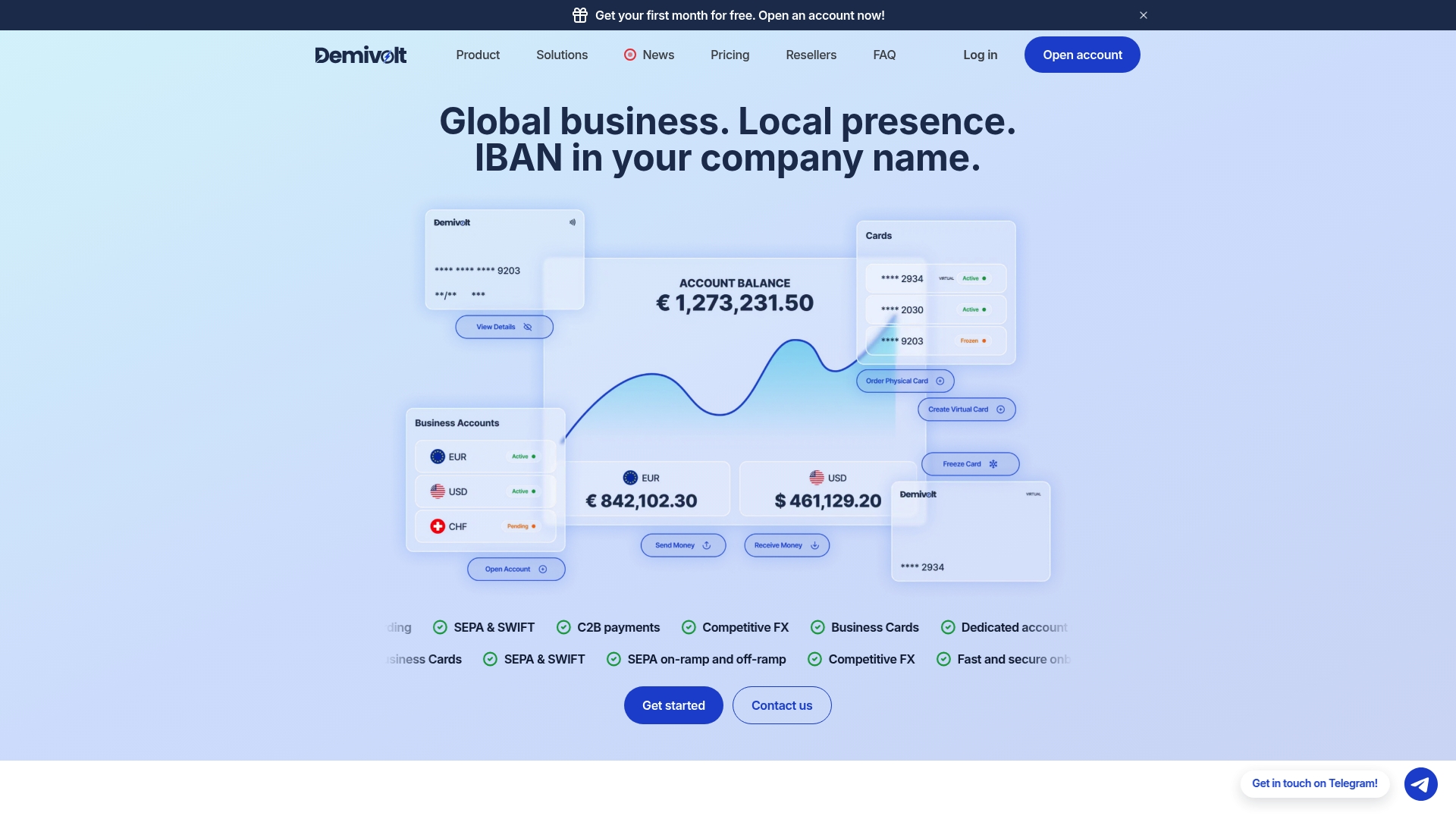
Demivolt is a regulated European fintech platform that addresses these requirements directly. It provides dedicated IBAN accounts, native SEPA and SWIFT payment support, open API connectivity, role-based user management, and virtual and physical business cards for expense control. Onboarding is digital, fast, and aligned with EU regulatory standards, with client funds held in segregated accounts. For finance leaders who need a platform that meets the criteria in this guide without requiring workarounds, Demivolt is worth a close look.
Frequently asked questions
What is strong customer authentication (SCA) and why is it important for SMEs?
SCA is a security protocol requiring two or more identity verification factors for online payments, reducing fraud and ensuring compliance with PSD2 regulations. SCA under PSD2 is especially critical for SMEs managing cross-border transactions across multiple European markets.
How can SMEs monitor payment fraud trends while respecting GDPR?
SMEs should build internal fraud incident playbooks and clear escalation procedures, since GDPR constrains cross-border fraud intelligence sharing, making internal response capability the primary defense rather than shared ecosystem alerts.
What operational controls should SMEs include in their digital banking checklist?
Dual control for high-value transactions, configurable transaction limits, real-time account alerts, scheduled system updates, and regular employee security training are the core controls. These banking security practices provide overlapping layers of protection that limit both internal misuse and external fraud.
Why is fraud risk governance focused on payment workflows rather than only authentication?
Because workflow fraud through social engineering bypasses authentication entirely by targeting internal processes. SMEs must enforce strict new-beneficiary verification, dual approval requirements, and out-of-band confirmation for any emailed payment instruction.
Recommended
- Demivolt | Blog – B2B banking checklist: Streamline cross-border compliance
- Demivolt | Blog – Digital banking explained: streamline cross-border success
- Demivolt | Blog – Digital banking client onboarding: a compliance-first guide
- Demivolt | Blog – Master the international payments process: SME guide