

TL;DR:
- Smooth digital onboarding enhances trust, reduces time-to-revenue, and supports scalable cross-border operations.
- Automation, thorough preparation, and ongoing compliance monitoring are key to reducing drop-offs and risks.
- Combining speed with data-rich, transparent processes builds stronger client relationships and regulatory confidence.
Slow, fragmented client onboarding is one of the most underrated growth blockers for European SMEs moving into digital banking. When a business owner tries to open an account, integrate payments, or expand across borders, every extra document request or manual delay creates a real risk of drop-off. Getting onboarding right is not just a compliance exercise. It is a direct competitive advantage, cutting time-to-revenue, building trust, and making cross-border operations scalable from day one.
Table of Contents
- What you need before onboarding clients
- Step-by-step: The digital banking onboarding process
- Cross-border onboarding and integrated payment management
- Verification, ongoing monitoring, and compliance controls
- Why SME onboarding is more than just ‘faster forms’
- Onboard clients seamlessly with Demivolt
- Frequently asked questions
Key Takeaways
| Point | Details |
|---|---|
| Start with regulatory prep | Gathering compliance documents and readiness for automation makes onboarding much faster and less risky. |
| Automate, but keep human review | A mix of automated and manual checks reduces client drop-offs and compliance errors for higher-risk cases. |
| Cross-border needs extra controls | Managing cross-border accounts means addressing added compliance and payment integration complexities up front. |
| Monitor continuously after onboarding | Ongoing verification and dynamic KYB prevent compliance issues and keep your business secure in the long run. |
What you need before onboarding clients
With the onboarding challenge defined, let’s start with exactly what SMEs must have in place to ensure a smooth and compliant digital onboarding process.
Most onboarding failures happen before the process even starts. Missing documents, unclear consent flows, or unvetted systems create bottlenecks that frustrate clients and expose your business to regulatory risk. Preparation is not optional. It is foundational.
According to Salesforce’s digital onboarding framework, a well-designed digital client onboarding process for regulated financial services is end-to-end: prospect creation, remote data capture, KYC and AML screening, account origination, and consent or disclosure workflows with digital signature automation. Each stage must be ready before you invite a single client through the door.
What you need to have ready:
- Business documentation: Certificate of incorporation, articles of association, proof of registered address, and tax identification numbers
- UBO (Ultimate Beneficial Owner) details: Full legal name, date of birth, nationality, proof of identity, and percentage of ownership for anyone holding 25% or more
- KYC and AML screening tools: A verified provider that checks clients against politically exposed persons (PEP) lists, sanctions databases, and adverse media
- GDPR-compliant consent flows: Clear disclosures, opt-in mechanisms, and a documented lawful basis for processing client data
- E-signature capability: Legally recognized electronic signatures under eIDAS (the EU regulation on electronic identification and trust services) to execute agreements remotely
- API readiness: If you plan to automate data exchange with banking platforms, your systems need open API connectivity
The table below shows which regulations apply to each stage of the prereq checklist:
| Prerequisite | Regulation | Why it matters |
|---|---|---|
| UBO documentation | 4AMLD / 6AMLD | Prevents anonymous shell structures |
| KYC identity check | KYC directive | Confirms client identity before account access |
| Data handling consent | GDPR | Lawful basis for storing and processing client info |
| E-signature workflow | eIDAS | Validates remote agreements legally |
| AML screening | FATF standards | Flags high-risk transactions or clients |
You will also want to review any local country-level harmonization rules within the EU. For example, Germany and France have additional national registers that may require cross-referencing your UBO checks.
Pro Tip: Organize all required documentation in a secure, remote-upload-ready folder before initiating any onboarding process. Clients who can upload everything in one session are far less likely to abandon the flow midway.
For real-world guidance on how other SMEs have navigated this stage, SME onboarding case studies offer a practical starting point.
Step-by-step: The digital banking onboarding process
Once all prerequisites are met, here’s how the actual onboarding journey flows and where the major gains come from automation.
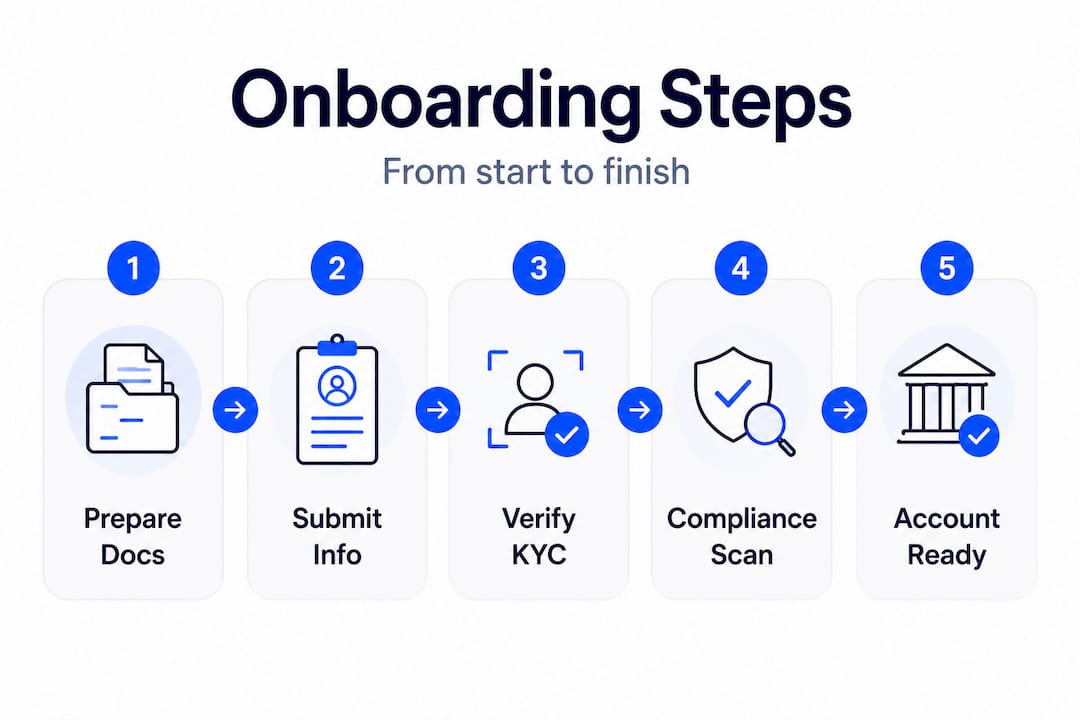
A well-executed digital onboarding process follows a logical sequence. Each step builds on the last, and skipping or rushing any stage typically creates costly errors later. Here is how the flow looks in practice:
- Digital data capture: The client submits business details, director information, UBO declarations, and supporting documents through a secure online portal or integrated form
- Identity verification: Automated ID checks using biometric matching or document scanning confirm the identity of directors and UBOs in real time
- KYC and AML screening: The platform cross-references client data against global watchlists, PEP databases, and sanctions lists, generating a risk score
- Account origination: Once screening clears, the system automatically provisions the business account, assigns an IBAN, and sets permission structures
- Consent and disclosure: The client receives and signs terms of service, data processing agreements, and any required regulatory disclosures via e-signature
- Confirmation and access: The account goes live, and the client receives credentials and onboarding documentation
The difference between manual and automated approaches is dramatic. Migros Bank reduced onboarding from several days to under 20 minutes once they replaced manual steps with automated workflows. Manual processes carry higher error rates, longer review queues, and abandonment rates that can reach 38% or more.
That said, automation is not a silver bullet. As InvestGlass notes in its onboarding analysis, straight-through processing improves speed and efficiency but may force risk teams to accept different controls. Many organizations implement hybrid flows, with automated processing for standard cases and manual checkpoints for higher-risk profiles.
When to use a manual checkpoint:
- Client is flagged as a PEP or has dual citizenship in a high-risk jurisdiction
- Transaction volumes declared do not match business profile
- UBO structure involves a complex multi-layer holding company
- Inconsistent data across submitted documents
The comparison below shows the operational difference:
| Process type | Average completion time | Error rate | Drop-off rate |
|---|---|---|---|
| Fully manual | 3 to 7 business days | High | Up to 38% |
| Hybrid (auto + manual review) | 4 to 8 hours | Moderate | 15 to 20% |
| Fully automated | Under 30 minutes | Low | Under 10% |
For SMEs looking to get more from their digital infrastructure, streamlining banking workflows covers practical process improvements beyond onboarding alone.
Pro Tip: Set up automated email or SMS reminders at each step of the onboarding flow. A single nudge sent 24 hours after an incomplete submission can recover a significant portion of clients who simply got distracted.
If you are starting from scratch and need to understand the basics of account setup first, the guide on opening an online business account in Europe walks through the foundational steps.
Cross-border onboarding and integrated payment management
For SMEs operating internationally, onboarding doesn’t stop at opening an account. Let’s tackle what makes cross-border onboarding and payment integration a different challenge and how to overcome it.
When your clients operate across multiple jurisdictions, onboarding complexity multiplies. It is not just about verifying a business once. You need to verify it in a way that accounts for different regulatory environments, currency corridors, and sanctions regimes that vary by country.
Visa’s analysis of cross-border card transfers in Europe highlights that institutions managing international SME clients need integrated, consistent payment connectivity alongside strong compliance and fraud controls, including AML monitoring, sanctions screening, and transaction monitoring, to handle corridor complexity without creating excessive onboarding delays.
The most common friction points in cross-border onboarding include:
- Sanctions screening delays: Automated systems flagging legitimate businesses due to name-matching errors with sanctioned entities, a problem known as false positives
- Corridor fragmentation: Each payment corridor (for example, EUR to GBP or EUR to PLN) may have different compliance requirements, meaning a one-size-fits-all check fails
- Data silos: When KYC data collected at onboarding is not shared across compliance, payments, and risk teams, the same client gets re-verified multiple times for different functions
- Currency and account structure mismatch: Clients expecting multi-currency accounts may find that standard onboarding does not provision for this automatically
“Compliance and fraud prevention remain top priorities for financial institutions managing cross-border payments. High false positive rates in sanctions screening are one of the primary reasons for onboarding delays and client frustration, making calibrated, integrated monitoring essential.” — Visa Direct, Cross-Border Card Transfers in Europe
The solution is a centralized compliance architecture. Rather than running separate AML checks for onboarding, payment processing, and ongoing monitoring, best-in-class platforms integrate all three into a single data model. This means one verified client profile feeds every compliance touchpoint automatically.
Open APIs play a key role here. When your banking platform can connect directly to payment rails, sanctions databases, and your internal accounting system, cross-border transactions flow without manual re-entry or compliance gaps. For a deeper look at how this works in practice, cross-border compliance insights break down the key requirements by region.
Understanding how IBANs for cross-border SMEs function within European payment structures is also critical for any business managing multi-country cash flows.
Verification, ongoing monitoring, and compliance controls
After onboarding, maintaining compliance is an ongoing process. Here’s how to proactively manage verification and regulatory controls.

Most SMEs treat onboarding verification as a one-time event. Submit documents, pass the check, get the account. That mindset creates serious long-term risk. Regulations increasingly require financial institutions and their business clients to treat KYB (Know Your Business) and UBO verification as dynamic processes that continue throughout the client relationship.
As TechUK’s research on financial crime in embedded finance makes clear, treating UBO verification and source-of-funds checks as part of an ongoing data model rather than a one-time check significantly reduces edge-case failures. These failures, such as synthetic business identities or financial signals that don’t match declared business activity, can otherwise produce false rejections or trigger compliance escalations months after a client is fully onboarded.
What ongoing monitoring looks like in practice:
- Automated transaction alerts: Real-time flags when a client’s payment volumes suddenly spike or shift to unfamiliar corridors
- Periodic KYB refresh: Scheduled reviews, typically every 12 to 24 months, to re-verify UBO structures, check for new directors, and confirm registered address information
- Adverse media monitoring: Automated scanning of news sources for mentions of your clients in relation to financial crime, sanctions, or legal proceedings
- PEP and sanctions list updates: Continuous screening against updated global watchlists, not just a check at the point of onboarding
The business case for this approach is straightforward. Early detection of a compliance issue costs far less than a regulatory investigation or account freeze that disrupts a client’s operations. A calibrated monitoring system also produces fewer false positives over time, because it builds a richer profile of what “normal” looks like for each client.
For SMEs wanting to stay ahead of evolving requirements, tracking banking compliance trends is an ongoing necessity, not a periodic exercise.
Pro Tip: Set automated alerts for sudden changes in transaction patterns, such as a 200% volume increase within a single week or payments to a new high-risk jurisdiction. Catching these early gives your compliance team time to investigate before a flag escalates to a regulatory authority.
Why SME onboarding is more than just ‘faster forms’
With all these operational tips addressed, here’s our perspective on what actually matters most in SME digital onboarding.
The fintech industry has spent years optimizing for speed. Reduce steps. Remove friction. Get the client to “account open” in under 10 minutes. That is a worthy goal, but it is only half the story.
We have seen what happens when speed becomes the only metric. SMEs get onboarded quickly, but the data captured is shallow. A generic business description gets waved through. UBO structures that deserve a second look get auto-approved because the risk score is just below the threshold. Then six months later, a transaction pattern flags something unusual, the account gets frozen, and the client is furious.
The conventional advice pushes for maximum automation. But the businesses that build the most sustainable client relationships treat onboarding as a living data process. Every interaction is an opportunity to enrich the business profile, understand how the client actually operates, and catch mismatches between declared and actual activity before they become problems.
Think of it this way. A fast onboarding that builds a shallow profile is like hiring someone based only on their resume without any follow-up. A thorough onboarding that includes smart manual review for edge cases is like a structured interview. One is faster. The other is more reliable.
The businesses we respect most in this space do not see compliance as a cost center. They treat it as a trust-building function. When a client knows their bank has done a thorough, transparent job of verifying them, they feel more secure. They are more likely to stay, expand their accounts, and refer others.
The practical wisdom here is to build repeatable processes that surface mismatches early. Accept a short manual review for edge cases rather than forcing every client through an identical automated funnel. The cost of a 15-minute manual review is trivial compared to the cost of a remediation, a regulatory fine, or a lost client relationship. Case studies on onboarding outcomes consistently show this to be true across different sectors and business sizes.
Speed matters. Compliance matters more. And building a data-rich onboarding process that keeps working for you over time matters most of all.
Onboard clients seamlessly with Demivolt
If you’re looking for a practical way to put these strategies into action, Demivolt delivers exactly the infrastructure European SMEs need.
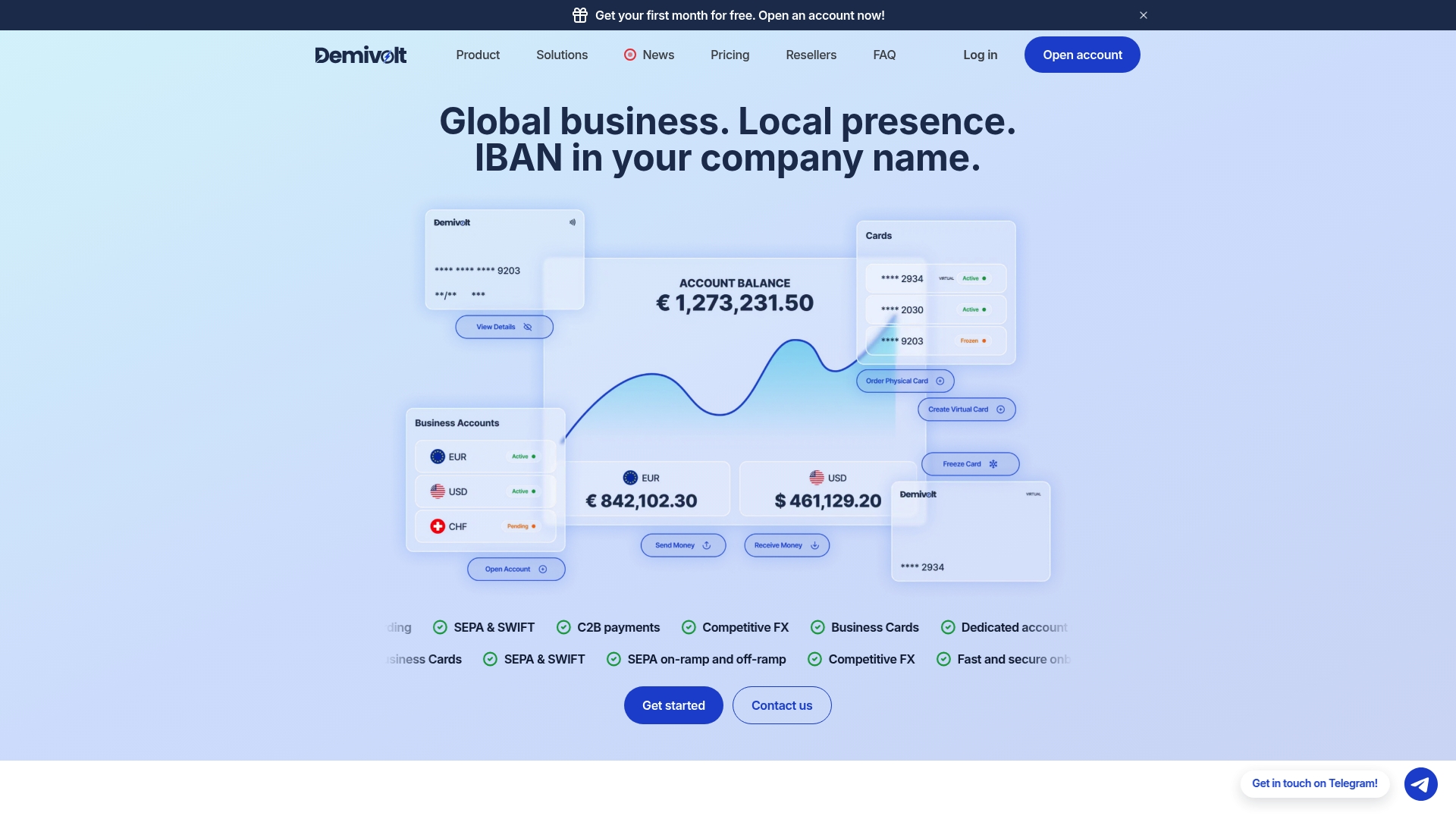
Demivolt’s business banking platform is built specifically for SMEs that need compliant, digital-first onboarding combined with powerful payment management. From dedicated IBAN accounts and SEPA or SWIFT payment processing to role-based user access and multi-account structures, every feature is designed to support cross-border operations without sacrificing compliance. The onboarding flow is fully digital, audit-ready, and built to EU regulatory standards, so you spend less time managing paperwork and more time running your business. Explore efficient onboarding solutions to see how Demivolt makes compliant SME banking genuinely fast.
Frequently asked questions
How long does digital client onboarding take for SMEs in Europe?
Automated onboarding now allows SMEs to complete digital client onboarding in as little as 20 minutes, compared to several days for manual processes, depending on the complexity of the business structure.
What are the biggest compliance risks in digital onboarding?
Major risks include gaps in KYC and AML checks, unverified UBOs, and fragmented payment screening for cross-border activities, all of which can produce onboarding delays and compliance escalations.
How do banks reduce clients dropping out during onboarding?
Automation and timely reminders at each step reduce abandonment significantly, while hybrid flows reserve manual review only for edge cases. Traditional abandonment rates around 38% drop sharply once automation handles standard cases.
Why is ongoing monitoring important after onboarding?
Continuous monitoring catches financial crime and compliance risks that a single one-time check can miss, particularly as business activity evolves. Ongoing monitoring as part of the onboarding data model reduces costly edge-case failures over time.
What documents are typically required to onboard SME clients?
Most platforms require company registration documents, UBO details with valid IDs, proof of business address, and tax identification numbers. Remote data capture and KYC screening frameworks specify exactly which documents apply at each stage of the process.
Recommended
- Demivolt | Blog – Onboarding in fintech: Efficient, compliant solutions for SMEs
- Demivolt | Blog – How to streamline your digital business banking workflow
- Demivolt | Blog – Modern business banking trends: boost efficiency & compliance
- Demivolt | Blog – Open banking explained: Control, compliance & SME benefits