

TL;DR:
- Fintech platforms reduce cross-border payment costs, settlement times, and compliance burdens for SMEs.
- Selecting the right platform depends on specific corridor familiarity and regulatory compliance experience.
- Digital payment records improve SMEs’ access to affordable, real-time business financing.
Cross-border payments cost European SMEs far more than they should, in both money and time. Moving funds between countries often means opaque fees, slow settlement windows, and compliance paperwork that can slow entire operations to a crawl. Fintech platforms have changed that calculus considerably, offering regulated, digital-first infrastructure that cuts costs, automates compliance, and opens access to finance that traditional banks rarely extend to smaller businesses. This article breaks down the evidence-backed operational, compliance, and strategic benefits so you can make an informed decision about your next banking move.
Table of Contents
- Top operational benefits of fintech for SMEs
- Compliance made easier: Automated controls, audit trails, and standards
- Boosting access to finance through digital payment rails
- Nuances, constraints, and corridor-specific realities of fintech benefits
- Why picking the right fintech platform matters more than chasing trends
- Make fintech work for your SME
- Frequently asked questions
Key Takeaways
| Point | Details |
|---|---|
| Faster, cheaper payments | Fintech platforms can dramatically reduce fees and processing times for cross-border SME payments. |
| Simplified compliance | Automation and embedded standards cut down on manual regulatory work and errors. |
| Easier access to credit | Digitized payments help SMEs qualify for loans by improving information visibility to lenders. |
| Corridor-specific advantages | The size of fintech benefits depends greatly on the payment corridor and transaction characteristics. |
Top operational benefits of fintech for SMEs
The friction in cross-border payments is not just annoying. It is a real barrier to growth. Reducing cross-border frictions in cost and speed is a material barrier to trade participation for SMEs. When an invoice goes unpaid because a wire transfer sat in a correspondent bank chain for five days, that is a cash flow event with real consequences.
Fintech platforms address this in several concrete ways:
- Lower transfer fees. Traditional banks charge anywhere from 3% to 6% of transaction value for international wires, plus fixed fees. Fintech providers often charge flat rates or a fraction of a percent, particularly for SEPA-zone transfers.
- Faster settlement. Many fintech platforms settle within hours rather than days by connecting directly to modern payment rails like SEPA Instant or SWIFT gpi.
- Real-time tracking. You can monitor exactly where a payment is at any given moment, reducing the “where is my money?” calls that eat into your team’s day.
- Automation of repetitive tasks. Batch payments, payroll runs, and recurring supplier invoices can be scheduled and processed automatically, freeing your finance team for higher-value work.
Interlinking fast payment systems can meaningfully improve cross-border outcomes by lowering costs, increasing transparency, and supporting trade flows. This is not theoretical. Businesses that have moved to modern payment rails report measurably shorter cash conversion cycles and fewer disputes caused by payment errors.
The access angle is equally important. Smaller businesses that previously could not meet the minimum deposit requirements or relationship thresholds at large banks can now open a business account, issue virtual cards, and send international payments within days of applying. Fintechs facilitating cross-border payments have genuinely lowered the floor for market entry.
| Feature | Traditional banks | Fintech platforms |
|---|---|---|
| Transfer fee (cross-border) | 3% to 6% plus fixed charges | 0.1% to 1% flat or fixed |
| Settlement time (international) | 2 to 5 business days | Same day to 48 hours |
| Real-time tracking | Rarely available | Standard feature |
| Onboarding timeline | 2 to 6 weeks | 1 to 5 business days |
| Multi-currency accounts | Limited | Commonly available |
Pro Tip: When evaluating platforms, look specifically for solutions that support both SEPA and SWIFT rails. Businesses that only support one or the other will become a bottleneck when your supplier base or customer geography grows beyond its current borders. Scalability matters from day one.
Understanding international payments for SMEs is critical before you commit to a provider because the corridor you operate in will shape which features actually matter to your business.
Compliance made easier: Automated controls, audit trails, and standards
Operational speed is only half the story. For SMEs, compliance can make or break growth. Getting fined for a missed AML (Anti-Money Laundering) check or failing a regulatory audit because you cannot produce a payment audit trail is an existential risk for a small business. Fintech platforms have made significant strides in baking compliance into the payment flow itself rather than treating it as an afterthought.

ISO 20022 is the global messaging standard that sits at the center of modern payment compliance. Unlike legacy formats, ISO 20022 sends structured, machine-readable data alongside every payment. That means compliance rules, like sanctions screening and KYC (Know Your Customer) verification, can be embedded directly into the payment workflow. Message automation reduces false positives and strengthens audit trails in AML and sanctions screening environments, with some implementations reporting a 25 to 30% reduction in false positive alerts compared to legacy screening systems.
Why does that matter? False positives create manual review queues. Manual review queues slow payments and cost staff hours. A 25% reduction in false positives is not just a compliance metric. It is also an operational efficiency gain.
Here is what modern compliance automation typically covers:
- AML screening. Automated checks against global watchlists run in milliseconds, not minutes.
- KYC verification. Digital document checks and identity verification happen during onboarding and are refreshed continuously.
- Sanctions screening. Every counterparty is checked against OFAC, EU, and UN sanctions lists before funds move.
- Straight-through processing (STP). Payments that pass all checks are processed without manual intervention, cutting error rates significantly.
- Audit trail generation. Every payment event is logged with timestamps, so you have a full record for internal review or regulator requests.
That said, compliance nuance is real. Cross-border regulatory complexity increases when payments cross jurisdictions. Sanctions logic that works perfectly for EU-internal transfers may need additional configuration for payments to Turkey, the UAE, or Southeast Asia. Choosing a platform that understands this is not optional. It is essential. You can read more about how modern platforms are handling this in the context of business banking trends that are shaping compliance requirements across European markets.
For a broader view of what financial compliance means for smaller businesses, the regulatory stakes are high enough that automation is not a luxury. It is a necessity.
“Compliance is not a back-office problem anymore. It is a front-line payment design issue. The platforms that embed controls into the payment flow will always outperform those that bolt them on afterward.”
Pro Tip: Before signing with any fintech provider, ask specifically whether you can access your own audit logs and in what format. Some platforms restrict log access to their support teams. If a regulator asks you for a payment trail, you need to be able to produce it independently, without waiting for a support ticket to be resolved.
Boosting access to finance through digital payment rails
Once compliance is streamlined, access to affordable finance is the next big lever fintech can pull for SMEs. One of the most underappreciated benefits of digitizing your payment infrastructure is what it does to your credit profile.
Traditional lenders struggle to evaluate SME creditworthiness because small businesses often lack the kind of financial history that appears cleanly in a credit bureau report. Inconsistent invoicing, cash-based revenue streams, and limited collateral all make lenders nervous. Digital payment rails solve this by generating a rich, verifiable record of transaction history.
Payment digitalization alleviates credit constraints for small firms, particularly in weaker-credit-infrastructure economies. This is not a marginal effect. It represents a structural shift in how lenders can assess risk for businesses they would previously have turned down.
Here is how digital payments open financing doors for SMEs:
- Transaction history as creditworthiness. A clean record of regular inbound and outbound payments tells a lender more than a balance sheet does in many cases.
- Faster trade finance approvals. When your payment flows are digital and auditable, trade finance products like invoice factoring and supply chain financing can be underwritten more quickly.
- Open banking integrations. Many fintech platforms allow lenders to connect directly to your account data with your permission, removing the need for manual document submission.
- Working capital products embedded in the platform. Some fintech providers now offer short-term credit or overdraft facilities based on real-time account activity rather than historical credit scores.
| Factor | Traditional bank lending | Digital payment-enabled lending |
|---|---|---|
| Credit assessment basis | Historical credit scores, collateral | Real-time transaction data |
| Processing time | Weeks to months | Days to 2 weeks |
| Access for micro-SMEs | Limited or denied | Increasingly available |
| Documentation required | Extensive manual submission | Often automated via open banking |
This matters especially for SMEs operating across borders, where building a credit relationship with a local bank in a new market can take years. Digital payment records from a regulated fintech platform can substitute for that relationship history in a growing number of financing contexts. If SME growth through digital payments is a priority for your business, building a verifiable payment history on a regulated platform is one of the smartest moves you can make right now.
Nuances, constraints, and corridor-specific realities of fintech benefits
But fintech is not a magic bullet. The benefits described above are real, but how much of them your business actually captures depends heavily on where you operate, who you pay, and how much you are moving.
Fintech benefits are context and corridor-specific. A payment between two EU member states using SEPA Instant will be fundamentally different in cost structure and settlement speed than a payment from Germany to a supplier in Serbia or North Macedonia. The infrastructure simply is not equivalent.
Key constraints to understand before you commit:
- Corridor maturity. Well-developed corridors like intra-EU SEPA routes offer the most immediate benefits. Corridors connecting the EU to the Western Balkans, Central Asia, or sub-Saharan Africa still involve correspondent banking intermediaries that reintroduce cost and delay.
- Transaction size effects. Larger wholesale transactions often see proportionally bigger savings from fintech platforms than small retail transfers, because fixed fee structures favor volume.
- Legacy system integration. If your ERP (Enterprise Resource Planning) system is more than five years old, connecting it to a modern payment API may require significant technical work that offsets short-term cost savings.
- Compliance logic gaps. Platforms optimized for EU payments may not have granular controls for payments to sanctioned-adjacent regions, creating compliance risk.
| Dimension | EU-internal (SEPA zone) | Western Balkans corridor |
|---|---|---|
| Cost savings potential | High (up to 80% vs. bank wire) | Moderate (30% to 50%) |
| Settlement speed | Very high (same day or instant) | Moderate (1 to 3 days) |
| Compliance automation | Strong, well-tested | Emerging, requires more scrutiny |
| Credit access improvement | High | Moderate, depends on local infrastructure |
The practical takeaway is to right-size your fintech adoption based on where your actual payment volume flows. There is little point in optimizing for SEPA if 70% of your payments go to non-EU markets. In that case, prioritizing a platform with strong SWIFT coverage and corridor-specific compliance experience will generate more return. Use business accounts for SMEs and tools that allow you to streamline business banking workflows in a way that maps to your actual operational geography.
Why picking the right fintech platform matters more than chasing trends
Here is an uncomfortable truth: most SMEs pick their fintech provider the same way they pick a restaurant. They go with the one that has the most Instagram ads or the slickest app interface. Then they spend six months working around the fact that the platform does not support the currencies their suppliers invoice in, or that customer support has no idea how to handle a payment query related to a specific regulatory requirement in a specific market.
The real mistake is treating fintech selection as a feature checklist exercise. “Does it have virtual cards? Yes. Does it have a dashboard? Yes. Sign us up.” That approach misses the one question that actually predicts ROI (Return on Investment): does this platform have deep, verified experience in the specific payment corridors and compliance contexts you operate in?
We have seen SMEs switch from large-brand fintech providers to more specialized ones simply because the specialist could answer corridor-specific compliance questions without escalating to a third party. That kind of institutional knowledge is what separates a genuinely useful platform from one that looks good in a demo. Fintech cross-border solutions vary enormously in their practical depth, even when their marketing materials say similar things.
Greater automation is also not always better. If a platform automates compliance logic that was designed for one regulatory environment and applies it uncritically to another, you could end up with more risk than if you had done things manually. The sophistication of the automation only helps if the underlying rules are correctly configured for your context.
Pro Tip: During your evaluation, do not just demo the product. Call the support line and ask a specific question about a payment corridor you actually use. How fast they answer, how specific their response is, and whether they escalate immediately will tell you more about operational fit than any sales presentation.
Fintech ROI is maximized when your platform selection is driven by corridor fit and compliance specificity, not brand recognition or feature counts.
Make fintech work for your SME
If you have been managing cross-border payments through a traditional bank, the operational and compliance improvements available through a purpose-built fintech platform are not incremental. They are structural. The difference in fee structure, settlement speed, and compliance automation alone can free up meaningful budget and hours every single month.
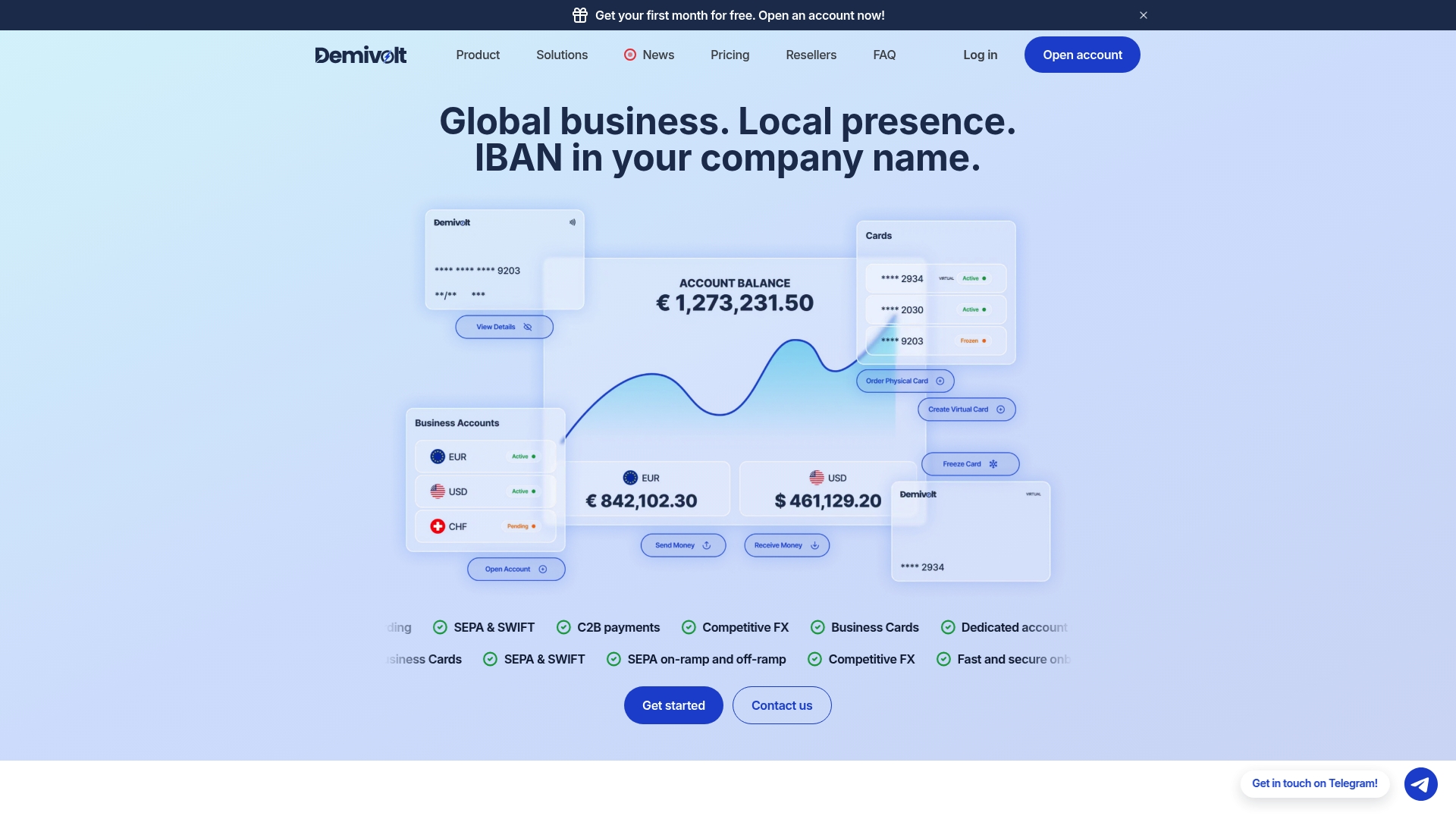
Demivolt is a regulated European fintech platform built specifically for businesses that operate across borders. With dedicated IBAN accounts, SEPA and SWIFT payment support, automated compliance controls, and fast onboarding, Demivolt gives SMEs the financial infrastructure they need to move money efficiently and stay compliant without building a compliance team from scratch. Whether you are paying suppliers in three countries or collecting revenue from customers across the EU, Demivolt is designed to support the complexity of your actual operations, not just the simple cases.
Frequently asked questions
How much cost savings can SMEs expect from fintech payment solutions?
Fintech payment solutions can make cross-border transfers up to 10 times cheaper compared to traditional bank routes, with the most dramatic savings seen in corridors with weak legacy banking infrastructure, such as transfers between Western Balkan economies.
Are fintech solutions secure for international payments?
Most regulated fintech platforms use ISO 20022 machine-readable standards to embed AML, KYC, and sanctions screening directly into payment workflows, producing full audit trails and significantly reducing compliance errors compared to manual processes.
Do fintech platforms help SMEs access more financing?
Yes. Payment digitalization reduces information gaps between SMEs and lenders, making it easier for creditors to evaluate risk based on real transaction data, which is particularly valuable for businesses with limited traditional credit history.
Will fintech benefits apply equally in every European country?
No. Benefits are context and corridor-specific, with EU-internal SEPA routes delivering the strongest cost and speed improvements. Corridors linking the EU to less developed financial markets offer real but more moderate gains, depending on local infrastructure and regulatory maturity.
Recommended
- Demivolt | Blog – Business account benefits for European SMEs in 2026
- Demivolt | Blog – International payments for SMEs: efficiency, compliance, growth
- Demivolt | Blog – Why Dedicated Business Accounts Matter for European SMEs
- Demivolt | Blog – Modern business banking trends: boost efficiency & compliance
- Valiutų keitimo eiga verslui: kaip sutaupyti 2-3%