

TL;DR:
- Fintech partnerships enhance cross-border payment speed, reduce costs, and improve compliance for SMEs.
- Stablecoin and multi-rail integrations offer faster settlement times and lower intermediary fees.
- Success depends on governance, alignment, and adaptable infrastructure rather than just features or pricing.
Choosing the right fintech partnership is the single biggest lever most SMEs still aren’t pulling hard enough. While treasury teams obsess over FX margins and finance directors debate banking relationships, the underlying payment infrastructure often stays unchanged for years. That’s expensive. The global cross-border payments market is evolving rapidly, with new partnership models, stablecoin rails, and bank-fintech alliances reshaping what’s possible for businesses that move money internationally. This article breaks down real partnership structures, live case studies, and frameworks you can actually use to evaluate your next move.
Table of Contents
- Defining fintech partnership types and selection criteria
- Case study: OpenPayd and Zetta’s instant stablecoin settlements
- Bank-fintech alliances: WorldFirst with global banking leaders
- Trade finance and B2B distributors: Measurable gains from stablecoin integration
- What most SMEs miss when forming fintech partnerships
- Power your SME with agile banking and payment solutions
- Frequently asked questions
Key Takeaways
| Point | Details |
|---|---|
| Fintech partnerships evolve cross-border payments | Strategic alliances between fintechs and banks unlock faster, lower-cost payments for SMEs operating internationally. |
| Stablecoins boost speed and savings | Integrating stablecoins like USDC consistently reduces fees and accelerates settlements in B2B trade. |
| Scale and flexibility require the right mix | Choosing between fintech-only, bank-fintech, or hybrid structures depends on corridor needs and SME goals. |
| Governance is critical for success | Alignment on KPIs, clear roadmaps, and continuous fit-checks make or break fintech partnership outcomes. |
Defining fintech partnership types and selection criteria
Before you evaluate any partner, you need to understand what “fintech partnership” actually means in practice. The term covers a surprisingly wide range of structures, and mixing them up leads to poor decisions.
At the broadest level, there are three core models. First, bank-fintech alliances, where established financial institutions provide regulated rails, balance sheet capacity, and compliance cover, while fintechs contribute technology, speed, and user experience. Second, fintech-to-fintech integrations, where two technology-led companies combine specialized capabilities, such as FX conversion paired with blockchain settlement. Third, platform-as-a-service arrangements, where one party provides the infrastructure and another white-labels or builds on top of it.
The mechanics of these partnerships often involve API integrations, orchestration layers, and hybrid arrangements designed for speed and transparency. Orchestration layers, in particular, are becoming central to efficiency in SME cross-border payments because they route transactions dynamically across multiple rails based on cost, speed, and corridor availability.
When evaluating a partnership or selecting a provider that has already formed strategic alliances, SMEs should assess the following factors:
- Integration model: Is it a direct API connection, a middleware layer, or a manual workflow? Simpler is faster to deploy, but less flexible.
- Payment speed and finality: Does the partnership deliver real-time settlement, or just faster notification of a slow underlying transfer?
- Fee transparency: Are all costs visible upfront, including correspondent bank charges, FX spreads, and platform fees?
- Regulatory compliance posture: Does the partnership cover your operating jurisdictions, and who holds regulatory responsibility at each stage?
- KPI alignment: Are technical performance metrics (uptime, latency) and commercial metrics (volume tiers, pricing) written into the agreement?
- Scalability path: Can the partnership accommodate your growth in new corridors or currencies without renegotiation?
Emerging tools like stablecoin sandwiches (where fiat converts to a stablecoin mid-route, then converts back at the destination) and multi-rail orchestration are also becoming selection factors. These approaches can dramatically cut costs in corridors where traditional correspondent banking is slow or expensive. Keep an eye on modern banking trends as these tools mature quickly.
Pro Tip: Before full deployment, run a structured trial with real transactions on your highest-volume corridor. Measure actual settlement times, landed costs, and exception rates rather than relying solely on vendor benchmarks. This prevents costly surprises after you’ve committed to integration.
The risk side is equally important. Integration risks include API version changes, data mapping errors, and latency issues under volume spikes. Strategic risks include partners with conflicting roadmaps or pricing structures that change once you’re locked in. Build in contractual protections, including SLA minimums and exit clauses, from day one.
Case study: OpenPayd and Zetta’s instant stablecoin settlements
With partnership structures in mind, let’s look at one of the most technically advanced examples currently operating at scale. The OpenPayd and Zetta partnership illustrates exactly how a fintech-to-fintech alliance can deliver capabilities that neither company could achieve independently.
OpenPayd partnered with Zetta to build infrastructure for cross-border payments supporting stablecoins like USDT and USDC on multiple blockchains, enabling automated fiat-to-stablecoin conversions and fast settlements for SMEs. That’s a significant statement in practice. It means a business sending money from a European bank account to a supplier in Southeast Asia no longer needs to wait for a chain of correspondent banks to complete the transfer. The funds convert to a stablecoin, travel across a blockchain network, and convert back to local fiat at the destination, often in minutes rather than days.
For SMEs specifically, this unlocks several concrete advantages:
- Liquidity speed: Faster settlement means suppliers get paid sooner, which strengthens negotiating positions and can unlock early-payment discounts.
- FX predictability: Stablecoin rails peg value during transit, reducing the FX slippage that occurs when transfers take multiple days through traditional correspondent networks.
- Reduced intermediary dependency: By bypassing parts of the correspondent banking chain, businesses avoid layered correspondent fees that can add 1 to 3 percent on top of the headline rate.
- Multi-blockchain flexibility: Operating across multiple blockchain networks means the infrastructure can adapt to the most efficient network at any given time based on congestion and cost.
The partnership also introduces complexity worth noting. Stablecoin rails bypass correspondent banking but require wallet whitelisting, liquidity orchestration across fiat and crypto environments, and hybrid fallback arrangements for corridors where stablecoin infrastructure is still immature. In plain terms, not every destination market is ready for this approach yet, and the technology requires careful configuration to meet AML and KYC requirements.
“Stablecoin-based settlement isn’t just faster. It’s structurally different. When you remove the correspondent layer, you remove both its cost and its opacity. For SMEs that have been tolerating unexplained deductions and slow confirmations, that change is significant.”
This type of SME cross-border collaboration also changes how finance teams manage treasury. With near-instant settlement visibility, cash forecasting becomes more accurate. Reconciliation time drops. The finance team spends less time chasing confirmations and more time on strategic decisions. For stablecoin integration insights beyond the OpenPayd model, the broader ecosystem is expanding rapidly with regulated on-ramps in multiple jurisdictions.
The takeaway from this case: cutting-edge fintech partnerships can deliver real operational improvements for SMEs, but they require thoughtful implementation, not just platform selection. Compliance, liquidity management, and corridor-specific testing all need to be part of the rollout plan.
Bank-fintech alliances: WorldFirst with global banking leaders
Building from a fintech-native partnership, the WorldFirst example shows how scale and reach expand dramatically when a fintech aligns with established banking infrastructure. This model appeals to SMEs that need breadth rather than just speed.

WorldFirst (Ant International) partners with banks like J.P. Morgan, HSBC, Citibank, and DBS to provide SMEs with cross-border business accounts for payments in over 100 currencies to more than 200 countries, expanding payout currencies from 40 to over 100 via these partnerships. That’s a fundamental shift in what an SME can access without building its own banking relationships in each market.
Here’s how the model compares before and after banking partnerships are integrated:
| Capability | Pre-partnership | Post-partnership |
|---|---|---|
| Payout currencies | ~40 | 100+ |
| Destination markets | ~80 | 200+ |
| Account types available | Single currency | Multi-currency business accounts |
| Compliance coverage | Home jurisdiction | Expanded to partner bank jurisdictions |
| Settlement speed | 2 to 5 days typical | Reduced, corridor-dependent |
The strategic motivations on both sides are worth understanding because they affect how reliably the partnership will serve your business. Banks gain access to SME customer segments they find expensive to serve directly, along with technology infrastructure they didn’t build. Fintechs gain access to the banking licenses, balance sheet capacity, and correspondent networks that take years to establish independently. When both parties benefit clearly, the partnership is more likely to remain stable.
For SMEs, the benefits of this model include:
- Simplified compliance: Operating through a fintech backed by major banking partners means KYC and AML processes are often more streamlined, with a single onboarding covering multiple jurisdictions.
- Cost consolidation: Pricing is typically more predictable than assembling multiple banking relationships, each with its own fee schedule.
- Currency reach: Access to 100-plus payout currencies means businesses can invoice and pay in local currencies, removing FX risk for suppliers and clients.
- Trust and stability: Banking partnership backing gives SMEs confidence that the infrastructure is regulated and capitalized properly.
This model is also influencing how payment infrastructure is being built more broadly. Fintechs are increasingly positioning themselves not as alternatives to banks but as distribution layers for banking capabilities. Understanding the IBAN role in global payments is also critical in this context, since IBAN-based account structures underpin many of the multi-currency capabilities these partnerships enable.
Trade finance and B2B distributors: Measurable gains from stablecoin integration
Shifting to concrete financial results, let’s examine a case where a B2B distributor implemented stablecoin-based payments and tracked every dollar of impact. This is the kind of data-driven analysis that should anchor any ROI conversation with your CFO or board.
A B2B distributor integrated USDC stablecoin payments, reducing cross-border wire fees by 40 percent, recovering the $39,500 integration cost in just 67 days on $4.2 million monthly volume, with end-to-end processing from ERP to supplier bank completing in under 4 minutes in most corridors.
Here’s what the numbers look like in a structured view:
| Metric | Traditional wire | USDC stablecoin | Improvement |
|---|---|---|---|
| Fee percentage | ~1.8% per transfer | ~1.1% per transfer | 40% reduction |
| Settlement time | 2 to 4 business days | Under 4 minutes | 67% faster |
| Monthly volume | $4.2M | $4.2M | Same |
| Integration cost | N/A | $39,500 | Recovered in 67 days |
| Annual savings | Baseline | ~$302,400 | Significant |
The benchmarks across similar implementations show 40 percent fee reductions via USDC with 67-day payback periods, 67 percent faster processing times, and 30 to 40 percent cost savings in trade finance broadly. For context, Wise FX spreads run at 0.4 to 0.6 percent compared to PayPal or Stripe’s 3 to 4 percent, which illustrates the range of outcomes depending on the integration path chosen.
The streamlined process this distributor implemented followed these steps:
- Purchase order raised in ERP system, triggering automated payment initiation.
- Payment instruction sent to stablecoin payment platform via API.
- Fiat funds convert to USDC at locked rate.
- USDC transfers across blockchain to destination wallet.
- Destination wallet converts USDC to local fiat currency.
- Funds credited to supplier’s bank account, confirmation sent back to ERP.
- Reconciliation record automatically updated, no manual intervention required.
The entire sequence, from step one to step seven, completes in under four minutes in established corridors. That compares to a multi-day process that previously required manual follow-up, FX exposure during transit, and manual reconciliation upon arrival.
Pro Tip: When calculating ROI for stablecoin integration, factor in three variables beyond direct fee savings: reconciliation labor cost reduction, early payment discount capture from faster settlements, and FX slippage eliminated during transit. Many SMEs undercount these and underestimate total payback by 30 to 50 percent. The friction reduction in payments compounds over volume.
What most SMEs miss when forming fintech partnerships
Here’s the uncomfortable truth: most SMEs evaluate fintech partnerships the same way they evaluate software subscriptions. They compare features, check the pricing page, and make a decision based on what the sales deck promises. That approach explains why so many partnerships underperform.
Technical capabilities and fee structures matter, but they’re table stakes. The real determinant of partnership success is governance alignment. Currently, 62 percent of banks partner with fintechs to fill capability gaps, yet still face significant integration risks because KPIs, technical milestones, and commercial targets aren’t aligned from the start.
What does that look like in practice? A partnership where one party optimizes for transaction volume and the other optimizes for margin creates friction at every escalation. A partnership where technical roadmaps diverge six months in leaves SMEs stranded on deprecated infrastructure. The companies that succeed treat partnership selection as a relationship decision, not a procurement decision.
The question isn’t just “can this partner process payments in 40 currencies?” It’s “when we need to add currency 41, or when a regulatory change disrupts our primary corridor, how does this partner respond?” That alignment, or the lack of it, determines long-term outcomes far more than the initial feature set. Understanding cross-border expansion pitfalls often comes down to exactly this: the partnership worked fine at launch but couldn’t adapt when conditions changed.
Power your SME with agile banking and payment solutions
The case studies above demonstrate what’s possible when SMEs connect with the right fintech infrastructure. Getting there requires a platform built for the complexity of modern cross-border operations, not one patched together from legacy systems.
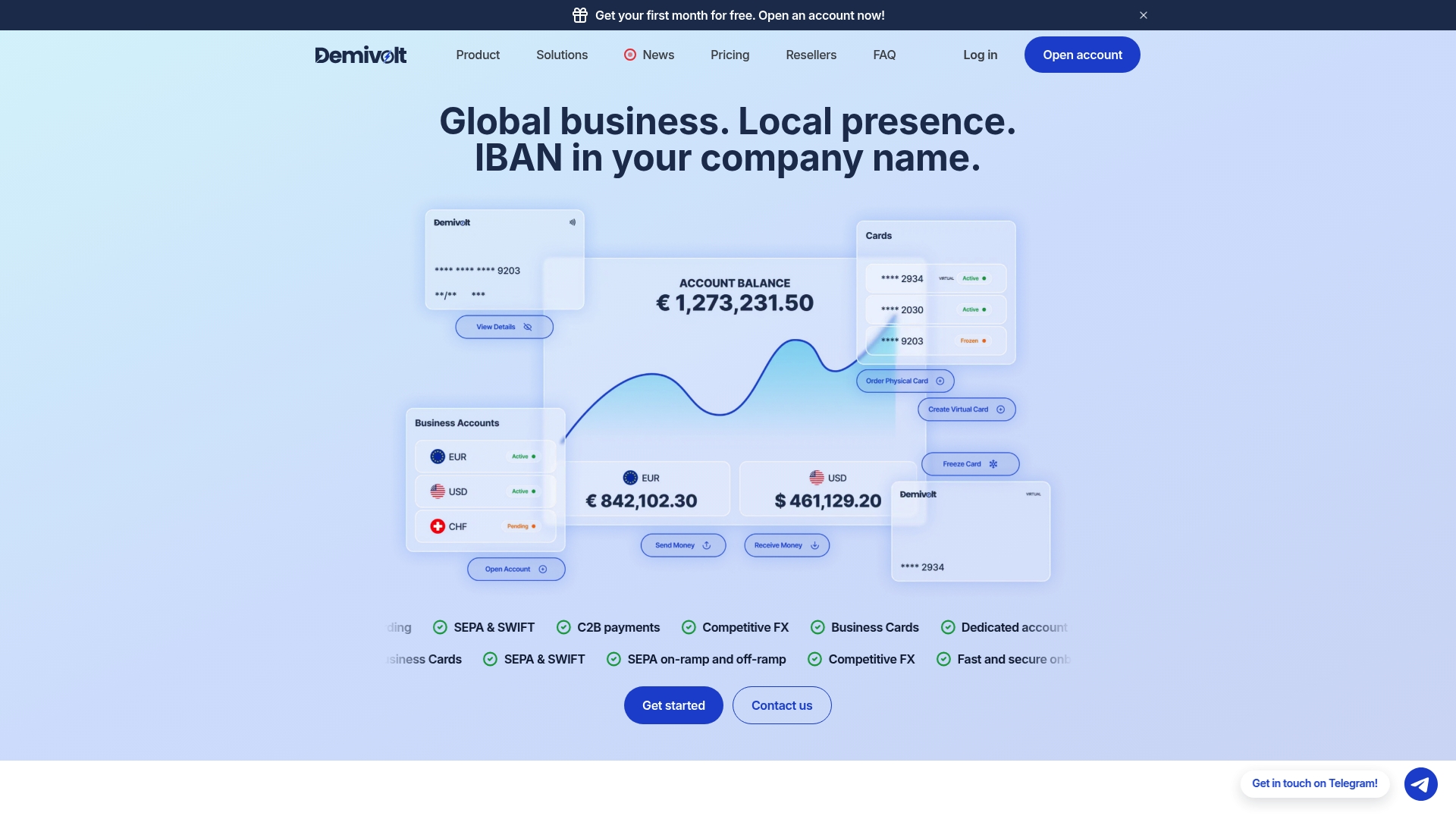
Demivolt provides regulated European business banking designed specifically for SMEs operating internationally. From dedicated IBAN accounts and SEPA and SWIFT payment management to virtual and physical business cards and role-based user controls, the platform gives your team the infrastructure to act on the strategies covered in this article. Onboarding is fast, compliant, and transparent, with client funds held in segregated accounts. Explore Demivolt business banking to see how your business can strengthen its cross-border payment capabilities today.
Frequently asked questions
What is the main advantage of fintech partnerships for SMEs?
Fintech partnerships enable SMEs to lower cross-border fees and speed up payments through combined, innovative infrastructure. Real implementations show 40% fee reductions with payback periods under 70 days on typical B2B volumes.
Are stablecoins widely used in SME cross-border payments?
Stablecoins like USDC and USDT are increasingly integrated into cross-border payment infrastructure for SMEs. The OpenPayd and Zetta partnership is a live example of stablecoin rails enabling fast, multi-blockchain settlements for business payments.
What risks should SMEs consider in fintech partnerships?
SMEs need to assess integration complexity, liquidity risks, regulatory compliance, and long-term partner alignment before committing. Partnerships fail most often when governance structures and KPIs aren’t defined clearly from the start.
How do bank-fintech partnerships help SMEs expand globally?
They provide access to multi-currency accounts and broader payment corridors that would otherwise require separate banking relationships in each market. WorldFirst’s banking alliances expanded available payout currencies from 40 to over 100, giving SMEs dramatically wider global reach.