

TL;DR:
- Managing multiple accounts causes risks like reconciliation delays and high FX costs.
- Automated systems streamline balance consolidation, reconciliation, and compliance, improving accuracy.
- Regular review and simplification of accounts help SMEs control complexity and optimize cash flow.
Managing multiple banking accounts, payment platforms, and virtual wallets is one of the most underrated headaches in SME finance. You’re juggling SEPA transfers here, SWIFT payments there, reconciling across three currencies before Friday’s close, and somehow still expected to forecast next quarter’s cash position. The stakes are real: a single oversight can create a cash flow gap that stalls payroll or delays a supplier payment. This guide walks you through a structured, repeatable approach to multi-account management, from mapping your current setup to automating oversight and solving cross-border challenges, so your team spends less time firefighting and more time driving growth.
Table of Contents
- Assessing your multi-account landscape
- Preparing efficient multi-account management systems
- Step-by-step multi-account management process
- Troubleshooting, compliance, and cross-border challenges
- What most guides miss about multi-account management
- Take the next step: Simplify your accounts with Demivolt
- Frequently asked questions
Key Takeaways
| Point | Details |
|---|---|
| Centralize account oversight | Mapping and aggregating all accounts eliminates blind spots and improves cash control. |
| Automate routine tasks | Automation boosts forecasting accuracy to 95% and accelerates reconciliation. |
| Follow a disciplined process | A step-by-step review and payment routine prevents errors and surprise shortfalls. |
| Monitor compliance and FX | Staying on top of compliance and foreign exchange saves money and protects from risks. |
Assessing your multi-account landscape
Before you can fix anything, you need a clear picture of what you’re working with. Most SME finance teams are surprised to discover just how many accounts they actually operate once they sit down and list them all. Banks, virtual wallets, payment processors, foreign currency accounts, expense card platforms, and even dormant accounts from old vendors. It adds up fast.
Start by building an account inventory. For each account, record the institution, account purpose, currencies held, authorized signatories, and average monthly transaction volume. This single exercise often reveals duplicate accounts, forgotten balances, and access permissions that haven’t been updated in years. Understanding business banking trends can also help you benchmark your setup against what modern SMEs are moving toward.
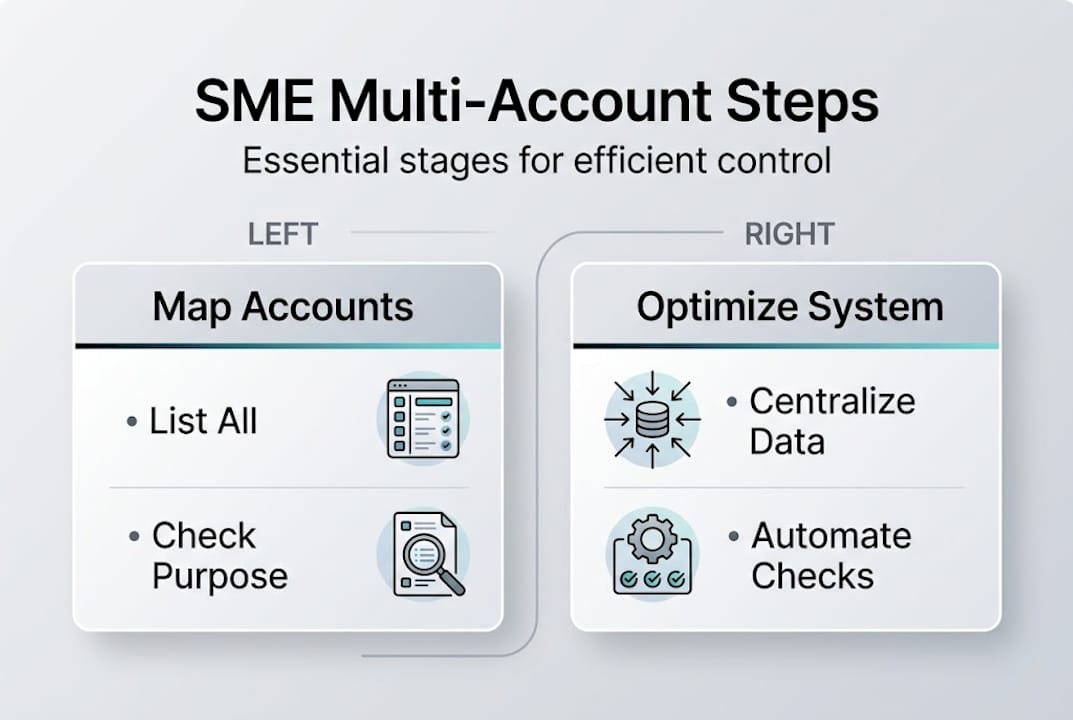
Here’s a simple mapping template to get started:
| Account | Institution | Currency | Purpose | Signatories | Avg. Monthly Transactions |
|---|---|---|---|---|---|
| Operating account | Main bank | EUR | Payroll, suppliers | CFO, CEO | 200+ |
| FX account | Fintech platform | USD/GBP | Cross-border payments | CFO | 50 |
| Expense card pool | Card provider | EUR | Team expenses | Finance manager | 80 |
| Reserve account | Secondary bank | EUR | Emergency buffer | CEO | 5 |
Once you have your inventory, look for the friction points. Common risks that finance teams overlook include:
- Reconciliation delays caused by mismatched transaction references across platforms
- Excessive FX conversion fees from routing payments through the wrong account
- Compliance gaps when accounts in different jurisdictions have conflicting KYC requirements
- Signatory bottlenecks that slow down urgent payments
- Fragmented reporting that makes it impossible to see your true consolidated cash position
Reviewing SME bank account essentials gives you a solid baseline for what each account type should actually deliver for your business.
Pro Tip: Liquidity buffers of 3-6 months are a best practice for SMEs. Map your reserve accounts explicitly and make sure that buffer is sitting in an account with fast access, not locked behind a notice period.
The goal of this assessment phase isn’t perfection. It’s clarity. You can’t optimize what you haven’t measured, and a well-structured account map is the foundation everything else builds on. Think of it as your financial business finance basics audit, done properly.
Preparing efficient multi-account management systems
With your accounts mapped, it’s time to reduce headaches with structured tools and smart policies. The biggest mistake SME finance teams make at this stage is trying to manage everything manually for just a little longer. That approach costs more than it saves.

The core tools you need fall into four categories: a centralized dashboard that aggregates balances across all accounts, reconciliation software that matches transactions automatically, role-based access controls that limit who can do what, and a payment platform that handles both SEPA and SWIFT without requiring you to log into separate portals.
Here’s how manual and automated approaches compare in practice:
| Task | Manual approach | Automated approach |
|---|---|---|
| Balance consolidation | Spreadsheet, updated daily | Real-time dashboard sync |
| Transaction reconciliation | 2-4 hours per week | Minutes, rule-based matching |
| Payment approvals | Email chains, delays | Workflow-based, role-gated |
| FX rate monitoring | Manual checks | Alerts and auto-routing |
| Compliance reporting | Manual compilation | Automated audit trail |
Setting up these systems doesn’t have to be overwhelming. Follow these steps in order:
- Audit your current tools and identify gaps against the four categories above.
- Select a centralized platform that integrates with your existing bank accounts.
- Define role-based access: who can view, who can initiate, who can approve.
- Configure reconciliation rules for your most frequent transaction types.
- Document your governance protocols, including escalation paths for exceptions.
- Train your team and run a two-week parallel test before going fully live.
For expense management, virtual cards for SMEs are one of the fastest wins available. You can issue cards per project or department, set spending limits, and reconcile automatically, without chasing receipts.
“Automation improves forecasting accuracy to 95% and enhances cash flow by 20%.” That’s not a marginal improvement. For an SME managing EUR 2M in annual payments, a 20% cash flow improvement translates directly into reduced borrowing costs and better supplier terms.
Good business banking automation also reduces human error, which is the leading cause of reconciliation failures in teams managing more than three accounts. The documentation and governance layer is just as important as the technology. Without clear protocols, even the best tools get used inconsistently. Resources on organizing finance teams can help you structure responsibilities clearly.
Step-by-step multi-account management process
Once you have the right systems in place, you’re ready to implement a high-impact management routine. The goal is a repeatable weekly cycle that keeps every account visible, every payment optimized, and every risk flagged before it becomes a problem.
Here’s the process, step by step:
- Consolidate balances. Every Monday morning, pull a consolidated view of all account balances. Flag any account below its minimum threshold and note any large pending transactions.
- Review transactions. Scan all transactions from the previous week. Look for duplicates, unusual amounts, and any payments that didn’t reconcile automatically.
- Forecast cash needs. Using your rolling 13-week cash forecast, identify upcoming payment obligations and confirm you have the right currency in the right account.
- Schedule and optimize payments. Batch SEPA payments to reduce per-transaction fees. For SWIFT payments for SMEs, time your FX conversions around rate windows your platform tracks.
- Reconcile and escalate red flags. Close out the week by reconciling all accounts and logging any exceptions. Anything unresolved within 24 hours gets escalated to the CFO.
Pro Tip: AI-powered forecasting tools can now run scenario tests automatically, modeling best case, base case, and stress scenarios simultaneously. At 95% forecasting accuracy, these tools are no longer a luxury for enterprise teams. SMEs can access them through modern fintech platforms.
A practical weekly schedule might look like this: Monday is the finance manager’s consolidation and review day. Wednesday is payment scheduling and FX optimization. Friday is reconciliation and reporting. This structure keeps the workload predictable and prevents the end-of-month crunch that plagues most SME finance teams.
Common pitfalls to avoid:
- Ignoring FX exposure on accounts held in non-functional currencies
- Leaving access permissions unchanged after staff turnover
- Relying on a single account for both operating and reserve funds
- Skipping the weekly review during busy periods, which is exactly when errors occur
The banking process for SMEs works best when it’s treated as a discipline, not a task. SMEs using Profit First methods grew profits and managed cash surprises more effectively by building structured account habits, not just reacting to problems.
Troubleshooting, compliance, and cross-border challenges
No system is flawless, so here’s how to solve the top issues SME teams encounter with multiple accounts. Cross-border operations add a layer of complexity that purely domestic businesses never face, and the consequences of getting it wrong range from payment delays to regulatory penalties.
The most disruptive pain points include:
- Regulatory mismatches between jurisdictions, especially when accounts are held in different EU member states or outside the EU entirely
- High FX conversion costs from routing payments through intermediary banks unnecessarily
- Fragmented compliance documentation that makes audits slow and stressful
- Declined cross-border payments caused by incorrect routing codes or beneficiary details
- Delayed settlements that create temporary cash flow gaps at critical moments
Optimizing DSO, DIO, and extending DPO are core treasury best practices for SMEs. DSO (Days Sales Outstanding) measures how quickly you collect receivables. DIO (Days Inventory Outstanding) tracks how long stock sits before converting to cash. DPO (Days Payable Outstanding) measures how long you take to pay suppliers. Improving all three simultaneously can free up significant working capital without any additional financing.
For cross-border payment challenges, fintech cross-border solutions have fundamentally changed what’s possible for SMEs. You no longer need to accept the delays and fees of traditional correspondent banking. Modern platforms offer real-time FX rates, automated compliance checks, and direct IBAN-to-IBAN transfers that bypass unnecessary intermediaries.
If your payments are being declined or delayed, the fix is usually one of three things: incorrect beneficiary details, a missing compliance document, or a routing issue. FX and routing fixes can resolve most of these without requiring you to restructure your entire banking setup.
On the compliance side, maintain a living document that tracks the regulatory requirements for each account jurisdiction. Review it quarterly. When regulations change, and they do, you want to catch it before your bank does. For SMEs weighing whether to split accounts across banks, understanding the multiple bank accounts pros and cons helps you make that decision based on actual risk, not habit.
What most guides miss about multi-account management
Most guides focus entirely on tools and processes, as if the right software automatically solves the problem. It doesn’t. The real bottleneck in most SME finance teams isn’t the technology. It’s the mindset.
Finance managers who see multi-account management as a compliance obligation rather than a strategic lever will always underperform. The teams that get the most value from their banking setup are the ones where every person with account access understands why the structure exists and takes ownership of their part in it.
Real-time AI alerts and platform integrations are dramatically underutilized by SMEs right now. Most teams have access to these features through their existing platforms and simply haven’t turned them on. That’s a missed opportunity.
Here’s the contrarian take: more accounts are rarely the answer. The instinct to open a new account for every new use case creates complexity that compounds over time. The best-performing SME finance teams we’ve seen are the ones who periodically ask whether they actually need all their accounts, and consolidate aggressively when the answer is no. Exploring banking alternatives is often the first step toward a leaner, more manageable structure.
Take the next step: Simplify your accounts with Demivolt
If you’ve worked through this guide and realized your current banking setup needs a serious upgrade, you’re not alone. Most SME finance teams are managing more complexity than necessary, with tools that weren’t designed to work together.
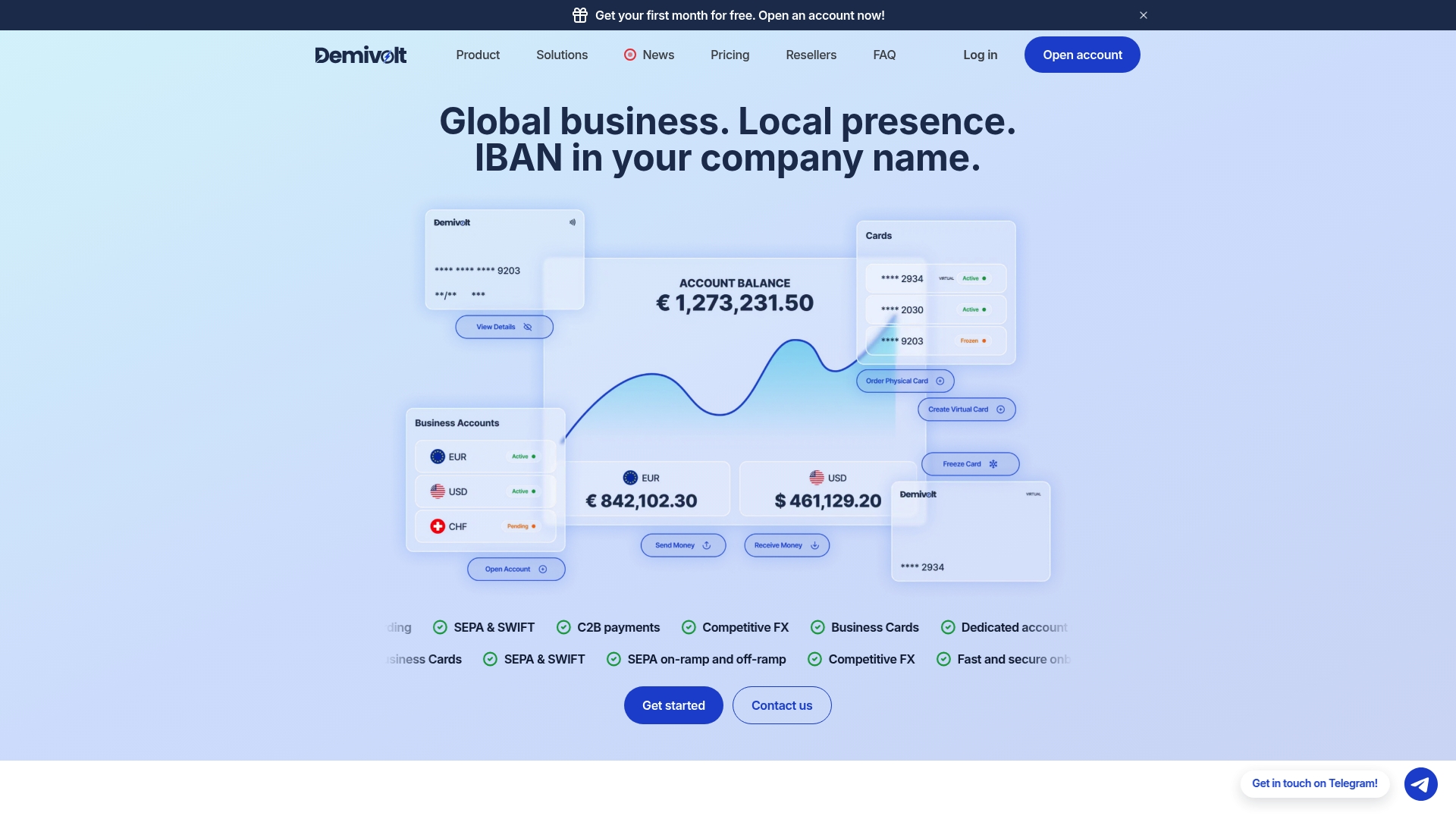
Demivolt business banking was built specifically for businesses that need centralized control, multi-account structures, and seamless cross-border payments in one regulated platform. From dedicated IBAN accounts and role-based access to integrated SEPA payments — with SWIFT support on the way — Demivolt gives finance managers the infrastructure to run a clean, compliant operation. If you’re ready to simplify, you can open a business bank account online and explore how the platform fits your team’s needs.
Frequently asked questions
What’s the biggest mistake SMEs make with multiple accounts?
The biggest mistake is failing to centralize oversight, which creates cash flow blind spots and wastes significant team resources. Without a consolidated view, poor processes risk cash flow gaps that compound over time.
How often should accounts be reviewed and reconciled?
Weekly reviews and reconciliations are the right cadence for most SMEs, giving you enough frequency to catch errors early. Automated tools increase forecasting accuracy and make this process fast enough to sustain consistently.
Can too many bank accounts hurt my business?
Yes, absolutely. Too many under-managed accounts inflate fees, increase compliance risk, and slow down decision-making. Reconciliation delays and compliance headaches are direct consequences of account sprawl that most SMEs underestimate.
What’s the best way to handle cross-border payments?
Use platforms that automate FX conversion and compliance checks, which minimizes errors and cuts settlement times significantly. Fintech platforms streamline cross-border payment compliance in ways that traditional banks simply cannot match at SME price points.
Recommended
- Demivolt | Blog – Business banking for SMEs: services, compliance & cross-border
- Demivolt | Blog – Open a business bank account online in Europe: step-by-step
- Demivolt | Blog – Modern business banking trends: boost efficiency & compliance
- Demivolt | Blog – How to issue virtual cards for SME finance teams: 2026
- Essential accounting skills checklist for SME hiring success
- Role of Accountants for SMEs – Ensuring Growth and Compliance