

TL;DR:
- SMEs face high costs and delays with traditional SWIFT cross-border payments.
- Proper preparation, accurate details, and compliance checks are essential for successful international transactions.
- Fintech platforms offering local rails and hybrid routing significantly reduce costs and speed up payments.
For many SMEs and digital-first businesses, sending money across borders feels like a gamble. You initiate a payment, and then you wait, watching days tick by while worrying about hidden fees, compliance flags, and whether the funds will actually arrive. SWIFT wire transfers alone can cost $50 to $100 or more per transaction and take up to five business days. That’s not just inconvenient — it’s a real drag on cash flow and supplier relationships. This guide breaks down every stage of the international payment process so you can move money faster, cheaper, and with full confidence in your compliance standing.
Table of Contents
- Understanding the international payments landscape
- What you need before sending an international payment
- Step-by-step: How to complete an international business payment
- How to troubleshoot and avoid common international payment mistakes
- Our perspective: Why most international payment guides miss the SME reality
- Streamline your international payments with Demivolt
- Frequently asked questions
Key Takeaways
| Point | Details |
|---|---|
| Preparation reduces risk | Collect the right information and compliance documents upfront to avoid payment delays or rejections. |
| Choose the right payment route | Mixing fintech/local rails with SWIFT can minimize costs and boost speed for international business payments. |
| Stay on top of compliance | Monitor evolving sanctions and automate checks to sidestep errors and ensure smooth transactions. |
| Troubleshoot proactively | Anticipate common issues and have a plan for resolving payment errors before they stall your business. |
Understanding the international payments landscape
International payments are not a single product. They’re a chain of actions involving multiple banks, currencies, compliance checks, and settlement systems. Understanding how that chain works helps you identify exactly where delays and costs creep in.
For most SMEs, the default option is still the SWIFT network. A payment travels from the sender’s bank through one or more correspondent banks before reaching the recipient. Each link in that chain can add fees and time. Traditional SWIFT works well for large, one-off payments where reliability is the priority, but it consistently fails SMEs on cost and speed for frequent, smaller transactions.
The fee structure is layered and often opaque:
- Sender fees: $20 to $50 charged by your own bank
- Intermediary fees: $10 to $20 per correspondent bank in the chain
- FX markups: Typically 2% to 5% above the mid-market rate
- Receiver fees: Variable charges applied by the beneficiary’s bank
Those layers compound quickly. In regions like Latin America, the situation is even more extreme. SMEs in LatAm face fees of 23% to 30% on a $250 payment, and 80% of those payments take more than four days to clear.
| Payment method | Typical cost | Typical speed | Best use case |
|---|---|---|---|
| SWIFT wire | $50–$100+ | 2–5 days | Large, infrequent payments |
| Fintech/local rails | $2–$15 | Hours to 1 day | Frequent, smaller transactions |
| SEPA (Europe only) | Near zero | Same day | EUR-denominated EU payments |
The B2B cross-border market is projected to grow 51% by 2032, with SMEs as the fastest-growing segment. Yet the infrastructure hasn’t kept pace.
The G20’s roadmap for cross-border payments targets most transactions completing within one hour at a cost below 1%. As of 2026, the majority of SME payments still fall far short of those targets.
The gap between policy goals and operational reality is exactly where SME payment efficiency breaks down. Knowing this landscape positions you to make smarter routing decisions.
What you need before sending an international payment
To avoid costly surprises and rejections, preparation is key. Here’s what to gather before you start.
The most common reason payments get rejected or bounce is simple: missing or incorrect information. A wrong digit in an IBAN, a missing BIC code, or an incomplete invoice can freeze a payment for days and generate additional fees to fix it.
Essential recipient account details:
- Full legal name and address of the beneficiary
- IBAN (International Bank Account Number) for European accounts
- BIC/SWIFT code of the recipient’s bank
- Correspondent bank details if required by the destination country
- Currency and account type confirmation
| Document | Purpose | When required |
|---|---|---|
| Commercial invoice | Proof of goods/services | Every payment |
| Contract or purchase order | Establishes payment obligation | High-value or recurring |
| KYC/KYB documentation | Identity and business verification | At onboarding and periodic review |
| Purpose of payment declaration | Regulatory reporting requirement | Often required above threshold amounts |
Beyond the paperwork, compliance is non-negotiable. KYC/KYB requirements cover identity verification, Ultimate Beneficial Owner (UBO) disclosure, Anti-Money Laundering monitoring, and ongoing sanctions screening against OFAC, EU, and UN lists. These checks happen at onboarding, at the point of each transaction, and on a continuous basis.

This matters practically because even an established supplier could appear on a sanctions list following a geopolitical event. If you’re not screening in real time, you’re exposed.
For SME banking compliance, setting up a structured compliance folder for each recurring counterparty is the fastest way to cut processing time on repeat payments.
Pro Tip: Create a payment template for each regular supplier that includes all account details, pre-approved KYC documentation, and a purpose-of-payment note. This alone can cut payment initiation time by more than half and dramatically reduces errors.
Step-by-step: How to complete an international business payment
With the groundwork in place, it’s time to see how the actual process works, step by step.
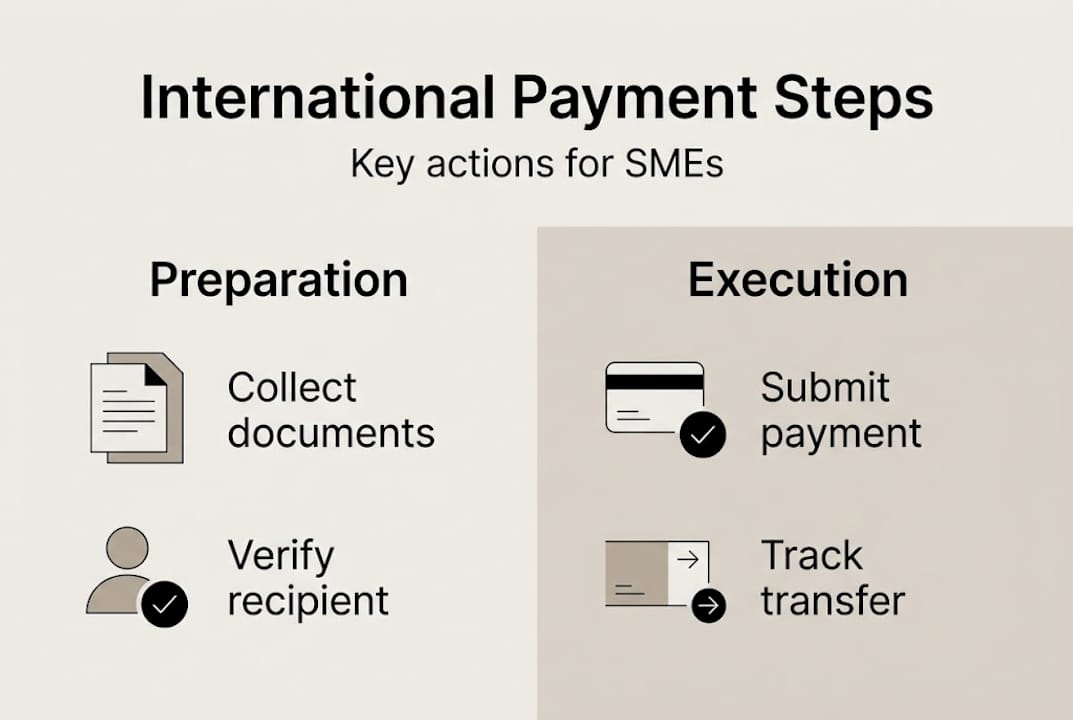
Step 1: Choose your payment route. Decide between SWIFT, a fintech platform, or local payment rails based on payment size, frequency, and destination. Large, infrequent payments to stable markets may still favor SWIFT. Frequent smaller transactions across emerging markets are often better served by fintech payment solutions.
Step 2: Enter recipient and payment details precisely. Copy, don’t type, the IBAN and BIC. Even one transposed digit causes a rejection. Include the correct purpose code and currency. Confirm whether the amount should be received in full by the recipient or if fees can be deducted from the payment.
Step 3: Run compliance checks before submitting. Modern platforms run real-time KYC, AML, and sanctions screening automatically. If you’re using a traditional bank, these checks may add one to two days. Know which applies to your workflow.
Step 4: Authorize and confirm the transfer. Most platforms require multi-factor authorization for payments above a threshold. This is good practice regardless. Save the transaction reference number immediately.
Step 5: Monitor the payment and notify the recipient. Share the expected arrival date and transaction reference with your recipient. If a payment hasn’t arrived within the expected window, use the reference number to trace it with your provider.
Step 6: Reconcile and document. Match the outgoing payment against your invoice in your accounting system. Store all transaction confirmations alongside the supporting documents.
Hybrid routing, combining fintech or local rails for regular smaller payments with SWIFT for large or infrequent ones, can save 40% to 95% compared to using traditional methods exclusively.
For businesses managing multiple currencies and global payment methods, hybrid routing is not optional. It’s the only way to keep costs under control at scale.
How to troubleshoot and avoid common international payment mistakes
Even with the right process, things can go wrong. Here’s how to stay ahead of common problems.
The most frequent causes of payment failure are preventable. Here’s what to watch:
- Incorrect beneficiary details: Always validate IBAN/BIC against the bank’s own verification tool before submitting
- Unexpected intermediary fees: Ask your provider for a full fee breakdown upfront, including what correspondent banks may deduct
- Sanctions list changes: Real-time sanctions screening is essential because lists update daily, and circumventing them, even accidentally, can result in frozen or rejected funds
- FX rate shifts: Lock in exchange rates where possible to protect against value erosion between initiation and settlement
- Missing documentation: A single missing field in a compliance record can trigger a manual review that delays settlement by days
If a payment is delayed, act quickly. Contact your payment provider with the transaction reference within 24 hours of the expected arrival date. Most delays are caused by correspondent bank queues or additional compliance checks triggered by the receiving institution. Knowing which is faster to resolve saves you time.
Pro Tip: For high-value payments, send a small test transaction first, especially to a new recipient. It costs a few dollars and confirms account details are correct before you transfer a significant amount.
For businesses using faster SWIFT transfers, understanding your bank’s cut-off times matters. A payment initiated after 3pm local time often doesn’t enter the SWIFT system until the next business day.
Avoiding hidden fees on cross-border payments requires asking the right questions before you send, not after you receive a settlement statement.
Adopting modern banking practices that prioritize transparency in fee structures is one of the most direct ways to reduce payment costs without changing your business model.
Our perspective: Why most international payment guides miss the SME reality
Most advice on international payments is written with large corporations in mind. It centers on SWIFT, correspondent banking relationships, and treasury management systems that cost more per month than most SMEs spend on payments annually. That framing misses the actual problem.
For a business sending 20 to 50 payments a month to suppliers, contractors, or platform partners across five countries, the priority is not reliability of a $500,000 wire. It’s predictable cost, speed, and effortless compliance on $2,000 transactions.
SMEs benefit most from speed and cost improvements, yet the guides they rely on still treat SWIFT as the default and fintech as an experimental alternative. That’s backwards in 2026.
What actually works for growing, globally distributed teams is investing in fintech payment infrastructure that embeds compliance, automates screening, and uses local rails wherever possible. The interoperability between these systems, not just the policy framework around them, is what moves money efficiently. Compliance technology isn’t a cost center. It’s the thing that keeps you operational when sanctions environments shift overnight. Build it in from day one.
Streamline your international payments with Demivolt
If managing costs, compliance, and speed across international payments feels like a full-time job, it shouldn’t. Demivolt was built for exactly this kind of work.
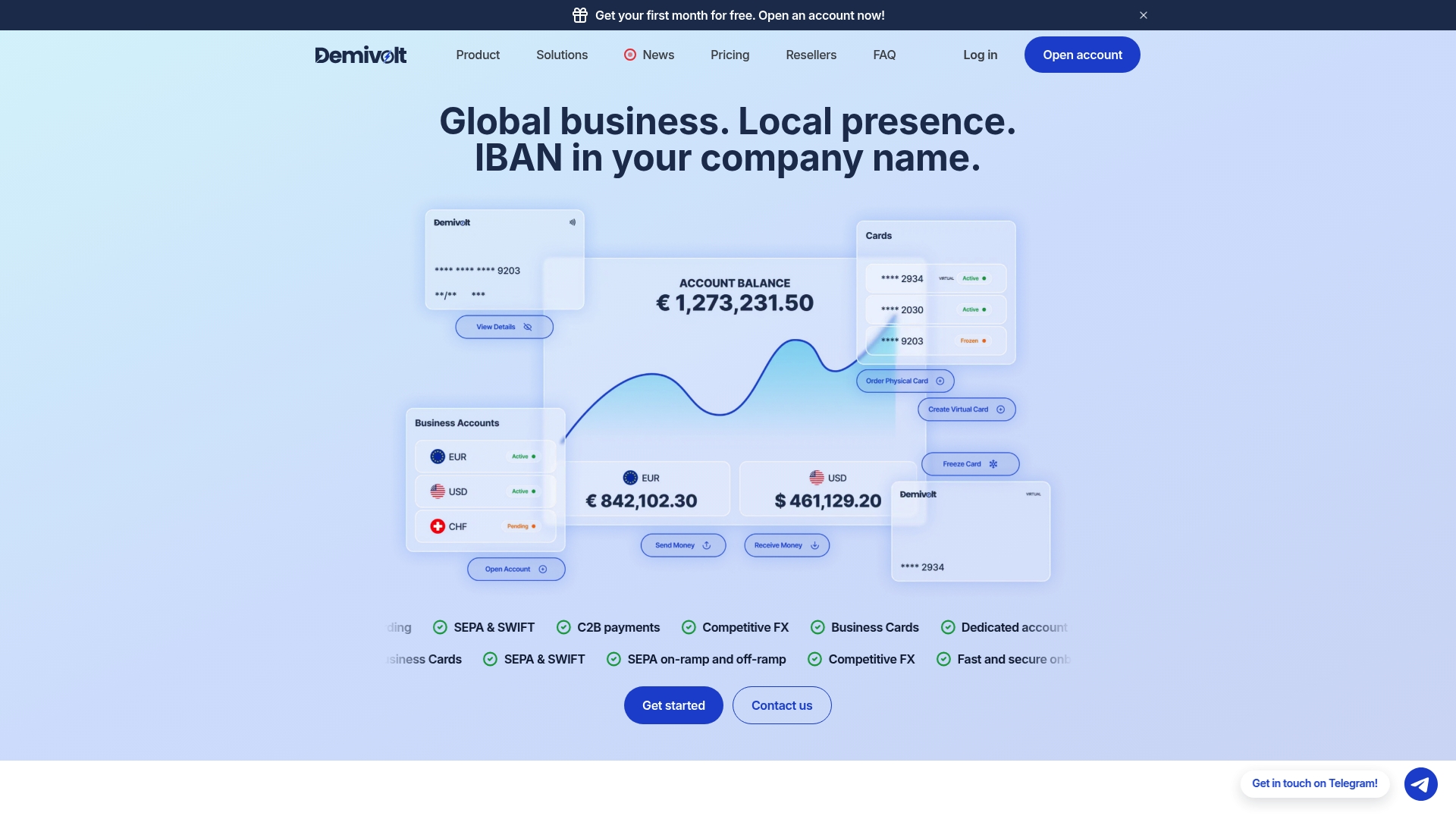
With Demivolt, you get dedicated IBAN accounts, SEPA and SWIFT payment capabilities, real-time compliance tooling, and multi-account structures designed for cross-border operations. Onboarding is fast, funds are held in segregated accounts for security, and every feature maps directly to what SMEs and digital-first businesses actually need when moving money globally. Explore business payment solutions that give you control over your international cash flow without the complexity.
Frequently asked questions
How long do international business payments take to clear?
Traditional wire transfers typically take 2 to 5 business days through SWIFT, but modern fintech platforms can process many international payments within hours, depending on the destination and payment rail used.
What details do I need to make an international payment?
You need the recipient’s IBAN or account number, BIC/SWIFT code, a supporting invoice or contract, KYC documentation, and confirmation that the recipient does not appear on any active sanctions list.
What is the typical cost for an SME to send an international payment?
Using traditional banking, total costs per transaction can reach $50 to $100 or more when sender fees, intermediary charges, FX markups, and receiver fees are combined. Fintech and local rail options often reduce this to under $15.
How can SMEs make compliance with international payment rules easier?
Use platforms with built-in KYC, AML monitoring, and real-time sanctions screening, and keep all counterparty documentation organized and up to date for recurring or high-value payments.
Recommended
- Demivolt | Blog – International payments for SMEs: efficiency, compliance, growth
- Demivolt | Blog – SWIFT payment guide: faster transfers for European SMEs
- Demivolt | Blog – What is SWIFT payment? How it works for SMEs
- Demivolt | Blog – Top payment method examples for global businesses
- Travel money budgeting guide: Smarter spending abroad