

TL;DR:
- Nearly 68% of consumers abandon fintech onboarding due to friction and delays.
- Modern onboarding leverages automation, AI, and risk-tiering to reduce time and improve experience.
- Treating onboarding as a product design issue enhances conversion, retention, and compliance.
Nearly 68% of consumers abandon fintech onboarding before completing it. That’s not a minor UX problem — that’s a revenue crisis hiding in plain sight. For business owners and financial decision-makers, onboarding is far more than filling out a form or clicking “create account.” It’s a layered, regulated, and highly consequential process that determines whether a prospect becomes an active, revenue-generating customer or walks away forever. This guide breaks down what fintech onboarding actually involves, how modern technology is reshaping it, where businesses lose customers, and what practical frameworks SMEs can apply to fix it.
Table of Contents
- Defining onboarding in fintech: Beyond account creation
- Modern onboarding workflows: Automation and AI in action
- Key challenges: Dropout rates, friction, and compliance risks
- Practical frameworks: Efficient onboarding strategies for SMEs
- What most articles miss: Onboarding as product, not paperwork
- Explore efficient, compliant onboarding solutions with Demivolt
- Frequently asked questions
Key Takeaways
| Point | Details |
|---|---|
| End-to-end process | Fintech onboarding covers identity, compliance, risk, account setup, and activation—not just opening accounts. |
| Automation boosts efficiency | AI-driven, risk-based onboarding cuts costs, reduces friction, and increases activation rates. |
| Friction drives dropout | Overly complex or slow onboarding causes high abandonment and revenue loss for SMEs. |
| Data-driven improvement | SMEs should measure onboarding performance with metrics like time-to-first-transaction, not just account openings. |
| Onboarding as product | Smart onboarding is a strategic design activity—continuous iteration ensures user experience and compliance. |
Defining onboarding in fintech: Beyond account creation
Most people assume onboarding ends when a user submits their email and sets a password. In fintech, that’s barely the starting line. Onboarding in fintech is the end-to-end digital process that converts prospects into active, verified, and compliant customers — covering KYC (Know Your Customer), KYB (Know Your Business), AML (Anti-Money Laundering) checks, risk assessment, account setup, and activation. Every step serves a dual purpose: protecting the platform from regulatory risk and giving the customer a reason to stay.
Think of it as a series of checkpoints, each with a specific function:
- Identity verification (KYC/KYB): Confirms who the customer is and validates their business entity using government-issued documents and corporate registration data.
- AML screening: Cross-references applicants against AML compliance requirements and sanctions lists to detect potential financial crime exposure.
- Risk tiering: Assigns a risk score based on business type, geography, transaction volume, and ownership structure.
- Account activation: Grants access to services once all checks are cleared, which can happen instantly or after manual review depending on the risk tier.
- Initial engagement: Guides the new customer through first transactions, feature discovery, and support resources.
Each checkpoint addresses both a regulatory obligation and a customer experience goal. Skip the AML step and you face fines. Make the KYC process clunky and you lose the customer.
“The quality of your onboarding process is the quality of your first impression. In fintech, there are no second chances — if a business can’t verify itself in minutes, it will find a platform that lets it.”
This matters even more as the fintech ecosystem expansion continues to accelerate. More platforms mean more competition, and businesses increasingly choose providers based on how fast and painless the onboarding experience is. Trends like agentic commerce in banking are pushing the bar even higher, with AI-driven agents expected to handle parts of the onboarding flow autonomously.
The takeaway here is simple: onboarding is a strategic asset. It’s the first real product experience your customer has, and it sets the tone for the entire relationship.
Modern onboarding workflows: Automation and AI in action
With the basics covered, let’s explore how technology has transformed onboarding in fintech. The shift from paper-based, branch-dependent processes to fully digital, AI-powered flows has been dramatic. AI boosts onboarding efficiency by 60% and cuts costs by 40%, and the firms that have embraced automation are pulling ahead of those still relying on manual review queues.
Here’s how modern onboarding workflows are structured:
- Automated document capture: Optical character recognition (OCR) tools extract data from passports, utility bills, and business registration documents without manual data entry.
- Biometric verification: Liveness checks and facial recognition confirm that the person submitting documents is physically present, reducing identity fraud.
- Risk-based tiering: Low-risk applicants, such as a registered EU company with clean ownership, get near-instant activation. High-risk cases, such as businesses in high-scrutiny industries or complex ownership structures, are routed to human reviewers.
- Progressive disclosure: Instead of overwhelming users with 40 fields upfront, platforms surface only the most essential questions first, then request additional data as the relationship deepens.
- Inline verification: Real-time feedback during form completion (for example, flagging an invalid company registration number immediately) prevents errors that would otherwise delay approval.
The comparison below shows how traditional and modern onboarding approaches differ in practice:
| Factor | Traditional onboarding | Modern AI-driven onboarding |
|---|---|---|
| Time to activate | 3 to 10 business days | Minutes to 24 hours |
| Document handling | Manual review | Automated OCR and biometrics |
| Risk assessment | Static rule sets | Dynamic, real-time scoring |
| Dropout rate | High | Significantly reduced |
| Compliance tracking | Spreadsheet-based | Automated audit trails |
For SMEs specifically, reducing onboarding friction is not just a nice-to-have. It’s a direct driver of revenue. Every extra step in the onboarding flow is an opportunity for a prospect to leave. Platforms that align with banking efficiency trends are investing heavily in friction budgeting, which means deliberately limiting the number of asks in each session and spacing them out intelligently.
Pro Tip: Use onboarding efficiency benchmarks to set internal targets. If your average time to first transaction exceeds 48 hours, your automation stack needs a serious review.
The smartest platforms also A/B test their onboarding flows continuously, treating each screen like a landing page with a measurable conversion rate. A single field removal or a reworded instruction can lift completion rates by double digits.
Key challenges: Dropout rates, friction, and compliance risks
As technology evolves, risks and challenges persist — so how can businesses overcome them? The data is sobering. 68% of consumers abandon onboarding, 70% of firms lose clients to delays, and regulatory fines for compliance failures exceeded $4.6 billion globally. These aren’t abstract statistics. They represent real customers lost and real money spent on penalties that could have been avoided.
The main friction points that drive dropout include:
- Information overload: Asking for too much data upfront overwhelms users and signals distrust.
- Delayed verification: Waiting days for manual document review in an era of instant everything feels unacceptable to business customers.
- Manual paperwork: Requiring wet signatures or physical document submissions creates hard stops in otherwise digital flows.
- Opaque status updates: Customers who can’t see where they are in the process assume something went wrong and abandon.
- Regulatory complexity: For businesses operating across borders, meeting multiple jurisdictions’ requirements simultaneously is genuinely difficult.
The table below summarizes key onboarding challenge benchmarks:
| Challenge | Impact |
|---|---|
| Consumer abandonment rate | 68% |
| Firms losing clients to delays | 70% |
| Global regulatory fines (2024) | Over $4.6 billion |
| Average onboarding time (manual) | 3 to 10 days |
For SMEs involved in cross-border onboarding, the compliance layer is especially complex. A business operating in multiple EU countries may need to satisfy different AML thresholds, beneficial ownership disclosure rules, and local licensing requirements simultaneously. Without a structured compliance framework, this becomes a serious bottleneck.

The SME compliance challenges are well documented, and the cost of getting it wrong is steep. Regulatory fines aren’t the only risk. Reputational damage, account freezes, and delayed market entry all compound the problem. Understanding why compliance matters is the first step toward building an onboarding process that won’t become a liability.
The uncomfortable reality is that most dropout doesn’t happen because customers don’t want to onboard. It happens because the process makes them feel like they’re being interrogated rather than welcomed. Fixing that perception is both a design problem and a compliance design problem.
Practical frameworks: Efficient onboarding strategies for SMEs
To address these challenges, here are clear frameworks SMEs can follow. The goal isn’t to eliminate compliance — it’s to make compliance feel invisible to the end user while remaining airtight on the back end.
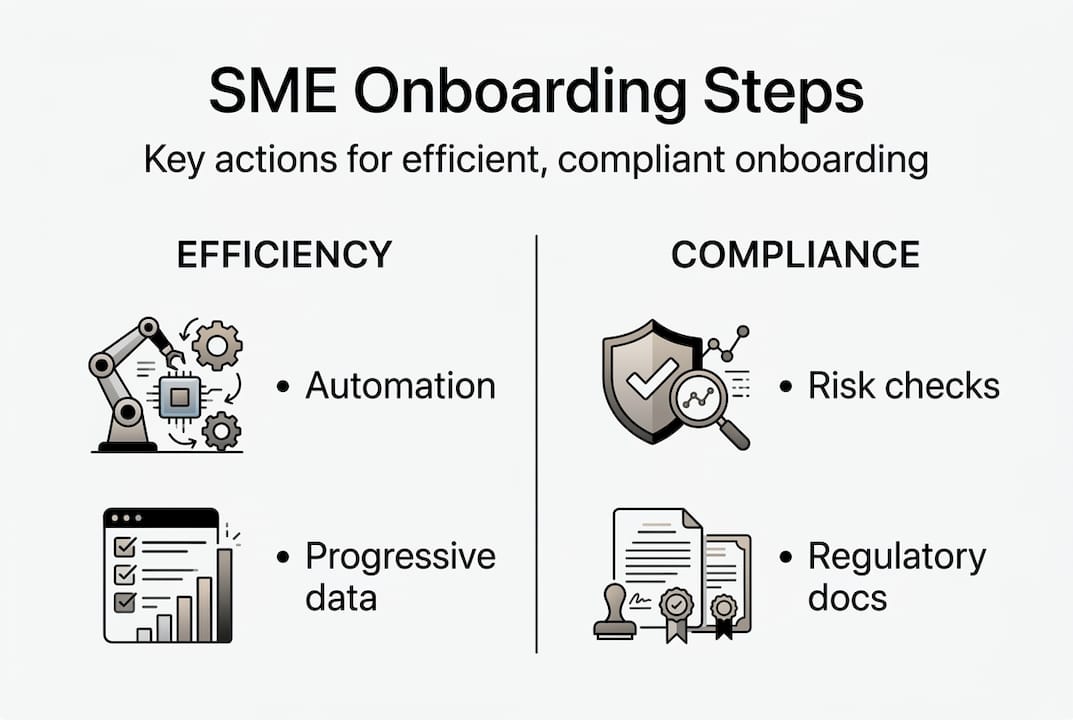
Prioritizing automation, human-in-loop processes, and risk-tiered flows is the foundation of any effective SME onboarding strategy. Here’s how to put that into practice:
- Map your onboarding journey end to end. Document every screen, every data request, and every decision point. You can’t optimize what you haven’t mapped.
- Implement risk-tiered activation. Not every applicant needs the same level of scrutiny. Build logic that fast-tracks low-risk profiles and routes edge cases to human reviewers without blocking the majority.
- Use bank data verification. Instead of asking customers to upload bank statements, use open banking APIs to verify account ownership and transaction history in seconds.
- Apply progressive disclosure. Collect only what you need at each stage. Ask for basic identity information first, then business details, then financial history — only as the relationship requires it.
- Set up a time-to-first-transaction metric. This is the most honest measure of onboarding success. An account that’s open but never transacts isn’t an activated customer.
- Build a human-in-loop escalation path. Automation handles 80% of cases. The other 20% need a trained compliance officer who can resolve edge cases without creating a bottleneck.
For business account onboarding, the stakes are even higher because the documentation requirements for companies are more complex than for individuals. Directors, beneficial owners, and corporate structures all need to be verified. Building a clean, guided flow for this is a competitive differentiator.
Pro Tip: If you’re rolling out virtual card onboarding as part of your financial product suite, treat card issuance as a separate onboarding milestone. Customers who activate a card within the first week are significantly more likely to remain active long-term.
Continuous improvement matters too. Treat your onboarding flow like a product, not a project. Run A/B tests on field order, instruction copy, and verification methods. Review onboarding design nuances regularly and benchmark against industry standards. Small, iterative changes compound into major conversion improvements over time.
What most articles miss: Onboarding as product, not paperwork
Here’s the perspective most onboarding guides skip entirely: onboarding isn’t an ops problem or a compliance checkbox. It’s a product design problem. And the firms that treat it as such are the ones winning on conversion, retention, and regulatory standing simultaneously.
Onboarding is product design that integrates product, technology, and compliance into a single, coherent user journey. That means your product team, your compliance team, and your engineering team need to be in the same room when you design it — not working in silos.
The firms that iterate their onboarding flows continuously, using A/B tests and real user feedback, consistently outperform those that set it and forget it. A form that worked in 2023 may be a dropout machine in 2026 because customer expectations have shifted. The bar keeps moving.
Good onboarding also means real activation, not just opened accounts. An account that sits dormant is a compliance liability and a wasted acquisition cost. Design for the “wow” moment — the first successful transaction, the first card used, the first payment sent. That’s what retention actually looks like. Explore more onboarding insights to stay ahead of what’s working in the market right now.
Explore efficient, compliant onboarding solutions with Demivolt
If the frameworks above resonate with where your business needs to go, Demivolt is built to get you there. Our platform delivers automation-driven, fully compliant onboarding for SMEs and digital-first companies operating across Europe, with dedicated IBAN accounts, SEPA payment management, with SWIFT on the roadmap and virtual and physical card issuance on the horizon — all from a single, streamlined interface.
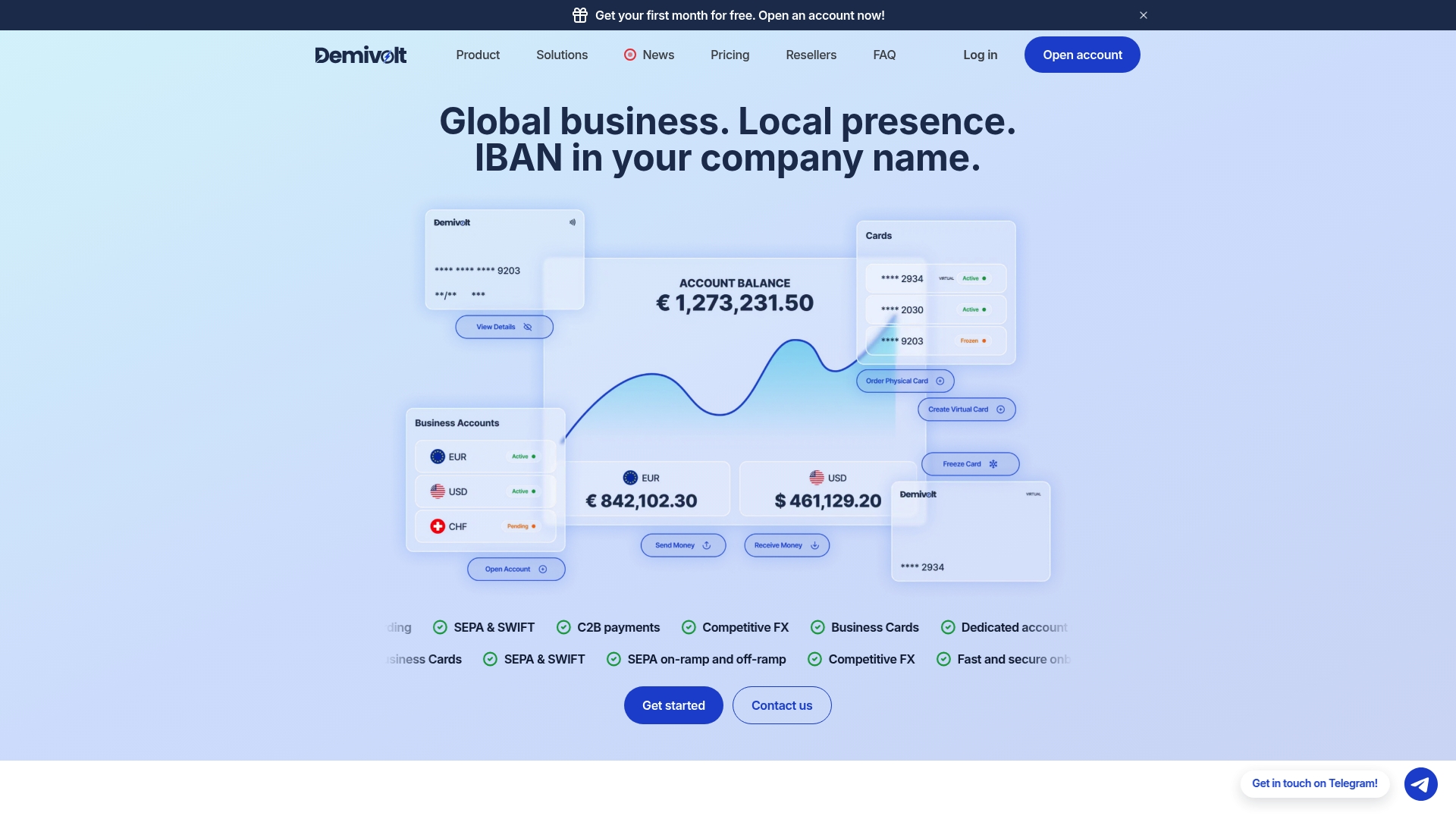
We’ve designed business banking onboarding to be fast, transparent, and regulation-ready from day one — so your team spends less time in verification queues and more time running your business. If you want to see what best onboarding practices look like in a live, regulated environment, our resources are a strong next step. Reach out to explore how Demivolt can align with your compliance and efficiency goals.
Frequently asked questions
What is the difference between fintech onboarding and traditional banking onboarding?
Fintech onboarding is fully digital, using AI-driven workflows and automated risk checks, while traditional banking relies on manual paperwork, branch visits, and multi-day review cycles.
Why does onboarding in fintech have such high abandonment rates?
Friction is the primary driver. 68% of consumers abandon fintech onboarding due to complex information requests, slow verification, and regulatory requirements that feel intrusive without clear explanation.
How can SMEs improve their onboarding process for financial services?
Focus on automation, progressive data collection, and risk-tiered flows. AI boosts efficiency 60% and cuts costs by 40%, and measuring time-to-first-transaction gives you the clearest signal of whether your onboarding is actually working.
Is regulatory compliance during onboarding mandatory for all fintech firms?
Yes, without exception. All fintech firms must conduct KYC, AML, and risk assessments to meet regulatory standards. Regulatory fines exceeded $4.6 billion in 2024 alone, making compliance non-negotiable for any firm operating in financial services.
Recommended
- Demivolt | Blog – Modern business banking trends: boost efficiency & compliance
- Demivolt | Blog – Business banking for SMEs: services, compliance & cross-border
- Demivolt | News – How fintechs facilitate cross-border payments for SMEs
- Demivolt | Blog
- Why financial compliance matters for UK SMEs: 2026 guide
- Understanding the role of bookkeepers in SMEs for success