

TL;DR:
- Europe has over 554 licensed third-party providers operating under open banking frameworks. Open banking is a regulated system enabling secure data sharing and payments with SME control, not a product. It offers benefits like real-time cash flow visibility and faster payments, but faces challenges such as API inconsistency and fraud risks across regions.
Europe now has over 554 licensed third-party providers operating under open banking frameworks, yet a surprising number of SME owners still confuse it with online banking or mobile apps. Open banking is something far more specific: a regulated system where banks share your financial data with licensed third parties through secure APIs, but only with your explicit consent. This guide cuts through the noise to explain what open banking actually is, how it works for your business, and why the regulatory shift from PSD2 to PSD3 matters more than most people realize.
Table of Contents
- What is open banking? Understanding the basics
- How open banking works: The SME perspective
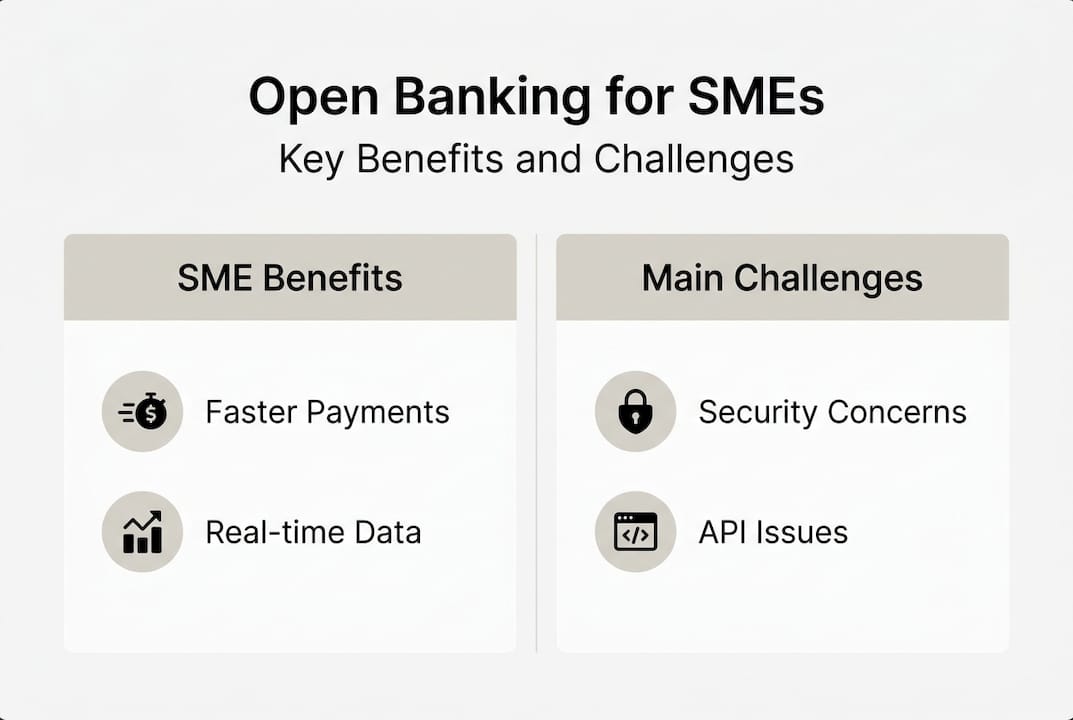
- Benefits and challenges of open banking for European SMEs
- Compliance, regulation, and the evolving landscape: PSD2, PSD3 & beyond
- Expert perspective: The real value and hidden hurdles of open banking for SMEs
- Get started with compliant, streamlined SME banking
- Frequently asked questions
Key Takeaways
| Point | Details |
|---|---|
| Open banking defined | It is a regulated system that lets licensed third parties securely access banking data and initiate payments with your consent. |
| SME benefits | European SMEs gain real-time cashflow visibility, faster reconciliation, and advanced payment tools with compliant open banking solutions. |
| Regulatory essentials | Strong Customer Authentication, TPP licensing, and new rules like PSD3 keep open banking secure and operationally resilient. |
| Growth and adoption | Open banking is expanding rapidly in the UK and beyond, but SMEs must navigate variable adoption and evolving API quality. |
| Action steps | Work with licensed providers, monitor regulatory changes, and prioritize data quality to maximize open banking advantages. |
What is open banking? Understanding the basics
Open banking is not a product. It is a framework. At its core, it allows licensed third-party providers (TPPs) to access your bank account data or initiate payments on your behalf, using secure application programming interfaces (APIs). The key distinction from traditional banking is that you control who sees your data and what they can do with it.
This framework did not happen by accident. The EU’s Payment Services Directive 2 (PSD2) created the legal mandate for banks to open their infrastructure to TPPs, driving competition and innovation across the European financial system. PSD2 also introduced Strong Customer Authentication (SCA), a two-factor security layer that protects every interaction.
Three key players shape the system:
- Your bank (the account-holding institution)
- TPPs (licensed technology providers that connect to your bank via API)
- You (the SME owner or financial decision-maker who grants and revokes consent)
Within the TPP category, two distinct service types exist:
| Service type | Acronym | What it does | SME use case |
|---|---|---|---|
| Account Information Service | AIS | Aggregates account data across banks | Cashflow dashboards, reconciliation |
| Payment Initiation Service | PIS | Initiates payments directly from accounts | Supplier payments, payroll, collections |
AIS providers give you a read-only view of multiple accounts in one place. PIS providers let you move money without logging into each bank separately. Together, they form the operational backbone of open banking.
Understanding types of SME bank accounts is actually a useful starting point here, because the account structure you hold directly affects how much visibility and control you can gain through open banking tools. If you are also evaluating whether to open a business bank account in Europe, knowing how open banking integrates with your account setup will help you choose the right provider from day one.
The regulatory framework for open banking also requires banks to provide APIs that match the performance of their own digital channels. In practice, this rule is often violated, which we will address later.
How open banking works: The SME perspective
Seeing open banking in action is more clarifying than reading another definition. Here is a practical walkthrough of how it functions for a typical European SME.
- Choose a licensed TPP. You select a provider registered with your national competent authority, such as the FCA in the UK or BaFin in Germany. Only licensed TPPs can legally access your banking data.
- Grant consent. The TPP redirects you to your bank’s secure portal, where you authenticate using SCA: something you know (PIN) plus something you have (phone or token). You choose exactly what data to share and for how long.
- Data flows in real time. The AIS aggregation and PIS payments features activate immediately. Your TPP dashboard now shows live account balances, transaction histories, and cashflow metrics across every connected bank.
- Initiate payments directly. Using a PIS provider, you authorize payments that go straight from your account to recipients, bypassing card networks entirely. This reduces processing fees and speeds up settlement.
- Revoke access anytime. Consent is not permanent. You can withdraw it instantly through your bank or TPP dashboard without calling customer support or submitting paperwork.
For streamlining business banking workflows, this is genuinely powerful. Instead of exporting CSV files from three different banks each Monday morning, your finance team sees a unified, real-time picture before the first meeting starts.

Security is a common concern, and reasonably so. SCA requirements under PSD2 mandate two independent authentication factors every time sensitive data is accessed or a payment is initiated. TPPs also never store your bank credentials; they use token-based access that your bank controls.
Pro Tip: Before onboarding any TPP, verify their license status on your national regulator’s public register. A legitimate TPP will always be listed. If they are not, walk away regardless of their pitch.
For SME banking compliance, open banking adds a layer of transparency that traditional banking simply cannot match, but only when implemented correctly with licensed providers.
Benefits and challenges of open banking for European SMEs
Open banking delivers measurable advantages, but the picture across Europe is uneven. Understanding both sides helps you make smarter decisions.
Key benefits for SMEs:
- Real-time cashflow visibility across multiple banks in a single dashboard
- Faster loan applications because lenders can see live transaction data instead of waiting for statements
- Automated reconciliation that cuts accounting time significantly
- Lower payment costs through direct account-to-account transfers instead of card rails
- Predictive analytics using historical multi-bank data to forecast cashflow gaps
The numbers behind open banking growth in the UK tell a striking story. The UK alone counts 16 million open banking users with 53% year-on-year payment growth, while the EEA hosts 554 active TPPs. Germany, by contrast, shows only 8.7% SME adoption despite having 206 registered TPPs.
| Region | Active TPPs | Adoption rate | YoY payment growth |
|---|---|---|---|
| United Kingdom | 130+ | High | 53% |
| EEA (total) | 554 | Moderate | Growing |
| Germany | 206 | 8.7% | Low |
The gap between Germany and the UK is not accidental. It reflects differences in API quality, regulatory incentives, and SME trust levels. German banks have been slower to build high-quality APIs, creating friction that discourages adoption.
Persistent challenges:
- API fragmentation across banks and countries creates inconsistent data quality
- Some banks deliberately throttle TPP API performance
- Fraud risks exist at the consent and initiation stages
- Adoption gaps across regions mean multi-bank aggregation sometimes fails when a bank’s API is poorly maintained
Pro Tip: Prioritize TPPs that publish API uptime and performance data publicly. Reliable providers monitor their connections and alert you when a bank’s API degrades. This operational visibility protects your cashflow reporting.
For decision-makers tracking modern business banking trends, the direction is clear: open banking adoption will accelerate, but the quality gap between markets will remain a real operational consideration for cross-border SMEs.
Compliance, regulation, and the evolving landscape: PSD2, PSD3 & beyond
Regulation is not just background noise for open banking. It is the engine driving every feature, security requirement, and provider obligation you interact with.
Under PSD2, the core compliance requirements for TPPs and banks include:
- Explicit, informed consent from the user before any data access or payment
- SCA on every sensitive operation
- Non-discrimination rules preventing banks from blocking or degrading TPP API access
- Fallback mechanisms ensuring TPPs can still function if a bank’s dedicated API fails
- Licensed status for every TPP operating in the EU
One edge case that trips up many SMEs: double SCA. This occurs when both the TPP and the bank independently trigger authentication, creating user friction that erodes the experience. Regulators are aware of it, and PSD3 is expected to address this directly.
The transition from PSD2 to PSD3775891_EN.pdf) is the most significant regulatory shift in open banking since 2018. Key improvements include mandatory API performance parity, stronger fraud liability rules, formal consent dashboards, and the foundation for open finance under the Financial Data Access (FiDA) framework.
“PSD3 will restart open banking’s promise, with stronger APIs and consumer protections that finally close the gap between regulatory intent and real-world performance.”
FiDA extends the open banking logic beyond payment accounts to include savings, investments, pensions, and insurance data. For SMEs managing complex finances across multiple products, this is a significant leap forward.
For international SME payments compliance, staying current on these regulatory changes is not optional. Consent dashboards, for example, will likely become mandatory features that your banking provider must support. If your current provider cannot demonstrate a roadmap for PSD3 readiness, that is a meaningful risk to your compliance posture.
Review the AIS vs PIS compliance requirements carefully when evaluating providers, since the obligations differ meaningfully between the two service types.
Expert perspective: The real value and hidden hurdles of open banking for SMEs
Most open banking guides stop at the regulatory overview and call it done. That misses the operational reality that SMEs face every day.
The UK’s faster adoption was not just about better APIs. It was about policy clarity and incentives that made the business case obvious to SMEs. Germany and several other EU markets still lack this. The result is that SMEs operating cross-border face a fragmented experience where the same TPP works brilliantly with one bank and unreliably with another.
What most guides overlook is operational resilience. When an API fails or delivers stale data, your cashflow dashboard is wrong, and decisions made on wrong data are expensive. Smart SMEs build a verification step into their processes and do not rely solely on aggregated data for critical payment decisions.
The other overlooked element is fraud reconciliation and SME cashflow management. Open banking creates new fraud attack surfaces at the consent layer. If an employee grants consent to an unlicensed or compromised provider, the exposure is real.
Our honest recommendation: work only with licensed TPPs, audit their API performance quarterly, and treat data quality as a financial control issue rather than an IT issue. The SME banking guide approach of starting with compliant, well-structured accounts gives you the cleanest foundation to build on.
Get started with compliant, streamlined SME banking
Understanding open banking is the first step. Acting on it with the right infrastructure is what actually moves the needle for your business.
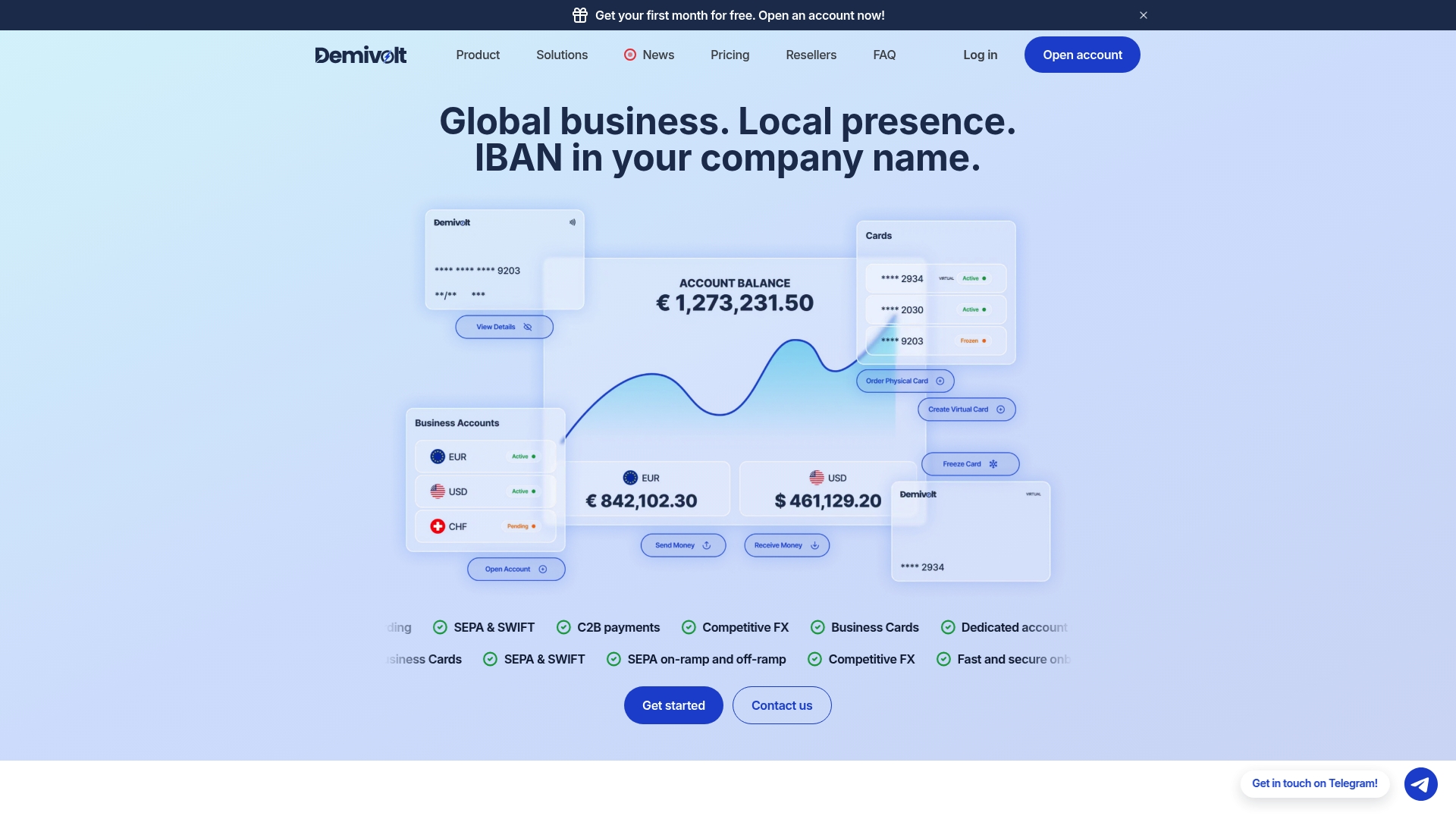
Demivolt’s business banking platform is built from the ground up to meet EU regulatory standards, with dedicated IBAN accounts, SEPA and SWIFT payments, multi-account structures, and role-based access controls that align directly with open banking compliance requirements. If you are ready to move beyond fragmented tools and disconnected bank accounts, our open banking account guide walks you through every step of setting up a compliant, integrated banking structure for your SME. The infrastructure is ready when you are.
Frequently asked questions
How does open banking improve SME cashflow and operations?
Open banking enables real-time multi-bank aggregation, faster reconciliation, and predictive analytics, giving SMEs better control of cashflow and payments without switching between portals.
What are the security requirements for open banking in Europe?
Open banking requires SCA with two factors of authentication and only allows licensed TPPs to access data with explicit, revocable customer consent.
What does PSD3 change for SMEs compared to PSD2?
PSD3 addresses API quality775891_EN.pdf) and fraud issues, introduces mandatory consent dashboards, and lays the groundwork for open finance through FiDA, offering SMEs more secure and transparent banking.
Which SMEs benefit most from open banking?
SMEs with complex payments, multiple bank accounts, and a need for real-time analytics gain the most from open banking’s aggregation and direct payment tools.
Are there any risks in using open banking for SMEs?
Risks include API fragmentation, data quality gaps, and fraud at the consent layer, though PSD3 regulatory improvements are directly targeting these shortcomings across European markets.
Recommended
- Demivolt | Blog – Modern business banking trends: boost efficiency & compliance
- Demivolt | Blog – Business banking for SMEs: services, compliance & cross-border
- Demivolt | Blog – International payments for SMEs: efficiency, compliance, growth
- Demivolt | Blog – How to streamline your digital business banking workflow
- Financial management for SME profitability: 5 key steps