

TL;DR:
- Correct scheme selection and validation reduce errors and processing delays in SEPA payments.
- Automating workflows with APIs and STP minimizes manual errors and enhances compliance.
- Speed, reliability, and automation are more critical than cost savings for efficient SME cross-border payments.
Every euro payment your business sends carries a hidden cost: the cost of getting it wrong. Incorrect IBANs, missing address fields, and wrong scheme selection trigger rejects, delays, and strained supplier relationships. For SMEs operating across Europe, 10-12x higher costs for transfers outside SEPA make mastering the system a financial priority, not just an operational one. This article gives you a clear, actionable framework covering scheme selection, step-by-step execution, error handling, compliance upgrades, and automation strategies, so your team can move money faster, cheaper, and with full confidence.
Table of Contents
- Understand SEPA schemes and essentials
- Step-by-step: How to initiate flawless SEPA transfers
- Avoid errors: Handling rejects, returns, and recalls
- Compliance and efficiency: New standards, instant payments, and cost comparisons
- Expert strategies: Automation, API integration, and fintech innovations
- A seasoned take: What SMEs really need to know about SEPA transfers
- Make SEPA transfers effortless with Demivolt
- Frequently asked questions
Key Takeaways
| Point | Details |
|---|---|
| Choose the right SEPA method | Select between SCT and SCT Instant by balancing speed, cost, and operational needs. |
| Validate IBAN details | Correct IBAN entry avoids payment rejects and delays. |
| Master error resolution | Proactive error handling and structured address use reduce transaction friction. |
| Embrace automation and compliance | APIs and STP workflows help SMEs meet regulations while reducing costs and mistakes. |
Understand SEPA schemes and essentials
Before your team sends a single payment, you need to know which SEPA scheme fits the job. The two primary options are SEPA Credit Transfer (SCT) and SEPA Instant Credit Transfer (SCT Inst), and choosing between them affects speed, cost, and recipient experience.
SCT processes in one business day, making it the standard choice for scheduled supplier payments, payroll, and invoices where same-day settlement is not critical. SCT Inst, by contrast, settles in under 10 seconds, 24 hours a day, 7 days a week, including weekends and holidays. That speed matters enormously when you are managing cash flow across multiple markets.
| Feature | SCT | SCT Inst |
|---|---|---|
| Processing time | Up to 1 business day | Under 10 seconds |
| Availability | Business hours | 24/7/365 |
| Amount limit | No cap | Up to €100,000 (bank-dependent) |
| Compliance check | Batch | Real-time |
| Best for | Scheduled payments | Urgent transfers, cash flow |
SEPA covers 36 to 41 countries, including all EU and EEA members plus Switzerland, the United Kingdom, and several others. Every transfer requires a valid IBAN (International Bank Account Number). The BIC (Bank Identifier Code) has been optional since 2016 for domestic and cross-border euro payments within the zone.
The scale of SEPA is worth appreciating: the network processes over 50 billion transactions per year, making it one of the largest payment infrastructures on the planet. Understanding IBAN validation best practices is the single most important technical step your team can take before initiating any transfer.
Key requirements at a glance:
- Valid IBAN for the recipient
- Correct scheme selection (SCT or SCT Inst)
- Structured address fields (mandatory from November 2026)
- ISO 20022 compliant data formatting
- Sanctions and AML screening (real-time for SCT Inst)
Step-by-step: How to initiate flawless SEPA transfers
Once you know your scheme and requirements, the next focus is executing each transfer with precision. A repeatable checklist eliminates the guesswork and protects your team from the most common, and costly, mistakes.
- Collect and validate recipient data. Gather the full IBAN and confirm the account holder name matches exactly. Use an IBAN validation tool before entry.
- Select the correct scheme. Choose SCT for scheduled payments and SCT Inst for urgent or time-sensitive transfers.
- Enter structured address fields. Include street, city, postal code, and country as separate fields, not a single unstructured block.
- Set the payment reference. Use a clear, unique reference your counterpart can match to an invoice. This saves hours of reconciliation work.
- Authenticate the payment. Apply strong customer authentication (SCA) as required under PSD2. Two-factor verification is the standard.
- Review before submission. A second set of eyes on the IBAN and amount is not bureaucracy; it is loss prevention.
- Confirm receipt. For high-value transfers, follow up with the recipient to confirm funds arrived.
“Double-check the IBAN before every submission. A single transposed digit sends the payment to the wrong account, and recovery is neither fast nor guaranteed.”
Manual data entry is the leading cause of SEPA rejects. If your team processes recurring supplier payments, consider reviewing your secure payment workflows to identify where human touchpoints introduce the most risk. A well-designed business credit checklist can also help you align payment controls with broader financial governance.
Pro Tip: Automate recurring supplier transfers using pre-validated payment templates. Templates lock in the IBAN, name, and address fields, cutting manual entry errors to near zero and freeing your team for higher-value work.
Avoid errors: Handling rejects, returns, and recalls
Precision reduces risk, but every SME must also be prepared to handle inevitable exceptions. Knowing the difference between a reject, a return, and a recall determines how fast you can resolve the issue and protect your cash flow.

Rejects happen before the payment is processed. The sending bank or clearing system identifies an error, such as an invalid IBAN or missing mandatory field, and sends the payment back immediately. No funds leave your account.
Returns occur after the payment has been credited to the recipient’s bank. The receiving bank sends the funds back, often because the account is closed or the beneficiary name does not match. This takes longer to resolve and can disrupt supplier relationships.
Recalls are initiated by the sending bank or the payer to reverse a completed payment, typically due to fraud, duplication, or a processing error. Recalls are not guaranteed to succeed and depend on recipient bank cooperation.
Common causes by category:
- Rejects: Invalid IBAN, missing address fields, incorrect BIC format, failed sanctions screening
- Returns: Closed account, name mismatch, account not accepting euro transfers
- Recalls: Duplicate payment, fraud detection, incorrect amount
A critical deadline is approaching: unstructured addresses become non-compliant after November 2026. Any payment using a single free-text address field will be rejected by compliant banks after that date. Audit your payment templates now.
Pro Tip: Set up real-time bank notifications for every outbound payment. Instant status alerts let your team act within minutes of a reject or return, rather than discovering the issue days later during a reconciliation run.
For a broader view of how to build efficient euro payments processes that minimize these edge cases, a structured review of your current workflows is the best starting point.
Compliance and efficiency: New standards, instant payments, and cost comparisons
To maximize return on investment, SMEs should leverage compliance upgrades and compare costs proactively. The shift to ISO 20022 is not optional; it is the mandatory data standard for both SCT and SCT Inst, and it brings real operational benefits alongside the compliance requirement.
ISO 20022 enables richer payment data, structured remittance information, and machine-readable fields that dramatically improve reconciliation accuracy. For finance teams managing dozens of cross-border payments weekly, this translates directly into fewer manual corrections and faster month-end close.
SCT Inst performance is striking: 99% of instant payments settle in under 5 seconds. For SMEs managing tight cash cycles, that speed is a competitive advantage.
| Method | Speed | Typical cost | Compliance workload |
|---|---|---|---|
| SCT | 1 business day | Low | Moderate (batch screening) |
| SCT Inst | Under 10 seconds | Low to moderate | High (real-time screening) |
| Non-SEPA (SWIFT) | 2-5 business days | High | High |
SMEs that rely on non-SEPA transfers for euro payments can pay up to 10x more per transaction compared to SEPA alternatives, according to ECB analysis.
For compliance, daily sanctions screening is required for standard SCT, while SCT Inst demands real-time anti-money laundering (AML) and sanctions checks. Understanding the difference between SWIFT payment comparisons and SEPA helps finance managers allocate the right method to the right payment. For teams building out compliance infrastructure, AI in sanctions compliance is increasingly relevant as regulatory expectations rise.
Expert strategies: Automation, API integration, and fintech innovations
Once best practices are applied, leading SMEs leverage technology for ongoing performance gains. The concept that drives the biggest improvement is Straight-Through Processing (STP): the ability to initiate, validate, screen, and settle a payment with zero manual intervention.
STP eliminates manual errors by removing human touchpoints from the payment chain. When your system validates the IBAN, checks sanctions lists, selects the correct scheme, and submits the payment automatically, the error rate drops to near zero. The EPC actively promotes STP adoption across the SEPA zone as a core quality standard.
APIs (Application Programming Interfaces) are the engine behind STP for most modern SMEs. Here is what API integration delivers in practice:
- Automated IBAN validation before any payment is queued
- Real-time sanctions screening integrated directly into your payment initiation flow
- Instant reconciliation by matching payment confirmations to open invoices
- Regulatory rule updates pushed automatically without manual system changes
- Multi-bank connectivity for SMEs managing accounts across several European institutions
Fintech platforms built for cross-border payments increasingly offer treasury management, automated reconciliation, and compliance monitoring as bundled capabilities, reducing the need for separate point solutions.
Pro Tip: When evaluating payment providers, ask specifically whether regulatory rule updates (such as the November 2026 address structure change) are applied automatically to your payment templates. Providers that require manual updates shift compliance risk back to your team.
Early adopters of SCT Inst and API-driven workflows are already seeing measurable gains: faster supplier onboarding, reduced days sales outstanding (DSO), and lower operational overhead per payment processed.
A seasoned take: What SMEs really need to know about SEPA transfers
Here is something most payment guides will not tell you: obsessing over per-transfer fees is the wrong optimization target for most SMEs. A payment that costs €0.50 less but requires 20 minutes of manual validation, triggers a reject, and takes three days to resolve has a true cost that dwarfs the fee savings.
The real competitive advantage in SEPA payments is not the cheapest provider. It is the most reliable, automated, and compliance-ready workflow. When your payment process catches errors before submission, updates automatically for new regulatory requirements, and gives your team real-time visibility into every transaction status, you are operating a financial control loop, not just a payment pipe.
For business banking compliance insights, the pattern is consistent: mid-sized firms that invest in STP and API-capable infrastructure early spend less time firefighting payment exceptions and more time on growth. The November 2026 address structure deadline is a forcing function. Use it as an opportunity to audit your entire payment workflow, not just the address field.
Make SEPA transfers effortless with Demivolt
For SMEs ready to move beyond patchwork payment processes, Demivolt offers a regulated, digital-first platform built specifically for efficient and compliant euro payments. From dedicated IBAN accounts to real-time payment monitoring and role-based access controls, every feature is designed to give your finance team full control without the manual overhead.
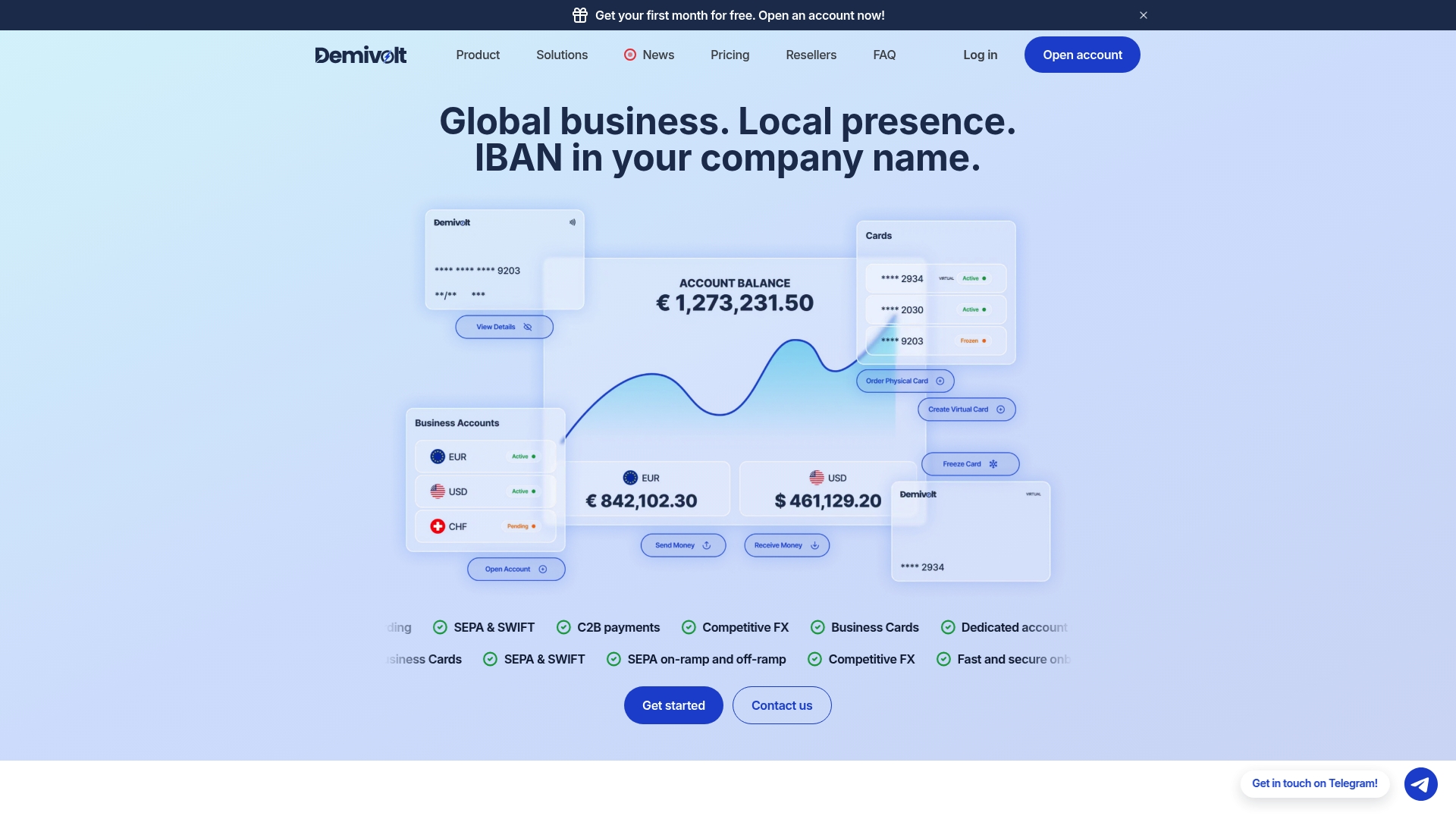
Demivolt business banking supports both SCT and SCT Inst, with built-in compliance infrastructure that updates automatically as regulations evolve. If your team is looking to reduce payment errors, cut processing time, and stay ahead of the November 2026 address structure requirements, explore how SME international payment tips and Demivolt’s platform can work together to simplify your cross-border operations.
Frequently asked questions
What are the main differences between SEPA Credit Transfer and SEPA Instant?
SEPA Credit Transfer settles in up to one business day with no amount cap, while SEPA Instant processes in under 10 seconds, around the clock, for amounts up to €100,000 depending on the receiving bank.
How can SMEs avoid common errors like payment rejects or returns in SEPA transfers?
Always validate the IBAN before submission and use structured address fields, since unstructured address fields will trigger rejects after November 2026 under updated EPC rulebook requirements.
What compliance checks are required for SEPA Instant transfers?
SCT Inst requires real-time sanctions and AML screening on every transaction, since the speed of instant payments makes batch-based compliance checks technically incompatible with the scheme.
Why should SMEs prioritize automation for SEPA payment workflows?
Automation via STP and APIs removes manual error points, ensures compliance rules are applied consistently, and gives finance teams real-time visibility into payment status without extra administrative effort.
Recommended
- Demivolt | Blog – SWIFT payment guide: faster transfers for European SMEs
- Demivolt | Blog – International payments for SMEs: efficiency, compliance, growth
- Demivolt | Blog – How to build a secure payment workflow for SMEs
- Demivolt | Blog – What is SWIFT payment? How it works for SMEs
- Politique de paiement sécurisé : acheter en ligne sans risque – Vitalcup