

TL;DR:
- European SMEs face outdated banking processes like manual approvals and high cross-border costs.
- Modern digital banking tools offer automation, real-time compliance, and configurable workflows for efficiency.
- Rapid adoption and iterative implementation provide greater benefits than waiting for perfect setups.
Manual payment runs, approval chains buried in email threads, and cross-border transfers that take three days and cost a small fortune. If any of that sounds familiar, you’re not alone. Most European SMEs still carry the weight of legacy banking processes that were designed for a different era. The good news is that digital banking workflows exist precisely to fix this. This guide walks you through assessing your needs, choosing the right tools, executing a step-by-step digitalization, and locking in cross-border compliance, so you can stop firefighting and start running a leaner, faster financial operation.
Table of Contents
- Assessing your digital banking workflow needs
- Key tools and features of a modern digital banking workflow
- Step-by-step guide to digitalizing your business banking workflow
- Enhancing cross-border efficiency and compliance
- A fresh perspective: Why rapid adoption beats perfect planning
- Ready to transform your SME banking?
- Frequently asked questions
Key Takeaways
| Point | Details |
|---|---|
| Clarify workflow needs | Map your SME’s current banking processes to identify core workflow bottlenecks and key compliance needs. |
| Leverage digital tools | Choose configurable, modern digital banking features that align with your business and regulatory context. |
| Automate for efficiency | Implement stepwise, automated workflows to reduce manual errors, speed up payments, and enhance compliance. |
| Maximize cross-border savings | Use SEPA Instant and compliant platforms to minimize costs and delays on European and international payments. |
Assessing your digital banking workflow needs
Before you change anything, you need a clear picture of where your current process actually breaks down. That sounds obvious, but most SMEs skip this step and end up buying tools that solve the wrong problems.
Start by thinking about your business structure. A 10-person company with one bank account has very different needs than a 150-person firm operating across five EU countries. SME business banking needs vary significantly based on the number of legal entities, currencies handled, and the volume of outgoing payments each month. Digital banking workflows for SMEs typically involve configurable multi-step journeys for onboarding, payments, approvals, and lending, with role-based access mirroring company structures.
Here are the most common bottlenecks SMEs report when they map their current workflows:
- Manual approvals that require a senior manager to physically sign off on every transfer, creating delays when that person is unavailable
- Duplicate data entry across accounting software, banking portals, and spreadsheets
- No clear audit trail, making it hard to prove compliance during a regulatory review
- Siloed roles, where finance and operations teams use different systems and reconcile data manually
- Opaque cross-border costs, with FX fees and correspondent bank charges only visible after the fact
Compliance is not optional, and it’s not just about avoiding fines. GDPR governs how you handle customer and employee financial data. Anti-money laundering (AML) rules require you to screen transactions and beneficiaries. Sanctions lists change frequently. Solid bank reconciliation guidance can help you build the internal controls that regulators expect to see.
Identify which processes generate the most friction. For most SMEs, it’s payments, payroll, and supplier onboarding. Those are the highest-value targets for digitalization because they’re repetitive, rule-based, and error-prone when done manually.
Pro Tip: Pull your finance lead and your operations manager into the same room to map your current workflow on a whiteboard. Finance sees the compliance gaps. Operations sees the time sinks. Together, they’ll find the bottlenecks that neither would spot alone.
If you’re also thinking about opening a business bank account online as part of this transition, that process itself is a good test of how digital-ready a platform really is.
Key tools and features of a modern digital banking workflow
Once you’ve mapped your needs, the next question is which tools actually deliver. Not every platform is built the same, and the gap between a basic online banking portal and a true workflow engine is significant.
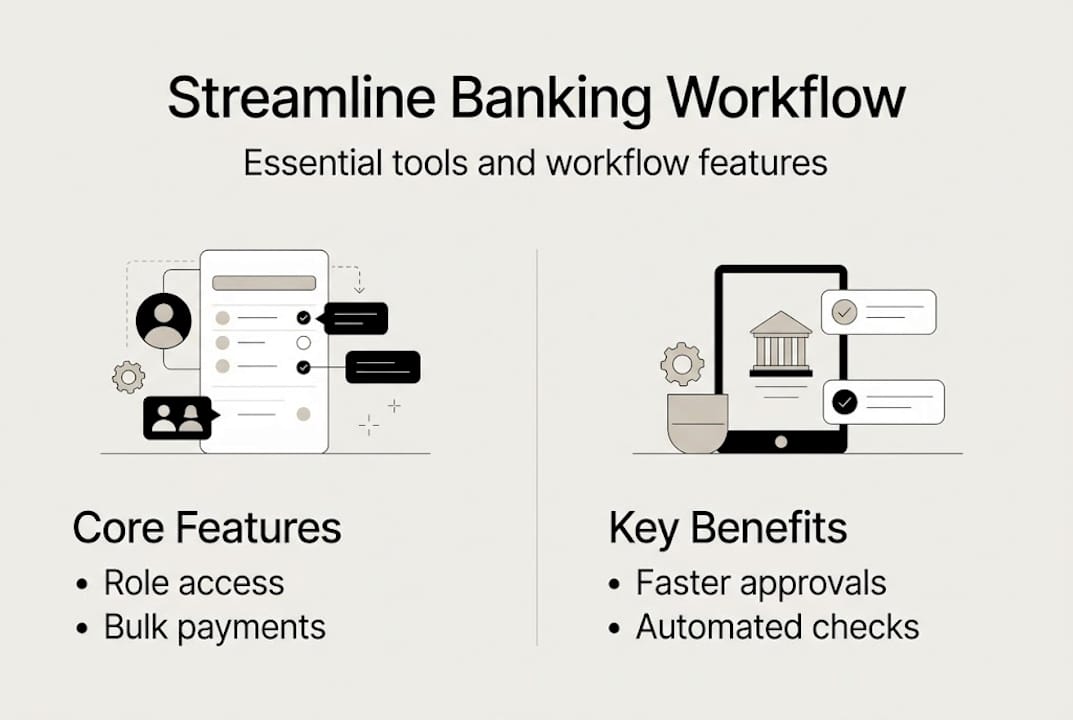
Here’s a breakdown of the core features that matter for European SMEs:
| Feature | What it does | Why it matters for SMEs |
|---|---|---|
| Role-based access | Assigns permissions by user role | Prevents unauthorized payments, supports internal controls |
| Bulk payments | Upload and process multiple payments at once | Saves hours on payroll and supplier runs |
| SEPA and SEPA Instant | Euro transfers within seconds, 24/7 | Eliminates payment delays for EU transactions |
| Compliance modules | AML, sanctions screening, GDPR tools | Keeps you audit-ready without manual checks |
| Beneficiary management | Whitelists and blacklists for payees | Reduces fraud and speeds up recurring payments |
| International transfers | SWIFT-based cross-border payments | Supports suppliers and partners outside the SEPA zone |
Payments workflows support SEPA Instant, bulk payments, payroll uploads with validation, international transfers, and beneficiary management with whitelists and blacklists. That combination is what separates a modern platform from a basic banking portal.

Automated validations are underrated. When a platform checks IBAN formats, flags duplicate payments, or verifies that a beneficiary is on your approved list before the transfer goes out, you eliminate an entire category of costly errors. These aren’t just convenience features. They’re risk controls.
Must-have features for European SMEs in 2026:
- Multi-currency accounts to manage EUR, GBP, USD, and other currencies without constant conversion
- Configurable approval chains so payments above a threshold require a second sign-off automatically
- Real-time notifications for every transaction, giving finance managers instant visibility
- API integration with your accounting software to eliminate manual data entry
- Fraud screening built into the payment flow, not bolted on afterward
Pro Tip: Choose a platform with configurable workflows from day one. Your compliance requirements will change as you grow or expand into new markets. A rigid system will cost you more to adapt than a flexible one costs to set up. Modern banking trends point clearly toward platforms that scale with you rather than forcing you to migrate every few years.
For finance teams managing employee expenses, issuing virtual cards through your banking platform adds another layer of control without adding administrative burden.
Step-by-step guide to digitalizing your business banking workflow
With your needs assessed and your toolkit chosen, here’s how to actually make the transition. Follow these steps in order and you’ll avoid the most common implementation mistakes.
- Map your current workflow in detail. Document every step, every handoff, and every approval. Include who does what and how long each step takes.
- Select your digital banking platform. Prioritize platforms with configurable workflows, compliance tools, and SEPA capability. Test the onboarding process itself as a signal of platform quality.
- Complete digital onboarding. Most modern platforms handle KYC (Know Your Customer) and KYB (Know Your Business) verification online. Gather your company documents, UBO (Ultimate Beneficial Owner) information, and regulatory filings in advance.
- Configure roles and access. Assign permissions based on job function. Finance managers get payment approval rights. Accountants get read access. Admins get user management. Nobody gets more access than they need.
- Integrate compliance checks. Enable AML screening, sanctions list validation, and GDPR-compliant data handling within the platform. Cross-border compliance steps should be built into the workflow, not treated as a separate process.
- Set up approval chains and payment rules. Define thresholds, required approvers, and escalation paths. Test them with internal transfers before going live.
- Run a parallel period. Keep your old process running alongside the new one for two to four weeks. Compare outputs, catch discrepancies, and build team confidence.
- Verify and maintain audit trails. After go-live, regularly review transaction logs and approval records. This is your evidence of compliance if regulators ask.
| Factor | Manual workflow | Digital workflow |
|---|---|---|
| Payment processing time | 1 to 3 days | Minutes to seconds |
| Compliance verification | Manual, inconsistent | Automated, real-time |
| Audit trail | Partial, paper-based | Complete, searchable |
| Error rate | High (human entry) | Low (automated validation) |
| Cost per transaction | High (staff time + fees) | Lower (automation + better rates) |
“Compliance is embedded via real-time sanctions and PEP screening, GDPR, AML checks, and configurable regulatory validations in workflows.” The Digital Omnibus aims for 25 to 35% admin cost cuts by 2030 through simplified GDPR, AI, and AML rules, giving SMEs a real compliance dividend.
Getting accountant compliance support during the transition period is worth considering, especially if your business operates across multiple EU jurisdictions.
Enhancing cross-border efficiency and compliance
For SMEs with suppliers, clients, or employees outside their home country, cross-border payments are often the single biggest source of friction and cost. Getting this right is not a nice-to-have. It’s a competitive advantage.
The numbers tell the story clearly. SEPA Instant settles in 10 seconds, 24/7, compared to the one to three business days of traditional transfers. Outside the SEPA zone, costs run 10 to 12 times higher. A €5,000 transfer from an EU country to the Balkans, for example, can cost multiples of what the same transfer within SEPA would. Interlinking fast payment systems across regions boosts trade by approximately 4%.
Best practices for cross-border SME payments:
- Use SEPA Instant for all euro-denominated transfers within the SEPA zone to eliminate delays
- Maintain clean beneficiary lists with regular reviews of whitelists and blacklists to avoid payment holds
- Handle FX transparently by choosing platforms that show the exchange rate and fee before you confirm a transfer
- Monitor regulatory changes in every country you operate in, since sanctions lists and AML requirements shift frequently
- Separate accounts by currency to reduce unnecessary conversion costs and simplify reconciliation
Core compliance requirements for cross-border operations include automated PEP (Politically Exposed Person) and sanctions screening on every payment, GDPR-compliant data handling for international data transfers, and payment validation tools like Verification of Payee (VoP) to confirm you’re sending money to the right account.
Pro Tip: Review your beneficiary whitelist every quarter. Suppliers change bank accounts, companies get acquired, and sanctions lists update constantly. A stale whitelist is a compliance risk and a fraud risk at the same time.
Understanding how fintechs facilitate cross-border payments gives you a practical lens for evaluating platforms. If you also use SWIFT for non-SEPA transfers, knowing how SWIFT works for SMEs helps you ask the right questions. And if you’re thinking longer term, the push for independent EU payment systems is reshaping the infrastructure your business will rely on. Many SMEs also underestimate cross-border payment challenges until they hit them at scale.
A fresh perspective: Why rapid adoption beats perfect planning
Here’s something the typical digital transformation guide won’t tell you: waiting for the perfect workflow setup is itself a form of risk.
We’ve seen SMEs spend six months in planning mode, mapping every edge case and debating every approval threshold, while their competitors went live with a “good enough” setup and started capturing efficiency gains immediately. Hybrid co-build models enable faster launches with custom workflows, reducing manual approvals without requiring a perfect blueprint upfront.
The data backs this up. 74% of Belgian SMEs use AI daily or weekly, with 34% running full cloud operations, the highest rate in the EU. Those businesses didn’t wait for perfect conditions. They moved, learned, and iterated.
“The businesses gaining the most from digital banking aren’t the ones with the most sophisticated setup. They’re the ones who started.”
The real value of digital workflows comes from using them, not designing them. Adopt something solid, run it in parallel briefly, then go live. You’ll learn more from two weeks of real usage than from two months of planning. Modern banking efficiency trends consistently show that action compounds. Every week you delay is a week of manual errors, slower payments, and compliance exposure that you’re choosing to carry.
Ready to transform your SME banking?
Everything covered in this guide, from mapping your workflow needs to automating cross-border compliance, is exactly what Demivolt is built to support. The platform gives European SMEs dedicated IBAN accounts, SEPA and SWIFT payment capabilities, role-based access controls, and built-in compliance tools, all in one regulated, digital-first environment.
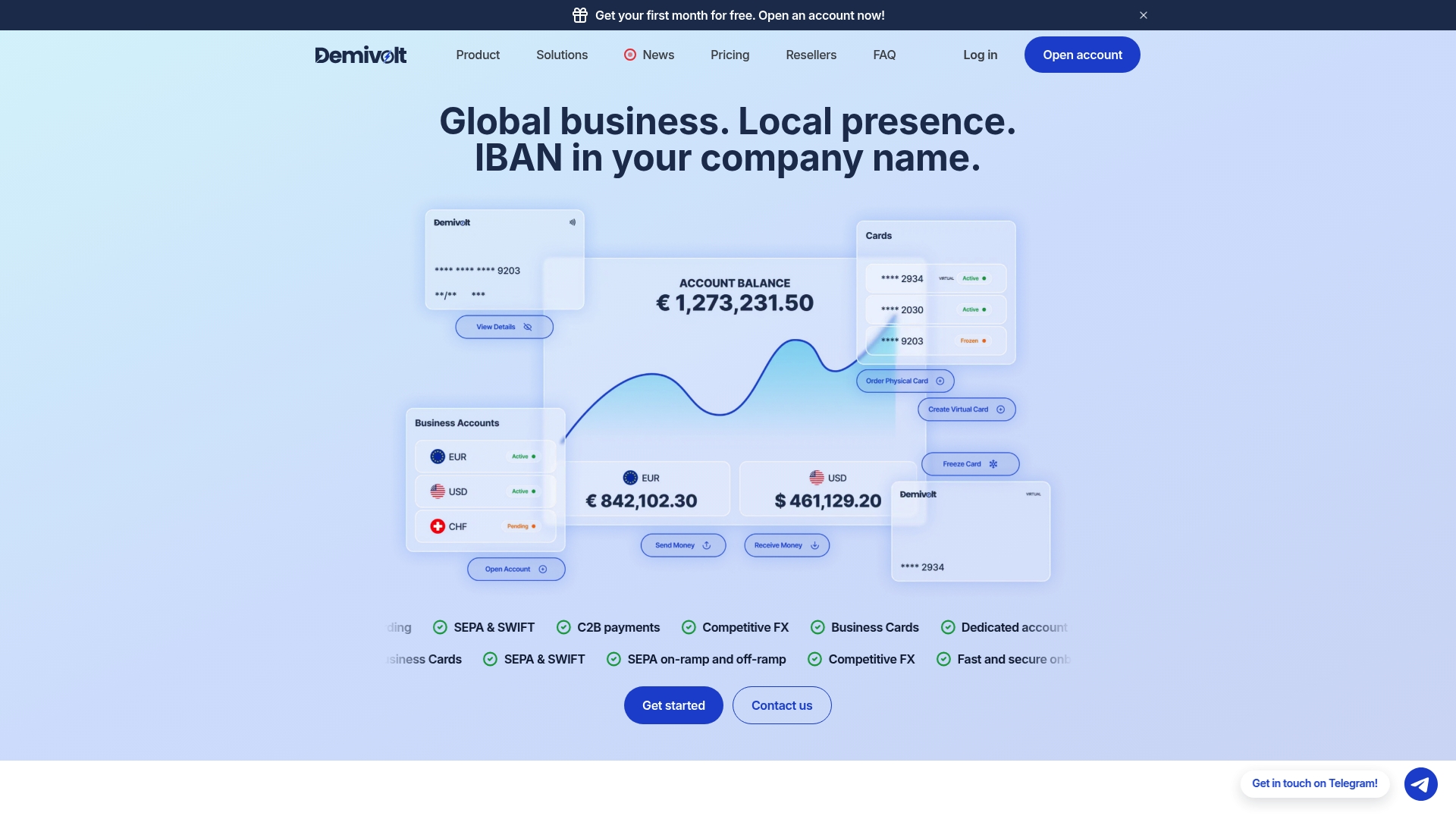
Whether you’re starting from scratch or optimizing an existing setup, Demivolt’s digital banking platform is designed to get you operational quickly, without sacrificing compliance or control. You can request a demo or speak with a specialist to see how the platform fits your specific workflow. The next step is simpler than you think.
Frequently asked questions
What is a digital business banking workflow?
A digital banking workflow is an automated set of steps for handling banking tasks like onboarding, payments, approvals, and compliance within a business, fully configurable to match your company structure and regulatory requirements.
How does SEPA Instant benefit cross-border SME payments?
SEPA Instant enables euro transfers in 10 seconds, 24 hours a day, cutting transfer times from days to seconds and dramatically lowering costs compared to traditional international wire transfers.
What compliance checks are built into modern banking workflows?
Modern workflows include real-time AML and sanctions screening, GDPR-compliant data handling, and Verification of Payee tools that validate every payment before it leaves your account.
Is it hard for SMEs to switch to digital banking workflows?
Switching is more straightforward than most expect. Hybrid co-build models offer customizable templates and rapid onboarding, so most SMEs can go live within days rather than months.
What role does AI play in digital banking workflow automation?
AI validates transactions, detects fraud patterns, and automates repetitive tasks. With 74% of Belgian SMEs using AI weekly, the productivity gains are well documented across European markets.