

TL;DR:
- Choosing the right payment methods is crucial for cross-border SMBs to reduce costs and improve speed.
- Focus on customer preferences, regional acceptance, and compliance to optimize payment strategies.
- Partnering with regulated fintech providers can streamline international payments and ensure regulatory adherence.
Choosing the right payment method for cross-border transactions is one of the most consequential decisions a growing SME or e-commerce business can make. The options have multiplied fast: cards, digital wallets, bank transfers, buy-now-pay-later, and even stablecoins are all on the table. Pick the wrong one and you absorb unnecessary fees, miss compliance requirements, or lose customers at checkout. Pick the right mix and you gain speed, trust, and competitive reach. This guide walks you through the major payment method categories, compares them on cost and speed, and gives you scenario-based guidance so you can make smarter choices for your business.
Table of Contents
- How to evaluate payment method options
- Major types of payment methods and global examples
- Side-by-side comparison: Cost, speed, and best use cases
- When to use each method: SMEs, e-commerce, and cross-border scenarios
- Key compliance and risk considerations
- What most businesses get wrong about payment methods
- Power your global payments with the right partner
- Frequently asked questions
Key Takeaways
| Point | Details |
|---|---|
| Evaluate by business need | Choose payment methods based on cost, speed, and compliance with your business scenario. |
| Know your options | Major payment types include cards, wallets, bank transfers, BNPL, and cryptocurrencies. |
| Compare costs and risks | Fintech platforms often deliver lower fees and faster cross-border settlements than banks. |
| More isn’t always better | Adding too many payment options can increase administrative and compliance burdens. |
| Stay compliant | Regularly review payment processes for AML, fraud, and evolving regulations. |
How to evaluate payment method options
With the payment method landscape in mind, let’s start by defining the right criteria to evaluate your options.
Before you commit to any payment method, you need a consistent framework for comparison. Not all methods are equal, and what works for a B2B wholesaler in Germany may fail an e-commerce retailer selling into Southeast Asia. The right evaluation criteria keep you from chasing trends and help you focus on what actually moves the needle for your business.
Here are the core factors to weigh:
- Cost: Transaction fees, currency conversion markups, monthly platform fees, and chargeback costs all add up. A 3% card processing fee on $2 million in annual revenue is $60,000 gone.
- Speed: How quickly do funds settle into your account? Days matter when you’re managing cash flow across borders.
- Global reach: Does the method work in your target markets? Some wallets are dominant in one country and nonexistent in another.
- Compliance: AML screening and fraud prevention are essential when choosing payment methods. Skipping this step exposes you to regulatory penalties.
- Customer preference: Buyers abandon carts when their preferred method isn’t available. Know your audience.
- Settlement reliability: Consistent, predictable payouts protect your working capital.
Risk management deserves its own focus. Fraud, chargebacks, and geographic restrictions can quietly erode margins. The compliance piece, specifically anti-money laundering (AML) rules and know-your-customer (KYC) checks, is non-negotiable in regulated markets. Understanding how fintechs and SMEs payment infrastructure has evolved helps you see why compliance-first platforms are gaining ground.
Pro Tip: Always confirm your payment partners’ compliance practices before onboarding a new method. Ask directly about their AML and KYC procedures. If they can’t answer clearly, that’s a red flag.
Major types of payment methods and global examples
Now, let’s look at the main payment method categories and highlight real-world examples and when to use each.
Credit and debit cards, digital wallets, bank transfers, BNPL, and cryptocurrencies are the most common payment methods for SMEs and e-commerce today. Each has a distinct profile.
1. Cards (Visa, Mastercard, Amex) Cards are the global default for consumer payments. They’re accepted almost everywhere, offer buyer protection, and integrate easily with most checkout systems. The downside: fees run high (typically 2.8% to 4.3% per transaction), and chargebacks can be costly and time-consuming to dispute.
2. Digital wallets (PayPal, Alipay, WeChat Pay) Digital wallets dominate in Asia and are growing fast in Europe and North America. PayPal works across most markets. Alipay and WeChat Pay are near-mandatory for selling into China. Speed is excellent, and buyer trust is high. The challenge is regional fragmentation. What works in Shanghai won’t work in São Paulo. Understanding digital wallets in fintech gives you a clearer picture of where this space is heading.
3. Bank transfers (SWIFT, SEPA, ACH) Bank transfers are the backbone of B2B payments. SEPA covers the Eurozone with low fees and reliable settlement. SWIFT reaches globally but costs more and takes longer. ACH is the standard for US domestic transfers. These are best for large, predictable transactions where speed is secondary to cost and reliability.
4. Buy now, pay later (Klarna, Affirm) BNPL has surged in e-commerce. It increases average order value and reduces cart abandonment, especially for higher-ticket items. The merchant typically pays a fee of 2% to 8%, and the regulatory environment around BNPL is tightening in several markets.
5. Cryptocurrencies and stablecoins Crypto enables 24/7 settlement with no intermediary bank. Stablecoins like USDC reduce volatility. The challenge is regulatory uncertainty and limited consumer adoption outside tech-forward markets.
Pro Tip: Not every method works in every region. Before adding a new payment option to your checkout, verify actual acceptance rates in your target market. A method with 90% adoption in one country may have 5% in another.
Side-by-side comparison: Cost, speed, and best use cases
Once you’ve met the main players, a head-to-head comparison helps spotlight the differences that matter most.
| Payment method | Typical fee | Settlement speed | Best use case | Main risk |
|---|---|---|---|---|
| Cards (Visa/MC) | 2.8%–4.3% | 1–3 days | Consumer e-commerce | Chargebacks, high fees |
| Digital wallets | 1.5%–3.5% | Minutes to hours | Mobile, Asia, global retail | Regional fragmentation |
| Bank transfer (SWIFT) | $25–$50 flat | 2–5 days | Large B2B payments | Slow, expensive |
| SEPA/ACH | Low to none | 1–2 days | Eurozone/US domestic | Geographic limits |
| BNPL | 2%–8% | Instant for buyer | High-ticket e-commerce | Regulatory risk |
| Crypto/stablecoins | Near zero | Minutes | After-hours, cross-border | Volatility, compliance |
Traditional bank wire transfers are reliable but slow and expensive, while fintech platforms offer faster and often much cheaper alternatives for SMEs. The gap is significant. Specialists like Wise and Airwallex settle in hours with low fees, compared to the $25 to $50 flat charges and multi-day waits from traditional banks.

For most cross-border SMEs, the practical takeaway is this: use bank transfers for large, scheduled B2B payments where predictability matters, and use fintech platforms or digital wallets for everything that needs speed or lower cost. The fintech vs banks debate is largely settled in favor of fintechs for speed and cost, but banks still win on familiarity and credit relationships.
When to use each method: SMEs, e-commerce, and cross-border scenarios
Having compared your payment method options, here’s how different situations call for different solutions.
Context is everything. The right payment method depends on your business model, your customer’s location, and the size and frequency of your transactions.
Here are common scenarios with recommended approaches:
- E-commerce selling into China: Alipay and WeChat Pay are not optional. Chinese consumers expect them, and card penetration for online purchases is comparatively low.
- US B2B supplier payments: ACH is the standard for domestic transfers. For cross-border, SWIFT or a fintech platform with USD accounts works best.
- European SME cross-border: SEPA covers most of the Eurozone cheaply and reliably. For non-EU markets, fintech platforms with multi-currency IBANs reduce friction significantly.
- After-hours or weekend settlement: Stablecoins and crypto rails operate 24/7, making them useful when traditional banking windows are closed.
- High-ticket consumer sales: BNPL options like Klarna reduce buyer hesitation and increase conversion for items above $200.
| Business type | Best method | Main risk | Key region |
|---|---|---|---|
| E-commerce (consumer) | Cards + digital wallets | Chargebacks | Global |
| B2B wholesale | Bank transfer/SEPA | Speed | Europe/US |
| Cross-border SME | Fintech platform | Compliance | Multi-region |
| Digital services | PayPal/Stripe | Fees | Global |
| High-growth e-commerce | BNPL + cards | Regulatory | US/EU |
SMBs average fewer payment methods than large enterprises, but more methods equal broader reach. The catch: each additional method adds admin, reconciliation work, and compliance obligations. Expanding your payment mix makes sense when you have the operational capacity to manage it. Explore global digital payments market trends to understand where growth is concentrated.
Key compliance and risk considerations
Before you implement or expand payment methods, let’s cover the compliance essentials you can’t overlook.
Compliance is not a one-time checkbox. It’s an ongoing operational function. As you add payment methods, your compliance surface area grows. Here’s what to track:
- AML and KYC checks: Every payment partner you work with must have documented AML and KYC procedures. If they don’t, you inherit their risk.
- Sanctions screening: Sanctions screening, tokenization, and multi-party compliance are crucial steps in any payment setup. Missing a sanctioned counterparty can result in severe penalties.
- Chargeback and fraud controls: Cards and digital wallets carry chargeback risk. Set thresholds, monitor dispute rates, and use fraud scoring tools.
- Geographic restrictions: Some payment methods are legally restricted in certain countries. Crypto regulations vary dramatically by jurisdiction.
- Data protection: PCI DSS compliance is mandatory for card processing. GDPR applies to any EU customer data you handle.
“Third-party payment relationships require the same due diligence as direct banking relationships. Regulatory responsibility doesn’t transfer just because you outsource the processing.”
Review method-specific documentation for compliance requirements before you go live. Build contingency procedures for when a payment provider goes down or a method is suspended in a key market. Compliance is not a static task. Regulations around BNPL, crypto, and cross-border payments are evolving fast in 2026, and staying current is part of the job.
What most businesses get wrong about payment methods
Stepping back, here’s where most businesses misstep and how you can avoid common pitfalls.
The most common mistake we see is treating payment method selection as a feature race. Businesses add methods because competitors have them, not because their customers need them. That logic leads to bloated payment stacks that are expensive to maintain and difficult to keep compliant.
Adding payment methods increases reach, but it also amplifies admin, fraud exposure, and compliance obligations. Three or four well-managed methods will almost always outperform ten poorly tracked ones. The operational drag of managing too many providers quietly erodes the margin gains you were chasing.
The smarter approach is to start with your actual customer data. Where do your buyers live? What do they use? What’s your average transaction size? Those answers should drive your payment mix, not industry trend reports. Understanding how fintech digital economy insights are reshaping buyer behavior helps you make evidence-based decisions rather than reactive ones.
Align payment choices with your core business goals. If you’re optimizing for cash flow, prioritize fast-settling methods. If you’re entering a new market, prioritize local preference. If compliance is your constraint, work with regulated platforms that carry the burden with you.
Power your global payments with the right partner
You now know the most effective payment methods and how to choose them. Here’s how Demivolt can help you put those insights into action.
Demivolt is built for exactly this challenge. As a regulated European fintech platform, we support SMEs and e-commerce businesses in managing cross-border payments, SEPA transfers (SWIFT support in the pipeline), and multi-currency accounts from a single, compliant platform.
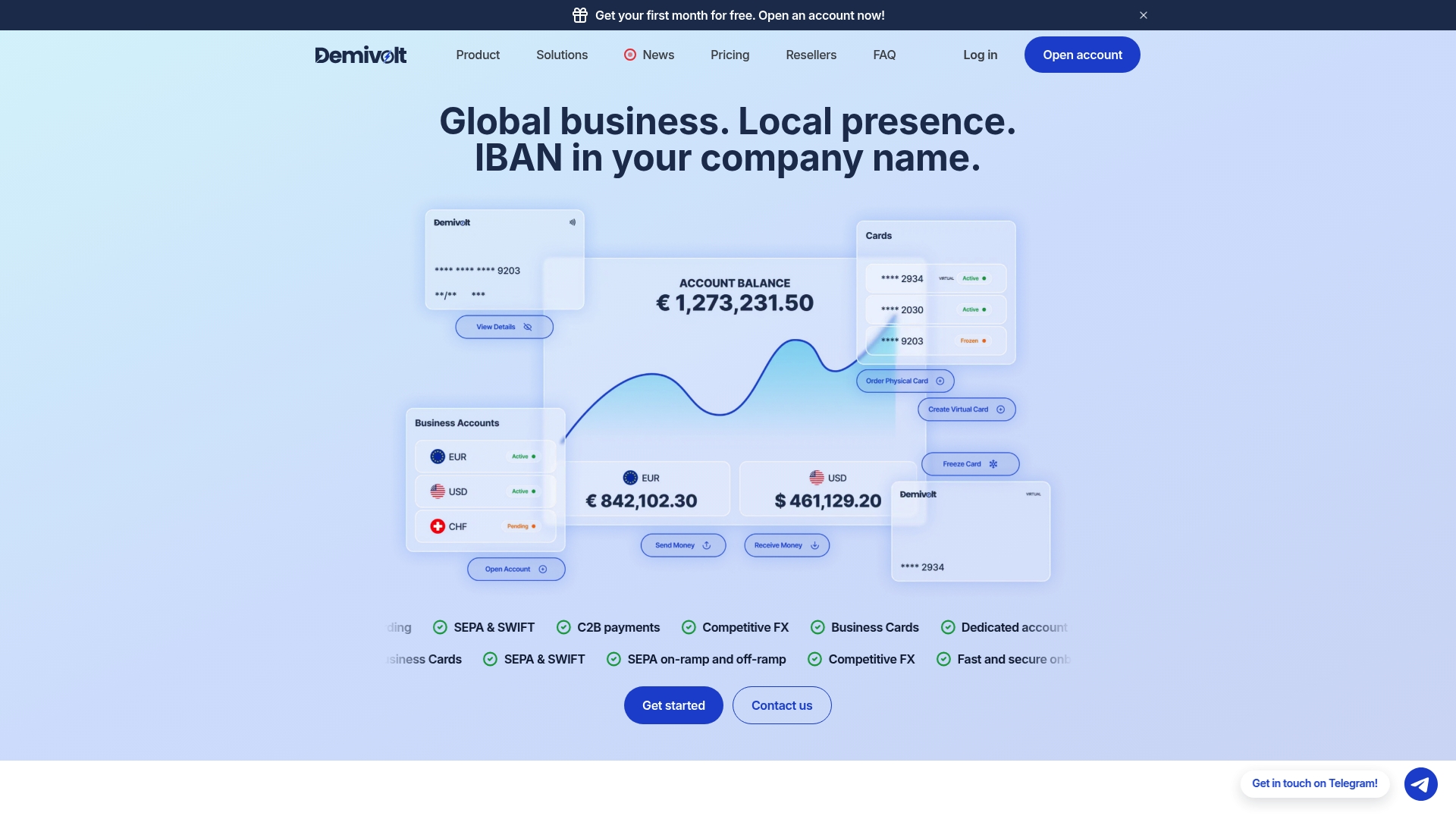
With business banking at Demivolt, you get dedicated IBAN accounts, role-based user management, and a payment infrastructure designed to meet EU regulatory standards without slowing you down. Whether you’re streamlining supplier payments in Europe or expanding into new markets, Demivolt gives you the tools to manage your payment stack with confidence. Our onboarding is fast, our compliance is built in, and our team understands what growing businesses actually need.
Frequently asked questions
What is the most cost-effective payment method for SMEs?
Fintech platforms like Wise and Airwallex typically offer the lowest fees and fastest settlements for SMEs, making them a strong default for cross-border transactions.
Which payment method works best for cross-border e-commerce?
Digital wallets like PayPal, Alipay, and region-specific wallets are ideal because they match buyer preferences in cross-border trade and settle quickly.
How can businesses ensure payment compliance?
Screen all payments for AML and sanctions, use tokenization for card data, and regularly update compliance protocols as regulations evolve in your key markets.
Does offering more payment methods improve sales?
It can broaden reach, but more methods add complexity and compliance obligations. A focused, well-managed set of methods typically delivers better results than an oversized stack.