

TL;DR:
- Choosing the right bank account is vital to avoid compliance issues, payment delays, and FX costs.
- SME accounts should match legal structure, transaction volume, currency needs, and integration requirements.
- Features like automation, multi-currency support, and integrated payment solutions are more important than labels.
Choosing the wrong business bank account costs more than just fees. It can create compliance gaps, slow down payments, and quietly drain your margins through FX markups and missed interest. For SMEs operating across Europe, the stakes are higher than ever. Regulatory requirements vary by entity type, transaction volumes differ wildly between industries, and the gap between a digital-first fintech and a legacy bank can mean weeks of onboarding versus hours. This article breaks down every major account type, what each one actually does for your business, and how to match the right structure to your specific operational needs.
Table of Contents
- How to evaluate business bank account options
- Business current accounts: The operational backbone
- Business savings accounts: Making your surplus work
- Merchant accounts: Accepting card payments with ease
- Multi-currency and foreign currency accounts: Go global, keep control
- Behind the labels: Why SMEs should focus on account features, not just type
- Ready to upgrade your business banking?
- Frequently asked questions
Key Takeaways
| Point | Details |
|---|---|
| Account choice impacts efficiency | The right business bank account improves both compliance and operational performance for SMEs. |
| Savings rates can vary widely | Switching from a big bank to a challenger can yield much higher interest on surplus funds. |
| Multi-currency is critical for trade | Multi-currency accounts help avoid large FX fees and simplify cross-border transactions. |
| Don’t judge by labels alone | Features and fees often matter more than the account type name—always compare closely. |
How to evaluate business bank account options
Before you compare products, you need to know what your business actually requires. The account type that works for a solo consultant in Amsterdam is not the same one that works for a logistics company moving goods between Poland and Spain.
Start with your legal structure. Limited companies legally need a separate business account, while freelancers are not legally required to have one but benefit significantly from the separation. If you deal with international clients or suppliers, multi-currency capability is not optional. It becomes essential infrastructure.
Here are the core criteria to evaluate before you commit:
- Legal requirement: Does your entity type mandate a separate account?
- Transaction volume: How many payments go in and out each month?
- Currency exposure: Do you invoice or pay in EUR, GBP, USD, or other currencies?
- Integration needs: Does the account connect with your accounting software?
- Regulatory compliance: Is the IBAN jurisdiction accepted by your counterparties?
- Onboarding speed: Can you get operational in days, not weeks?
Digital banking adoption across Europe has accelerated sharply, making it easier to open a business bank account entirely online with minimal paperwork. Still, not all digital accounts are equal. Some offer only basic payment rails, while others provide full business banking for SMEs including multi-account structures and role-based access.
Pro Tip: Always verify that the IBAN jurisdiction your provider issues is accepted by your key clients and payment partners. An LT or DE IBAN may be treated differently depending on the country and industry.
Business current accounts: The operational backbone
After understanding the key criteria, it is vital to explore the account types starting with the most common. The business current account is the foundation of day-to-day financial operations for most SMEs.
Business current accounts are the standard for day-to-day SME operations across Europe. They handle incoming revenue, outgoing supplier payments, payroll, and recurring expenses. Without one, managing cash flow becomes a manual, error-prone process.
Key features to look for in a business current account include:
- Online and mobile access for real-time visibility
- Debit and virtual cards for employee expenses
- Bulk payment support for payroll or supplier runs
- SEPA and SWIFT payment rails for domestic and international transfers
- Automated bookkeeping integrations with tools like Xero or QuickBooks
For limited companies, a current account is also a legal necessity for VAT registration and maintaining the separation between personal and business finances. Partnerships and LLPs face the same requirement. Sole traders are in a gray area legally, but mixing personal and business funds creates accounting headaches and potential compliance issues during audits.
One often overlooked feature is support for business SWIFT payments. If your business pays international invoices or receives funds from outside the SEPA zone, SWIFT capability is not a bonus. It is a baseline requirement.
Pro Tip: Prioritize accounts that offer automated bookkeeping connections. Reconciling transactions manually is a time drain that compounds as your business grows. A direct feed to your accounting software eliminates that friction entirely.
The right current account does more than hold money. It becomes the operational hub that connects your income, expenses, cards, and reporting in one place.
Business savings accounts: Making your surplus work
With day-to-day operations secured, consider how your business maximizes idle funds. Most SMEs leave significant money sitting in low-yield current accounts when it could be earning meaningful interest elsewhere.

The numbers make a compelling case. UK challenger banks offer 4.31% average interest rates versus 1.21% at major banks, and SMEs holding £75,000 in a standard account lose an estimated £2,326 per year by not switching to a higher-yield option.
| Account type | Average rate (2026) | Access | Best for |
|---|---|---|---|
| Big bank savings | 1.21% | Instant | Low-risk, convenience |
| Challenger bank savings | 4.31% | 1-30 day notice | Yield-focused SMEs |
| Fixed-term deposit | Up to 5.0% | Locked term | Predictable surplus |
The key differentiators between savings products are access terms, interest calculation methods, and minimum balance requirements. Notice accounts offer better rates in exchange for a short waiting period before withdrawal. Fixed-term deposits lock funds for a defined period but deliver the highest yields.
Best practices for maximizing returns on business savings:
- Keep only 1-2 months of operating expenses in your current account
- Move predictable surplus into a notice account for better yield
- Use fixed-term deposits for funds you know you will not need for 3-12 months
- Review rates quarterly since the market shifts frequently
- Check whether interest is paid monthly or annually, as this affects cash flow
Linking your savings strategy to your SME banking services provider means you can move funds between accounts quickly without external transfer delays. That flexibility is worth factoring into your choice.
Merchant accounts: Accepting card payments with ease
Having protected your surplus, next comes handling customer payments. If your business accepts card payments, either in person or online, you need a merchant account. This is a distinct product from a current account and serves a different purpose.
Merchant accounts enable SMEs to process card payments and streamline the flow of funds from customer to business. When a customer pays by card, the funds move through a payment processor into the merchant account before settling into your current account, typically within one to three business days.
Here is how a typical merchant account setup works in Europe:
- Apply through a payment processor or acquiring bank
- Complete KYC and business verification
- Integrate payment gateway with your website or POS system
- Set up settlement schedule to your current account
- Monitor chargebacks and disputes through the provider dashboard
| Fee type | Typical range | Notes |
|---|---|---|
| Transaction fee | 0.3% to 2.9% | Varies by card type and volume |
| Monthly fee | €10 to €50 | Some providers waive with volume |
| Chargeback fee | €15 to €25 per case | Avoidable with strong fraud controls |
| Settlement time | 1 to 3 business days | Faster with premium plans |
Integrating your merchant account with your current account at the same provider reduces reconciliation time significantly. When settlement data flows automatically into your accounting system, you eliminate a major source of manual error.
If you are ready to open a merchant account alongside your primary banking setup, look for providers that offer unified dashboards so you can track both operational cash flow and card payment settlements in one view.
Multi-currency and foreign currency accounts: Go global, keep control
For expansion or international suppliers, specialized currency accounts are vital. Standard EUR accounts are not built for businesses operating across multiple currency zones. The cost of ignoring this is real and recurring.
FX markups on standard business accounts typically run between 2.5% and 3.5% per transaction. On a €500,000 annual payment volume, that is €12,500 to €17,500 in avoidable costs. Multi-currency accounts are essential for cross-border SMEs, and the IBAN type, whether LT, DE, or FR, matters for acceptance by counterparties.
When evaluating multi-currency options, look for:
- Local IBANs in key markets (DE, FR, NL) for better acceptance rates
- Supported currencies: EUR, GBP, USD, CHF, PLN as a baseline
- Real exchange rates with transparent markup disclosure
- Inbound payment routing so clients can pay in their local currency
- FX conversion controls to lock rates at favorable moments
Choosing the right cross-border banking strategies comes down to understanding your payment flows. If 60% of your revenue comes from UK clients, a GBP-denominated account with a local sort code is worth more than a generic EUR account with conversion fees. Staying current on cross-border payment trends also helps you anticipate where the market is heading.
Pro Tip: Prefer providers that issue local IBANs rather than virtual IBANs routed through a single jurisdiction. Local IBANs reduce rejection rates and improve trust with enterprise clients who have strict payment compliance requirements.
Behind the labels: Why SMEs should focus on account features, not just type
Here is something the financial industry does not advertise: account type labels are largely marketing constructs. A “business savings account” at one bank might offer worse terms than a “business current account” with a sweep feature at a digital provider. The label tells you almost nothing about actual value.
What matters is the feature stack. Does the account support role-based user access? Can you set spending limits on individual cards? Does it connect to your ERP or accounting software without a workaround? These questions reveal more about operational fit than any account category name.
SMEs that chase account types instead of account features often end up with products that do not match their workflows. The right provider adapts to your processes, not the other way around. Reviewing modern banking trends shows a clear shift toward feature-rich, API-connected accounts that replace the rigid segmentation of traditional banking.
Fee transparency is equally critical. Hidden charges for SWIFT payments, card issuance, or account maintenance can erode the apparent value of a “free” account. Always model your actual monthly cost based on real transaction behavior before committing.
Ready to upgrade your business banking?
If this breakdown has clarified what your business actually needs, the next step is finding a provider that delivers it without compromise.
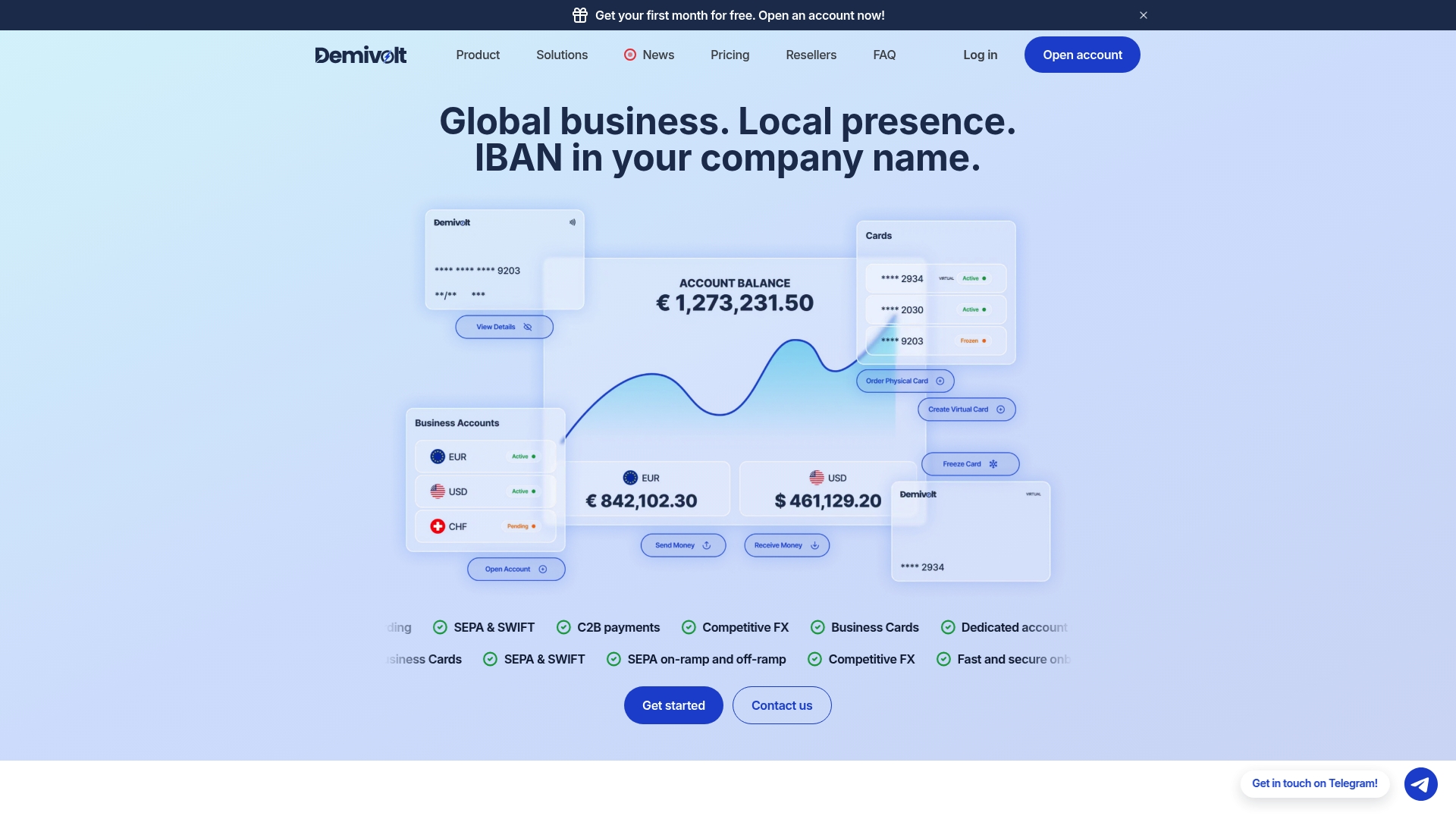
Demivolt business banking is built specifically for SMEs that need more than a basic account. From dedicated IBAN accounts and SEPA payment support (SWIFT coming soon) to multi-account structures (virtual and physical cards launching soon), and role-based user management, Demivolt covers every account type discussed in this article under one regulated, digital-first platform. Onboarding is fast, transparent, and designed to meet EU regulatory standards from day one. If you are ready to stop patching together multiple providers, open your account today and consolidate your business banking into a single, compliant infrastructure.
Frequently asked questions
Which business bank account is best for freelancers in Europe?
Freelancer accounts are optional but strongly recommended for clean invoicing and tax separation. A basic business current account with low monthly fees and good invoicing tools is usually the right starting point.
How do multi-currency accounts save SMEs money?
Multi-currency accounts eliminate the 2.5% to 3.5% FX markups applied on standard EUR accounts and provide local IBANs that reduce payment friction with international clients.
Are digital-only banks safe for SMEs in Europe?
Yes. 80% of EU SMEs now use digital banking, and regulated challengers operate under national and EU deposit protection schemes equivalent to traditional banks.
Can I have more than one business bank account?
Absolutely. Running separate accounts for operations, savings, and international payments is a recognized best practice that improves financial control, simplifies audits, and reduces the risk of a single point of failure.
What is the main reason for switching business savings accounts?
Challenger banks offer rates more than 3% higher than large traditional banks, making switching one of the lowest-effort, highest-return financial decisions an SME can make.