

TL;DR:
- Most European SMEs face overdue B2B invoices that cause cash flow crises across supply chains. Effective management requires understanding complex workflows, compliance, and leveraging integrated digital payment solutions to reduce delays and errors. Automating order-to-cash processes enhances visibility, compliance, and resilience against late payments.
Most European business owners assume their payment problems boil down to slow banks or outdated software. The reality is more sobering. Late-payment prevalence across Western Europe shows a majority of firms regularly dealing with overdue B2B invoices, creating a cash flow crisis that ripples across entire supply chains. B2B payments are not simply a “business version” of paying for something online. They are complex, multi-step financial processes with their own rules, risks, and compliance requirements that every European SME needs to understand before choosing a payment solution.
Table of Contents
- What B2B payments really are
- The mechanics and workflow of B2B payment processing
- European specifics: SEPA Direct Debit B2B and compliance
- Edge cases, operational risks, and late-payment impact
- Why B2B payments demand smarter solutions: Beyond payment rails
- Get started with secure, compliant B2B payments
- Frequently asked questions
Key Takeaways
| Point | Details |
|---|---|
| B2B payments are complex | Business-to-business transactions involve multiple steps, negotiations, and higher values than consumer payments. |
| Workflow impacts speed | Approval and settlement often delay payments; automation speeds cycles and reduces risk. |
| European compliance matters | Schemes like SEPA Direct Debit B2B require careful adherence to EPC rulebooks and mandates. |
| Late payments are widespread | Overdue invoices and payment gaps pose significant cash flow risks for SMEs in Europe. |
| Digital solutions offer relief | Integrated digital tools help minimize delays, improve compliance, and boost efficiency. |
What B2B payments really are
With overdue payments framing the challenge, let’s clarify exactly what sets B2B transactions apart.
At their core, B2B payments are transactions between companies rather than between a business and an individual consumer. The difference sounds simple, but the operational reality is far more involved. Consumer payments are typically low value, instant, and require no negotiation. B2B payments involve larger sums, agreed payment terms (net 30, net 60, or even net 90 days), and a structured approval chain before money ever moves.
Consider three everyday examples most European SMEs encounter regularly:
- Supplier invoices: A manufacturing firm orders raw materials. The supplier ships goods, issues a formal invoice, and the buyer’s accounts payable team must verify, approve, and schedule the payment within agreed terms.
- Logistics and freight: A freight company completes a delivery run and submits an invoice. The client’s procurement team cross-checks the invoice against delivery records before releasing funds.
- SaaS and digital subscriptions: A company subscribes to a cloud platform at an enterprise tier. The vendor bills monthly or annually, and the finance team reconciles each charge against a signed contract.
Each of these involves negotiation, invoicing, internal approval, and reconciliation. That four-step sequence is what makes B2B payments genuinely different from a consumer tapping a contactless card.
| Payment type | Typical value | Settlement speed | Approval steps | Refund flexibility |
|---|---|---|---|---|
| Consumer (card) | Low | Instant to 1 day | None | High |
| B2B wire transfer | High | 1 to 3 days | Multiple | Low |
| B2B SEPA Credit | Medium to high | Same day to 1 day | Multiple | Moderate |
| B2B Direct Debit | Medium to high | 2 to 3 days | Pre-authorized | Very low |
Understanding this table helps you select the right method for each use case. Recurring supplier payments have different requirements than one-off cross-border transfers.
Pro Tip: Build a simple invoice-tracking log that captures the date sent, approval status, scheduled payment date, and actual payment date. Even a spreadsheet is a significant improvement over relying on email threads alone. For structured business payment solutions for SMEs, a centralized payment platform removes this manual burden entirely.
The mechanics and workflow of B2B payment processing
With definitions in place, let’s follow the practical journey of a B2B payment.
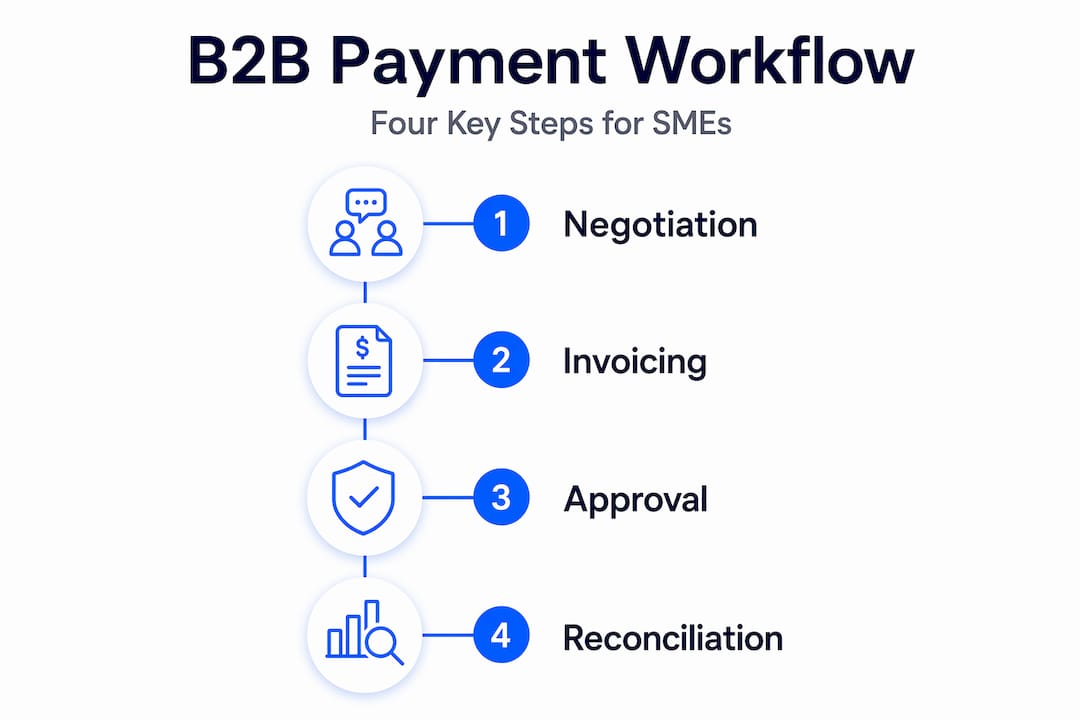
Every B2B payment begins with an invoice. The seller issues a document stating the amount owed, the payment method accepted, due date, and reference details. From there, the process moves through layers of internal review on the buyer’s side. B2B payment processing is triggered by invoicing and then cleared through complex internal workflows before settlement, which itself can take multiple business days.
Here is the standard workflow most European SMEs experience:
- Invoice issuance: The supplier generates and sends a structured invoice (PDF, XML, or e-invoice format depending on jurisdiction).
- Invoice receipt and logging: The buyer’s accounts payable team receives and logs the invoice, matching it against purchase orders or contracts.
- Multi-department approval: Procurement confirms goods or services were received. Finance checks the invoice details. Treasury verifies budget availability. Legal may review for contract compliance on large deals.
- Payment authorization: A finance director or CFO authorizes the outgoing payment, especially above a set threshold.
- Payment execution: The payment is initiated via SEPA, SWIFT, or bank transfer. Settlement occurs within the agreed banking timeframe.
- Reconciliation: Both buyer and seller update their accounting systems to reflect the settled transaction.
“The gap between invoice issue and actual settlement is where most cash flow problems live. A payment method can be perfect on paper, but if the internal approval process has no clear owner, delays are inevitable.”
This workflow creates several natural pressure points. Approval that requires four departments to sign off can stall for days if even one person is traveling or the request lands in the wrong queue. Format mismatches between the seller’s invoicing software and the buyer’s ERP (Enterprise Resource Planning) system can trigger rejections that restart the entire process.
Automation in business payments directly addresses this problem. When invoice data flows automatically into an approval queue, and authorized approvers receive notifications with one-click review options, the entire process compresses from days to hours. Modern payment banking trends increasingly move toward integrated platforms that connect invoicing, approval, and settlement in one environment rather than treating each step as a separate tool.

Pro Tip: If your ERP system and payment platform don’t share data automatically, you are manually re-entering information at least once per transaction. That manual step multiplies error risk and slows every payment. Integrating these two systems is one of the highest-return efficiency investments an SME finance team can make.
European specifics: SEPA Direct Debit B2B and compliance
Understanding the broad workflow, let’s dive into European payment specifics and compliance factors.
Europe has a payment infrastructure that many other regions envy. The SEPA (Single Euro Payments Area) network covers 36 countries and creates a unified framework for euro-denominated transfers. Within this framework, SEPA Direct Debit B2B is an optional but powerful scheme exclusively available to business payers, unlike the core consumer-facing scheme.
Here is what makes SEPA Direct Debit B2B distinctive for SMEs:
- Business-only access: Only companies can participate as payers. This restricts the scheme to verified business relationships.
- Pre-authorized mandate system: The payer’s bank must validate and store the direct debit mandate before any collection can occur. This creates a strong compliance layer.
- No refund right for authorized transactions: Unlike the consumer SEPA Direct Debit Core scheme, businesses using SDD B2B have virtually no right to reclaim authorized payments. This strongly protects the creditor.
- Automated recurring collections: Once a mandate is in place, recurring payments (monthly supplier fees, subscription services, leasing installments) collect automatically without manual intervention each cycle.
- Liquidity advantage for creditors: Funds arrive predictably on the scheduled date, improving cash flow forecasting.
| Feature | SDD B2B | SDD Core | Wire transfer |
|---|---|---|---|
| Eligible payers | Businesses only | Consumers and businesses | Any |
| Refund rights | Very limited | Up to 8 weeks (authorized) | None after settlement |
| Mandate validation | Bank-verified | Self-managed | Not applicable |
| Automation level | High | High | Low to medium |
| Settlement time | 2 business days | 5 business days (first use) | 1 to 3 days |
| Best for | Recurring B2B billing | Consumer subscriptions | One-off large payments |
The European Payments Council governs this scheme through a regularly updated rulebook. SMEs using SDD B2B must monitor rulebook revisions, which typically occur annually. Missing an update can mean your mandate templates or bank notification timelines fall out of compliance, exposing you to collection failures or regulatory issues.
For businesses processing payments regularly across the eurozone, understanding SEPA payments for EU businesses is foundational. Applying SEPA transfer best practices and maintaining a current payment compliance checklist are practical steps that protect both cash flow and regulatory standing.
Edge cases, operational risks, and late-payment impact
Now, let’s highlight the main operational risks and how they shape real-world B2B payment performance.
Even with the right payment methods in place, execution errors create significant friction. The most common pain points for European SMEs include incorrect invoicing, limited ERP integration, and approval delays, with 47% of B2B invoices reported as overdue and bad debts affecting approximately 6% of outstanding receivables. These are not rare edge cases. They are the routine experience of businesses that have not yet modernized their payment workflows.
| Risk category | Root cause | Business impact |
|---|---|---|
| Incorrect invoices | Manual data entry errors | Payment rejection, restart cycle |
| Format inconsistency | ERP-bank system mismatch | Processing delays, manual rework |
| Approval bottlenecks | No defined workflow owner | Days of added delay per invoice |
| Late payment from customers | Customer liquidity issues | Cash flow shortfalls |
| Bad debt | Non-payment after terms expire | Direct financial loss |
The cash flow math is brutal for smaller firms. A company with 30-day payment terms that routinely receives payment in 50 to 60 days effectively finances its customers’ operations. That gap must be covered by working capital, credit lines, or delayed payments to its own suppliers, perpetuating the cycle.
The compounding effect is well documented. 62% of European businesses pay their own suppliers late when their customers pay them late, and the average gap between receiving payment from customers and paying suppliers stands at 20 days. This ripple effect means that a single large overdue invoice at the top of a supply chain can cause payment delays three or four levels deep.
Key risk mitigation steps SMEs should implement immediately:
- Standardize invoice formats across all customers and suppliers to reduce rejection rates
- Set automated payment reminders at 7 days, 3 days, and on the due date for outgoing invoices
- Define a maximum approval timeline internally and assign a specific owner for every payment workflow stage
- Segment customers by payment behavior and adjust credit terms accordingly
- Monitor receivables weekly rather than monthly to catch late payments before they become critical
Digital-first platforms dramatically reduce exposure to these risks by embedding controls directly into the payment workflow rather than relying on manual discipline. The business payment solutions guide covers the specific features SMEs should evaluate when selecting a payment platform.
Why B2B payments demand smarter solutions: Beyond payment rails
After reviewing the facts and operational pitfalls, here is what most guides miss: the real challenge in B2B payments is not which payment method you use. It is whether your entire order-to-cash process is connected.
Most SMEs approach the problem by upgrading one tool at a time. They switch to a faster bank, adopt a new invoicing app, or enable SEPA Direct Debit. Each upgrade helps at the margin. But if the invoicing system doesn’t talk to the approval workflow, and the approval workflow doesn’t connect to the payment execution engine, you still have a fragmented process with human hand-offs at every seam. Those hand-offs are where delays, errors, and compliance gaps live.
B2B payments are fundamentally an order-to-cash process, integrating ERP, approval workflows, and reconciliation, not just payment rails. This reframing changes where you invest your effort. Instead of asking “which payment method is fastest?” the better question is “where does my process break down between raising an invoice and confirming settlement?”
The late-payment and working-capital pressures that European SMEs face are not going away. They are structural features of B2B commerce. What changes when you adopt smarter, integrated systems is your ability to absorb that structural reality without it damaging your financial position. Companies that automate business payments don’t just save time. They create visibility, reduce error rates, and free finance teams to focus on strategy rather than chasing invoices.
The uncomfortable truth is that most late payment problems are solvable with process improvements before they require legal action, credit insurance, or expensive financing. The businesses that figure this out early build a compounding advantage over competitors still relying on spreadsheets and email threads.
Pro Tip: Map your current order-to-cash process on a whiteboard before choosing any new payment tool. Identify every human hand-off. Then ask which of those hand-offs can be eliminated by connecting systems directly. The answer tells you exactly which tool to buy next.
Get started with secure, compliant B2B payments
Ready to apply these lessons? Here is how you can take action on smarter B2B payments.
Understanding B2B payment mechanics is the first step. Putting that knowledge to work requires a platform built for exactly this kind of operational complexity.
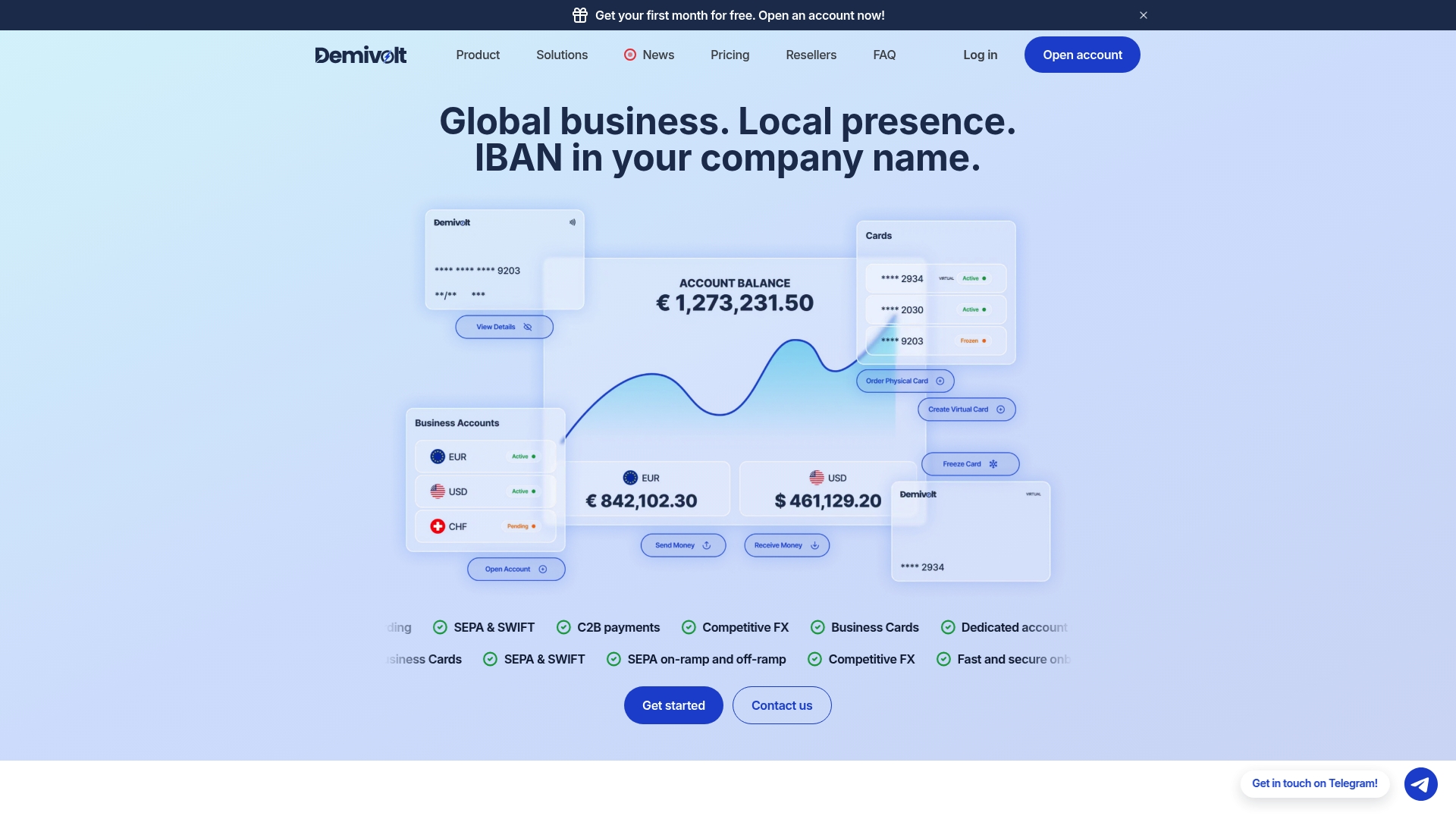
At Demivolt, we built our business banking for SMEs platform specifically around the pain points described in this guide. You get dedicated IBAN accounts for clean fund separation, full SEPA and SWIFT payment capabilities, and role-based user management so every approval step has a named owner. Our onboarding is fast, EU-regulated, and designed to get your business operational without the usual paperwork delays. For efficient SEPA payments and compliant payment infrastructure that scales with your business, Demivolt gives European SMEs the financial control they need to stop chasing invoices and start managing growth.
Frequently asked questions
How do B2B payments differ from consumer payments?
B2B payments involve transactions between businesses, not individuals, meaning they carry larger amounts, negotiated payment terms, and multi-step internal approval processes that consumer payments simply do not require.
What makes European B2B payments unique?
European B2B payments benefit from the SEPA network, and specifically SEPA Direct Debit B2B, an automated, business-only scheme governed by EPC rulebooks that delivers predictable collections with very limited refund exposure.
Why are late payments such a big concern for SMEs?
47% of B2B invoices in Western Europe are overdue, and bad debts affect around 6% of receivables, creating serious working capital strain that can force SMEs to delay their own supplier payments in turn.
What operational risks should SMEs watch for in B2B payments?
The primary risks include incorrect or inconsistent invoices, limited ERP integration, undefined approval workflows, and cumulative cash flow stress from persistent late payments by customers.
How can digital solutions make B2B payments easier?
Digital tools automate invoicing, streamline approval workflows, and accelerate settlement, which reduces error rates, improves compliance, and materially lowers the risk of late payments becoming bad debts.
Recommended
- Demivolt | Blog – Business Payment Solutions Explained for European SMEs
- Demivolt | Blog – Master the international payments process: SME guide
- Demivolt | Blog – IBAN Accounts Explained: Guide for SMEs Managing Cross-Border Payments
- Demivolt | Blog – Digital banking explained: streamline cross-border success