
Summary
Circle is expanding the use of its USD Coin (USDC) across Africa through a strategic partnership with Sasai Fintech. The collaboration aims to weave USDC
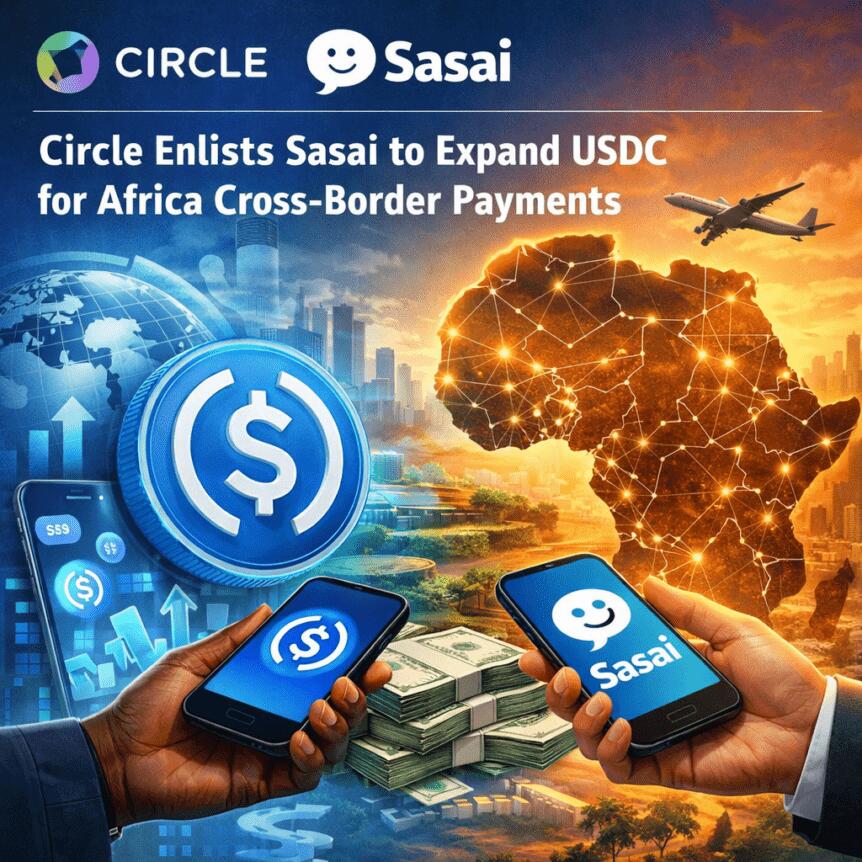
Circle is expanding the use of its USD Coin (USDC) across Africa through a strategic partnership with Sasai Fintech. The collaboration aims to weave USDC into Sasai’s payments fabric, covering cross-border transfers, enterprise payments, and consumer wallets, with the goal of lowering costs and shortening settlement times for users across multiple markets.
In a Business Wire release, Circle and Sasai described integrating USDC into Sasai’s infrastructure to unlock practical on-chain use cases for the stablecoin within Sasai’s network. Sasai operates digital payments services across several African markets, and the partnership would connect Circle’s on-chain rails with Sasai’s cross-border and mobile-payment ecosystem.
Circle CEO Jeremy Allaire framed the collaboration as part of the company’s broader focus on high-growth payment corridors in emerging markets, while Cassava Technologies Chairman Strive Masiyiwa highlighted the potential to broaden access to digital financial services for both businesses and consumers.
Data from DefiLlama shows USDC remains the second-largest stablecoin by market capitalization, at roughly $78.6 billion, trailing only Tether’s USDT, which sits around $184.1 billion. The size of USDC liquidity underscores the potential scale that could flow into Africa’s payments rails as the ecosystem grows.
The rise of crypto and stablecoins in Africa Africa has witnessed a notable uptick in crypto activity, with Sub-Saharan Africa showing a 52% year-over-year increase in on-chain activity in the 12 months through June 2025, tallying more than $205 billion in on-chain value, according to Chainalysis data cited in recent market coverage.
Nigeria accounted for the largest share of that activity—over $92 billion—followed by South Africa, Kenya, Ethiopia, and Ghana. Remittances, cross-border payments, and hedging against currency volatility are among the leading use cases driving this surge. The region’s crypto expansion is drawing attention from global players expanding into Africa.
For example, Blockchain.com announced Ghana-focused expansion as part of its broader push across the continent, reflecting growing demand for retail and institutional access to digital assets and stablecoins as a payment and settlement layer. Regulatory developments are also beginning to mature alongside growth.
Ghana’s Securities and Exchange Commission approved 11 crypto trading platforms to operate within a regulatory sandbox framework under the country’s Virtual Asset Service Providers Act, signaling a structured pathway for crypto services to scale with oversight. Beyond the technology itself, policymakers and industry participants emphasize stablecoins as a faster, lower-cost alternative to traditional remittance routes.
The World Bank continues to highlight an urgent cost challenge: while the global target is to bring average remittance costs below 3%, many economies in Sub-Saharan Africa still register higher levels. A World Bank analysis noted that in 2023 several economies, including Sierra Leone, Uganda, Angola, Botswana, and Zambia, faced remittance costs above 7%.
What this partnership signals for investors and users The Circle–Sasai collaboration arrives as Africa’s payments ecosystem matures, with an emphasis on onboarding more people into digital finance through stablecoins and mobile-first services. For investors, the deal highlights a growing preference among builders and operators to anchor on-chain liquidity with regionally relevant rails.
Source
Original coverage by Crypto Breaking News.
Use the button below to read the article on the publisher website.
Read on Crypto Breaking News