
Summary
NexaPay Review 2026: Is This Crypto Payment Gateway Legit? We Tested It, Talked to Their Team, and Investigated Everything.
Share Share Share Share Email NexaPay Review 2026: Is This Crypto Payment Gateway Legit? We Tested It, Talked to Their Team, and Investigated Everything. By Ian Galbraith · Senior Fintech Correspondent · April 2026 · 12 min read When a payment platform starts showing up in Forbes, Yahoo Finance, TechBullion, and MEXC News within the span of a few months — and simultaneously attracts anonymous Reddit accounts calling it a scam — something interesting is happening.
Either the platform is legitimate and threatening enough to provoke competitor retaliation, or it’s a fraud operation sophisticated enough to get covered by major financial publications. In our experience, it’s almost always the former. Scam platforms don’t get featured on Forbes.
They don’t get syndicated on cryptocurrency exchange news feeds. And they don’t invite journalists to test their product with live, production-grade payment links. NexaPay.one did all of those things. So we investigated. What NexaPay Actually Is NexaPay (nexapay.one) is a fiat-to-cryptocurrency payment gateway registered in Estonia as an OÜ (the Estonian equivalent of a limited liability company).
The platform lets merchants accept Visa, Mastercard, Apple Pay, and Google Pay from their customers and receive settlement in USDC or other supported cryptocurrencies. It also operates as a consumer fiat onramp — individuals can buy crypto with a card without KYC. The key differentiators that have generated attention: zero merchant KYC, 60-second setup, no rolling reserves, no fund freezes, and fees of 1–3%.
For high-risk merchants — peptide companies, CBD brands, supplement sellers, adult content creators, online casinos — NexaPay has positioned itself as a structural alternative to the traditional high-risk processing model. Estonia is not an accidental registration choice. The country has been one of Europe’s most forward-thinking jurisdictions for digital business since launching its e-Residency program in 2014, and it has established a clear regulatory framework for cryptocurrency-related businesses.
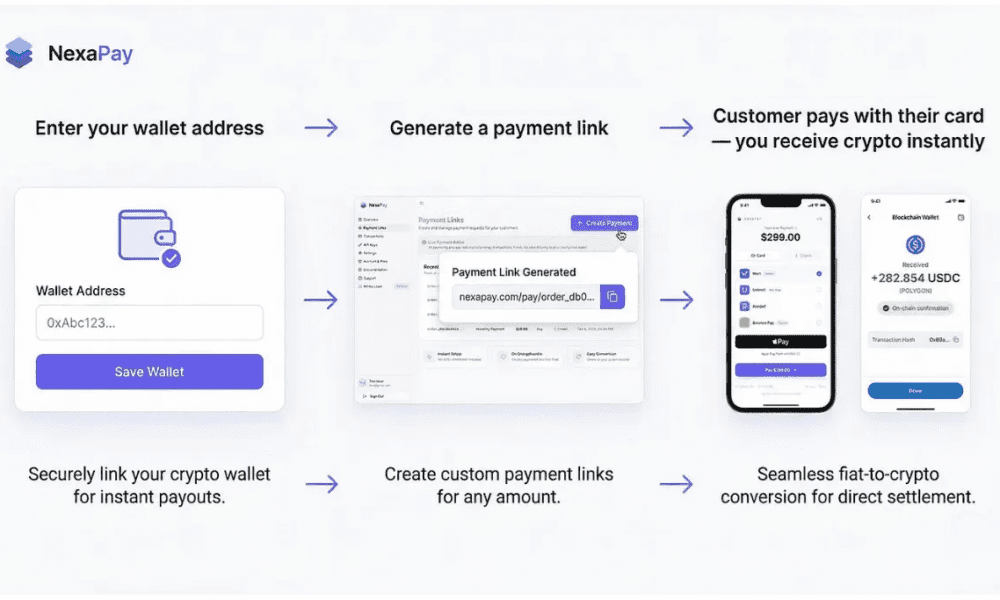
An Estonian OÜ is a real, registered legal entity — not an offshore shell. It has directors, a registered address, and obligations under Estonian and EU law. Our Testing Process We didn’t rely on press releases or marketing materials. We tested NexaPay the way a merchant would. Step 1: Setup.
We visited nexapay.one and set up a payment link. Total time: 47 seconds. No documents requested. No email verification. No phone verification. We entered a USDC wallet address and generated a live payment link — not a sandbox, not a test environment, but a production link that processes real payments.
This is worth emphasizing: NexaPay offers live, production-quality payment links as a free trial. Most payment processors give you a sandbox environment with fake transactions. NexaPay gives you the real thing. You can test with an actual card payment and see the actual USDC arrive in your actual wallet.
If the platform didn’t work, this would be immediately obvious. Step 2: Payment test. We processed a small test payment using a standard Visa card. The checkout was a clean, professional card payment form — indistinguishable from any mainstream e-commerce checkout. No crypto jargon.
No QR codes. No wallet addresses visible to the buyer. Step 3: Settlement. The USDC appeared in our wallet within minutes. The transaction was verifiable on the blockchain. The amount matched the payment minus the disclosed processing fee — no hidden conversion spreads, no surprise deductions.
Source
Original coverage by TechBullion.
Use the button below to read the article on the publisher website.
Read on TechBullionRelated to this article