
Summary
Visa is accelerating its foray into AI-powered payments with a new platform designed to let artificial intelligence agents act on behalf of consumers in
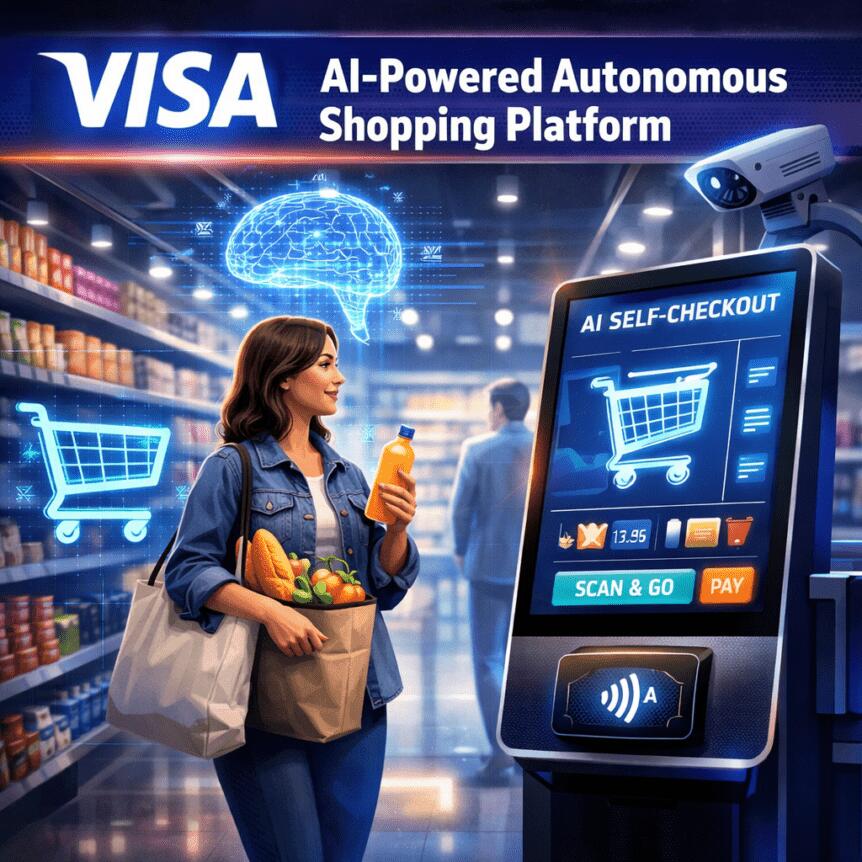
Visa is accelerating its foray into AI-powered payments with a new platform designed to let artificial intelligence agents act on behalf of consumers in online commerce. Intelligent Commerce Connect, announced by the payments giant this week, positions Visa as a universal on-ramp for agentic shopping—facilitating secure payments, tokenization, and merchant discovery through a single integration.
In a Wednesday statement, Visa described Intelligent Commerce Connect as a network, protocol, and “token vault-agnostic on-ramp” for AI agent builders and merchants. The system is pitched as a universal platform for agentic AI payments, enabling an AI agent to browse catalogs, select items, and initiate payments for a consumer’s behalf within a controlled, secure framework.
Visa’s description emphasizes a streamlined integration via the Visa Acceptance Platform, with features that include secure payment initiation, tokenization, spend controls, and authentication. The rollout comes as part of a broader industry movement toward agentic AI commerce, where AI agents—operating on behalf of users—could transact directly online.
The move aligns with activity across the ecosystem, with networks like Ethereum, Tron, and Solana, alongside fintech firms, signaling interest in enabling AI-driven payments to unlock faster, more seamless shopping experiences for users. Key takeaways Visa’s Intelligent Commerce Connect provides a single integration path through the Visa Acceptance Platform to initiate payments for AI agents, with built-in tokenization, spend controls, authentication, and PCI compliance.
The platform supports both Visa and non-Visa card payments and is designed to work with major AI agent protocols, enabling merchants to be discoverable within AI ecosystems. Intelligent Commerce Connect is currently in pilot with select partners and is slated for a broader rollout later in 2026, signaling a measured, enterprise-oriented deployment.
The initiative sits amid broader industry momentum around AI-agent payments, with examples of other ecosystems and partnerships testing autonomous card-based transactions. Recent activity from related players—such as Nevermined integrating with Visa via the x402 protocol—highlights growing collaboration between AI agents, payment rails, and programmable payment requests.
Visa’s AI-enabled payments vision: a practical on-ramp for agentic commerce Visa positions Intelligent Commerce Connect as more than a conceptual framework. By offering a token vault-agnostic on-ramp, the platform aims to decouple AI agent payment flows from any single tokenization infrastructure, enabling merchants to participate without being tied to one ecosystem.
The “one integration” approach promises developers and merchants a straightforward way to onboard, tokenize payments, and apply spend controls within AI-driven shopping flows. Among the functional pillars are catalog discovery inside AI platforms, tokenization of payment credentials, authentication, and PCI compliance.
In practical terms, an AI agent could peruse a merchant’s catalog, place an order, and trigger a payment that adheres to predefined rules—such as spending limits or merchant restrictions—while maintaining the security guarantees expected of traditional card-based payments. Visa’s emphasis on compatibility with both Visa and non-Visa cards broadens potential uptake across diverse payment rails and partner ecosystems.
The emphasis on a universal protocol also aligns with a broader industry push to standardize how AI agents request and execute payments. While the exact standards and implementations continue to evolve, Visa’s framework signals a mature, enterprise-friendly path forward that balances automation with risk controls and regulatory considerations.
Source
Original coverage by Crypto Breaking News.
Use the button below to read the article on the publisher website.
Read on Crypto Breaking News