

TL;DR:
- Digital business accounts enable faster, cheaper cross-border payments and improve cash flow.
- They provide enhanced financial control through real-time data, role-based access, and automation.
- Scalability and compliance are simplified with automated KYC, structured ownership, and multi-market support.
Most European SMEs assume that opening a business account means weeks of paperwork, rigid bank interviews, and fees that eat into already tight margins. That assumption is outdated. SEPA Instant Payments now settle euro transactions in roughly 10 seconds, around the clock, across 36 EU and EFTA countries. That single capability flips the cash flow equation for any company that moves money across borders. This guide breaks down the real, practical benefits of dedicated business accounts, from compliance and cost savings to financial visibility and scalable growth, so you can make an informed decision for your company.
Table of Contents
- Why SMEs need dedicated business accounts
- Unlocking faster, cheaper cross-border payments
- Boosting financial control and visibility
- Compliance, transparency, and scalability made easy
- What most SMEs still miss about business accounts
- Get started with a digital business account
- Frequently asked questions
Key Takeaways
| Point | Details |
|---|---|
| Instant cross-border advantages | Digital business accounts unlock 24/7 instant euro payments and reduce cross-border costs for SMEs. |
| Improved financial control | Real-time oversight and advanced features help SMEs monitor cash flow, automate tasks, and reduce errors. |
| Streamlined compliance | Automated onboarding, transparent structures, and record-keeping simplify compliance for growing businesses. |
| Scalable solutions | Digital business accounts support growth into new markets with flexible, multi-user access and cloud tools. |
Why SMEs need dedicated business accounts
With the promise of instant payments and improved control, it is important to understand why having a separate business account is so impactful. Many founders start out mixing personal and business funds in one account. It feels convenient at first. But the moment you face a tax audit, a supplier dispute, or a growth round, that blurred line becomes a serious liability.
A dedicated business account creates a clean legal and financial boundary. Your accountant can reconcile transactions faster, your tax filings are cleaner, and your auditors have a clear paper trail. These are not minor conveniences. They are the foundation of a compliant, scalable operation.
Here is what a dedicated business account gives you that a personal account simply cannot:
- Separation of funds for accurate bookkeeping and tax compliance
- Role-based access so team members handle only what they need to
- Professional credibility with clients, suppliers, and regulators
- Dedicated IBANs for receiving payments from international partners
- Expense cards linked directly to business budgets, not personal credit lines
Role-based access deserves special attention as your team grows. When a finance manager can approve payments but cannot change account settings, and a junior employee can submit expense claims but cannot view salary data, your internal controls become far more robust. That structure protects you from both external fraud and internal errors.
“The biggest compliance risk for a growing SME is not a rogue employee. It is an unstructured system where everyone has access to everything.”
Traditional banks have historically made this harder, not easier. Digital providers use real-time screening for sanctions and politically exposed persons, which means faster onboarding without sacrificing safety. This matters especially for companies with non-EU ultimate beneficial owners, who often face outright rejection from legacy institutions.
Pro Tip: When evaluating providers, ask specifically about their onboarding timeline for non-EU directors or shareholders. A provider that cannot give you a clear answer is one that will slow you down when it matters most.
Understanding the types of business bank accounts available to your company is the first practical step before you commit to any platform.
Unlocking faster, cheaper cross-border payments
Now that we know why business accounts are essential, let us see how they enable efficient cross-border operations. Speed and cost are the two variables that determine whether cross-border trade is profitable or painful for an SME.
The numbers are stark. Cross-border transfer costs can run 10 times higher for a €5,000 transfer from the EU to the Western Balkans compared to an equivalent intra-EU transfer, according to World Bank data. Digital solutions that optimize SEPA and SWIFT routing can cut those fees by up to three times versus traditional banks. For an SME sending 20 international payments a month, that difference compounds quickly.
SEPA Instant is the clearest example of where digital accounts pull ahead. Payments arrive in roughly 10 seconds, any hour of any day, including weekends and public holidays. That means a supplier in Poland gets paid on a Friday evening, not the following Tuesday. Your working capital does not sit idle waiting for a bank to open.
Here is how the two approaches compare:
| Feature | Traditional bank | Digital business account |
|---|---|---|
| SEPA transfer speed | T+0 to T+1 (business hours) | ~10 seconds, 24/7/365 |
| SWIFT fees | High, often opaque | Reduced, transparent pricing |
| FX rates | Marked up, non-competitive | Near mid-market rates |
| Geographic coverage | Varies by institution | 36+ EU/EFTA countries |
| Weekend availability | Limited or none | Full |
The strategic advantage of early adoption is real. Only a small fraction of SEPA payments currently use the instant rail, which means companies that do use it are moving faster than the majority of their competitors. That liquidity edge lets you negotiate better payment terms with suppliers and offer faster settlements to clients.
To get the most from cross-border capabilities, follow this sequence:
- Confirm your provider supports both SEPA Instant and SWIFT from a single account
- Map your top 10 payment corridors and compare per-transaction fees
- Set up automated payment rules for recurring supplier invoices
- Use real-time FX rate alerts to time larger currency conversions
- Review your payment data quarterly to identify corridors where costs are still high
Understanding how fintechs and cross-border payments interact gives you a clearer picture of the infrastructure behind these capabilities. For companies using SWIFT regularly, a dedicated resource on faster SWIFT transfers can help you optimize routing and reduce delays.
Boosting financial control and visibility
Beyond just saving money and speeding up payments, business accounts offer essential control and oversight tools. Real-time visibility into your cash position is not a luxury. It is what separates reactive financial management from proactive strategy.

Modern digital platforms connect directly to accounting software via APIs, which means transactions are categorized and reconciled automatically. No more end-of-month scramble to match invoices to bank statements. The data is always current, always accurate, and always accessible to the right people.
Platforms like Revolut, Wise, and Qonto offer plans starting at €0 to €10 per month that include API integrations, role-based access, and consolidated visibility across multiple accounts. That price point makes enterprise-grade financial infrastructure accessible to companies of any size.
Here is a direct comparison of what you get:
| Capability | Traditional banking | Digital business account |
|---|---|---|
| Real-time balance updates | Delayed (end of day) | Instant |
| API access for accounting | Rarely available | Standard feature |
| Multi-user permissions | Basic or none | Granular role control |
| Spend analytics | Manual export required | Built-in dashboards |
| Fraud alerts | Reactive | Real-time notifications |
The fraud protection angle is often underestimated. Real-time notifications mean you see an unusual transaction the moment it happens, not three days later when your statement arrives. That response window is the difference between stopping a fraudulent payment and chasing a refund.
Key features to look for when evaluating a platform:
- Real-time dashboards that show cash flow across all accounts
- Automated reconciliation via direct accounting integrations
- Granular user permissions that match your internal org structure
- Instant spend alerts for cards and outgoing transfers
- Multi-account support for separating revenue streams or project budgets
Pro Tip: Set up a dedicated sub-account for tax reserves. Every time revenue lands, automatically sweep a fixed percentage into that account. When your tax bill arrives, the money is already there. This one habit eliminates a significant source of cash flow stress for growing SMEs.
For a deeper look at how to structure your internal processes, streamlining digital workflows offers practical guidance. Staying current on banking trends and compliance also helps you anticipate changes before they affect your operations.
Compliance, transparency, and scalability made easy
A final essential pillar is compliance and the ability to scale safely in a fast-changing regulatory environment. For SMEs operating across multiple EU countries or with international ownership structures, compliance is not a one-time checkbox. It is an ongoing operational requirement.
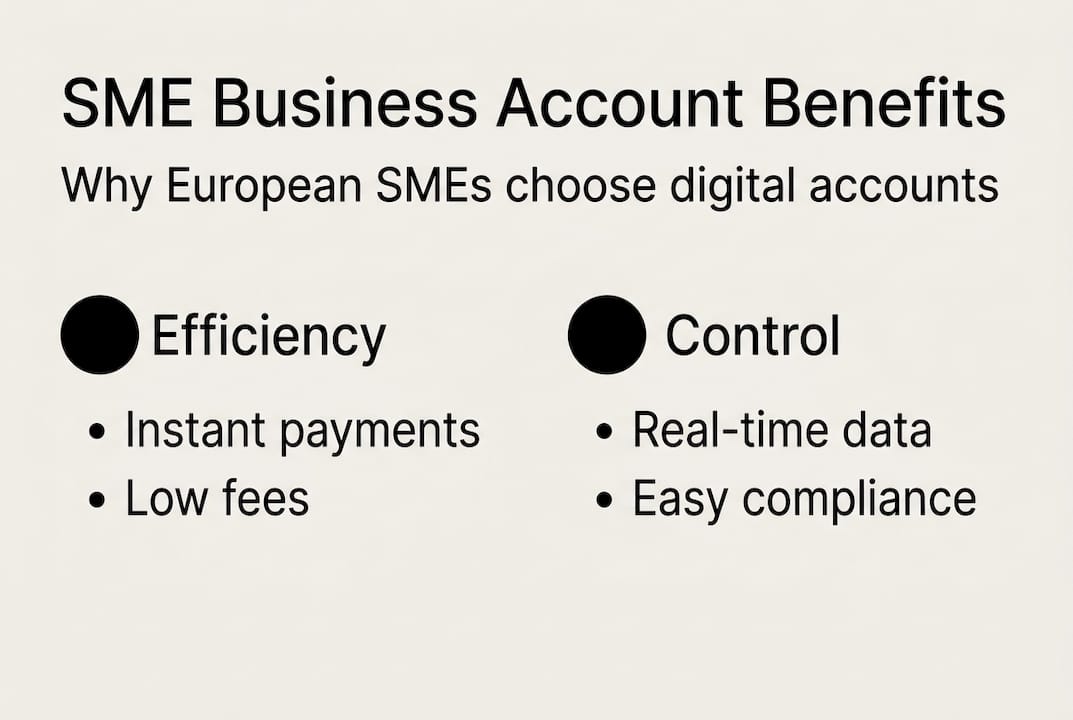
Digital business account providers have rebuilt the onboarding process from the ground up. Automated KYC (know your customer) verification can cut setup time from weeks to days. Document uploads, identity checks, and beneficial ownership declarations happen through a secure digital interface, not a branch appointment.
The benefits extend well beyond opening day:
- Automated transaction records that are audit-ready at any time
- Structured ownership documentation that satisfies EU regulatory requirements
- Real-time compliance screening that flags issues before they escalate
- Scalable account structures that grow with your headcount and market reach
- Support for non-EU UBOs through transparent, documented ownership chains
That last point matters more than most SMEs realize. Digital providers support non-EU UBOs with transparent structures, using real-time sanctions and PEP screening to maintain safety without blocking access. Traditional banks often cannot or will not accommodate these structures, forcing companies into workarounds that create more risk, not less.
Scalability is the other side of this coin. When you hire a remote employee in another EU country, your account structure should accommodate that without requiring a new banking relationship. When you enter a new market, you should be able to open a sub-account or add a new IBAN without starting the onboarding process from scratch.
Pro Tip: Before expanding into a new EU market, confirm that your banking provider can issue a local IBAN or support local payment rails in that country. This single check can save you months of operational friction.
For a full breakdown of regulatory considerations, international payments and compliance covers the key frameworks. If you are ready to act, the guide on how to open a business bank account online walks you through the process step by step.
What most SMEs still miss about business accounts
Here is the part most articles skip. The technical benefits of digital business accounts are well documented. Faster payments, lower fees, better compliance. But the real competitive gap is not in the payments themselves. It is in what companies do with the data those payments generate.
Most SMEs open a digital account, use it for transfers, and stop there. They treat it like a faster version of their old bank. That is a significant missed opportunity. The companies pulling ahead are the ones connecting their accounts to cloud accounting tools, automating cash flow forecasting, and using transaction data to make faster, smarter decisions.
Belgium’s SME market illustrates this clearly: 80% digital banking adoption, 34% full cloud integration, and 75% AI tool usage among SMEs. Those numbers are not coincidental. They reflect a deliberate choice to treat financial infrastructure as a growth lever, not just a utility.
The SMEs that win in the next five years will not be the ones with the fastest payment rails. They will be the ones who turn financial data into operational intelligence. That starts with the right account structure and the right business banking trends awareness, but it ends with a culture of using data to drive decisions.
Get started with a digital business account
Ready to turn business banking into a strategic advantage? The benefits covered in this guide are not theoretical. Faster settlements, lower cross-border costs, real-time visibility, and scalable compliance are all available today through the right digital platform.
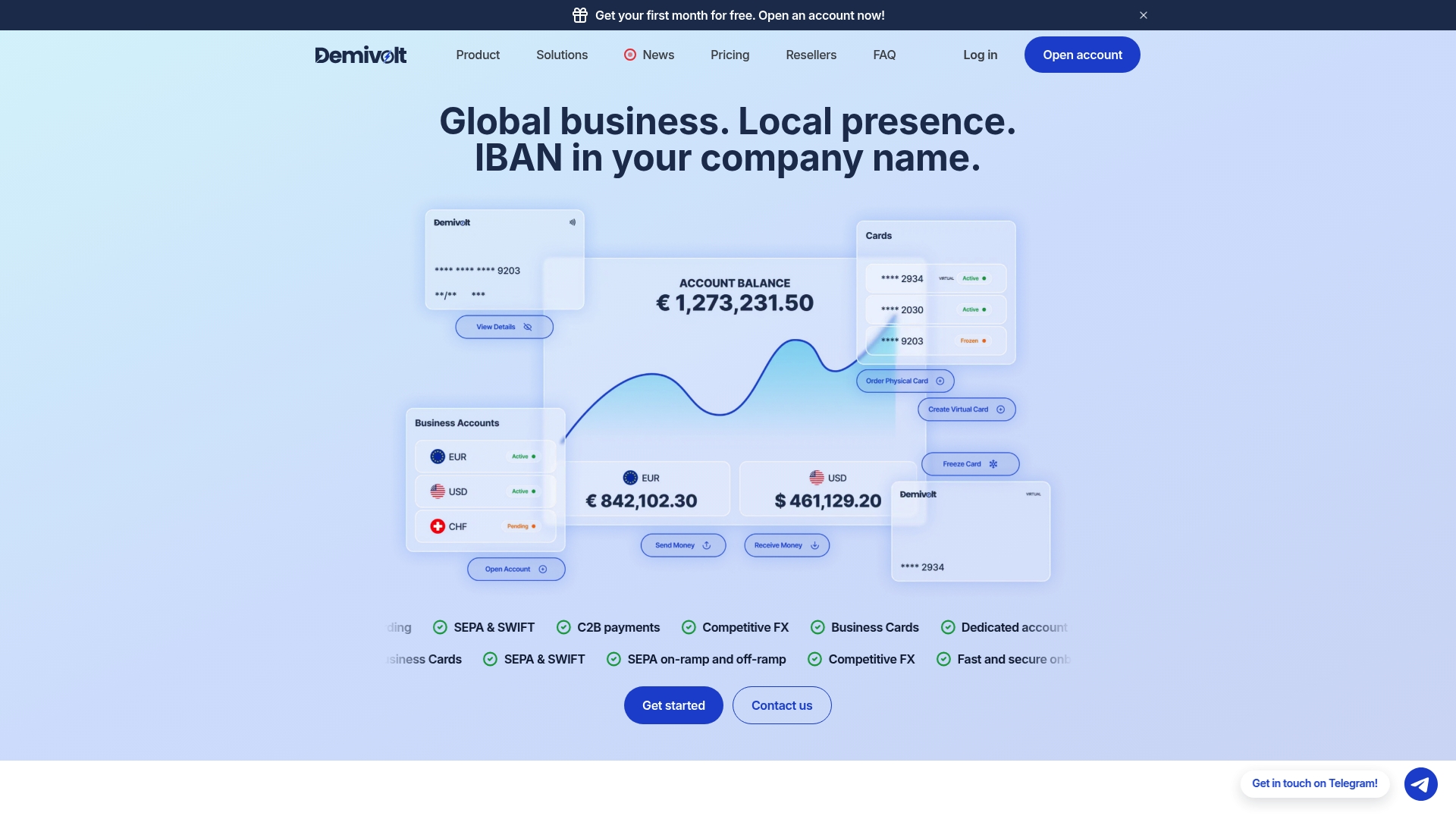
Demivolt business banking is built specifically for European SMEs that need compliant, digital-first infrastructure without the friction of traditional banking. From dedicated IBANs and SEPA Instant support to role-based access and segregated client funds, the platform is designed to give you control from day one. If you are still evaluating your options, the guide to find the right business account helps you match your company’s structure and payment needs to the right solution.
Frequently asked questions
How do digital business accounts help with compliance?
Digital business accounts automate KYC procedures and maintain structured transaction records, so your company is audit-ready at any time. Real-time screening for sanctions and PEP lists keeps your account activity compliant without slowing down operations.
Are SEPA Instant Payments available to all European SMEs?
Most digital business accounts support SEPA Instant, but only 17% of SEPA payments currently use the instant rail, which means early adopters hold a clear liquidity advantage over competitors still relying on standard transfers.
Can a non-EU owner open a digital business account in Europe?
Many digital providers accommodate non-EU UBOs as long as the company structure is transparent and passes compliance checks. Digital providers support non-EU UBOs through documented ownership chains and real-time screening, which traditional banks often cannot match.
What features should I prioritize in a business account?
Focus on instant payment support, granular user permissions, API integrations, and cross-border transaction coverage. Platforms offering role-based access and consolidated account visibility give you the financial control needed to scale without adding operational complexity.
Recommended
- Demivolt | Blog – Business banking for SMEs: services, compliance & cross-border
- Demivolt | Blog – Open a business bank account online in Europe: step-by-step
- Demivolt | Blog – Types of Business Bank Accounts: Find the Right Fit for Your SME
- Demivolt | Blog – International payments for SMEs: efficiency, compliance, growth
- Unlock the Key Benefits of Business Bank Accounts