

TL;DR:
- EU SMEs must maintain dedicated business accounts to ensure compliance and avoid penalties.
- Separate accounts simplify financial management, automate reconciliation, and streamline audits.
- For cross-border payments, dedicated accounts reduce costs, delays, and enhance international trust.
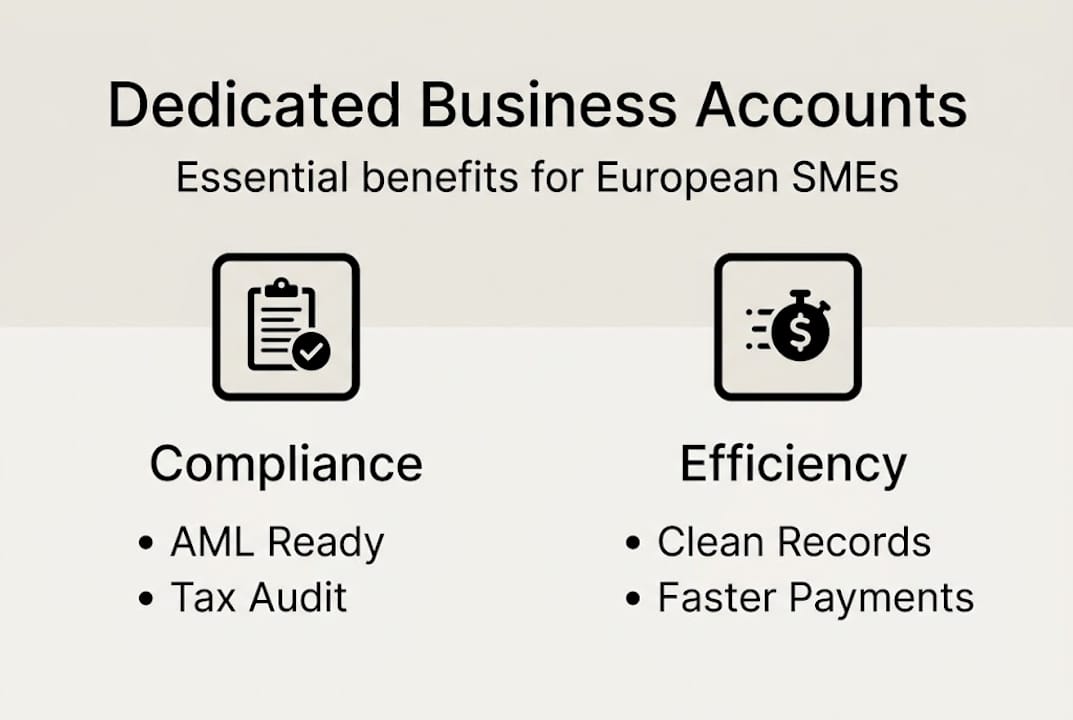
Most European SMEs assume that mixing personal and business funds is simply a minor inconvenience, something they’ll sort out once the business grows. But dedicated business accounts are legally and operationally required for EU SMEs, not just a best practice. The consequences of ignoring this are real: tax audits, regulatory investigations, blocked payments, and serious reputational damage. This article breaks down what you actually need to know about compliance, cross-border payments, and choosing the right account structure so your business can scale without hitting preventable financial walls.
Table of Contents
- Why dedicated business accounts are essential for EU compliance
- How dedicated business accounts streamline financial management
- Why dedicated business accounts optimize cross-border payments
- Choosing the right dedicated business account: fintech, bank, or hybrid?
- Our perspective: What most SMEs miss about dedicated business accounts
- Upgrade your financial management with a dedicated business account
- Frequently asked questions
Key Takeaways
| Point | Details |
|---|---|
| Mandatory for compliance | Dedicated business accounts are a legal requirement for EU SMEs to avoid audits and meet tax regulations. |
| Simplifies financial management | Separate accounts streamline accounting, VAT registration, and tax filing by providing clear business records. |
| Enables cost-effective cross-border payments | Dedicated accounts with multi-currency and IBAN support cut costs and complexity for international business. |
| Pick the right solution | Hybrid fintech and bank accounts offer the best blend of speed, compliance, and scalability for modern SMEs. |
Why dedicated business accounts are essential for EU compliance
The EU’s regulatory environment has tightened significantly over the past decade. Anti-Money Laundering (AML) and Know Your Customer (KYC) rules, combined with VAT reporting obligations and evolving tax authority scrutiny, mean that blended personal and business finances are a red flag. Tax authorities across Germany, France, the Netherlands, and beyond are increasingly using automated systems to flag accounts where business income mixes with personal spending. When they find it, investigations follow.
Many SME owners hold on to a few persistent misconceptions. “My business is too small to matter” is the most dangerous one. Regulatory thresholds apply regardless of your revenue. Another common belief is that one account is simply easier to manage. In practice, the opposite is true once tax season arrives and you’re manually separating transactions from months ago.
The real risks of non-compliance include:
- Tax authority audits triggered by inconsistent or mixed transaction records
- Delayed VAT refunds because your account history doesn’t clearly separate business income
- Regulatory fines under EU AML directives for insufficient financial segregation
- Account freezes if a bank or payment provider flags your account for suspicious mixed activity
- Loan rejections because lenders can’t verify clean business cash flow
Statistic callout: SMEs that maintain clean, separated business records report significantly fewer compliance issues and faster audit resolutions, according to EU fintech compliance analysis.
When you start opening a business account correctly from day one, you build a compliance foundation that protects you during growth, not just during routine operations.
Pro Tip: Set up your dedicated business account before your first invoice goes out. It’s far harder to reconstruct clean financial records retroactively than to maintain them from the start.
The EU’s regulatory framework rewards structure. Businesses that treat their finances with the same rigor as their operations will always have the upper hand when regulators or auditors come knocking.
How dedicated business accounts streamline financial management
Beyond compliance, dedicated accounts make the actual work of running a business much simpler. Automation tools, accounting integrations, and clean transaction histories all depend on having a clearly defined business account feeding your data.
Here’s how dedicated accounts translate into day-to-day operational advantages:
- Automated reconciliation: Modern business accounts sync with accounting platforms, categorizing transactions automatically and reducing manual data entry by a substantial margin.
- Clean audit trails: Every transaction is tagged to a business purpose, making quarterly reviews and year-end filings straightforward.
- VAT tracking in real time: Dedicated accounts allow you to tag VAT-applicable transactions immediately, rather than piecing them together before a filing deadline.
- Faster bookkeeping: Your accountant spends less time sorting through personal expenses and more time on strategic financial planning.
- Cleaner creditor relationships: Suppliers and clients who send or receive payments to a named business account have more confidence in your operation.
| Task | Personal account | Dedicated business account |
|---|---|---|
| Transaction categorization | Manual, error-prone | Automated with accounting tools |
| VAT record accuracy | Low, requires reconstruction | High, real-time tagging |
| Audit preparation time | Days to weeks | Hours |
| Lender cash flow review | Difficult to verify | Clean, verifiable history |
| Cross-border payment tracking | Inconsistent | Structured and traceable |
Dedicated accounts enable streamlined compliance with EU AML and KYC rules, giving you the clean financial records tax authorities expect during VAT registration and beyond. Many EU member states require proof of a dedicated business account before processing VAT registration at all.

Choosing between right business account types matters here because not all accounts offer the same integrations or reporting features. Some are optimized for high-volume transactions, others for multi-currency environments.
Pro Tip: Open your business account before registering for VAT. Several EU tax authorities will ask for bank account details during the VAT registration process, and a personal account number can delay or even block your application.
The operational lift you get from a dedicated account compounds over time. Clean records in year one mean smooth audits in year three. That’s not a minor convenience. It’s a structural business advantage.
Why dedicated business accounts optimize cross-border payments
Once your transactions cross national borders, the gap between a personal account and a dedicated business account becomes a real financial cost. Currency conversion fees, payment delays, and compliance friction are three areas where the wrong account structure can quietly drain your margins.
Here’s what to look for in a dedicated business account built for international operations:
- SEPA credit transfers and direct debits for fast, low-cost euro payments across the EU
- SWIFT access for payments to and from non-EU markets like the US, UK, and Asia
- Multi-currency account holding so you aren’t forced to convert funds the moment they arrive
- Dedicated IBAN assigned specifically to your business, not a pooled number shared with other clients
- Real-time FX rates with transparent fee structures, not hidden markup on mid-market rates
“The difference between a pooled IBAN and a dedicated IBAN isn’t just cosmetic. For growing businesses, it determines whether international counterparts trust your payment infrastructure.”
For cross-border transactions, dedicated accounts support SEPA and SWIFT efficiently, offer multi-currency holding, and reduce FX costs and delays compared to traditional retail bank accounts.
| Feature | Traditional bank | Dedicated fintech business account |
|---|---|---|
| SEPA transfer speed | 1 to 3 business days | Same day or next day |
| SWIFT access | Often restricted for SMEs | Standard feature |
| Multi-currency holding | Rarely available | Commonly supported |
| FX fees | 2 to 4% markup | Transparent, near mid-market |
| Dedicated IBAN | Sometimes pooled | Always dedicated |
Learn more about the role of IBANs in cross-border payments and why a dedicated IBAN is a core requirement for digital services businesses scaling across EU borders. When your payment rails are solid, international growth becomes a process instead of a problem.
Choosing the right dedicated business account: fintech, bank, or hybrid?
Not every dedicated business account is built the same. Choosing between a traditional bank, a fintech provider, and a hybrid model is one of the most consequential decisions you’ll make for your financial infrastructure.
Traditional banks offer strong lending access, established compliance credibility, and physical branch support. They tend to be slower on digital features and charge higher account fees and FX rates. For businesses that rely on credit facilities or have complex collateral requirements, they remain relevant.
Fintech providers excel in speed and cost. Onboarding takes days instead of weeks. FX rates are transparent. API integrations are built for digital businesses. However, they may have limitations around large credit lines or complex lending products.
Hybrid approaches combine the digital speed of fintech with the reliability and regulatory standing of a traditional bank. For SMEs that are scaling internationally while also managing local compliance requirements, a hybrid often provides the best of both worlds.
| Provider type | Best for | Weaknesses |
|---|---|---|
| Traditional bank | Lending, local compliance | Slow, expensive, limited digital features |
| Fintech | Cross-border speed, low FX cost | Limited credit products |
| Hybrid | Scaling SMEs, international trade | Can require multiple relationships |
Key considerations when choosing:
- Pooled IBANs vs. dedicated IBANs: Pooled IBANs are only appropriate for low-volume, low-risk operations. For digital services businesses or any company scaling internationally, a dedicated IBAN is non-negotiable.
- Compliance infrastructure: Does the provider maintain full EU regulatory compliance, including AML reporting and KYC verification?
- Scalability: Can you add sub-accounts, team users, or virtual cards as you grow?
Stay informed about modern business banking trends and understand how fintechs facilitate cross-border payments specifically for growing SMEs. The market has moved fast, and your account choice should reflect where your business is going, not where it started.
Our perspective: What most SMEs miss about dedicated business accounts
Here’s the uncomfortable pattern we see repeatedly: SMEs treat their banking infrastructure as an afterthought. They open whatever account is easiest, use it for everything, and only discover the true cost when a tax audit lands or a cross-border payment gets flagged.
The real insight is this: a dedicated business account isn’t just a compliance checkbox. It’s the backbone of your financial scalability. Businesses that set up proper account structures early consistently outperform peers who scramble to fix it later, not because they’re more compliant, but because clean financial data fuels better decisions, faster approvals, and smoother partnerships.
SMEs often overlook the operational drag of pooled or personal accounts until compliance and scaling friction become too expensive to ignore. Waiting is always more costly than acting early.
Hybrid solutions exist for exactly this reason. They let you move fast without sacrificing the regulatory standing that growth requires. If your business is serious about scaling across EU markets, your account structure needs to be as serious as your growth plan. The financial infrastructure you build now determines the speed of everything that comes after.
Upgrade your financial management with a dedicated business account
If you’re managing cross-border payments, navigating EU compliance, or simply trying to keep your finances clean and audit-ready, the right account structure makes every part of that easier. Demivolt is built specifically for European SMEs that need more than a basic account.
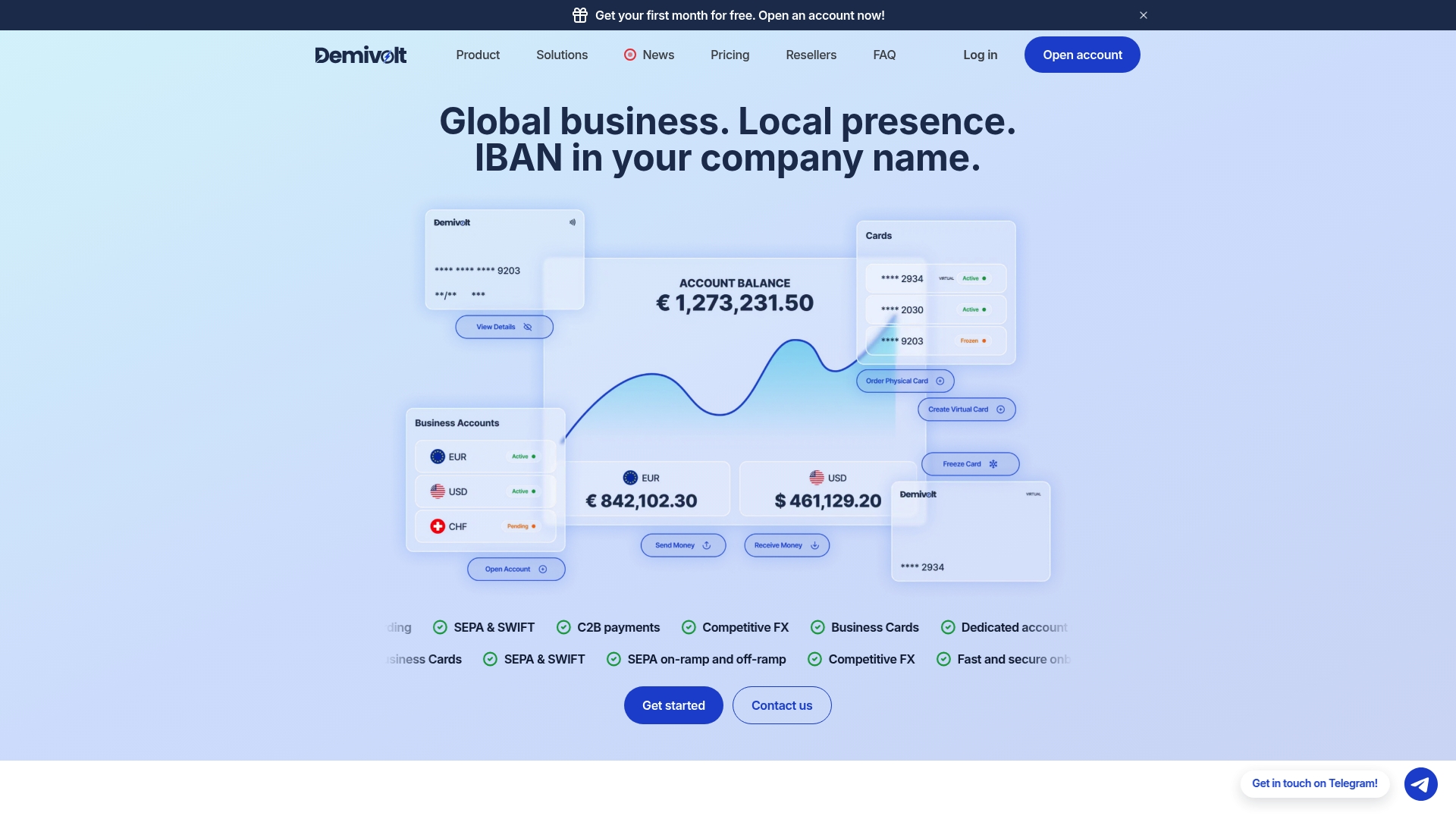
With Demivolt business banking, you get dedicated IBAN accounts, full SEPA and SWIFT payment support, virtual and physical business cards, and a compliance-first onboarding process designed to meet EU regulatory standards. Multi-account structures, role-based access, and seamless integrations mean you can manage your finances exactly the way your business operates. Explore Demivolt and see how a dedicated business account can remove the friction between where you are and where you’re headed.
Frequently asked questions
Are dedicated business accounts mandatory for SMEs in the EU?
Yes, EU regulations require SMEs to separate business and personal funds. Dedicated accounts with dedicated IBANs are both legally and operationally required for compliant business operations.
Can I use my personal account for business transactions?
Using a personal account for business creates serious audit and tax risks and can trigger regulatory scrutiny, delayed VAT refunds, and potential account freezes.
How do dedicated business accounts help with international payments?
They support SEPA and SWIFT transfers, enable multi-currency holding, and reduce FX costs and payment delays compared to standard retail bank accounts, making cross-border payments faster and cheaper.
Should I open a business account before registering for VAT?
Yes. Many EU tax authorities require a business account during VAT registration, and opening your account early ensures clean records that support a smooth application process.
Recommended
- Demivolt | Blog – Open a business bank account online in Europe: step-by-step
- Demivolt | Blog – Types of Business Bank Accounts: Find the Right Fit for Your SME
- Demivolt | Blog – Business banking for SMEs: services, compliance & cross-border
- Demivolt | Blog – International payments for SMEs: efficiency, compliance, growth
- How to set up corporate accounts for global businesses