
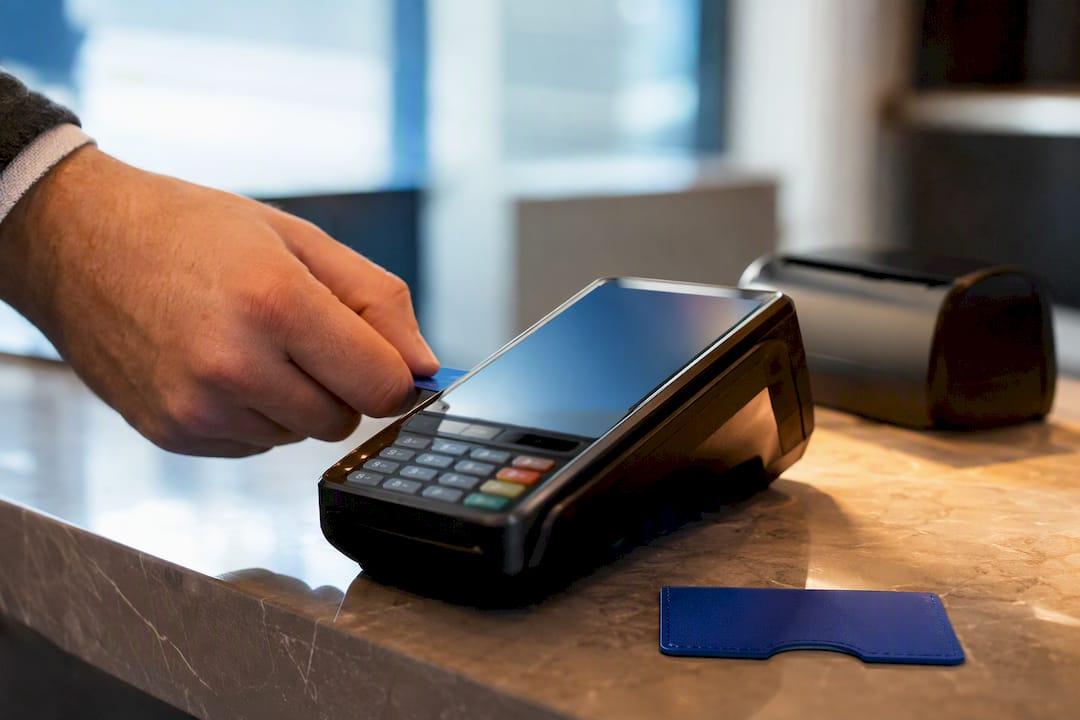
The rate you see quoted publicly is the mid-market rate, not what your card gets charged. Your actual bill combines the card scheme’s conversion rate, your issuer’s margin, and any explicit foreign-transaction fee. To confirm the exact figure, check your posted transaction detail against your bank’s pricing document, known in Lithuania as the “Kainynas.”
TL;DR:
- Only the issuer determines the final currency conversion rate, which includes their markup and any additional foreign-transaction fees.
- The scheme rate is close to the mid-market rate but includes a small spread, and the issuer can add a separate margin on top of it.
- Settlement date, not authorization date, sets the exchange rate, which can cause differences in the final charge if the transaction is delayed.
- Dynamic currency conversion is usually more expensive because merchant-set rates typically include extra markups from acquirers.
- To evaluate costs accurately, check the issuer’s Kainynas and use Visa’s exchange-rate calculator for the scheme component before traveling or invoicing internationally.
DemivoltManage Cross-Border Payments ClearlyDemivolt provides compliant business accounts, international payments, and physical or virtual cards for modern companies.Explore Demivolt
Table of Contents
- How card currency conversion works: parties, flow, and where the rate is applied
- Where exchange rates and fees come from: scheme rate vs. retail rate vs. mid-market rate
- Timing and lifecycle: authorization vs. settlement and how it changes the applied rate
- Dynamic currency conversion: what it is and the rule for choosing at checkout
- Worked example: calculate the final amount on your card statement
- Practical takeaways and issuer-side guidance
- Why transparency on card exchange rates matters
- An editorial perspective on card exchange transparency
- Sources
How card currency conversion works: parties, flow, and where the rate is applied
Every foreign-currency card payment moves through four parties before it lands on your statement: the merchant, the acquirer (the merchant’s bank), the card scheme (Visa or Mastercard), and your issuer (your own bank). Each one has a distinct job, and only one of them actually sets the exchange rate you’ll ultimately pay.
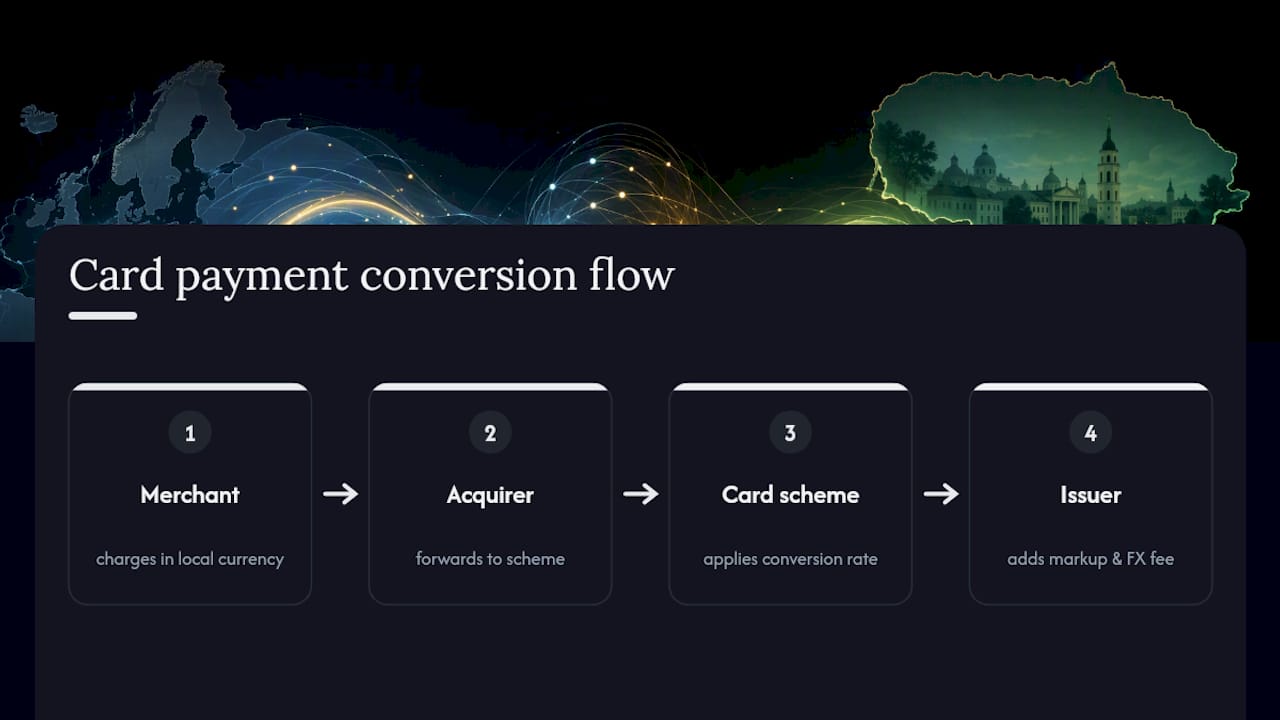
The merchant simply charges you in its local currency. The acquirer forwards that transaction into the scheme network. The card scheme, Visa or Mastercard, converts the merchant’s currency into your card’s billing currency using its own daily conversion rate, drawn from wholesale currency markets. That scheme rate is the raw conversion baseline, but it’s rarely the final number on your bill.
Your issuer, the bank or fintech that issued your card, receives that scheme rate and can add its own markup, plus a separate foreign-transaction fee if its pricing allows for one. This is the step most cardholders never see coming: the scheme sets the exchange, but the issuer decides the final markup.
There’s a technical wrinkle worth knowing. Some transactions process “off-us,” moving fully through the scheme network for conversion, while “on-us” transactions (rare for cross-border retail purchases) can be settled differently, sometimes applying an internal rate instead. For nearly all everyday foreign purchases, though, you should expect the standard flow: merchant, acquirer, scheme conversion, issuer markup.
Where exchange rates and fees come from: scheme rate vs. retail rate vs. mid-market rate
The number that shows up on financial news sites and currency converter apps is the mid-market rate, sometimes called the interbank rate. It reflects the midpoint between global buy and sell prices for a currency pair, and no retail cardholder actually transacts at it. It’s a benchmark, not a price.
Visa and Mastercard publish their own daily conversion rates, which sit close to the mid-market figure but include a small built-in spread. You can check the exact rate Visa applied to a specific transaction date and currency pair using Visa’s exchange-rate calculator, which is the fastest way to isolate the scheme’s contribution to your final charge.
Your issuer then layers its own retail pricing on top of that scheme rate. This is where the real variance between banks shows up, and it’s documented in each issuer’s Kainynas, the formal pricing schedule that lists foreign-transaction fees, currency conversion margins, and card-specific charges. Public bank rate calculators are often indicative only; the exact non-cash rate applied to your account typically appears only inside internet banking or on the posted transaction itself.
Timing and lifecycle: authorization vs. settlement and how it changes the applied rate
A card transaction has two dates that matter, and they can produce two different exchange rates. Authorization happens the moment you tap, swipe, or book. Settlement, when the merchant actually captures the funds, can happen hours or even days later. The scheme applies its conversion rate on the settlement date, not the authorization date.
This gap explains why hotel deposits, car rental holds, and online reservations sometimes post at a different amount than the hold you saw at checkout. A five-day gap between booking a rental car and the company finalizing the charge is enough for currency markets to shift the applied rate by a noticeable margin. Course material on card payment lifecycles walks through exactly how authorization and clearing operate as separate steps, each capable of picking up a different rate.
The practical rule: never budget against a preauthorization hold. Wait for the transaction to post fully, then check that final number against your issuer’s pricing document.
Dynamic currency conversion: what it is and the rule for choosing at checkout
Dynamic currency conversion, or DCC, is the option a foreign merchant or ATM offers to charge you in your home currency instead of the local one. It sounds convenient. It’s usually the more expensive choice, because the merchant or its acquirer sets that conversion rate, not the card scheme or your issuer, and that rate almost always includes an extra markup on top of what your issuer would have charged anyway.
The decision rule is simple:
- If a POS terminal or ATM asks “Pay in your home currency or local currency?”, choose the local currency.
- Let your card’s issuer handle the conversion using the scheme rate plus its published margin.
- Only accept DCC if you’ve specifically compared both rates in advance and confirmed the merchant’s offer beats your issuer’s stated pricing, which is uncommon.
Worked example: calculate the final amount on your card statement
Here’s the formula that determines what actually posts to your account:
Final charge = (Merchant amount × Scheme rate) × (1 + Issuer margin) + Fixed FX fee
Walk through it with real numbers:
- You spend €100 at a merchant billing in euros, and your card is denominated in a different currency with a scheme rate of 1.0850.
- The scheme conversion alone gives you 108.50 units of your billing currency.
- Your issuer applies a margin on top of that scheme rate, adding an additional amount according to their pricing.
- Your issuer may also charge a flat foreign-transaction fee per transaction, detailed in their pricing document.
- Your total posted charge comes to approximately 111.17 units.
Pro Tip: Run the scheme portion of this calculation yourself using Visa’s exchange-rate calculator before you travel, then add your own bank’s published margin and fee from its Kainynas. If the two don’t add up to what posts on your statement, that gap is your signal to contact your issuer.
Reproducing an issuer’s exact billed amount requires the specific scheme rate for the settlement date, not an approximation from a mid-market converter, a distinction that operational FX training for banks covers in detail.
Practical takeaways and issuer-side guidance
Issuers set margins to cover interchange costs, operational FX handling, and fraud or routing risk, particularly on cross-border transactions with higher-risk merchant categories. Save your receipts, cross-check the Coursera treasury coursework on multi-step currency conversion if you want the underlying mechanics, verify against your Kainynas, and dispute promptly if the posted charge doesn’t match. Businesses billing internationally should review their fee structure and card program setup rather than absorb unpredictable FX costs quietly.
Why transparency on card exchange rates matters
I built this explainer because too many cardholders assume the number on a menu or a booking site is what they’ll actually pay. It rarely is. For teams managing cross-border billing, understanding how virtual cards handle foreign-currency charges is a practical next step.
If you’re running a business that regularly bills or pays across currencies, the margin stacking described above adds up fast at volume. Virtual and physical Visa business cards issued through regulated infrastructure allow finance teams to see FX costs clearly instead of discovering them on a statement. You can also learn what an IBAN is and how it’s used for cross-border payments, or check the free IBAN validator tool when setting up new payment routes. Get started with Demivolt to open a dedicated account built for international operations.
An editorial perspective on card exchange transparency
Most guidance on foreign-transaction fees treats the topic as a single flat percentage, and that framing is where cardholders get misled. The real cost of a foreign purchase is assembled in layers, scheme rate, issuer margin, and fixed fee, each set by a different party with different incentives, and no single published number captures all three at once. That’s not a conspiracy. It’s just how four separate businesses coordinate a transaction that has to settle in seconds.
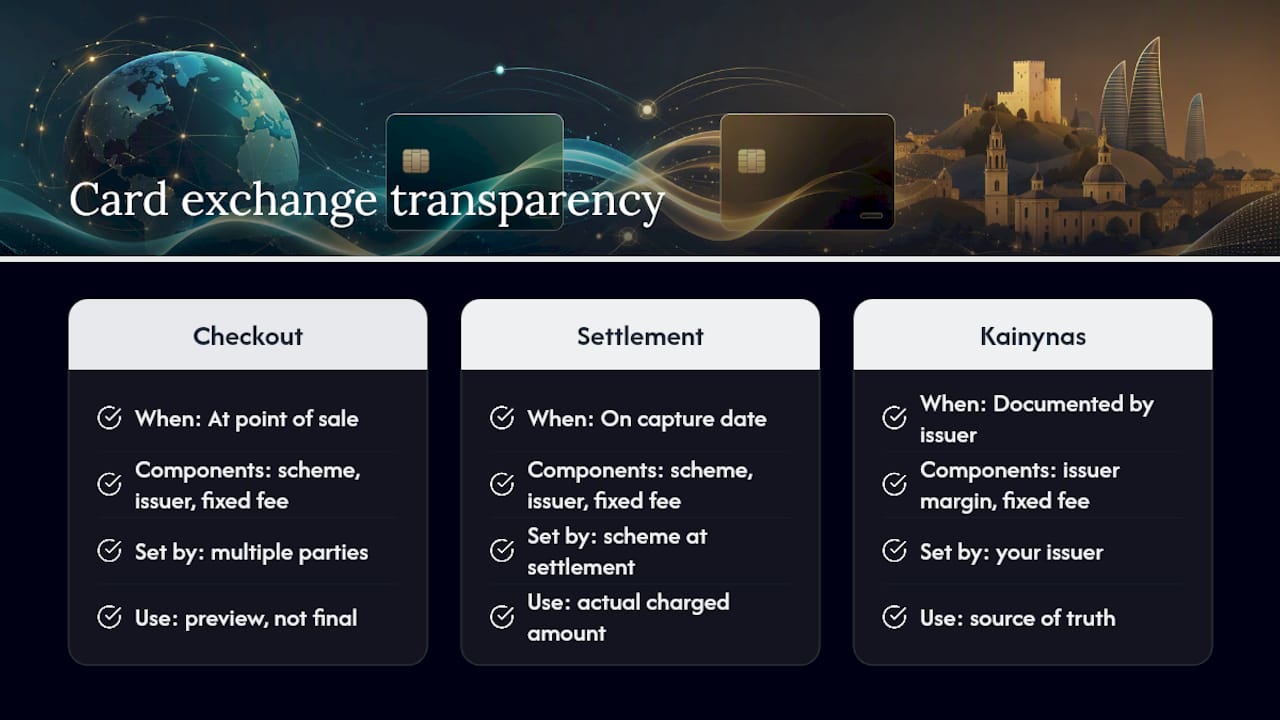
What gets underestimated is the settlement-date gap. Travelers fixate on the rate they see at checkout, but that number can be stale by the time a hotel or rental company actually captures the charge days later. The hold amount is a preview, not a promise. Anyone budgeting a trip around a preauthorization figure is budgeting against a number the scheme hasn’t finalized yet.
The fix isn’t complicated, but it does require a habit change: stop trusting the displayed rate at the point of sale, and start treating your issuer’s Kainynas as the actual source of truth. It’s the one document that tells you, in writing, exactly what markup and fee structure apply to your card. Most people never open it until something looks wrong on a statement. That’s backwards. Read it before you travel, not after you dispute a charge.
— dd
This article is general information, not a substitute for advice from a qualified financial advisor. Consult a qualified financial professional about your own circumstances before acting on anything here.
Sources
Check Visa’s exchange-rate calculator for live scheme conversions, and review your issuer’s Kainynas for exact margins and fees before you travel or invoice internationally.
- Valiutų keitiklis – valiutų kursų skaičiuoklė | Visa
- Analyze & Apply Bank Forex Operations | Coursera