
Virtual Cards Evolving Beyond Supplier Payments
Corporate finance teams are discovering a second use case for virtual cards that goes well beyond traditional accounts payable. While these instruments still facilitate supplier payments, they now offer CFOs greater control over cash timing, transaction visibility, and short-term capital access.
Fresh research from PYMNTS Intelligence reveals a striking divide: the fastest-growing middle market companies recognise this dual role far more often than their slower-moving counterparts.
How Top Performers Convert Cash Faster
The study, The 24-Day Advantage: What Top-Performing CFOs Know About Working Capital, analysed three years of financial data from firms generating $100 million to $1 billion in annual revenue. It found that the highest performers deploy working capital with deliberate strategy rather than reacting to immediate needs.
These companies arrange financing ahead of demand, integrate more suppliers into automated payment systems, and accelerate cash movement throughout their operations. Virtual cards support this approach by blending payment execution with financing optionality, keeping liquidity flowing without forcing businesses to relinquish process oversight.
The cash conversion gap is substantial: top performers turn working capital in 24.2 days, compared with 44.4 days for bottom performers. The strongest firms also fund planned expansion projects with working capital, while weaker organisations more frequently tap it for crisis management.
Five-Fold Difference in Strategic Adoption
The data reveals three key distinctions in how companies view and plan to use virtual cards:
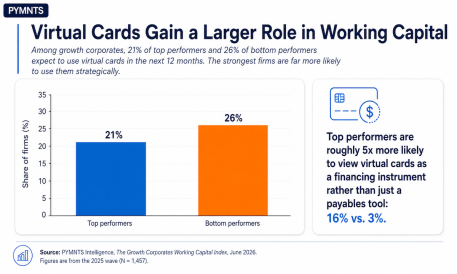
- 16% of top performers regard virtual cards as a financing instrument, versus only 3% of bottom performers — making the strongest companies roughly five times as likely to see the cards as more than a payment rail
- 21% of top performers say they are very or extremely likely to adopt virtual cards over the next 12 months, though that figure rises to 26% among bottom performers, suggesting interest is broadening even when strategic intent varies
- 29% of top performers expect to use corporate cards, compared with 23% of bottom performers, while top companies also show stronger appetite for working capital loans and non-bank credit facilities
What Comes Next for Middle Market Finance Teams
The research makes clear that virtual cards alone will not close the performance gap between high-growth and stagnant middle market companies. Yet the findings indicate these instruments can become a valuable component of a broader system.
That system typically features predictable cash flow management, stable supplier relationships, and financing arranged well before liquidity pressure arrives. Companies that master this combination — using virtual cards strategically rather than reactively — appear positioned to sustain faster growth cycles and maintain stronger balance sheets.
Source
Original coverage by PYMNTS.
Use the button below to read the article on the publisher website.
Read on PYMNTSRelated to this article