

Picking a business banking or payments tool that handles cross-border transfers and modern compliance is confusing for growing companies. Many platforms hide pricing behind quotes, lack regulatory guidance, or restrict currency and account features for international businesses. This list compares fees, onboarding, currency tools, and permissions so finance teams can match a service to account controls and settlement needs.
Table of Contents
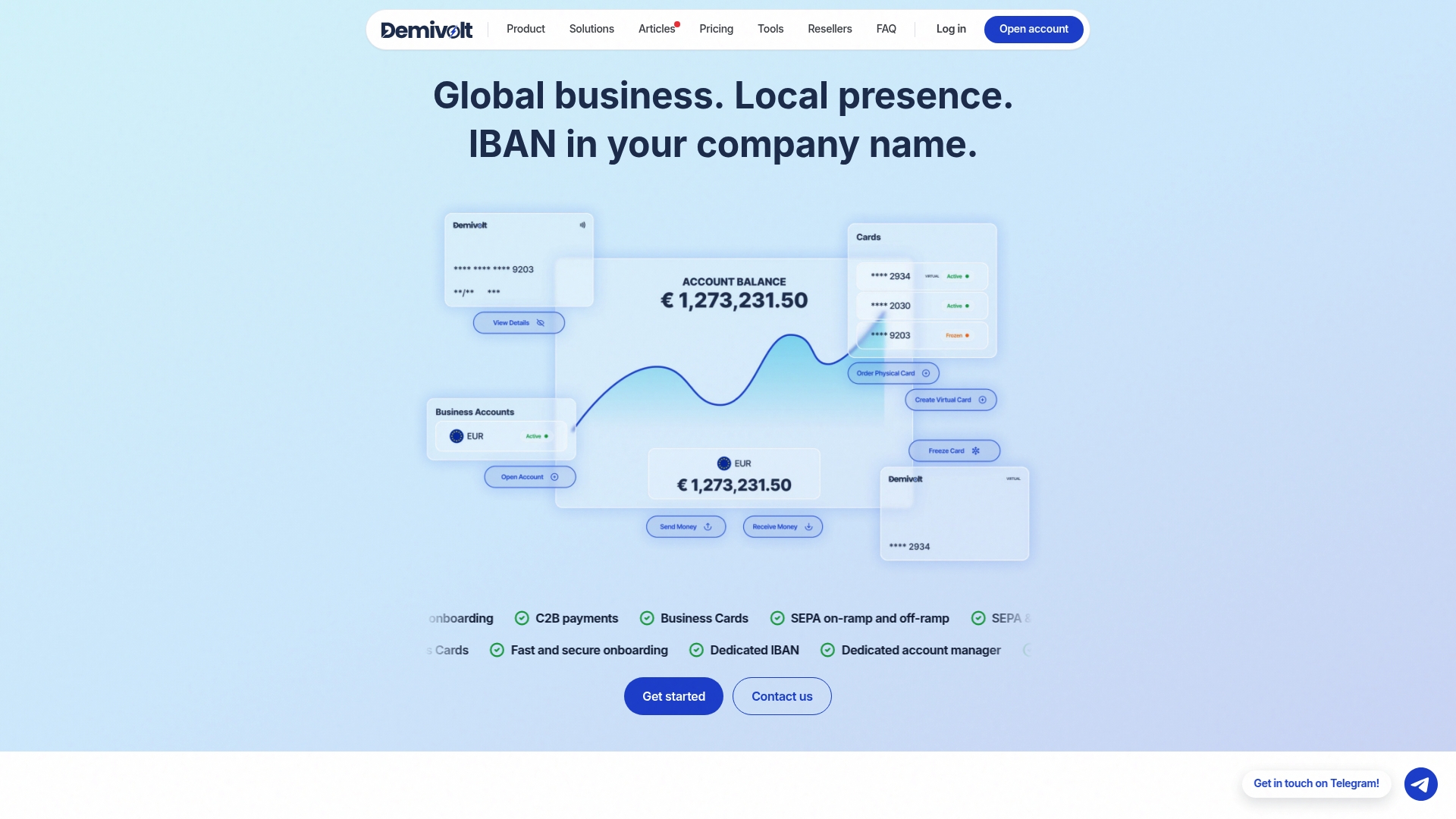
Demivolt
At a Glance
Outgoing SWIFT transfers cost €30, incoming SWIFT cost €25, and outgoing SEPA transfers cost €0.40. That pricing sits beside dedicated IBANs for business accounts and planned physical and virtual business cards. The platform targets EU and international SMEs that need clear cross-border fees and account separation.
Core Features
The vendor states Demivolt operates as an electronic money institution regulated under EU standards. It issues dedicated business IBANs, supports SEPA and SWIFT transfers, and plans to offer physical and virtual business cards. A centralized dashboard manages multi-account structures, role based user permissions, onboarding, and account monitoring, and the product offers an optional reseller program for partners.
Key Differentiator
The platform’s single strongest differentiator is its EU regulatory posture combined with transparent global payment support and upcoming card issuance. That combination targets businesses that must meet compliance checks while moving funds across borders. The clear fee schedule and segregated account approach make regulatory audits and client reporting simpler.
Pros
Regulatory coverage and compliance controls reduce the manual work around onboarding and monitoring for regulated entities. Transparent fees for SEPA and SWIFT transfers remove surprise costs and simplify cash flow forecasting. Multi-account support with segregated funds and role based user management lets teams separate client money and assign permissions without multiple banking relationships.
Cons
- Availability varies by jurisdiction and business risk profile, which can limit onboarding for some international customers.
Who It’s For
Businesses that need compliant account infrastructure and predictable cross-border payment costs will benefit most. The product fits SMEs, fintech resellers, and regulated entities operating in or through the EU. Companies that rely on separate IBANs per client or project gain administrative and audit clarity.
Unique Value Proposition
Dedicated business IBANs combined with segregated accounts and role based user controls let you map accounts to clients, projects, or legal entities. That design reduces reconciliation work and simplifies audits for regulated teams. When paired with the transparent transfer fees, the setup cuts administrative overhead and clarifies cost allocation across markets.
Real World Use Case
A Lithuanian tech startup uses Demivolt to assign dedicated IBANs for each product line. The team receives international customer payments via SEPA and SWIFT and reconciles funds by IBAN rather than by spreadsheets. The reseller program lets their regional advisor earn recurring commissions for referrals.
Pricing
Core features are free for most account operations, with explicit per transfer fees for international rails. Outgoing SWIFT transfers are €30, incoming SWIFT transfers are €25, and outgoing SEPA transfers are €0.40. Account setup and other specific fees are disclosed transparently during onboarding.
Website: https://demivolt.com
Bebawa

At a Glance
Bebawa’s marketing materials state it is regulated as an electronic money institution in Lithuania. That regulatory posture supports its use for cross border payments and multi currency IBAN accounts. The vendor also advertises real time foreign exchange inside transfers and flexible account structures for marketplace settlements.
Core Features
Bebawa groups local and cross border payments with SEPA and SWIFT transfers and transparent fee information. The product offers multi currency IBAN accounts, role based permissions, and audit trails that help manage access across teams. It also includes real time FX rates and automatic currency conversion inside transfers.
Key Differentiator
That regulatory posture pairs with configurable account structures aimed at complex business models such as marketplaces and platforms. Bebawa emphasizes compliance first while exposing tools for settlements, permissions, and automated FX within the payments flow. This combination fits organizations that need European regulatory coverage plus modular account controls.
Pros
Regulatory coverage and security materialize in concrete controls such as multi factor approvals and encryption, which support internal audit requirements. The platform’s account model lets you create tailored holdings and subaccounts for different business units or marketplaces, simplifying fund segregation. Support for multi currency flows and in transfer FX reduces manual conversion work, and upcoming physical and virtual cards will add native spend controls.
Cons
- Public pricing is limited. The vendor provides little transparent tariff information, suggesting custom quotes for business clients.
- Mobile app features are not yet fully available. Teams that need a mature mobile experience today may find gaps.
- The offering is not documented for sole proprietors or micro enterprises. Small single owner firms may need a different, simpler provider.
When It May Not Fit
If you require a polished mobile app immediately, Bebawa may not meet that need today. If you need clear, published pricing for quick vendor comparison, the lack of public rates will slow procurement. If you run a one person business with minimal banking complexity, the platform can feel oversized.
Who It’s For
Mid sized and larger enterprises, marketplaces, and platform operators needing compliant European payment rails will benefit most. Financial teams with multi currency exposure and internal compliance requirements gain from the permissioning and audit features. Companies expecting to scale cross border settlement logic will find Bebawa aligned with that roadmap.
Real World Use Case
A marketplace uses Bebawa to hold seller funds in separate IBANs, convert incoming euros to local currencies during payouts, and run role based approvals for large disbursements. The marketplace tracks FX activity in real time and reconciles settlements with audit trails. Upcoming card issuance will let the platform extend controlled spend to merchant operations.
Pricing
Pricing is not publicly listed. The vendor appears to offer tailored commercial terms for business clients and enterprise arrangements. Procurement teams should request a bespoke quote to compare total cost and fees.
Website: https://bebawa.com
Wallter
At a Glance
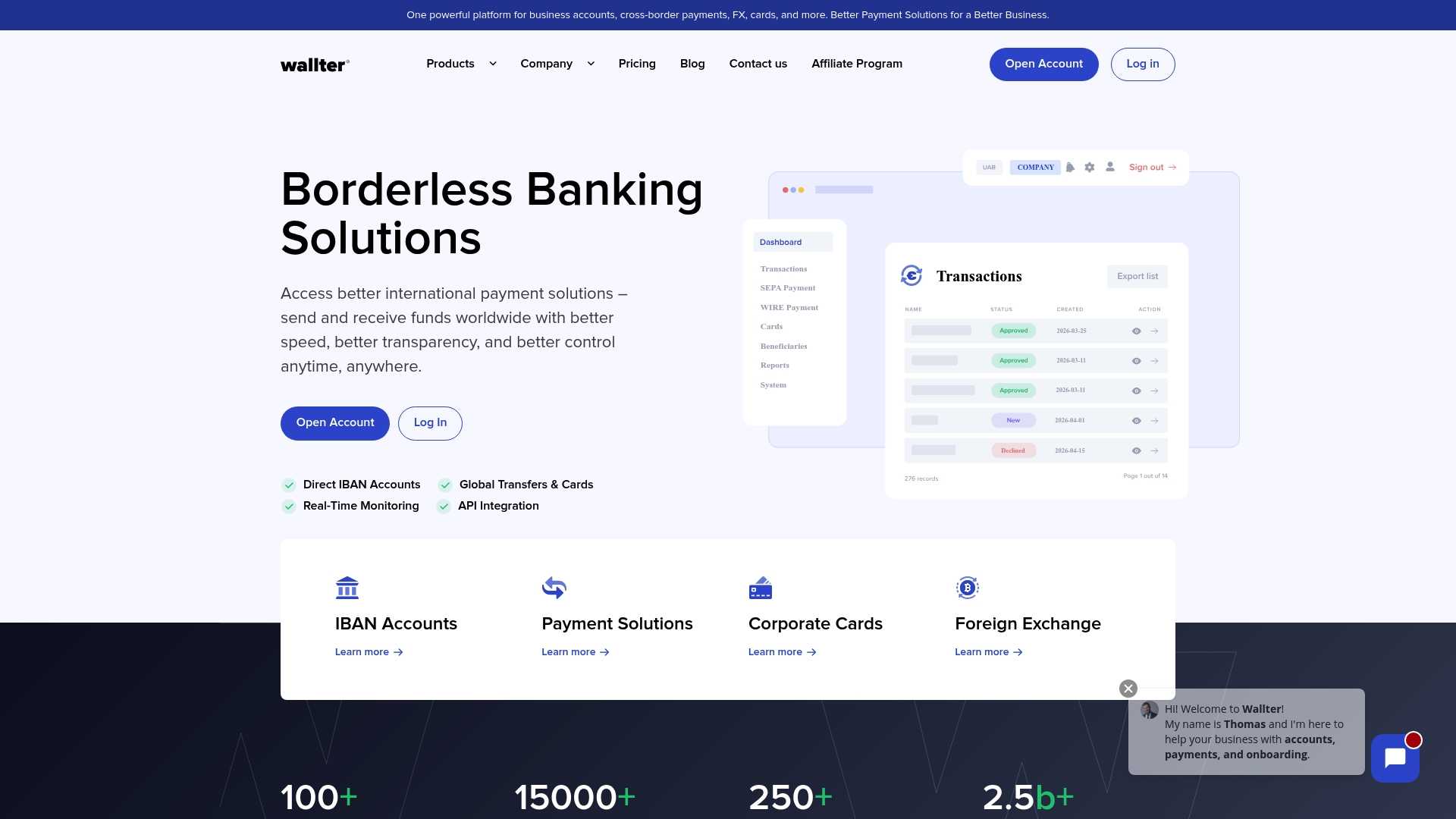
Wallter’s marketing materials state account approval can happen in as little as 2 days. That claim targets teams that need faster access to outbound payments and card issuance. The platform supports dedicated EUR IBAN accounts and multi currency wallets covering over 40 currencies. It pairs real time monitoring with API access for automated transfers and reconciliation.
Core Features
Wallter combines EUR IBAN accounts, multi currency wallets, and support for SEPA and SWIFT transfers in a single dashboard. The platform offers physical and virtual corporate cards, real time monitoring, and API integration for automated collections, payouts, and balance checks. Compliance operations run under Bank of Lithuania oversight and include multifactor authentication and AML controls.
Key Differentiator
The vendor highlights Bank of Lithuania regulation alongside dedicated IBANs and a broad currency set as Wallter’s main differentiator. That combination targets businesses that move funds across Europe and maintain centralized treasury controls. The focus suits firms that want regulated, account level tooling for cross border work.
Pros
That timeline reduces wait time for corporate account acceptance, and gets teams transacting sooner. Security features include multifactor authentication and active monitoring systems to flag unusual activity. Support for physical and virtual corporate cards and multiple payment rails gives finance teams flexibility when paying suppliers or reimbursing staff.
Cons
- Buyer reviews mention a steep learning curve for administrators because the feature set is extensive.
- Pricing structure can feel complex. Fees vary by transaction type and volume and may require careful comparison.
- The vendor provides limited public detail about service restrictions in some jurisdictions.
When It May Not Fit
Small startups or sole proprietors with limited cross border volume may find Wallter more complex than necessary. Organizations that only need a local bank account and no foreign exchange services will likely prefer a simpler provider. Teams without technical resources will struggle to extract value from the API capabilities.
Who It’s For
Mid sized businesses and enterprises engaged in cross border trade will benefit most from Wallter. Companies that need multi currency accounts, programmatic transfers, and corporate card controls will find the platform aligned with their operations. Teams prioritizing European regulatory oversight will also appreciate the licensing.
Real World Use Case
A European tech startup opens a EUR IBAN to receive client payments, issues virtual cards to remote staff, and pushes payouts via API for vendor invoices. Real time monitoring detects an unusual transfer and prompts manual review before settlement. That scenario shows how the platform blends treasury tooling with operational controls.
Pricing
Wallter lists a tiered fee structure and transaction based charges. See the full pricing list at Wallter pricing. Prospective customers should review fees for SEPA, SWIFT, and card services before committing.
Website: https://wallter.com
Weybey

At a Glance
Supports more than 21 currencies and native handling of BTC, ETH, and SOL in the same account. The vendor states it operates on EU regulated infrastructure with licenses issued in 2026. That mix of multi currency holdings and crypto management targets founders who move money across borders and chains.
Core Features
Weybey combines multi currency accounts with built-in crypto asset management, letting you buy, hold, and sell major tokens in one app. It uses real exchange rates for global transfers and offers instant cross border payments through its EU regulated rails. Onboarding is remote and fast, and merchant rewards are available for everyday business spending.
Key Differentiator
What sets Weybey apart is the pairing of regulated EU custody and payments with first party crypto services. The vendor claims regulatory coverage for payment services and custody of assets while excluding deposit insurance. That regulatory focus plus instant onboarding makes it easier for small businesses to hold currencies and crypto without juggling multiple providers.
Pros
Weybey runs on a regulated EU foundation, which supports trust for businesses dealing across jurisdictions. The app combines multi currency balances and crypto trading, so you keep treasury and token exposure in a single interface. Pricing is tiered and transparent, and onboarding is quick, which reduces operational friction when opening accounts for teams or founders. Merchant rewards and cashback add a measurable offset to card spend for frequent buyers.
Cons
- Third party crypto services carry high volatility and are not covered by investor protection schemes.
- Crypto assets are not insured and expose holders to capital risk.
- Some capabilities such as unlimited cards or higher transaction limits are restricted by tier and by user location.
- Fiat and crypto features may vary significantly based on regional licensing and regulation.
When It May Not Fit
If your business needs insured deposit products, Weybey is not suitable because custody excludes deposit insurance. Companies that require the same card or transfer limits across all users may find tiered limits restrictive. Firms operating in jurisdictions with limited licensing could see reduced feature sets. Large enterprises needing bespoke treasury controls may outgrow the tiered consumer oriented model.
Who It’s For
Modern founders, entrepreneurs, and small businesses that move money internationally and want to consolidate currency and crypto activity. Teams that value quick remote onboarding and prefer transparent monthly tiers will find the product practical. Businesses seeking full deposit insurance or enterprise grade treasury controls should look elsewhere.
Real World Use Case
A startup founder holds euros, dollars, and crypto in one Weybey account to pay contractors in different countries. They convert at real exchange rates, send instant vendor payments, and use merchant cashback to reduce routine expenses. The single app removes the need for separate exchanges and multicurrency wallets.
Pricing
Weybey offers a Free Lite tier plus paid tiers. The paid plans start at Pro $45/month and Max $79/month, with higher tiers unlocking more cards, higher limits, and priority support.
Website: https://weybey.com
Comparison of alternatives
Businesses seeking diverse financial capabilities in a competitive global market benefit from analyzing additional resources available for international payment processing and account management. Providers such as Demivolt, Bebawa, Wallter, and Weybey offer compelling tools tailored to specific requirements. Here’s a detailed comparison of their offerings.
Cost transparency and fee structures
Demivolt’s transparent pricing model sets it apart among reviewed providers. Explicit costs for SEPA and SWIFT transactions present predictable budgeting, favored by businesses navigating financial audits or stringent compliance requirements. Comparatively, Bebawa’s lack of published pricing might hinder decision-making for businesses requiring upfront clarity. Weybey offers tier-based pricing with features outlined clearly, suitable for businesses desiring straightforward tier selection.
Advanced financial versatility
While Demivolt emphasizes clarity and compliance, Bebawa and Wallter cater to more complex organizational needs. Bebawa’s real-time FX and multi-currency IBAN accounts improve global operations for marketplace settlements. Critical aspects include underlying compliance tools aiding scaling organizations. Wallter’s API capabilities integrate into technical setups, benefiting firms with in-house developer teams implementing automated workflows. Weybey attracts modern ventures—its multi-currency alongside crypto-handling features streamlining operations across diverse assets.
Best fit
- Prioritizing regulatory compliance with transparent fee structures makes Demivolt a perfect solutions provider for businesses engaged in significant cross-border transactions.
- Companies needing advanced management tools with multi-currency accounting and FX capacities should consider Bebawa.
- Tech-forward teams seeking API functionalities for payment system integration will benefit from Wallter’s adaptable and dynamic environment.
- Global startups managing both financial and cryptocurrency transactions reduce logistical overheads using Weybey’s consolidated, secure ecosystem.
Our pick
For businesses prioritizing clear pricing and stringent compliance, Demivolt is an partner in managing cross-border financial operations effectively. This is demonstrated by adherence to regulatory standards and Desivolt’s transparent pricing model. However, other providers offer unique benefits. Entities requiring advanced financial flexibility may find Bebawa or Wallter more aligned with their structures. Cryptocurrency-reliant operations should explore Weybey as a viable choice.
Businesses seeking transparent pricing and regulatory integration in cross-border payments can compare these platforms.
| Product Name | Core Feature | Key Differentiator | Best For | Pricing | Notable Limitation |
|---|---|---|---|---|---|
| Demivolt | Dedicated business IBANs | EU regulation with clear global payments | SMEs requiring compliance and transparency | €30 outgoing SWIFT, €25 incoming SWIFT, €0.40 outgoing SEPA | Limited jurisdictional availability |
| Bebawa | Multi-currency IBANs | Real-time FX conversions | Marketplaces and platforms | Price not published | Limited public pricing and mobile features |
| Wallter | Multi-currency wallets and APIs | Broad currency support with API access | Cross-border trade enterprises | Transaction-based pricing, see website | Steep learning curve for administrators |
| Weybey | Crypto management and multi-currency accounts | Integrated fiat and crypto handling | Entrepreneurs managing currencies and crypto | Free Lite, Pro $45/month, Max $79/month | Lacks deposit insurance and tiered limits |
How Can Your Business Benefit From Transparent Cross-Border Banking Solutions?
Finding the right payment provider can be a challenge, especially when you need clear fees and regulatory compliance across borders. Demivolt addresses this by offering dedicated IBAN accounts and predictable SEPA and SWIFT transfer fees. Its multi-account management and role-based controls help SMEs and fintech resellers simplify client fund separation and audit processes.
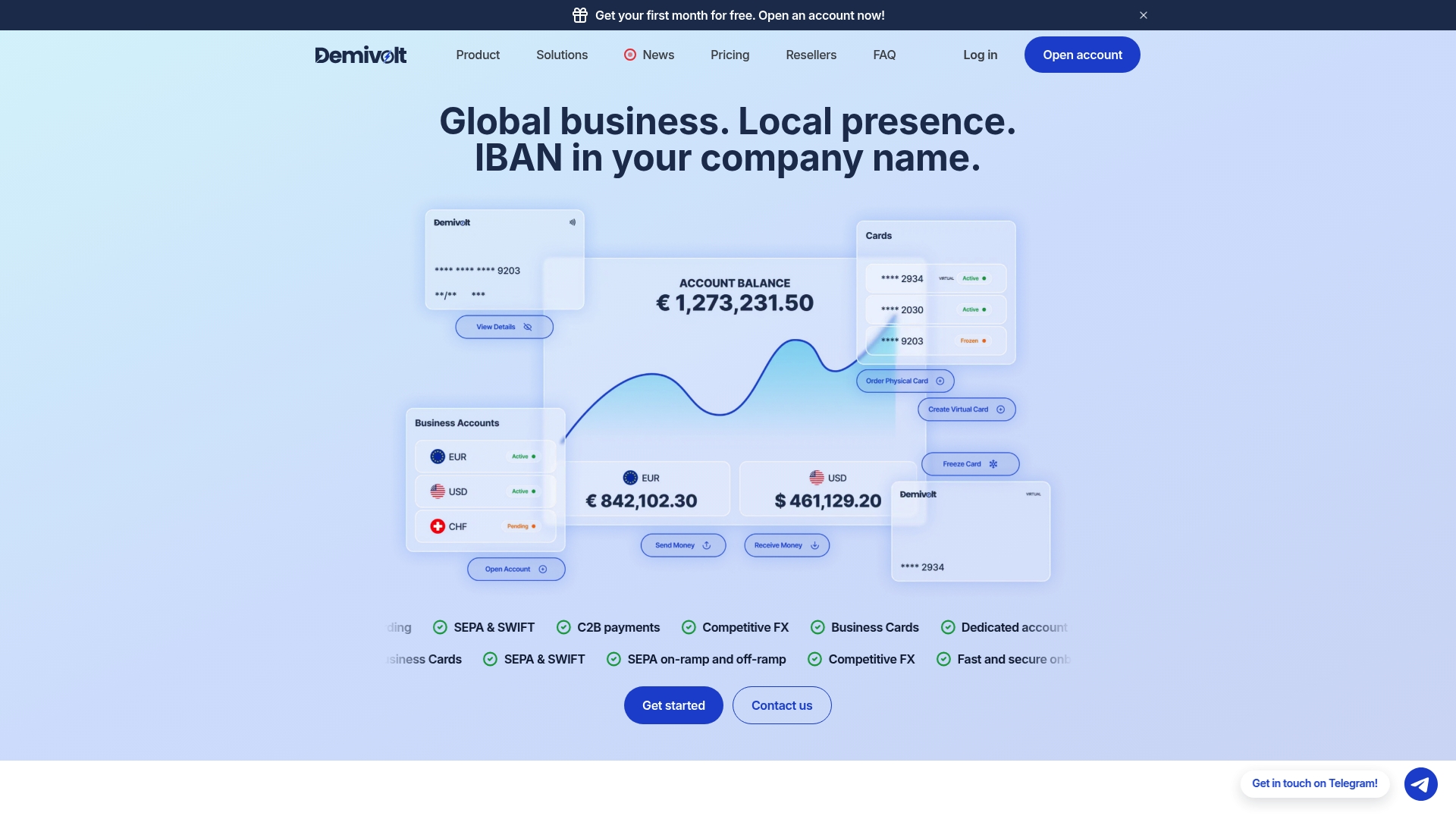
Explore how Demivolt’s EU-regulated platform fits businesses involved in cross-border trade. Visit Demivolt to open accounts quickly and manage payments with confidence. Take control of your payments with dedicated IBANs and transparent pricing tailored for international operations.
FAQ
How does Demivolt support transparent cross-border payment costs?
Demivolt offers clear pricing with outgoing SWIFT transfers costing €30, incoming SWIFT transfers at €25, and outgoing SEPA transfers for €0.40. This transparent fee structure simplifies cash flow forecasting for businesses. Expect no surprise costs when managing international transactions.
What is the difference between Bebawa and Demivolt for marketplace operations?
Bebawa excels in providing configurable account structures tailored for complex business models, particularly marketplaces. Demivolt, on the other hand, provides segregated accounts with dedicated business IBANs, which helps businesses maintain clarity and compliance in their transactions. Both products serve unique operational needs but Demivolt fits better for standard payment structures.
Can I use Demivolt if my business needs physical and virtual card solutions?
Yes, Demivolt plans to offer physical and virtual business cards as part of its features, which enhances payment flexibility for businesses. The feature aims to support companies managing both physical and online transactions effectively. Keep an eye out for updates on card issuance to fully utilize this benefit.
Does Demivolt support multi-account management for team permissions?
Demivolt allows for role-based user permissions and centralized management of multi-account structures. This capability simplifies team collaboration by separating client funds and assigning appropriate access controls. Businesses can expect enhanced security and organizational clarity with this feature.
How does Demivolt’s regulatory coverage compare to Wallter?
Both Demivolt and Wallter are regulated under EU standards; however, Wallter emphasizes faster account approval times and broader currency support. Demivolt’s strength lies in its transparent global payment support and dedicated IBANs, making it particularly well-suited for compliance-focused businesses. Evaluate your operational priorities to choose the right fit.