

TL;DR:
- Payment automation streamlines the entire payment cycle from invoice capture through reconciliation, significantly boosting efficiency. It reduces manual errors, enhances security, and strengthens vendor relationships by providing reliable, automated payment processes. Successful implementation requires full lifecycle coverage, careful vendor onboarding, and proper system security configuration.
Payment automation is the end-to-end technology-driven process of executing and managing business payments automatically, from invoice approval through final reconciliation, without manual intervention. Platforms like Bill.com, Tipalti, and PayStream Advisors have demonstrated that finance teams using integrated payment automation can process invoices three times faster and cut monthly reconciliation from 18 hours to 90 minutes. That kind of efficiency gain is not a marginal improvement. It fundamentally changes how your finance team operates, freeing them from repetitive data entry and check printing to focus on decisions that actually move the business forward.
What is payment automation and how does it work?
Payment automation is the replacement of manual accounts payable tasks with rules-based digital workflows that handle every step of the payment lifecycle. The industry term for the full process is procure-to-pay (P2P) automation, and understanding that scope matters because many businesses automate only part of it, then wonder why they still have bottlenecks.
Here is how a complete automated payment workflow runs in a typical SME or e-commerce business:
- Invoice capture. Invoices arrive by email, vendor portal, or EDI. Optical character recognition (OCR) technology extracts key fields: vendor name, invoice number, line items, amounts, and due dates. No manual keying required.
- Validation and matching. The system checks the extracted data against purchase orders and goods receipts in a two-way or three-way match. Discrepancies trigger an exception flag rather than a payment error.
- Approval routing. Invoices that pass validation route automatically to the right approver based on rules you configure: amount thresholds, department, vendor type. Approvers receive a notification and act through a web or mobile interface.
- Payment scheduling. Once approved, the system schedules payment based on the invoice due date or an early payment window. Platforms like Tipalti can identify a 2% discount for paying 20 days early and optimize payment timing to capture that return automatically.
- Payment execution. The system initiates the payment via ACH, wire transfer, virtual card, or SEPA credit transfer depending on vendor preference and geography. No check printing. No manual bank uploads.
- Remittance delivery. Automated remittance advice goes to the vendor immediately after payment, confirming what was paid and against which invoices.
- Reconciliation. Automated reconciliation matches bank statement entries against payment files and posts confirmed transactions to your ERP or accounting system. This is where most of the 18-to-90-minute time saving occurs.
- ERP integration. Payment automation software connects to platforms like NetSuite, Microsoft Dynamics, and Sage Intacct via API or file transfer, keeping your books current without duplicate data entry.
Pro Tip: Configure your approval rules before go-live. Approval routing is only as good as the thresholds you set. A rule that sends every invoice over $500 to the CFO creates a new bottleneck just as bad as the manual one you replaced.
What are the benefits of payment automation for SMEs?
The advantages of payment automation fall into four categories: time, money, risk, and relationships. Each one compounds the others.

Time savings are the most visible benefit. Finance teams using integrated automated payment solutions cut reconciliation from 18 hours to 90 minutes monthly. That is not a rounding error. It represents roughly two full workdays returned to your team every month, and that figure covers reconciliation alone, before counting the hours saved on data entry, approval chasing, and check runs.
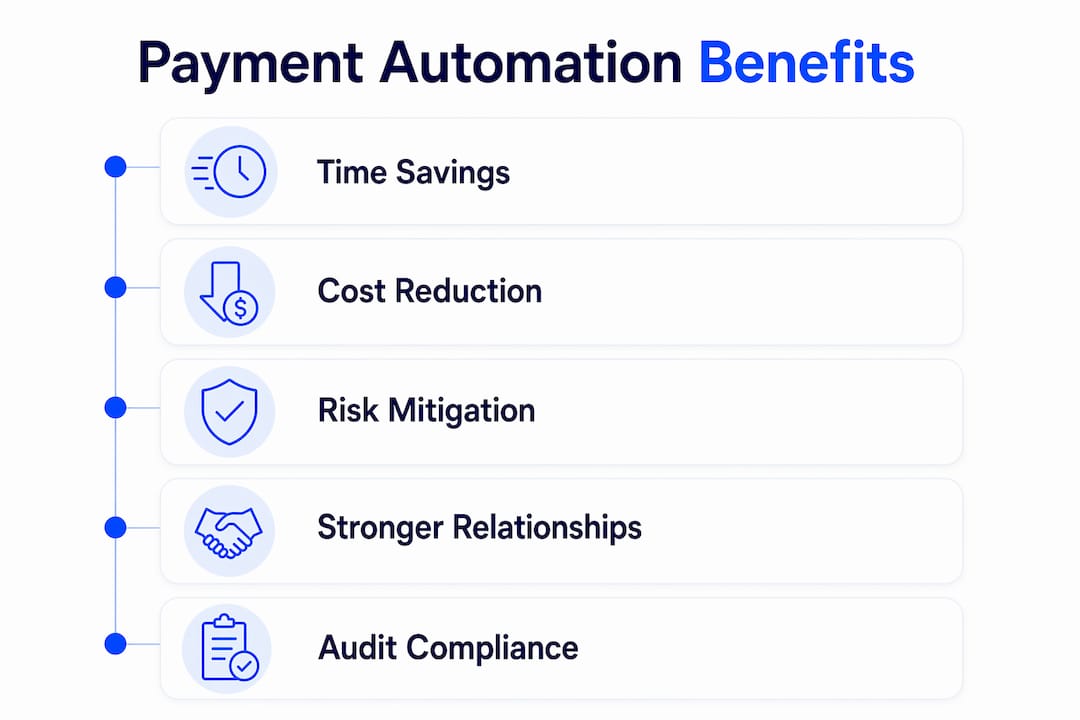
Error reduction changes your risk profile. Payment processing automation replaces manual data entry and paper checks with rules-based workflows, removing the two most common sources of payment fraud and error in SME finance. Duplicate payments, transposed account numbers, and unauthorized check alterations become structurally impossible rather than just unlikely.
Working capital management improves measurably. Automated platforms identify early payment discount opportunities, such as a 2% reduction for paying 20 days early, and schedule payments to capture that return automatically. Annualized, that discount rate exceeds the cost of capital for most SMEs, making early payment a genuine financial strategy rather than a favor to vendors.
Vendor relationships strengthen with reliable payment cycles. Predictable, automated payments combined with automated remittance advice give vendors confidence in your business. That confidence translates into better credit terms, priority fulfillment during supply crunches, and willingness to negotiate pricing. For e-commerce businesses dependent on fast supplier turnaround, this is a competitive advantage that rarely appears on a balance sheet but shows up in margins.
Internal controls become auditable by default. Every payment action generates a timestamped record. Dual-authorization rules for high-value payments mean no single employee can approve and execute a large transaction alone. Your audit trail is complete and current at all times, which matters both for internal governance and for external compliance reviews.
What are the common challenges in adopting payment automation?
Most SMEs underestimate implementation complexity, and the most common mistake has a name: the half-cycle trap. Businesses that automate invoice approval but not payment execution create a digital front end attached to a manual back end. Approvals move fast; payments still require someone to log into a bank portal and initiate transfers manually. The efficiency gains are real but partial, and the fraud risk at the manual handoff point remains.
Avoiding the half-cycle trap requires committing to full lifecycle automation before you start. That means selecting a platform that handles execution and reconciliation, not just approval routing.
Vendor onboarding is the second major obstacle. Automation effectiveness depends entirely on vendors accepting digital payment methods like ACH or virtual cards before you go live. A vendor still requiring paper checks forces a manual exception every time. Prioritize vendor onboarding as a pre-launch workstream, not an afterthought.
Security configuration requires deliberate setup. Dual authorization on high-value payments must be configured in the system, not assumed. Automated platforms are only as secure as the controls you build into them. Segregation of duties, approval thresholds, and exception alerts all need explicit configuration by someone who understands your internal control requirements.
Here are the implementation best practices that separate successful deployments from stalled ones:
- Map your current payment workflow before selecting a platform. Know exactly where manual steps occur and what data flows between systems.
- Involve your ERP administrator early. Integration with NetSuite, Microsoft Dynamics, or Sage Intacct requires technical setup that takes time.
- Run a vendor payment method audit before go-live. Identify which vendors need onboarding to ACH or virtual card and start that outreach immediately.
- Configure dual-authorization rules for any payment above your defined threshold before processing a single live transaction.
- Train your finance team on exception handling. Automation handles the standard cases; your team needs to handle the edge cases confidently.
- Set up monitoring dashboards from day one. Exception rates, approval cycle times, and payment error rates tell you whether the system is performing as expected.
Pro Tip: Treat vendor onboarding as a parallel workstream to your technical implementation, not a follow-on task. Waiting until after go-live to convert vendors to digital payments delays your return on investment by months.
How SMEs and e-commerce businesses apply payment automation in practice
An SME running 200 vendor invoices per month with a two-person finance team faces a specific problem: the volume is too high for manual processing to be accurate, but too low to justify a large AP department. Payment processing automation solves exactly this ratio. The same two-person team can handle 400 invoices with the same accuracy and fewer hours, because the system handles capture, matching, routing, and execution.
For e-commerce businesses, the operational impact centers on supplier payment cycles. Reliable, on-time payments to fulfillment partners and inventory suppliers build the kind of trust that gets your orders prioritized when stock is tight. Automated remittance advice removes the vendor’s need to call and confirm payment, which reduces inbound queries to your team and strengthens the relationship simultaneously.
Integration with accounting software is where the long-term value compounds. Payment automation software connects to NetSuite, Microsoft Dynamics, and Sage Intacct via API, meaning every confirmed payment posts to your general ledger automatically. Your books are current in real time, not at month-end when someone reconciles a spreadsheet.
The compliance and audit readiness benefit is underappreciated by most SME owners until they need it. A complete, timestamped payment audit trail means that a regulatory review, investor due diligence, or internal audit does not require weeks of document retrieval. The records are already organized, searchable, and complete. For businesses operating across European markets, this aligns directly with EU financial reporting expectations.
Payment data also becomes a decision-making input rather than a historical record. Analytics from your payment platform show you which vendors you pay early most often, where your DPO (days payable outstanding) sits relative to industry benchmarks, and which payment methods carry the highest processing costs. That data drives better cash flow decisions, not just better payment execution.
Key takeaways
Payment automation delivers maximum value only when it covers the full payment lifecycle, from invoice capture through reconciliation, not just the approval stage.
| Point | Details |
|---|---|
| Full lifecycle coverage | Automate from invoice capture through reconciliation to avoid the half-cycle trap and manual bottlenecks. |
| Measurable time savings | Integrated automation cuts monthly reconciliation from 18 hours to 90 minutes and speeds invoice processing threefold. |
| Vendor onboarding first | Convert vendors to ACH or virtual card before go-live; paper check exceptions undermine the entire automation benefit. |
| Security requires configuration | Dual authorization for high-value payments must be explicitly set up; it is not a default feature. |
| ERP integration compounds value | Connecting to NetSuite, Microsoft Dynamics, or Sage Intacct keeps books current in real time and supports audit readiness. |
Why partial automation is the most expensive mistake SMEs make
I have seen this pattern more times than I can count. A business owner invests in an AP platform, gets invoice approval running smoothly, and declares the project done. Six months later, the finance team is still logging into a bank portal to initiate payments manually, still spending hours reconciling statements, and still wondering why the efficiency gains feel smaller than promised.
The uncomfortable truth about payment automation is that the hardest part is not the technology. It is the organizational commitment to automate all the way through to reconciliation, including the steps that feel like “just a few minutes” of manual work. Those few minutes, multiplied across 200 invoices and 12 months, are where the real cost lives.
The security dimension is also consistently underweighted. Replacing paper checks with electronic payments and real-time audit trails is not just an efficiency upgrade. It is a fraud prevention measure that paper-based processes cannot match. SMEs are disproportionately targeted by payment fraud precisely because their controls are thinner. Automation, configured correctly, closes those gaps structurally.
My honest recommendation: before you evaluate any platform, read Demivolt’s guide on automating business payments compliantly. The compliance dimension of payment automation is where most SME implementations create unintended risk, and getting that right from the start is worth more than any feature comparison.
— dd
How Demivolt supports your payment automation setup
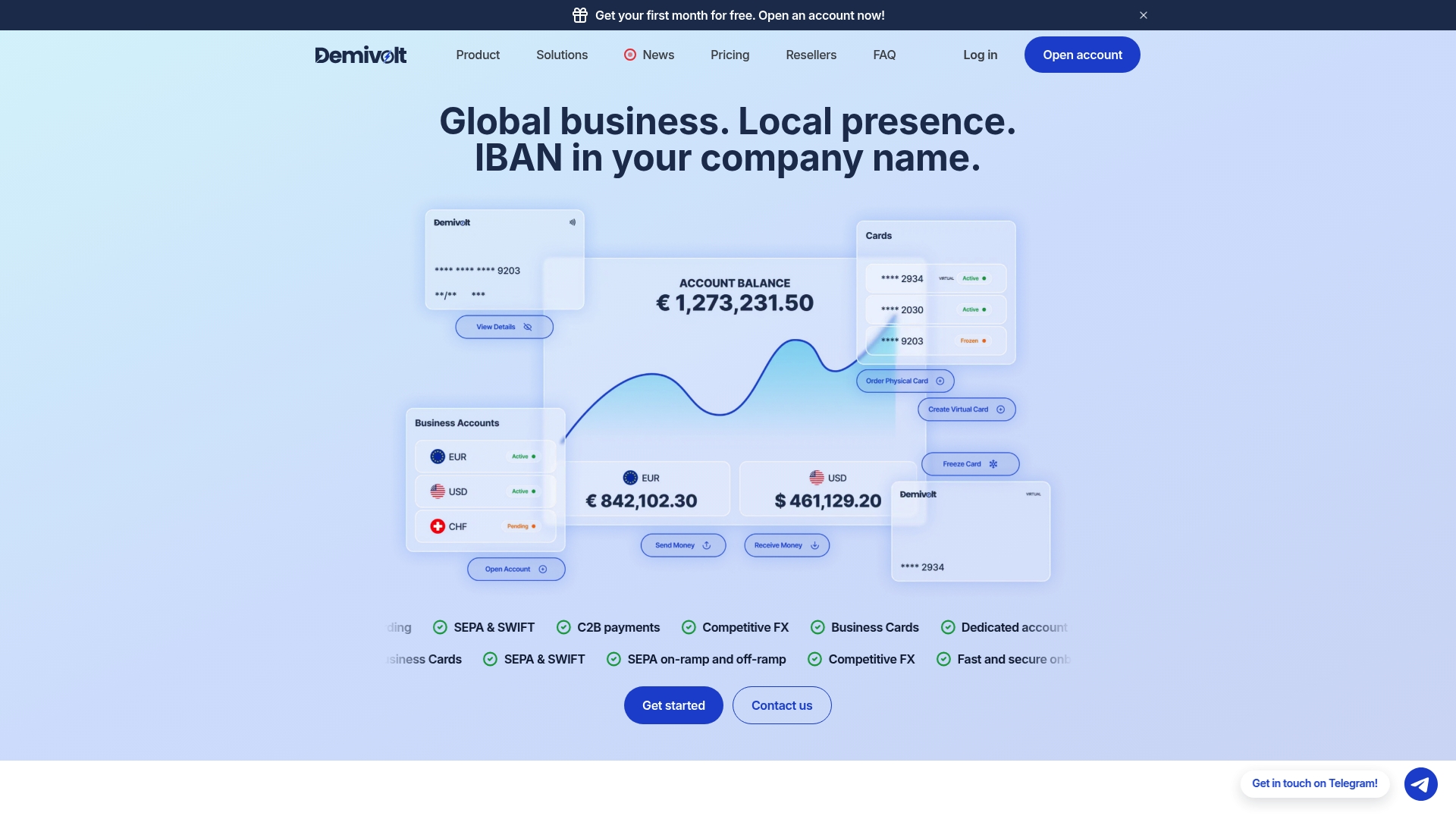
Demivolt’s platform gives SMEs and e-commerce businesses the financial infrastructure that payment automation requires to function correctly. Dedicated IBAN accounts, SEPA and SWIFT payment execution, and role-based user controls mean your automated workflows have a compliant, regulated banking layer underneath them. Before you run a single automated payment, use Demivolt’s IBAN validator tool to confirm every vendor bank detail is accurate. A single incorrect IBAN sends a payment into a resolution process that takes days. Demivolt also offers free SEPA tools that support European payment accuracy and reduce the manual verification steps that slow down AP teams. For SMEs building payment automation on a European banking foundation, Demivolt provides the compliance and account infrastructure that makes the whole system work.
FAQ
What is payment automation in simple terms?
Payment automation is technology that handles the entire business payment process automatically, from receiving an invoice to executing payment and reconciling your books, without manual data entry or check writing.
How does payment automation reduce fraud risk?
Automated systems replace paper checks with electronic payments and generate real-time audit trails, removing the manual steps where most payment fraud occurs. Dual-authorization rules add a second layer of control for high-value transactions.
What is the biggest mistake businesses make with payment automation?
The most common error is automating invoice approval but not payment execution, which leaves a manual gap between approval and settlement. True automation must cover the full cycle through reconciliation.
Does payment automation work for small businesses?
Payment automation is particularly well-suited to SMEs with high invoice volumes and small finance teams. Platforms integrate with accounting software like NetSuite and Sage Intacct, making full automation accessible without a large IT department.
How long does it take to implement payment automation?
Implementation timelines vary by platform and ERP complexity, but the most time-consuming step is vendor onboarding to digital payment methods. Starting vendor outreach before technical go-live is the single most effective way to shorten the timeline.