
Familiar Platforms Lead Adoption
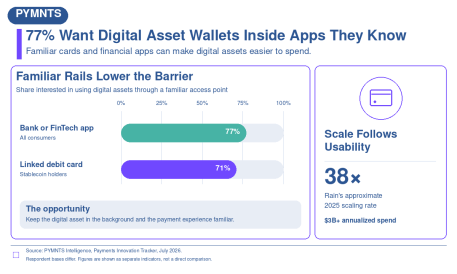
A significant majority of consumers — 77% — say they would open a cryptocurrency or stablecoin wallet through their existing banking or fintech application if the option were available. This preference gives traditional financial institutions and fintech platforms a clear edge over standalone crypto services.
The finding comes from the July 2026 Payments Innovation Tracker, which examines how digital assets are transitioning from speculative investments to practical payment tools. Banks and fintechs already control the customer relationship, login credentials, and interface design that make new payment methods feel accessible rather than alien.
Linked Cards Bridge Acceptance Gap
71% of stablecoin holders say they would use a linked debit card to spend their digital assets. These cards function as real-time converters at checkout, transforming digital currency into traditional payment signals that merchants already accept.
The approach eliminates the need for separate checkout flows or merchant integration. The card translates the asset at the point of sale, routes the transaction through existing payment networks, and delivers settlement in the currency the merchant expects. Consumers avoid friction; merchants avoid new systems.
Infrastructure Enables Rapid Scaling
Modern processing platforms that handle real-time authorization, currency conversion, and card issuance across both digital and traditional networks are proving essential for growth. The report highlights Rain, a processor that secured direct Visa network membership and scaled roughly 38-fold in 2025, reaching over $3 billion in annualized spending.
The example demonstrates how backend infrastructure can support wider market reach and faster program launches when designed to bridge digital assets and established payment rails.
Demand Outpaces Merchant Acceptance
Consumer interest in spending digital assets exceeds current opportunity. 42% of stablecoin holders want to use these assets for major purchases, but only 28% currently do. Nearly half of potential users cite limited merchant acceptance as the primary obstacle.
Business-to-business cross-border transfers already account for the majority of global stablecoin payment volume, driven by faster settlement times, lower transaction costs, and access to dollar-linked value in markets with volatile local currencies.
Regulatory Clarity Supports Expansion
Europe's MiCA framework and the U.S. GENIUS Act have established clearer standards for issuers and service providers, reducing regulatory uncertainty that previously slowed adoption.
The next phase centers on practical implementation: giving consumers trusted methods to spend digital assets without requiring them to abandon familiar payment habits or learn entirely new systems. The pathway forward relies on integration rather than replacement.
Source
Original coverage by PYMNTS.
Use the button below to read the article on the publisher website.
Read on PYMNTSSusiję su šiuo straipsniu