
Summary
If a Bitcoin-settled insurance mechanism for Strait of Hormuz became real, it would turn Bitcoin’s “neutral money” thesis into a geopolitical test case.
IRGC-affiliated Fars News reported on May 16 that Iran launched a platform called Hormuz Safe, offering digital insurance for vessels transiting the Strait of Hormuz with premiums settled in Bitcoin. A document cited by Fars's reporter indicated Iran's Economy Ministry had been developing the mechanism since early May, with projected revenue above $10 billion.
The platform's website features a “Coming Soon” page, along with text describing fast, cryptographically verifiable insurance settled via Bitcoin. No official press release from the Economy Ministry, government gazette, or regulator has confirmed the launch. ClaimCurrent statusWhy it mattersFars reported Hormuz Safe launchReported by IRGC-affiliated FarsStrongest source, but not official confirmationWebsite text references Bitcoin insuranceIndexed / “Coming Soon” pageSupports existence of a public-facing web asset, not operationEconomy Ministry linkClaimed via document cited by FarsNot the same as a ministry announcementBitcoin / USDT Hormuz messagesMARISKS called prior messages a scamCreates caution around all crypto-safe-passage claimsOfficial government confirmationNot foundArticle must stay conditional In April, Greek maritime risk firm MARISKS warned shipping companies that fraudulent messages impersonating Iranian authorities had demanded Bitcoin or USDT payments for Hormuz clearance and declared them a scam.
Iranian forces reportedly fired on the Epaminondas, a vessel owned by Greek company Technomar, when it apparently acted on a fraudulent safe-passage message. The scam backdrop makes caution essential before treating any unverified claim about crypto Hormuz payments as operational.
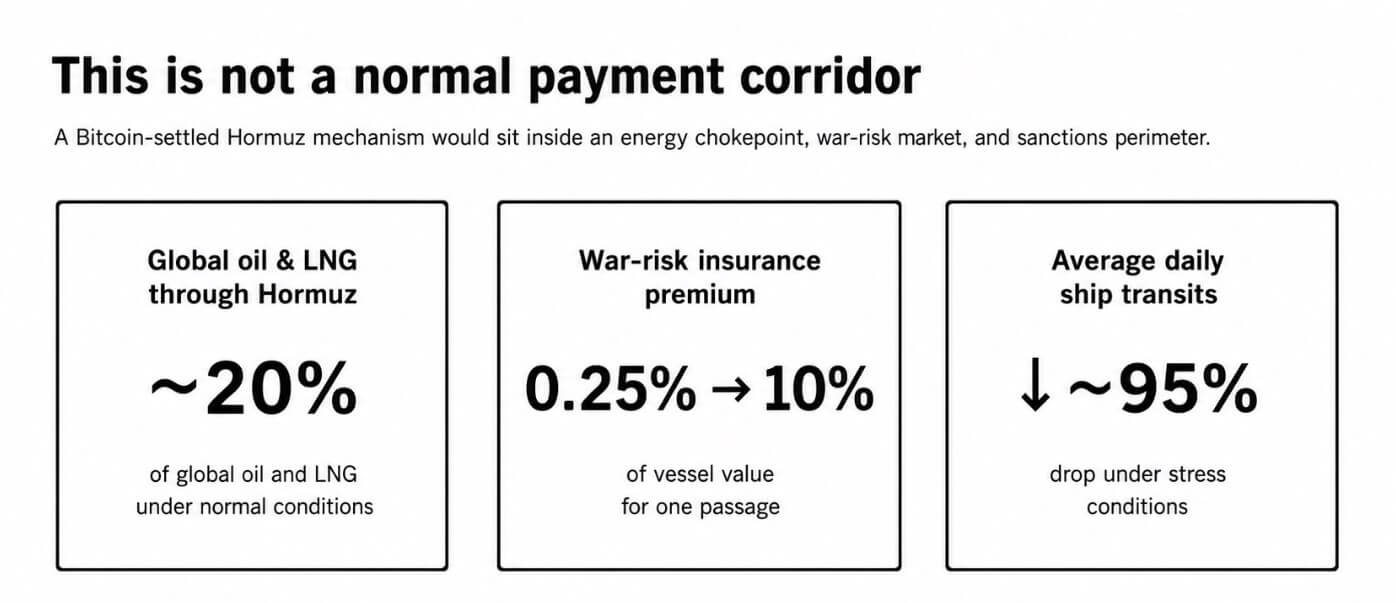
Yet, a verified mechanism would test Bitcoin's institutional position in ways that extend well beyond the strait itself. Bitcoin at the world's most important chokepoint Hormuz handles about 20% of the world's oil and liquefied natural gas under normal conditions. As the conflict with the US and Israel has continued since late February 2026, Iran has blocked or restricted transit, war-risk insurance premiums have surged from roughly 0.25% to as high as 10% of a vessel's value for a single passage, and average daily ship transits have dropped by about 95%.
A Bitcoin-settled insurance mechanism in that environment would be Bitcoin operating as settlement infrastructure for a live conflict zone, a use case with no precedent in the asset's history. OFAC issued an alert on May 1, warning that paying any Hormuz toll to Iran creates sanctions exposure regardless of payment method.
In a related FAQ published the same day, OFAC confirmed that Iranian digital asset exchanges qualify as Iranian financial institutions under existing sanctions regulations, and that Executive Order 13599 blocks their assets held by US persons or located within the US. FinCEN's May 11 alert cited a Chainalysis analysis putting Iran's crypto economy at $7.8 billion, noting IRGC dominance and a documented move toward Bitcoin, and explicitly cited press reporting that Iran had stated its intent to use digital assets to collect payments from oil tankers seeking Hormuz passage.
FinCEN listed petroleum and shipping companies that deviate from normal business practices by sending or receiving digital asset payments related to Iranian oil as a compliance red flag. If enforcement becomes structural If Hormuz Safe becomes operational and draws enough shipping participants to generate a traceable pattern of Bitcoin payments, every address associated with the mechanism becomes a potential OFAC target.
Through Operation Economic Fury, Treasury has already frozen nearly $500 million in regime-linked cryptocurrency. If OFAC identified Hormuz-linked wallet addresses, enforcement actions would target exchanges, OTC desks, and brokers that face deposit screening requirements for any BTC in the payment chain.
Bitcoin's base-layer transactions are public, but connecting an on-chain address to a specific Hormuz insurance payment requires off-chain attribution. Exchanges can screen addresses only once off-chain attribution links them to a specific Hormuz payment; that attribution then forces regulated venues to choose between blocking tainted flows and accepting downstream liability.
FATF's October 2025 update classified Iran as a high-risk jurisdiction, noting no material progress on its action plan, recommending countermeasures against proliferation-financing risks, and giving regulators across jurisdictions legal cover to act aggressively against intermediaries that handle Iranian crypto flows.
Source
Original coverage by CryptoSlate.
Use the button below to read the article on the publisher website.
Read on CryptoSlateRelated to this article