
Digital Channels Drive SMB Revenue Growth
Smaller enterprises are increasingly turning to online platforms to expand their reach without the overhead of opening new physical locations. Research tracking four years of data shows that most small and medium-sized businesses are experiencing growth, with confidence levels nearing their highest point since mid-2022.
As of February 2026, 51% of SMBs reported year-over-year revenue increases, while only 13% saw declines. That contrasts sharply with July 2022, when 22% of businesses reported falling revenues. The shift reflects a broader embrace of digital selling tools that function as virtual storefronts.
Owned Websites Close Gap with Physical Retail
Fifty-seven percent of small businesses now generate sales through their own websites, trailing physical store sales by just 4 percentage points. The 61% of SMBs still selling through brick-and-mortar locations suggests that digital and physical channels are converging in importance.
Businesses with annual revenues exceeding $1 million posted average growth of 13.7% since 2020, compared with just 0.6% among the smallest firms. While smaller operations can't instantly replicate that scale, they can adopt the multichannel strategies that larger peers use to reach more customers.
Delivery Apps and Marketplaces Show Strongest Gains
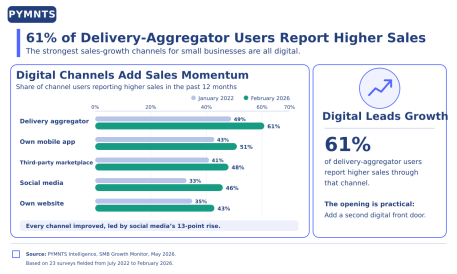
Among businesses using third-party delivery platforms, 61% reported higher sales through those channels, up from 49% in January 2022. Owned mobile apps followed at 51%, while marketplace sellers and social media sellers posted gains of 48% and 46%, respectively.
These platforms serve as secondary customer touchpoints, offering SMBs expanded visibility without the capital requirements of opening additional storefronts. The data suggests that diversifying sales channels can produce measurable revenue lifts across multiple business sizes.
Payment Acceptance Gaps Remain Despite Card Saturation
Credit card acceptance has plateaued at 79% for both in-store and online transactions, but newer payment methods show uneven adoption. Venmo is accepted by 41% of SMBs online compared with 36% in physical locations, while Apple Pay reaches 32% online and 30% in stores.
Buy-now-pay-later options are available at just 13% of online checkouts and 8% of physical locations. Closing these gaps could reduce abandoned carts and give customers more flexibility at the point of sale, particularly as alternative payment methods gain mainstream traction.
Strategic Financing Replaces Desperation Borrowing
Of SMBs seeking outside capital in February 2026, 37% did so for strategic expansion and 28% cited both strategy and operational necessity. Only 13% identified an inability to secure financing as a survival threat, down from higher levels in prior years.
The shift opens opportunities for lenders and fintech providers to offer working-capital products tied to invoices or sales activity, with faster underwriting and clearer use cases. Confidence has also risen: 82% of businesses are very or extremely confident they'll survive the next two years, up from 78% in July 2022.
Source
Original coverage by PYMNTS.
Use the button below to read the article on the publisher website.
Read on PYMNTSRelated to this article