

Bankininkystė kaip paslauga, known internationally as banking as a service (BaaS), lets businesses embed accounts, payments, and card issuance through APIs while a licensed provider keeps the banking license. Two facts make this model work: compliance is shared, not outsourced entirely, and the structure runs on a three-layer stack that separates the licensed bank, the BaaS middleware, and the fintech front-end.
Before signing anything, run a regulatory and integration readiness check. That means confirming:
- Who holds the license and what capital adequacy standards they meet
- Which KYC/AML obligations fall on your team versus the provider
- Whether the API surface covers accounts, payments, and card actions natively
- What the safeguarding structure looks like for client funds
Key Takeaways
Banking as a service works because it separates the regulatory license from the customer-facing product, letting businesses launch accounts, payments, and cards through a regulated partner while sharing compliance responsibility rather than outsourcing it entirely.
| Point | Details |
|---|---|
| Three-layer architecture | Licensed bank, BaaS middleware, and fintech front-end each play a distinct, non-interchangeable role. |
| Compliance is shared | Partners must run their own KYC/AML onboarding checks even under a licensed provider’s regulatory umbrella. |
| Capital transparency matters | Bank of Lithuania supervisory data shows sector growth paired with rising scrutiny on capital adequacy. |
| Pilot before you scale | Sandbox testing with defined reconciliation and fraud metrics reduces launch risk more than lengthy contract talks. |
| Demivolt as a regulated example | Offers dedicated IBANs, SEPA/SWIFT processing, Visa business cards, and segregated client funds for SMEs and fintechs. |
Table of Contents
- What Is Banking as a Service and How Is It Structured?
- Demivolt: A Regulated Platform Example in Practice
- Who Handles KYC and AML in a BaaS Partnership?
- What APIs and Technical Infrastructure Does BaaS Require?
- How Should You Design Payment Rails and Card Programs?
- Why Are Businesses Embedding Banking Into Their Products?
- What Should You Expect for Onboarding Timelines and Costs?
- How Does BaaS Handle Data Privacy and Cybersecurity?
- Where Is the BaaS Market Heading Next?
- An Editorial Take on Choosing a BaaS Partner
- Get Started With a Regulated BaaS Partner Built for Businesses
- Sources
What Is Banking as a Service and How Is It Structured?
BaaS is commonly described as a three-layer stack. A licensed bank or electronic money institution sits at the base, holding the balance sheet and the regulatory license. On top of that sits the BaaS middleware, the layer that exposes banking functions through APIs. The fintech or brand builds its customer-facing product on that middleware, per the standard BaaS conceptual model.
What does that middleware layer actually deliver? In most implementations, it covers:
- Deposit accounts and IBANs issued to end customers or business clients under the licensed partner’s regulatory umbrella
- Card issuing, both virtual and physical, tied to a BIN sponsorship arrangement
- Payment rails for domestic and cross-border transfers, including settlement logic
- Reporting and reconciliation tools that feed compliance and finance teams
The difference between white-label and branded implementation matters for product teams. A white-label setup hides the underlying bank entirely, so the end customer sees only your brand. A branded or disclosed model surfaces the regulated partner’s name in account documentation and terms, which can affect trust perception but often simplifies compliance disclosures.
Demivolt: A Regulated Platform Example in Practice
Demivolt operates as a regulated European fintech platform built specifically for business banking and payment infrastructure. It safeguards client funds through segregated accounts, a structural detail that matters more than most feature comparisons because it determines what happens to your money if something goes wrong operationally.
The platform’s core feature set includes:
- Dedicated IBAN accounts for individual business entities, not pooled or shared identifiers
- SEPA and SWIFT payment processing for both domestic euro transfers and cross-border transactions
- Virtual and physical Visa business cards for expense management
- Multi-account structures with role-based user management for finance teams handling multiple entities or subsidiaries
Pro Tip: Ask any BaaS provider whether their IBANs are dedicated per client or pooled under one master account. Pooled structures can complicate reconciliation and, in some jurisdictions, affect how quickly you can prove fund segregation during an audit.
Demivolt’s typical buyer profile includes SMEs running cross-border trade, digital service companies managing multi-currency invoicing, and fintechs that need regulated infrastructure without building a banking license from scratch. Its reseller program also lets advisors and partners refer clients and earn recurring commissions, which reflects a broader industry pattern: embedded finance works best when the licensed partner shares operational and commercial upside with the businesses distributing it.
Who Handles KYC and AML in a BaaS Partnership?
Compliance in a BaaS relationship is genuinely shared, and treating it as fully outsourced is the single most common mistake fintech teams make. The licensed provider holds the regulatory license and manages core controls like capital adequacy and transaction monitoring at the infrastructure level. Your business, as the partner, still has to integrate KYC and AML checks into your own onboarding flow for end users.
Bank of Lithuania supervisory activity backs this up directly. Its sector reporting shows income and transaction volumes rising sharply across the EMI and PI sector, while supervisors simultaneously flagged capital adequacy gaps and operational deficiencies during targeted inspections. Growth and scrutiny are rising together, not one instead of the other.
Industry practitioners increasingly treat the regulatory umbrella as conditional: it accelerates market entry, but it never removes your obligation to run and document your own KYC/AML controls.
Before signing a BaaS contract, demand these operational controls in writing:
- Audit rights that let you verify the provider’s compliance posture, not just take their word for it
- A defined reporting cadence for suspicious activity and transaction monitoring outcomes
- Explicit safeguarding details describing where client funds sit and how they’re protected
- Clarity on which entity is liable for KYC failures at onboarding versus ongoing monitoring
Legal complexity compounds here. A recent European Court of Justice ruling clarified that holding funds in a payment account without a specific payment order doesn’t automatically count as e-money issuance — classification depends on contractual and functional criteria under PSD2 and EMD2. That distinction can determine which license your provider actually needs, so read the role of KYC in banking compliance closely before you assume a provider’s license covers your use case.
What APIs and Technical Infrastructure Does BaaS Require?
Every BaaS integration runs on API endpoints and webhooks, and understanding the typical surface area helps engineering leads scope effort accurately before committing to a build.
- Account opening endpoints that create and configure IBANs programmatically
- KYC submission and status endpoints for onboarding new users or businesses
- Payment initiation and status endpoints covering both SEPA and SWIFT flows
- Card action endpoints for issuing, freezing, or setting spend limits on virtual and physical cards
- Event webhooks that push real-time notifications for transactions, KYC decisions, and account status changes
Security expectations follow standard fintech baselines: encryption in transit and at rest, strong customer authentication (SCA) for payment initiation under PSD2, and defined data retention periods tied to regulatory record-keeping rules. Most providers, including vendor platforms like FIS’s embedded finance infrastructure, offer sandbox environments so engineering teams can test flows before touching production data.
Pro Tip: Run your sandbox pilot with explicit success metrics for reconciliation accuracy and fraud detection response time. That produces more reliable go-live confidence than months of pre-contract negotiation alone.
Best practice rollout follows three stages: sandbox testing for core flows, a staged pilot with a limited user group, then full production with reconciliation processes already validated. Skipping the staged pilot is where most integration timelines quietly slip. Reviewing what API banking actually involves before scoping your build avoids surprises during the sandbox phase.
How Should You Design Payment Rails and Card Programs?
Every operational decision here touches unit economics, so it deserves deliberate design rather than default settings.
- IBAN issuance: dedicated IBANs per client simplify reconciliation and audit trails; pooled structures cost less to administer but complicate fund tracing.
- Payment rails: SEPA covers euro transfers across the EU with same-day or next-day settlement; SWIFT handles cross-border and non-euro transactions with longer settlement windows and correspondent bank fees.
- Card-program controls: BIN sponsorship determines who underwrites the card program; decide early whether you need virtual cards only, physical cards, or both, and how granular your spend controls need to be.
- Dispute processes: confirm who handles chargebacks and how quickly disputed transactions get resolved, since this directly affects customer trust in your product.
You can validate IBAN formatting issues before they reach production using a tool like the IBAN validator, which catches structural errors that would otherwise surface as failed payments downstream.
Why Are Businesses Embedding Banking Into Their Products?
The strategic case for BaaS comes down to speed and revenue, not novelty. Building banking infrastructure from scratch takes years and a banking license; embedding it through a regulated partner takes months. That speed difference translates into faster go-to-market, new revenue lines from interchange or account fees, and a smoother user experience than bolting on a third-party banking redirect.
The most common use cases, in order of typical adoption:
- Neobank front-ends that offer full account and card experiences under a new brand
- Merchant finance at the point of purchase, where platforms extend credit or installment options
- Platform payouts for marketplaces paying out sellers, drivers, or freelancers directly
- Corporate expense management combining virtual cards with role-based spend controls
Choosing your first use case matters more than most teams realize. The right MVP minimizes regulatory burden and technical scope simultaneously. Corporate expense management, for instance, usually carries lighter KYC requirements than a full consumer neobank launch, which makes it a common starting point for teams that want to prove the model before scaling into riskier territory.
What Should You Expect for Onboarding Timelines and Costs?
Procurement to production follows a fairly predictable arc, though scope changes it substantially.
- Sandbox phase: typically 2 to 6 weeks to test core API flows and validate data models
- Pilot phase: 6 to 12 weeks running a limited rollout with real transactions and a small user base
- Production phase: 4 to 12 or more weeks depending on the complexity of your card program, multi-entity structure, and compliance review depth
Pricing models vary by provider but generally combine a few components: setup fees, per-account fees, transaction fees on payments, card issuance fees per card, and a monthly platform fee. Negotiate these upfront rather than discovering them after go-live.
Sector data from the Bank of Lithuania shows income and transaction volumes across the EMI and PI sector rising sharply even as supervisors tighten capital adequacy scrutiny, a signal that provider stability now matters as much as feature depth when you’re choosing a partner for a multi-year commitment.
Before signing, prioritize contract terms covering service-level agreements, data access and export rights, exit and migration terms if you switch providers later, and a clear process for regulatory notifications that affect your business. Review EU payment regulations early so your legal team isn’t negotiating blind on PSD2-related clauses.
How Does BaaS Handle Data Privacy and Cybersecurity?
Data privacy in a BaaS relationship is inherently a two-party problem. Your business collects and processes customer data during onboarding, while the licensed provider processes transaction and account data on the regulated infrastructure side. Both parties fall under GDPR obligations, and both need clear data processing agreements defining who controls what, who can access it, and how long it’s retained.

Cybersecurity expectations extend beyond basic encryption. Strong customer authentication under PSD2 requires multi-factor verification for most payment initiations, and providers typically enforce this at the API layer rather than leaving it to the front-end app. Data retention periods are usually dictated by AML record-keeping rules, which in most EU jurisdictions require transaction records to be kept for several years after the relationship ends, not just while the account is active.
A practical concern many product teams overlook: API access tokens and webhook endpoints are common attack surfaces. If your BaaS provider issues API keys without rotation policies or IP allowlisting options, that’s a gap worth flagging during technical due diligence, not after a security incident. Ask providers directly how they handle penetration testing cadence and whether they share results or certifications with partners, since providers reluctant to discuss this openly are usually signaling a maturity gap rather than a confidentiality concern.
Segregated client fund accounts, the same safeguarding structure that protects your money operationally, also reduce a specific cyber risk: a breach at the provider level is less likely to expose commingled balances across multiple business clients when funds are properly partitioned by account.
Where Is the BaaS Market Heading Next?
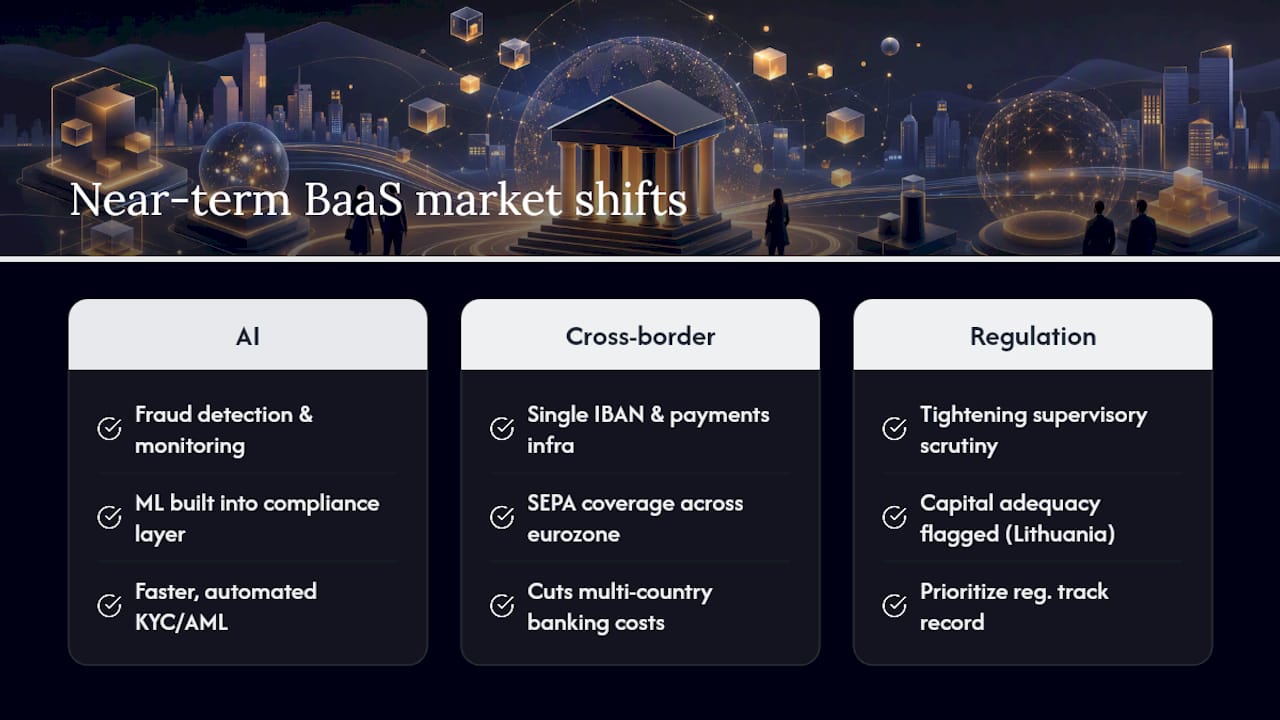
Two forces are reshaping BaaS faster than most product roadmaps account for: AI integration and cross-border expansion.
AI is moving into fraud detection and transaction monitoring first, since that’s where pattern recognition at scale delivers the clearest return. Providers are increasingly building machine learning models directly into their compliance layer, which means the KYC and AML checks your business relies on today will likely get faster and more automated over the next few years, not slower or more manual.
Cross-border expansion is the second major shift. As more EU businesses run operations across multiple member states, demand is growing for BaaS providers that can offer a single IBAN and payment infrastructure covering SEPA transactions across the entire eurozone, rather than country-by-country banking relationships. This matters directly for any business selling across borders, since managing five separate banking relationships in five countries is operationally far more expensive than one regulated partner covering all of them.
Expect continued regulatory tightening alongside this growth. Bank of Lithuania’s supervisory activity, flagging capital adequacy gaps even as sector income rises, suggests regulators across the EU will keep raising the bar on provider stability rather than easing it. Businesses evaluating BaaS partners in 2026 and beyond should weight regulatory track record more heavily than they might have three years ago, when the market was younger and less scrutinized.
An Editorial Take on Choosing a BaaS Partner
The conventional advice on BaaS treats it like a vendor selection exercise: compare feature lists, pick the cheapest transaction fees, sign. That approach undersells the real risk, which isn’t technical. It’s regulatory durability. A provider with thin capital reserves and a clean feature checklist can still leave you exposed if supervisors intervene mid-contract.
What gets underweighted constantly is the shared compliance model itself. Too many product teams assume a licensed partner’s regulatory status means their own KYC obligations disappear. It doesn’t. The license accelerates your market entry; it doesn’t outsource your onboarding controls or your audit readiness.
If you take one thing from this guide, prioritize capital transparency and supervisory track record before you evaluate API documentation. A well-documented API on a shaky regulatory foundation is a liability wearing good UX. Ask your prospective partner for their own supervisory history before you ask for their sandbox credentials. The order matters more than most procurement checklists suggest.
— dd
Get Started With a Regulated BaaS Partner Built for Businesses
Demivolt gives businesses a faster path to embedded banking than building compliance infrastructure from scratch: dedicated IBANs, SEPA and SWIFT payment processing, and virtual and physical Visa business cards, all running on a regulated European platform with segregated client funds.
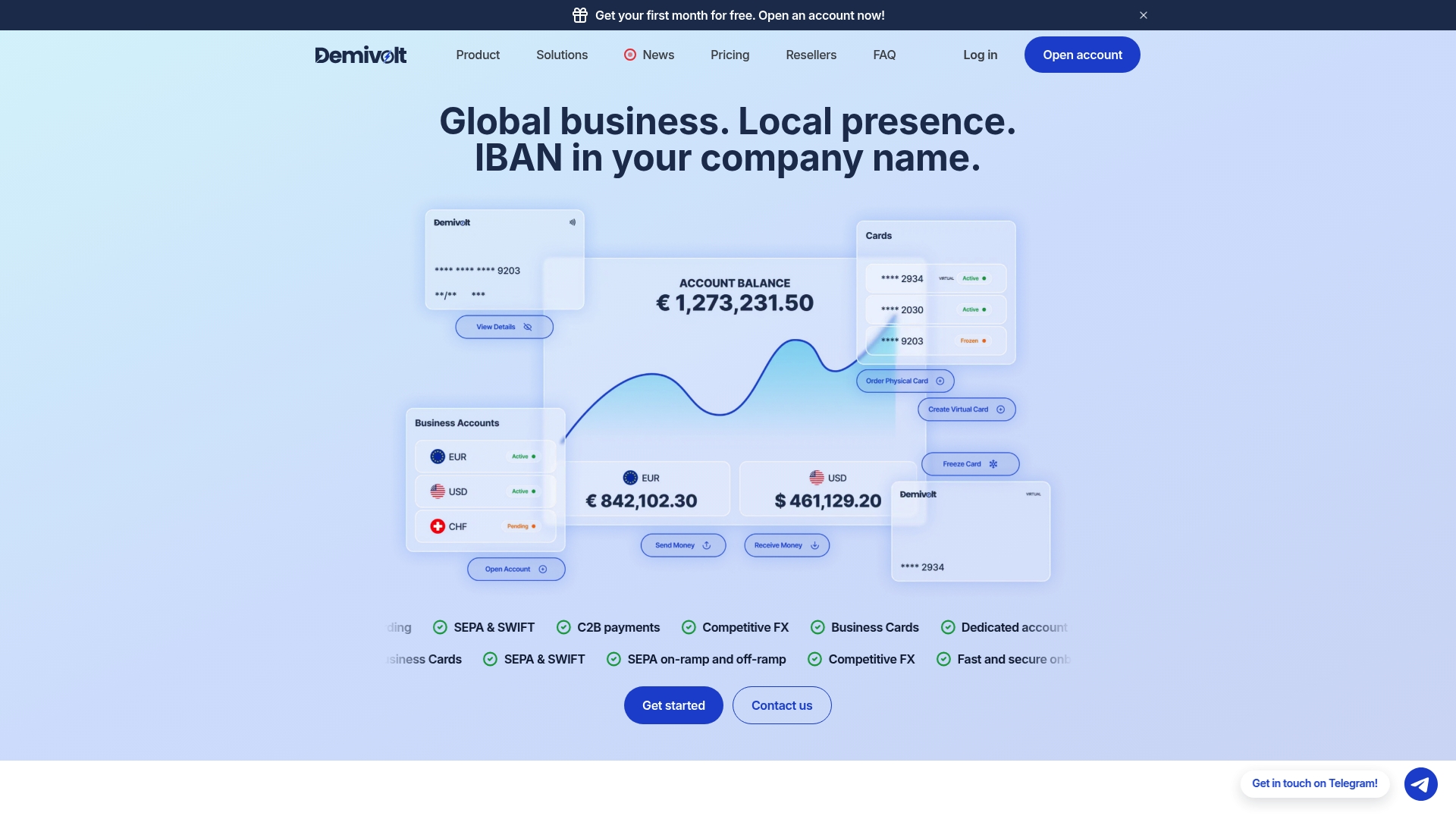
For SMEs managing cross-border trade or fintechs that need regulated banking infrastructure without a multi-year licensing process, Demivolt’s multi-account structures and role-based user management solve the operational complexity that trips up most in-house builds. Its reseller program also gives advisors and partners a way to bring this infrastructure to their own clients while earning recurring commissions. If you’re comparing BaaS providers, start by checking your IBAN formatting requirements with the IBAN validator, then reach out to open a dedicated business account and see how quickly your team can move from sandbox testing to live payments.
Sources
- EMI and PI sector: a significant financial and qualitative leap in a year | Bank of Lithuania
- Banking as a service — Wikipedia
- Payment services versus e-money issuance: Court of Justice of EU clarifies regulatory border | JDSupra