

Most businesses pay three types of SEPA charges: a monthly account or admin fee, a per-transfer outgoing fee, and occasionally an incoming or beneficiary charge. Add a possible premium for SEPA Instant (SCT Inst) transfers, and that is the full picture for most companies moving euros across the EU. Scheme rules harmonize how the transfer moves and what data travels with it, but your bank or payment service provider (PSP) sets the actual prices, so two companies sending identical payments can pay very different amounts depending on their price list.
The immediate fix costs nothing and takes fifteen minutes. Before you negotiate anything or switch providers, do this:
- Pull your current account’s price list and identify every line item tied to SEPA transfers, not just the headline “transfer fee.”
- Confirm whether your provider actually supports SCT Inst, and at what limit, rather than assuming it does.
- Run IBAN validation on your most frequent payees to catch formatting errors before they trigger repair charges.
Key Takeaways
Businesses control most of their SEPA costs through routing discipline and data hygiene, not through finding the single cheapest provider.
| Point | Details |
|---|---|
| Fee mix is predictable | Expect a monthly admin fee, per-transfer outgoing charges, and an occasional SCT Inst premium. |
| Scheme rules aren’t pricing rules | The EPC rulebook standardizes SEPA data and processing, but each provider sets its own fees. |
| Reconciliation errors cost twice | A rejected or returned payment triggers a fee and delays cash flow while someone fixes it manually. |
| Route by urgency, not habit | Default to standard SCT and reserve SCT Inst for genuinely time-critical payments. |
| Demivolt tools cut hidden costs | Demivolt’s SEPA Fee Calculator and IBAN Validator help businesses model routing costs and prevent repair fees before they happen. |
Table of Contents
- Understanding SEPA Mokesčiai Verslui: The Payment Types Behind the Fees
- The Actual Fee Types Showing Up on Your Statement
- SEPA Instant: Fast Settlement, Sometimes at a Premium
- Settlement Timelines, Returns, and Reconciliation That Actually Works
- Cutting SEPA Costs: What Finance Teams Can Actually Control
- How Demivolt Approaches SEPA Fee Transparency for Businesses
- A Practical Path Through SEPA Costs, Not Around Them
- Get Real Numbers on Your Own SEPA Costs
- Sources
Understanding SEPA Mokesčiai Verslui: The Payment Types Behind the Fees
SEPA fees don’t exist in a vacuum. Every charge on your statement ties back to a specific payment instrument, and understanding SEPA mokesčiai verslui starts with knowing which instrument you’re actually using. The Single Euro Payments Area, as the European Central Bank describes it, is a harmonized zone that erases the old distinction between a domestic euro payment and a cross-border one. A transfer from Vilnius to Munich should move with the same speed, format, and rights as one from Vilnius to Kaunas.
That harmonization happens through three main instruments:
- SEPA Credit Transfer (SCT), the standard push payment for salaries, supplier invoices, and general B2B transfers. It settles by the next business day and remains the cheapest default rail for most companies.
- SEPA Instant Credit Transfer (SCT Inst), which moves funds in under ten seconds, around the clock, every day of the year. It costs more in many pricing plans and isn’t universally supported by every bank.
- SEPA Direct Debit (SDD), a pull payment used for recurring collections like subscriptions or lease payments, with a business-to-business variant (SDD B2B) carrying stricter mandate and refund rules than the consumer version.
Here’s the distinction that trips up a lot of finance teams: the scheme itself, governed by rulebooks from the European Payments Council, standardizes the data fields, processing rules, and exception handling for these instruments. It does not set what your bank charges you to use them. Two banks running the identical SCT Inst rail under the identical EPC rulebook can price that transfer at wildly different rates, because pricing is a competitive decision each provider makes independently. That gap is exactly where cost control lives, and it’s why reading your own price list matters more than reading a generic guide to “SEPA fees.”
The Actual Fee Types Showing Up on Your Statement
Bank pricing pages for business accounts tend to group charges into a handful of predictable buckets. Knowing the labels helps you spot what you’re actually paying for, rather than treating your monthly bill as one opaque number.
- Account or monthly administration fees. Many business accounts bundle a flat monthly charge that may include a set number of free transfers, with overages billed per transaction. This model makes sense if your volume is stable and predictable; it makes less sense if your payment activity is seasonal or lumpy.
- Outgoing transfer fees by channel. A transfer initiated through your bank’s app or online portal is usually cheaper than the same transfer submitted at a branch counter or over the phone. Some providers also offer API-based initiation at a lower per-transaction rate for businesses sending high volumes programmatically. Billing models vary between flat fees, percentage-based fees, and tiered pricing that drops as monthly volume rises.
- Incoming or beneficiary fees. Most standard SCT transfers arrive fee-free for the recipient, but some providers charge a small incoming fee on certain account types or for payments arriving from outside the SEPA zone through a correspondent path.
- Exception and repair fees. These are the charges that catch businesses off guard: manual repairs for malformed IBANs, returned payments due to closed accounts, and payment recalls initiated after a transfer has already settled. Lietuvos bankas publishes a transaction price table that lists many of these line items explicitly, which is a useful cross-check against your own provider’s disclosures.
- Fee waivers. Transfers between accounts at the same PSP are frequently free, and many plans include a monthly allowance of transfers before per-transaction fees kick in. High-volume businesses can often negotiate these thresholds directly.
SEPA Instant: Fast Settlement, Sometimes at a Premium
SCT Inst settles very quickly at any time of day or year, and functions on the same underlying rulebook as standard SCT. The difference is pace, not process, and it changes how you should think about time-sensitive payments like supplier deposits or emergency payroll corrections.
Scheme ceilings don’t guarantee provider support. SEPA Instant carries a maximum transaction ceiling set at the scheme level, but individual banks decide whether to support instant transfers at all, and if so, at what per-transaction or daily cap. A payment that fits comfortably within scheme rules can still bounce back to standard SCT processing if your bank hasn’t built out full instant capability.
That gap explains why some banks quietly route “instant” requests through standard SCT rails by default. It isn’t always deception. It’s often a limitation in the provider’s own infrastructure or an internal decision to cap instant volume for risk management. Before you rely on SCT Inst for anything time-critical, test it with a real counterparty and confirm the actual per-transaction and daily limits your provider enforces, not just the limits published in scheme documentation.
Pro Tip: Reserve SCT Inst for payments where the ten-second settlement actually changes an outcome, like releasing goods on receipt of funds. For routine supplier payments and payroll batches, standard SCT settles by the next business day at a lower cost, and the speed premium buys you nothing.
Settlement Timelines, Returns, and Reconciliation That Actually Works
Standard SCT transfers process by the next bank business day, with cutoff times that vary by provider, so a payment submitted late on a Friday afternoon may not settle until Monday or Tuesday. SCT Inst, by contrast, settles in seconds regardless of the day or hour, which matters when you’re managing cash flow around a tight payroll deadline or a supplier that requires proof of payment before releasing goods.
When something goes wrong, three exception types can generate fees:
- Rejects happen before settlement, usually due to an invalid IBAN, an inactive account, or a data field that doesn’t match the scheme’s requirements.
- Returns happen after the payment reaches the beneficiary’s bank, if the account is closed or the beneficiary bank cannot process the credit.
- Recalls happen when the sender requests the payment be pulled back after it has already settled, often due to a duplicate payment or a fraud concern, and these frequently carry a fee because they require manual intervention on both sides.
The single biggest lever for avoiding all three is remittance data quality. The EPC SEPA Credit Transfer Rulebook defines a structured creditor reference field specifically so that payments carry machine-readable matching data instead of free-text notes a human has to interpret. Businesses that skip this field and rely on unstructured descriptions push reconciliation work onto their own accounts receivable team, and every mismatched payment becomes a manual lookup instead of an automatic match.
Structured references solve a real operational bottleneck. As The Global Treasurer has documented, a structured ISO creditor reference passed consistently through the full payment chain acts as reconciliation glue, preventing the rejects and manual matching that eat into finance team hours. Combine that with routine IBAN validation on your payee database, and the volume of R-messages, the scheme’s shorthand for reject, return, and recall notifications, drops significantly.
Cutting SEPA Costs: What Finance Teams Can Actually Control
Reducing SEPA fees isn’t about finding one secret discount. It’s about auditing your payment mix, then applying disciplined routing and negotiation to the categories that cost the most.
- Audit your transaction mix first. Break down last quarter’s transfers by instrument, amount, and urgency. Most businesses find a sizable share of payments routed through SCT Inst didn’t need to be, and a smaller share that should have been instant weren’t.
- Set a routing policy. Default every payment to standard SCT unless a specific business reason, like a same-day supplier release, justifies the instant premium.
- Batch predictable payments. Payroll runs, recurring supplier invoices, and scheduled disbursements can often be grouped into a single batch submission, which many providers price lower than the equivalent number of individual transfers.
- Negotiate plan thresholds directly. If your volume exceeds your current plan’s free allowance every month, ask your provider for a bundled allowance or a volume discount rather than absorbing the overage fee indefinitely.
- Automate IBAN validation and reference insertion. Manual entry is where most repair fees originate; automating both removes the human error that triggers them.
- Model your routing choices before committing. A SEPA fee calculator lets you compare the real cost difference between instant and standard routing across your actual payment volume, rather than guessing.
For businesses running recurring collections instead of one-off transfers, mandate-based SEPA Direct Debit paired with disciplined mandate lifecycle management can also work out cheaper than chasing repeated incoming SCTs from customers, since it shifts collection timing to your control instead of theirs. Companies managing this alongside broader compliance obligations, including recurring tax filings for smaller entities, may also want to review micro enterprise taxation guidance to keep payment operations aligned with reporting requirements.
Pro Tip: Run the audit quarterly, not annually. Payment mix shifts as your business grows, and a routing policy set a year ago rarely still matches your current volume or urgency profile.
How Demivolt Approaches SEPA Fee Transparency for Businesses
Demivolt operates as a regulated European fintech platform built specifically for the fee categories and operational headaches this article covers. Instead of treating SEPA pricing as a fixed cost businesses absorb, Demivolt gives finance teams the tools to see and control it directly.
- Dedicated IBAN accounts with SEPA and SWIFT payment processing under one roof, so you’re not juggling multiple providers for euro and non-euro transfers.
- A SEPA Fee Calculator that models the cost difference between instant and standard routing before you submit a payment, not after you see the invoice.
- An IBAN Validator that checks payee details against ISO 13616 formatting rules to prevent the rejects and repair fees that come from bad data entry.
- Policy-based rail selection and reconciliation support that apply the routing discipline this article describes automatically, rather than relying on someone remembering to check every time.
- Multi-account structures and role-based user management, useful for businesses running payments across several entities or teams with different approval needs.
Onboarding is built for speed without cutting corners on compliance, and client funds sit in segregated accounts consistent with EU regulatory standards. Businesses working with advisors can also route clients through Demivolt’s reseller program, which pairs compliance-grade infrastructure with recurring partner commissions.
| Feature | What it addresses |
|---|---|
| SEPA Fee Calculator | Compares instant vs. standard routing costs before you send |
| IBAN Validator | Cuts rejects and manual repair fees from bad payee data |
| Segregated accounts | Meets EU safeguarding standards for client funds |
A Practical Path Through SEPA Costs, Not Around Them
The conventional advice on SEPA fees tends to stop at “shop around for a cheaper bank,” which misses where the real money leaks out. Most of the avoidable cost sits in exception handling, not headline pricing. A business paying a slightly higher per-transfer fee but running clean structured references and validated IBANs will almost always come out ahead of one chasing the lowest advertised rate while eating repair charges on a fifth of its outgoing volume.
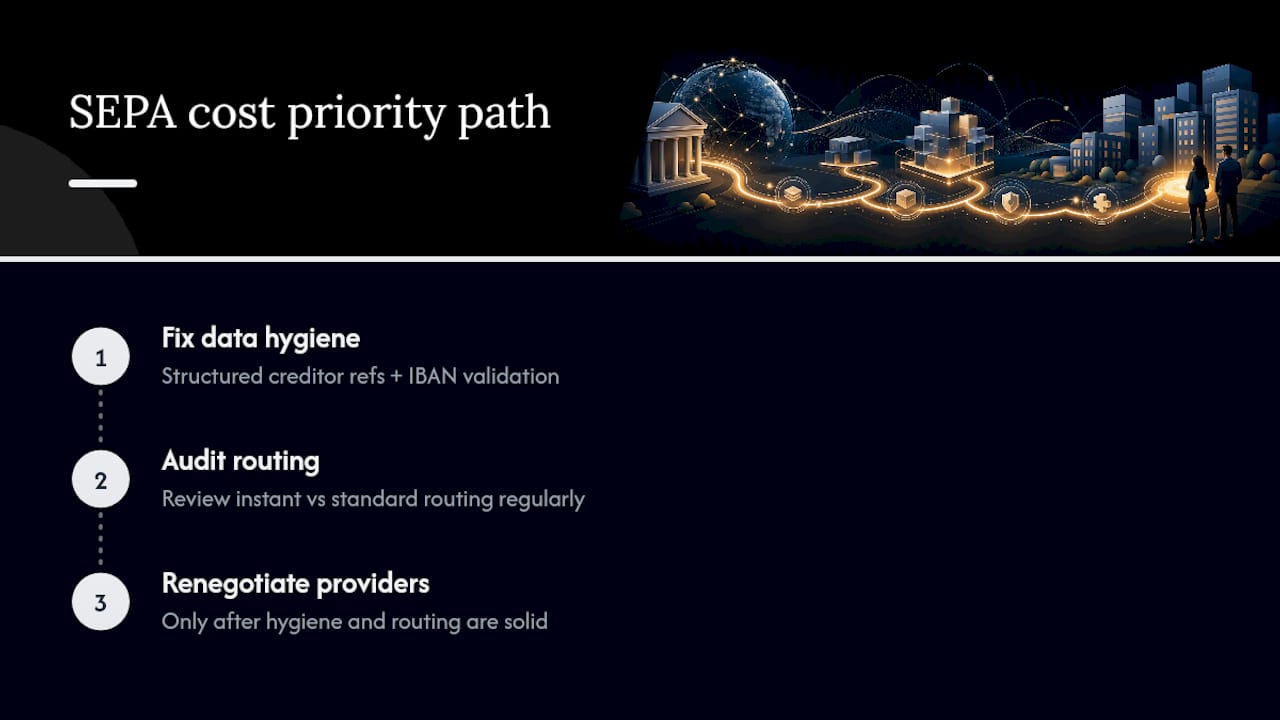
The overrated fix is switching providers purely on price. The underrated fix is fixing your own data hygiene first, because a rejected payment costs you twice: once in the fee, and once in the days of delayed cash flow while someone manually chases down what went wrong. Businesses with tight receivables cycles feel that second cost far more than the first.
If you take one thing from this, prioritize reconciliation mechanics before you renegotiate anything. Get structured creditor references and IBAN validation running consistently, then audit your instant-versus-standard routing. Only after those two things are solid does provider negotiation start moving the needle in any meaningful way.
— dd
Get Real Numbers on Your Own SEPA Costs
Demivolt is built for exactly the problem this article walks through: business payments where the fee structure is opaque until you’re already committed to a transfer. Rather than reading through a PSP’s price list and guessing which routing choice saves the most, you can model it directly.
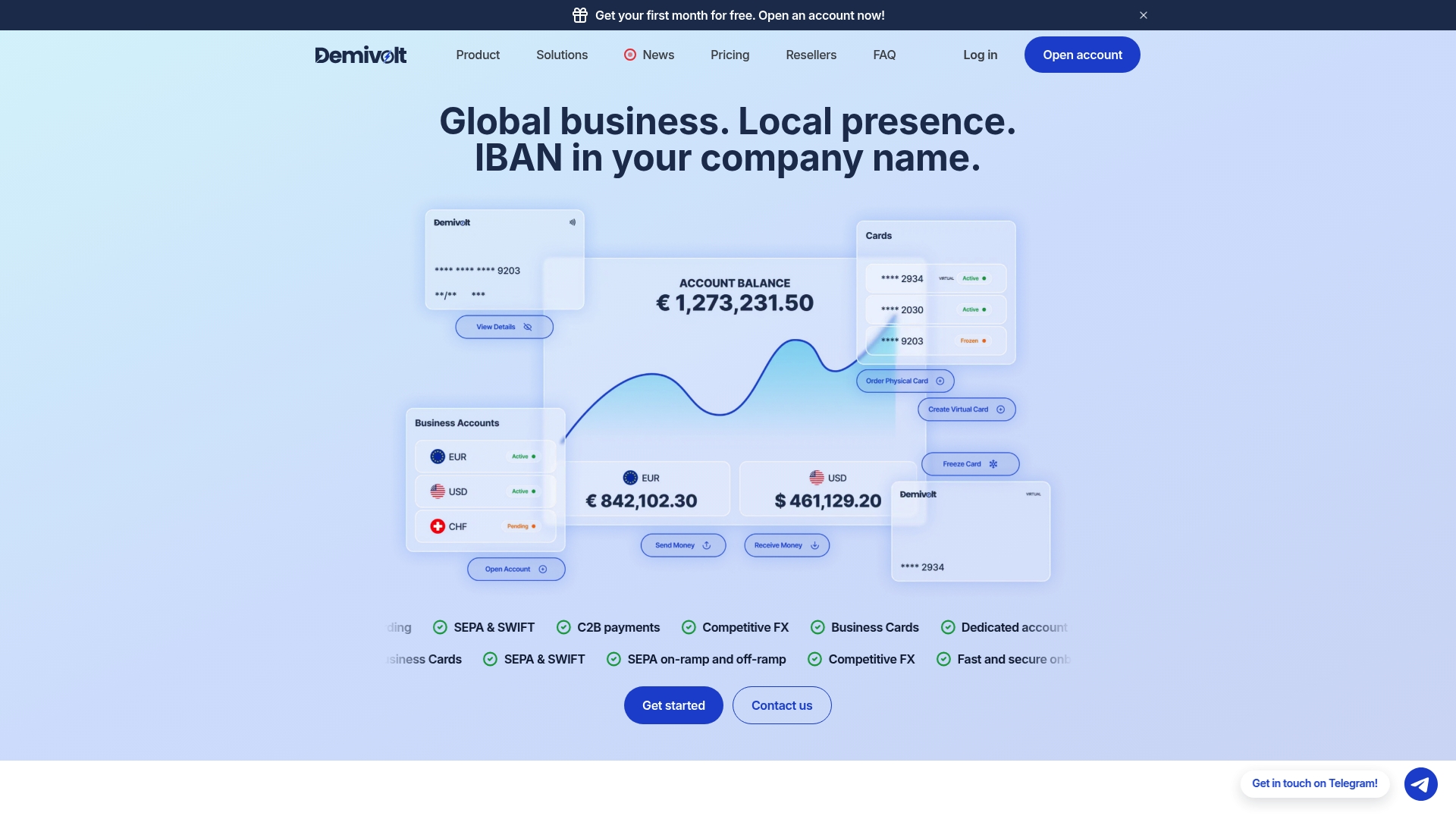
Demivolt gives you dedicated IBAN accounts, transparent SEPA and SWIFT processing, and the validation tools that prevent the repair fees eating into your margins. If your business sends recurring payroll, supplier payments, or cross-border transfers, the IBAN validator takes minutes to run against your existing payee list and flags formatting issues before they become returned payments. For a broader look at how IBANs function across account structures, Demivolt’s guide on what an IBAN is used for is a useful starting point if you’re setting up new accounts. Run a fee-savings snapshot on your current payment mix and see where standard SCT routing could replace unnecessary instant transfers, or open a Demivolt business account to start managing SEPA payments with full visibility into every fee line.