

TL;DR:
- A structured onboarding process moves new hires or clients from acceptance to full productivity through detailed phases. Proper sequencing and tools, such as checklists and feedback loops, prevent delays, confusion, and disengagement. Extending onboarding beyond 90 days improves retention, productivity, and long-term role mastery.
A step by step onboarding process is a structured sequence of coordinated activities that moves new hires or clients from their first day to full productivity with clarity, compliance, and connection. Structured onboarding improves retention by 82% and productivity by 70% in the first year. Those numbers mean a well-designed onboarding plan is one of the highest-return investments an SME can make. The Society for Human Resource Management (SHRM) draws a clear line between orientation, a one-day administrative event, and onboarding, a months-long process built around role clarity and relationship building. This guide gives you the exact phases, tools, and execution tactics to build an onboarding program that actually works.
What are the key stages of a step by step onboarding process?
Every effective onboarding program follows a logical sequence. Skip a phase or reorder the steps, and you create bottlenecks, confusion, and disengagement.
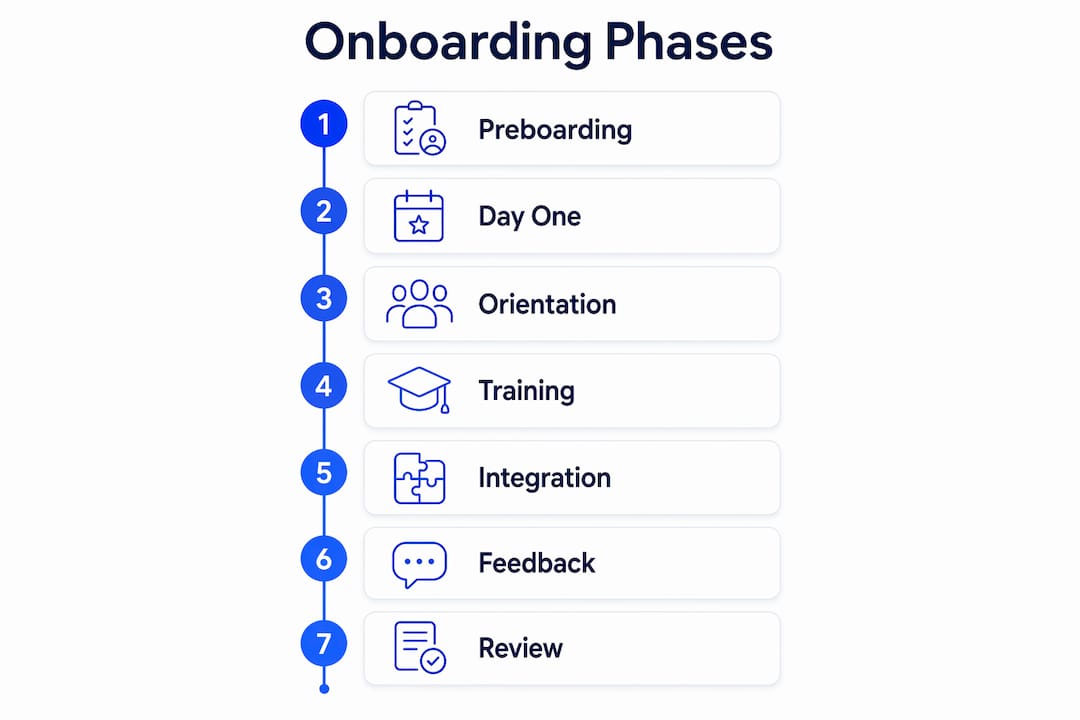
The seven core phases
- Preboarding (offer acceptance to Day 1). Send the offer letter, collect digital paperwork, ship equipment, and set up system access. The goal is to eliminate administrative friction before the new hire walks in the door.
- Day 1 orientation. Cover the essentials: team introductions, office or remote setup confirmation, a clear agenda for the week, and a welcome from a senior leader. Keep it light. Overloading new hires on Day 1 causes anxiety and reduces information absorption.
- First week training. Introduce role-specific tools, workflows, and key contacts. Schedule short daily check-ins with the direct manager. Avoid back-to-back training blocks longer than 90 minutes.
- Days 2–30: role immersion. Assign a first real project with clear scope and a defined deliverable. Pair the new hire with a buddy from outside their immediate team. Run a formal 30-day review with the manager.
- Days 31–60: independent contribution. Reduce hand-holding and increase ownership. The new hire should be running their own meetings and producing work with minimal supervision.
- Days 61–90: performance calibration. Conduct a structured 90-day review covering goals, gaps, and development needs. Only 29% of companies run a structured 90-day program. That gap is where most SME onboarding fails.
- Ongoing development (90 days and beyond). Set quarterly check-ins, assign stretch goals, and keep a feedback loop open. Onboarding often requires 6–12 months for full role mastery. Programs that end at 90 days risk hidden disengagement and turnover later.
Pro Tip: Treat each phase as a dependency chain. Equipment must arrive before access is provisioned. Access must be live before training begins. Map these dependencies before Day 1 to eliminate “waiting around” bottlenecks.
The sequencing matters as much as the content. A new hire who cannot log into their systems on Day 1 loses trust in the organization before they have done a single task.

What tools and prerequisites do you need for smooth onboarding?
The right tools reduce manual effort and prevent tasks from falling through the cracks. For SMEs, the priority is simplicity over complexity.
Core tools by function
- Digital paperwork platforms. Tools like DocuSign or PandaDoc collect signed contracts, tax forms, and policy acknowledgments before Day 1. This eliminates the paperwork pile that causes 52% of employees to disengage during onboarding.
- IT provisioning systems. A basic IT checklist tied to your HR system triggers laptop orders, email setup, and software licenses the moment an offer is accepted.
- Onboarding checklists. A shared onboarding checklist assigns every task to a named owner with a due date. Without ownership, tasks drift.
- Scheduling tools. Google Calendar or Microsoft Outlook, used with a template meeting schedule, removes the guesswork from booking training sessions and check-ins.
- Workflow tracking. Project management tools like Asana, Trello, or Notion let you see which onboarding tasks are complete, overdue, or blocked.
Pro Tip: Assign one onboarding owner per new hire. This person, usually the direct manager, is accountable for every task completing on time. HR handles compliance. The manager drives integration.
What to prepare before Day 1
The week before a new hire starts is the most critical window in the entire process. Confirm that the workspace or remote setup is ready, all accounts are provisioned, and a welcome email has been sent with a clear Day 1 agenda. Assign a buddy from a different team to handle informal questions. For SMEs managing funding alongside rapid hiring, simplifying the funding process can free up the cash flow needed to invest in proper onboarding infrastructure.
How to implement each onboarding step effectively
Knowing the phases is one thing. Executing them without common errors is another.
Preboarding execution
Send a welcome email within 24 hours of offer acceptance. Include the start date, first-day logistics, a link to complete digital paperwork, and a short note from the team. Ship equipment at least five business days before Day 1. Confirm IT access is live the day before the start date, not the morning of.
Day 1 through week 1
Keep Day 1 to four hours of structured activity maximum. Use the afternoon for informal team time. Spread product and process training across the full first week, not a single day. Spreading training over weeks improves absorption and reduces stress. Schedule a 15-minute daily check-in between the new hire and their manager for the first two weeks.
Common mistakes to avoid
- Delayed IT setup. A new hire who cannot access their tools on Day 1 loses momentum immediately. Provision access before they arrive.
- No feedback loops. 26% of employees receive no feedback during their first year. Build weekly manager touchpoints into the onboarding calendar from Day 1.
- Unclear role expectations. Write a 30/60/90-day goal document before the new hire starts. Share it on Day 1 so they know exactly what success looks like.
- HR-only ownership. Manager-led onboarding produces significantly better retention and role clarity than HR-only approaches. HR sets the structure. Managers execute the relationship.
- Ignoring remote needs. 75% of employees prefer hybrid onboarding models. For remote hires, replace physical office tours with virtual team introductions, recorded process walkthroughs, and a dedicated Slack or Teams channel for onboarding questions.
Pro Tip: For client onboarding, the same logic applies. Send a welcome pack, confirm account access, and schedule a kickoff call before the contract start date. A practical client onboarding guide can help you adapt employee onboarding frameworks to client relationships.
The most overlooked execution detail is pacing. New hires can absorb roughly three to five new concepts per day before retention drops. Build your training calendar around that limit, not around what is convenient for the trainer.
How can you measure onboarding success and improve over time?
A well-run onboarding program generates measurable data. Track it, and you can improve every future cohort.
Key metrics to monitor
- 90-day retention rate. The percentage of new hires still employed at 90 days. This is your primary signal of onboarding health.
- Time to productivity. How long it takes a new hire to complete their first independent deliverable at the expected quality level.
- New hire satisfaction score. A short survey at 30 and 90 days asking new hires to rate clarity, support, and readiness. Keep it to five questions maximum.
- Manager satisfaction score. Ask managers to rate new hire readiness at 30 and 90 days. Gaps between manager and employee scores reveal communication failures.
Building a feedback loop
Run a 30-day survey, a 60-day check-in conversation, and a formal 90-day review for every new hire. Explicit feedback loops support faster adjustment and higher satisfaction. After each cohort, update your onboarding checklist based on what new hires flagged as confusing or missing. Treat the process as a living document, not a one-time build.
| Metric | Measurement method | Review cadence |
|---|---|---|
| 90-day retention rate | HR system headcount data | Monthly |
| Time to productivity | Manager assessment | At 30 and 60 days |
| New hire satisfaction | 5-question survey | At 30 and 90 days |
| Manager satisfaction | 3-question manager survey | At 30 and 90 days |
The data from these reviews tells you exactly where your onboarding plan breaks down. Most SMEs discover the same two failure points: delayed IT setup and insufficient feedback in weeks two through four.
Key Takeaways
A structured, manager-led onboarding process that extends well beyond 90 days is the single most effective way for SMEs to improve retention, accelerate productivity, and reduce early turnover.
| Point | Details |
|---|---|
| Sequence dependencies first | Provision equipment before access, and access before training, to prevent Day 1 bottlenecks. |
| Distribute paperwork early | Move all administrative tasks to preboarding so Day 1 focuses on people, not forms. |
| Assign manager ownership | HR sets compliance structure; managers drive integration, feedback, and culture. |
| Extend beyond 90 days | Full role mastery takes 6–12 months; programs that stop at 90 days risk hidden turnover. |
| Measure and iterate | Track retention, productivity, and satisfaction scores at 30, 60, and 90 days, then update the process. |
What I have learned from watching SME onboarding fail
Most SME owners treat onboarding as a checklist to complete, not a process to design. That framing is the root cause of most early turnover I have seen.
The single biggest mistake is handing onboarding entirely to HR and walking away. HR is excellent at compliance: contracts, tax forms, policy sign-offs. But HR cannot replace the manager’s role in showing a new hire how decisions get made, who the real influencers are, and what “good work” actually looks like in your specific context. When managers opt out of onboarding, new hires fill that gap with assumptions. Those assumptions are usually wrong.
The second mistake is treating 90 days as the finish line. For knowledge roles, 90 days is roughly when a new hire starts to feel comfortable asking questions. Real productivity, the kind that justifies the hiring cost, typically arrives between months four and eight. Only 11% of employers extend onboarding past three months. That statistic explains a lot of the “great hire, gone by month six” stories I hear from SME owners.
The counterintuitive truth is that a more structured onboarding process actually feels less rigid to new hires. When people know what to expect, when their first check-in is, and what their 30-day goal is, they relax and perform better. Ambiguity is what creates anxiety, not structure.
— dd
Demivolt’s tools for SME onboarding efficiency
Running a growing SME means onboarding new team members and business clients at the same time. The administrative load compounds fast.
Demivolt’s business banking platform is built for exactly this situation. When you onboard a new client or business partner, validating their banking details is a critical compliance step. Demivolt’s free IBAN validator checks account numbers against ISO 13616 standards instantly, cutting a common source of payment errors during client onboarding. The full suite of free SEPA tools supports payment verification, reducing the manual back-and-forth that slows down financial onboarding for SMEs operating across European markets.
FAQ
What is a step by step onboarding process?
A step by step onboarding process is a structured sequence of activities that moves a new hire or client from initial acceptance through full productivity. It typically covers preboarding, Day 1 orientation, role training, and 30/60/90-day reviews.
How long should employee onboarding last?
Onboarding should last at least 90 days, but full role mastery takes 6–12 months for most knowledge roles. Programs that end at 90 days risk disengagement and turnover in months four through six.
What is the most common onboarding mistake?
Delayed IT setup and no structured feedback loops are the two most common failures. 52% of employees report excessive administrative tasks during onboarding, which signals poor preboarding preparation.
Who should own the onboarding process?
HR owns compliance tasks, but the direct manager must own integration, feedback, and culture. Manager-led onboarding produces significantly better retention and role clarity than HR-only approaches.
What metrics measure onboarding success?
Track 90-day retention rate, time to first independent deliverable, and new hire satisfaction scores at 30 and 90 days. These three metrics reveal where your onboarding plan breaks down and where to improve it.