

TL;DR:
- Effective SME financial onboarding requires risk-tiered workflows, continuous monitoring, and structured team training to reduce compliance and operational risks. Implementing progressive disclosure and real-time audit trails enhances client experience and audit readiness, while standardized workflows before automation prevent errors and inefficiencies. Strong governance, clear escalation paths, and appropriate technology tools ensure onboarding processes meet regulatory standards and support scalable growth.
Financial onboarding best practices are defined as the structured, risk-aware processes that regulated businesses use to verify client and counterparty identities, collect required documentation, and activate compliant payment workflows. For SMEs, getting this right is not optional. Regulatory pressure from EU frameworks, combined with the operational cost of manual rework, makes a digital-first, risk-tiered approach the standard for 2026. This article covers the core components, technology enablers, and governance structures that finance professionals need to build onboarding processes that hold up under scrutiny.
1. Financial onboarding best practices: the core components

Effective financial onboarding is built on five interdependent components: tailored risk assessment, digital-first data collection, clear client communication, progressive disclosure, and perpetual monitoring. Moody’s five-step framework confirms that onboarding must be calibrated to both the product type and the customer risk profile. A payment account for a domestic retailer carries different risk than a multi-currency account for a cross-border digital services firm. Treating them identically wastes compliance resources and frustrates low-risk clients.
Digital-first data collection replaces paper forms and email attachments with structured digital intake, e-signature tools, and automated document checks. This shift cuts processing time and reduces the transcription errors that trigger compliance flags downstream. Clear communication matters just as much: clients who understand what documents are needed and why are far less likely to submit incomplete files.
- Tailored risk profiles: Match onboarding depth to the actual risk level of each client and product.
- Digital intake: Use structured forms and e-documents to eliminate manual data entry.
- Progressive disclosure: Request only the data needed at each stage, not everything upfront.
- Perpetual monitoring: Replace one-time KYC/KYB checks with ongoing, automated review cycles.
- Feedback loops: Track where clients drop off and use that data to fix friction points.
Pro Tip: Build your onboarding checklist around the specific regulatory jurisdiction of each client. Onboarding requirements vary by country, product, and client type. A single global template will create compliance gaps in at least one market.
2. How progressive disclosure and risk tiering reduce drop-offs
Progressive disclosure is the practice of requesting only the information required at each specific step of the onboarding process, rather than presenting a full document checklist on day one. Progressive data collection is a critical success factor for reducing abandonment, particularly when combined with real-time document verification. The logic is simple: a client who sees a 40-field form on screen one is far more likely to abandon than one who completes three short steps over two days.
Risk tiering works alongside progressive disclosure to direct compliance effort where it is actually needed:
- Low-risk clients: Auto-approval after basic KYC checks. Typical for domestic sole traders with clean sanctions screening results.
- Medium-risk clients: Expedited human review, usually within 24 to 48 hours, with targeted document requests.
- High-risk clients: Enhanced due diligence, including source-of-funds verification, beneficial ownership mapping, and senior compliance sign-off.
Tiered KYB risk handling from Inyo Global demonstrates that this model keeps standard cases moving quickly while concentrating scrutiny on the cases that genuinely warrant it. The result is faster average approval times and a compliance team that is not buried in low-value reviews.
API integrations for document OCR and sanctions screening accelerate each tier. When a client uploads a passport or certificate of incorporation, automated OCR extracts the data instantly rather than waiting for a staff member to key it in manually. API-driven automation is cited as a critical factor in scalable onboarding operations by both Trio.dev and Inyo Global.
Pro Tip: Set a maximum document upload wait time of 72 hours before triggering an automated reminder. Clients who go silent at the document stage are usually confused, not disinterested. A single prompt with a clear explanation of what is missing recovers a significant share of stalled applications.
3. Ongoing governance and monitoring that actually hold up
One-time KYC/KYB checks at onboarding are no longer sufficient. Regulators in the EU and beyond now expect perpetual or near-real-time monitoring, meaning that client risk profiles are updated continuously as new information becomes available. Governance and auditability requirements from ComplyOne confirm that documented risk-rating criteria, periodic refreshes, and independent reviews are the baseline expectation for regulated fintechs and their SME clients.
The practical implication is that your compliance infrastructure needs to log every decision, not just the final approval. When a regulator or auditor requests your KYB file for a specific client, you need to produce a complete, time-stamped record of every check, every document reviewed, and every risk rating change. Scattered documentation is one of the most common failure modes in audit preparation, causing delays that can escalate into formal findings.
Strong governance structures for SME finance operations include:
- Risk-rating documentation: Written criteria for how each tier is assigned, reviewed annually.
- Audit trails: Every KYC/KYB decision logged at the time it is made, in a single exportable system.
- Periodic risk refreshes: Low-risk clients reviewed annually, high-risk clients reviewed quarterly or on trigger events such as ownership changes.
- Independent review: A compliance function or external reviewer who is not involved in day-to-day onboarding signs off on the governance framework at least once per year.
- Accountable ownership: One named individual holds responsibility for the onboarding compliance program, not a committee.
| Governance element | Recommended frequency |
|---|---|
| Risk-rating criteria review | Annual |
| Low-risk client refresh | Annual |
| High-risk client refresh | Quarterly or on trigger event |
| Audit trail export test | Quarterly |
| Independent governance review | Annual |
4. Structured onboarding plans for finance team members
The onboarding process for financial services teams is not only about clients. New finance hires in SMEs represent a significant operational risk during their first 90 days. Errors in payment processing, month-end close, or compliance reporting during this period are disproportionately costly. The Corporate Finance Institute recommends phased learning and active participation in critical close processes as the most effective way to reduce operational risk in early employment.
A structured 30-60-90 day plan gives new finance team members clear milestones and prevents the common failure mode of leaving someone to “figure it out” during a live reporting cycle.
- Days 1 to 30: System access, process documentation review, and shadowing. No independent transaction processing. Focus on understanding the ERP, payment workflows, and escalation paths.
- Days 31 to 60: Supervised participation in month-end close, payment runs, and reconciliation. Errors are caught before they reach the ledger.
- Days 61 to 90: Independent task ownership with weekly check-ins. The hire is now accountable for defined outputs, with a clear escalation path for edge cases.
Clear task ownership is the element most SMEs skip. When a new hire does not know who to escalate to for an unusual payment or a compliance query, they either delay or guess. Both outcomes are expensive. Document escalation paths as part of the onboarding pack, not as tribal knowledge passed on verbally. You can find a practical starting point in this SME onboarding checklist that covers phased training and compliance alignment.
5. Technology tools that support best-in-class onboarding
The right technology stack for financial onboarding in an SME does not need to be complex. It needs to cover four functions: identity verification, workflow routing, document management, and analytics.
Before adding any automation, IBM’s guidance on AI in finance is clear: redesign the workflow first. Automating a broken process produces faster errors, not better outcomes. Map your current onboarding steps, identify where decisions are made and where data is collected, and standardize those inputs before connecting any API or tool.
| Function | What it does | Example tools |
|---|---|---|
| Identity verification | KYC/KYB checks, sanctions screening, PEP lists | API-based providers integrated at intake |
| Workflow routing | Assigns risk tier and routes to correct review queue | Rules-based workflow engines |
| Document management | OCR extraction, storage, and audit trail logging | Centralized document management systems |
| Analytics | Tracks completion rates, drop-off points, and processing times | Onboarding dashboards with funnel reporting |
Analytics deserve more attention than most SMEs give them. Tracking where clients abandon the onboarding process tells you exactly where friction is highest. If 30% of applicants drop off at the document upload step, the problem is either the UX of the upload interface or the instructions provided. Both are fixable. UX and compliance design are inseparable: progress indicators, contextual help text, and clear error messages directly affect completion rates. For SMEs managing cross-border payments, a compliance-first onboarding guide provides additional depth on aligning digital intake with EU regulatory requirements.
Key takeaways
Effective financial onboarding for SMEs requires risk-tiered workflows, perpetual KYC/KYB monitoring, and structured team onboarding plans working together to reduce compliance risk and processing delays.
| Point | Details |
|---|---|
| Risk tiering is non-negotiable | Route low-risk clients to auto-approval and reserve enhanced due diligence for genuinely high-risk cases. |
| Progressive disclosure cuts abandonment | Request only the data needed at each step to keep clients moving through the process. |
| Audit trails must be real-time | Log every KYC/KYB decision at the moment it is made in a single exportable system. |
| Finance team onboarding needs structure | A 30-60-90 day plan with clear task ownership reduces errors during the highest-risk period. |
| Redesign before automating | Standardize workflows and decision points before connecting APIs or automation tools. |
What I have learned from watching SME onboarding fail
Most SME onboarding failures I have seen share one characteristic: the process was designed for the compliance team, not the client. The forms are exhaustive, the instructions are written in regulatory language, and the document requirements are presented all at once. The result is a 40% drop-off rate that the compliance team never sees because they are measuring approvals, not abandonment.
The counterintuitive lesson is that reducing friction at the front of the process actually improves compliance outcomes at the back. When clients understand what is being asked and why, they submit accurate documents the first time. When they are confused or overwhelmed, they submit whatever they have and hope for the best. That generates rework, delays, and the kind of incomplete files that cause problems during regulatory reviews.
The second lesson is that governance is not a document. I have reviewed onboarding frameworks where the written policy was excellent and the actual practice bore no resemblance to it. Perpetual monitoring was described in the policy but never operationalized. Audit trails existed in theory but were assembled manually from email threads when needed. The gap between policy and practice is where regulatory risk actually lives. Closing that gap requires named ownership, regular testing, and the willingness to treat the onboarding process as a live operational system rather than a compliance checkbox. For SMEs operating in the EU, the EU banking regulations guide is worth reviewing to understand what regulators are actually looking for during onboarding audits.
— dd
How Demivolt supports compliant financial onboarding for SMEs
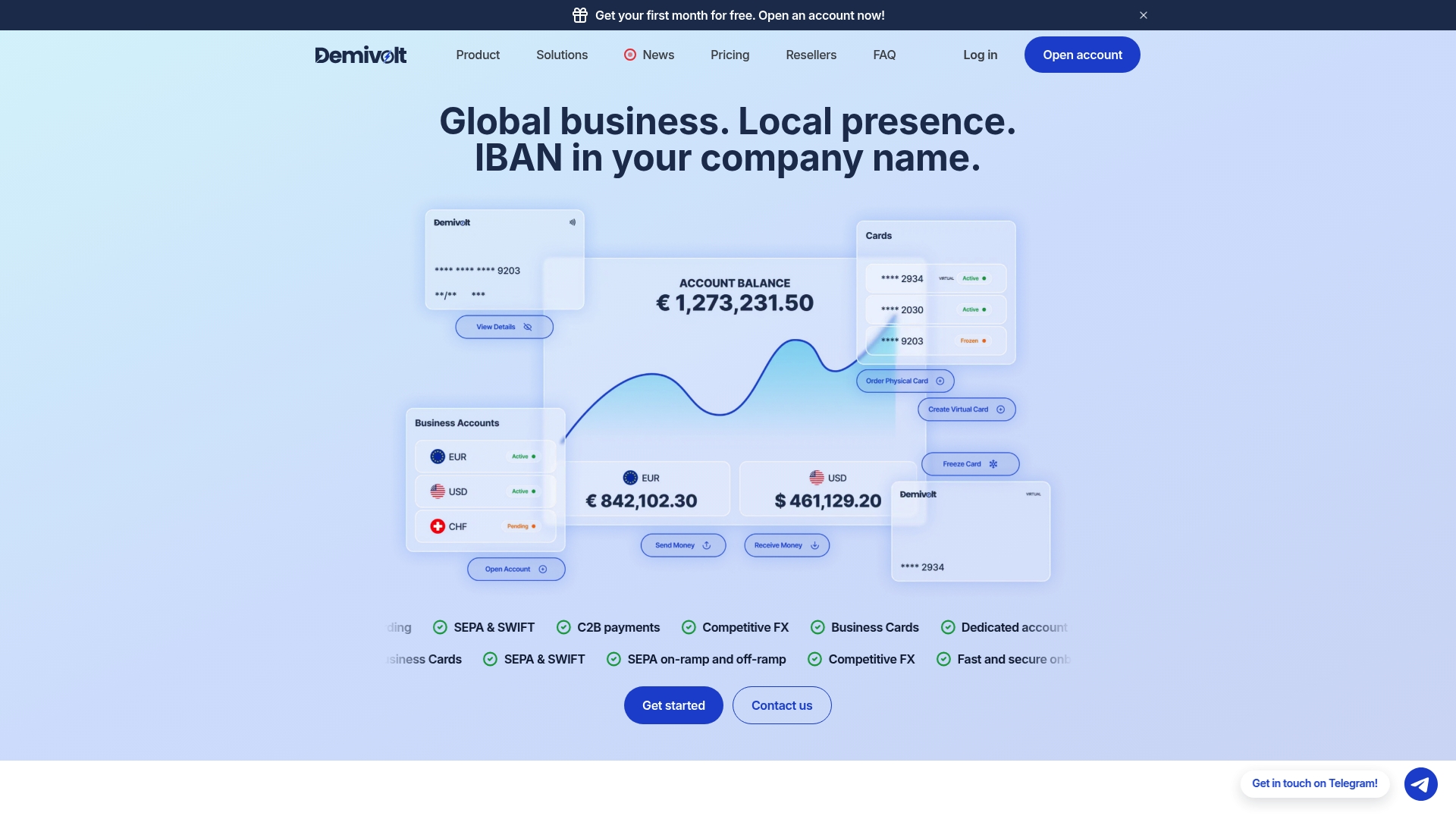
Demivolt is built for SMEs that need compliant, digital-first financial infrastructure without the complexity of enterprise banking. The platform supports dedicated IBAN accounts, SEPA and SWIFT payment management, and role-based user access, all within a framework that meets EU regulatory standards. For finance teams managing payment onboarding, the IBAN Validator provides free ISO 13616 verification to catch account number errors before they reach the payment run. Demivolt’s SEPA payment tools reduce manual verification steps and support the kind of audit-ready documentation that regulators expect. If your SME is building or rebuilding its financial onboarding process, Demivolt provides the infrastructure to do it correctly from the start.
FAQ
What are the core components of financial onboarding best practices?
Financial onboarding best practices include tailored risk assessment, digital-first data collection, progressive disclosure, and perpetual KYC/KYB monitoring. Moody’s framework confirms that onboarding must be calibrated to both product type and customer risk profile to be effective.
How does risk tiering improve the onboarding process for financial services?
Risk tiering routes low-risk clients to auto-approval, medium-risk clients to expedited review, and high-risk clients to enhanced due diligence. This model keeps standard cases moving quickly while concentrating compliance resources where they are genuinely needed.
Why is an audit trail critical in financial onboarding?
A real-time audit trail logs every KYC/KYB decision and source document at the moment it is made, in a single exportable system. Scattered documentation is a leading cause of compliance delays during regulatory reviews and audits.
What is a 30-60-90 day onboarding plan for finance teams?
A 30-60-90 day plan structures the first three months of a new finance hire’s employment into distinct phases: system familiarization, supervised participation in close processes, and independent task ownership. This phased approach reduces errors during the period when operational risk is highest.
How can SMEs improve financial onboarding without large technology budgets?
SMEs should redesign and standardize their onboarding workflows before adding any automation or API integrations. Fixing the process first prevents the common outcome of automating inefficient steps, which produces faster errors rather than better compliance outcomes.