

The SWIFT international payments system is a secure, standardized global messaging network that transmits payment instructions between financial institutions — it does not move money itself, but it is the authoritative channel through which banks communicate the intent, routing, and compliance data behind virtually every cross-border wire transfer. For finance teams, SWIFT is the backbone of international money transfer: it carries the structured data that drives reconciliation, satisfies sanctions screening, and, through SWIFT GPI, provides end-to-end traceability that legacy correspondent banking never offered.
Key facts every finance professional should know before reading further:
- SWIFT is a member-owned cooperative, not a government body, subject to oversight by central banks including those in the G10.
- SWIFTNet is the secure IP messaging infrastructure that transports authenticated financial messages between institutions.
- SWIFT GPI (Global Payments Innovation) provides real-time tracking via a Unique End-to-End Transaction Reference (UETR), with nearly 60% of GPI payments credited within 30 minutes and almost all within 24 hours.
- BIC / SWIFT code is the 8- or 11-character identifier required to route any international transfer to the correct institution.
- ISO 20022 is the structured data standard replacing legacy MT message formats, enabling richer remittance data and greater automation.
- SWIFT connects more than 11,000 financial institutions across more than 200 countries and territories.
Key Takeaways
The SWIFT international payments system is a messaging network, not a settlement system — and understanding that distinction is the foundation of every effective cross-border payment workflow.
| Point | Details |
|---|---|
| SWIFT carries instructions, not funds | Settlement happens through correspondent banking, Fedwire, or CHIPS — not through SWIFT itself. |
| GPI delivers real-time tracking | Nearly 60% of GPI payments credit within 30 minutes; log the UETR in your systems for reconciliation. |
| Data quality drives compliance | Accurate BIC, IBAN, and beneficiary name fields are compliance obligations, not just routing requirements. |
| ISO 20022 migration is underway | Audit your ERP parsers and map MT-to-MX fields now; the migration affects every institution on the network. |
| Demivolt supports SWIFT workflows | Dedicated IBAN accounts, pre-validation tooling, and API integrations provide regulated SWIFT infrastructure for SMEs. |
Table of Contents
- What Is the SWIFT International Payments System?
- How SWIFT Enables International Payments
- What Data Does a SWIFT Payment Actually Require?
- How Settlement Actually Happens: SWIFT vs. Fund Movement
- ISO 20022: What It Means for Your Finance Team
- How SWIFT Supports Security, AML, and Sanctions Compliance
- How Businesses Send SWIFT Payments: Steps, Timelines, and Fees
- Connectivity Options: How Do You Connect to SWIFT?
- SWIFT vs. Domestic Rails: Choosing the Right Payment Method
- How Demivolt Supports SWIFT Payment Workflows
- The Future of Cross-Border Payments: A Perspective for Treasury Teams
- Sources
What Is the SWIFT International Payments System?
SWIFT — the Society for Worldwide Interbank Financial Telecommunication — was established in 1973 as a member-owned cooperative to replace the fragmented, error-prone telex systems that banks had relied on for cross-border communication. Its core mission has remained consistent: provide a secure, standardized messaging platform, maintain the technical standards that govern financial messages, and supply the software and network services that connect institutions globally.
The cooperative structure is deliberate. No single government or commercial entity controls SWIFT. Membership is open to banks, broker-dealers, investment managers, market infrastructures, and corporate treasury operations, all of which share governance responsibilities. That design preserves systemic neutrality and is one reason central banks trust SWIFT as a critical financial infrastructure provider.
Network scale: According to SWIFT’s own reporting, the network processes more than 53 million FIN messages per day across 40,000+ payment routes worldwide. Those figures reflect the systemic weight SWIFT carries in global finance — disruption to the network would affect payment flows across virtually every major economy.
Governance oversight sits with the National Bank of Belgium as lead overseer, supported by the central banks of the G10 countries. This arrangement is not merely ceremonial. Oversight bodies review SWIFT’s operational resilience, security standards, and risk management frameworks. For finance teams, that oversight translates into a level of institutional trust that private payment processors do not carry by default.
SWIFT’s membership spans commercial banks, central banks, custodians, clearing houses, and, increasingly, corporate treasury departments that connect directly through SWIFT’s corporate access programs. The network’s reach means that a payment instruction originating at a US multinational’s treasury system can reliably reach a beneficiary bank in Singapore, Brazil, or South Africa using the same message standards and routing logic.
How SWIFT Enables International Payments
Understanding the message lifecycle is the most practical thing a finance team can do before building or auditing a cross-border payment workflow.
The message lifecycle
- Initiation. Your treasury or AP team enters payment details in an ERP, TMS, or bank portal. The system formats the instruction as a SWIFT message.
- Message formation. The sending bank validates the message structure, applies compliance screening, and queues it for transmission over SWIFTNet.
- Transmission. SWIFTNet, SWIFT’s secure IP-based messaging backbone, routes the authenticated message toward the beneficiary bank, often via one or more correspondent banks.
- Intermediary notifications. Each institution in the chain acknowledges receipt and updates the GPI tracker, giving the originator real-time visibility.
- Beneficiary bank confirmation. The receiving bank credits the beneficiary account and sends a confirmation message back through the chain.
SWIFTNet itself is not a bank or a settlement system. It is the encrypted, authenticated transport layer that carries messages between institutions. Think of it as a highly regulated postal network for financial instructions: it guarantees delivery and authentication, but the actual value movement happens elsewhere (covered in the settlement section below).
MT vs. MX messages
SWIFT has historically used MT (Message Type) formats — structured but relatively limited text-based messages. The industry is now migrating to MX messages, which are built on the ISO 20022 XML standard and carry significantly richer, structured data.
| Feature | MT (legacy) | MX / ISO 20022 |
|---|---|---|
| Data structure | Fixed-field text | Structured XML |
| Remittance data | Limited, often truncated | Rich, structured, machine-readable |
| Reconciliation support | Manual matching common | Automated straight-through processing |
| Regulatory reporting | Partial | Comprehensive, granular |
| Current status | Being phased out | Mandatory migration underway |
| Typical use | Legacy cross-border wires | Modern SWIFT and domestic rails |
SWIFT GPI and what it changes for your treasury
SWIFT GPI is the most significant operational improvement to the cross-border payment system in decades. Every GPI payment carries a UETR — a unique, immutable reference that travels with the instruction through every correspondent in the chain. Finance teams can query the GPI tracker at any point and see exactly where a payment sits, which institution is holding it, and what fees have been deducted.
GPI speed: Nearly 60% of GPI payments are credited within 30 minutes. Almost all complete within 24 hours. For treasury teams managing supplier relationships or intercompany flows, that predictability replaces the traditional “call your bank and wait” exception process.
GPI also includes a stop-and-recall feature. If a payment is sent to the wrong account or flagged as potentially fraudulent, the originating institution can issue a recall request that propagates through the chain in near real time. That capability is a material improvement over the legacy model, where irrevocable wires were genuinely difficult to recover.
What Data Does a SWIFT Payment Actually Require?
Every cross-border payment instruction depends on two identifiers working correctly: the BIC (Business Identifier Code, commonly called the SWIFT code) and, for most corridors, the IBAN (International Bank Account Number).
A BIC is either 8 or 11 characters:
- 8-character BIC: Identifies the institution and country (e.g.,
CHASUS33for JPMorgan Chase, US). - 11-character BIC: Adds a branch code (e.g.,
CHASUS33XXX), whereXXXdenotes the head office.
An IBAN follows the ISO 13616 standard. A typical European IBAN looks like DE89 3704 0044 0532 0130 00 — country code, check digits, and the domestic account number combined into a single validated string. US banks do not issue IBANs for domestic accounts, but US companies paying into IBAN-based corridors (the EU, UK, and many others) must supply the beneficiary’s IBAN precisely.
According to Investopedia, the BIC is required to identify the specific bank involved in any international transfer. An incorrect or missing BIC is one of the most common causes of payment failure.
Beyond the BIC and IBAN, banks typically require:
- Full legal name of the beneficiary (must match the account exactly)
- Beneficiary’s full address
- Purpose of payment or remittance reference
- Correspondent bank BIC where applicable
- Currency and amount
The most frequent failure causes are a beneficiary name that does not match the account record, a wrong or outdated BIC, and a missing or malformed IBAN. Each of these triggers a manual exception, adds days to settlement, and often incurs additional fees.
Pro Tip: Implement beneficiary pre-validation before submission. SWIFT’s pre-validation tooling and bank-provided payee directories verify account details against live data before the payment is initiated. Integrating an automated IBAN/BIC validator into your AP or TMS workflow reduces rejections at the source rather than managing them as exceptions after the fact.
How Settlement Actually Happens: SWIFT vs. Fund Movement
The most persistent misconception about SWIFT is that it moves money. It does not. SWIFT carries the instruction; settlement happens through a separate, parallel system of correspondent banking relationships and domestic clearing rails.

The correspondent banking chain
When a US company’s bank (Bank A) sends a payment to a beneficiary at a bank in Germany (Bank C), the two institutions likely do not hold accounts with each other. Instead, the payment routes through a correspondent bank (Bank B) that maintains accounts with both. The mechanics work like this:
- Bank A debits the corporate’s account and sends a SWIFT message instructing Bank B to pay Bank C.
- Bank B debits Bank A’s nostro account (Bank A’s account held at Bank B) and credits Bank C’s vostro account (Bank C’s account held at Bank B).
- Bank C credits the beneficiary’s account.
The SWIFT message and the ledger entries happen in parallel but are distinct processes. The message travels in seconds; the ledger entries depend on cut-off times, correspondent relationships, and the settlement rails each institution uses.
US settlement rails and their interaction with SWIFT
For USD-denominated international payments, two domestic rails handle the actual value movement:
- Fedwire Funds Service: The Federal Reserve’s real-time gross settlement system. Fedwire settles individual transactions in real time during operating hours, making it the preferred rail for large-value, time-sensitive USD payments.
- CHIPS (Clearing House Interbank Payments System): Operated by The Clearing House, CHIPS nets multilateral positions throughout the day and settles final positions over Fedwire. It handles the majority of large-value cross-border USD transactions.
Key operational implications for finance teams:
- Fedwire and CHIPS have cut-off times (Fedwire closes at 6:00 PM ET for most transfers). Payments initiated after cut-off settle the next business day.
- Correspondent chains add fees at each hop. A three-bank chain can deduct fees from the payment amount unless SHA or OUR fee instructions are specified.
- The number of correspondents in a corridor directly affects both cost and timing. Well-connected corridors (USD/EUR, USD/GBP) typically settle faster and cheaper than exotic corridors with multiple hops.
ISO 20022: What It Means for Your Finance Team
ISO 20022 is the international standard for financial messaging that underpins MX messages on SWIFT and is being adopted across domestic rails globally, including Fedwire. The migration from legacy MT formats to ISO 20022 MX is not a technical curiosity — it has direct operational consequences for corporate treasury.
Why it matters: ISO 20022 messages carry structured, machine-readable remittance data that MT messages could not reliably transmit. That means invoice references, purchase order numbers, and payment purpose codes travel with the funds instruction in a format your ERP can parse automatically. The result is a material reduction in manual reconciliation effort and a significant improvement in straight-through processing rates.
SWIFT’s Payments modernization program is driving ISO 20022 adoption across the network, with the goal of enabling richer data flows that benefit both financial institutions and corporate clients.
For finance teams, the practical preparation checklist looks like this:
- Audit your back-office parsers. Confirm that your ERP, TMS, or accounting system can ingest ISO 20022 XML. Many legacy systems parse MT fields only.
- Map MT fields to MX equivalents. Key fields like remittance information (MT field 70) map to structured ISO 20022 elements. Document the mapping before your bank switches.
- Log and test UETR fields. Ensure your systems capture the UETR from incoming MX messages and store it for reconciliation and exception workflows.
- Confirm your bank and any third-party providers support MX. Not all banks have completed the migration. Ask explicitly.
- Prioritize high-volume corridors first. Focus ISO 20022 readiness on the payment corridors where you send the most volume — the reconciliation gains will be most visible there.
The migration timeline is a medium-term priority, not a distant one. Banks that have already completed the transition are sending MX messages now. Treasury teams that delay parser upgrades will face growing volumes of messages their systems cannot process automatically.
How SWIFT Supports Security, AML, and Sanctions Compliance
SWIFT is a neutral cooperative, not a regulator. It does not itself screen payments for sanctions or AML violations. What it does is provide the standardized message structure and network infrastructure that makes compliance screening possible and consistent across thousands of institutions.

SWIFT’s cooperative governance and central-bank oversight are deliberate design choices that preserve systemic stability. Because every institution on the network uses the same message standards, compliance data travels in predictable, machine-readable fields that screening systems can interrogate reliably.
Every SWIFT payment message carries mandatory fields that financial institutions use for compliance purposes:
- Ordering customer details (name, address, account number of the sender)
- Beneficiary details (name, address, account number of the recipient)
- Correspondent bank identifiers (BICs of all institutions in the chain)
- Purpose of payment and remittance reference
Banks apply AML/CTF screening and sanctions checks at the point of message formation and again at receipt. The quality of those checks depends entirely on the accuracy and completeness of the data in those fields. An incomplete beneficiary name or a missing address field does not just cause a routing failure — it can trigger a compliance hold that delays the payment by days.
Compliance scale: SWIFT processes more than 53 million messages per day, each carrying structured compliance data that institutions use for sanctions screening. The volume underscores why data quality at the point of initiation is a compliance obligation, not just an operational preference.
Pro Tip: Require your bank or payment provider to confirm that message-level sanctions screening, transaction monitoring, and audit trail retention are in place for every SWIFT payment corridor you use. For high-risk corridors, ask specifically whether GPI stop-and-recall is supported — it provides a meaningful last line of defense against misdirected or fraudulent payments.
Finance teams should also maintain their own internal controls: a pre-approved beneficiary list, dual-authorization for payments above defined thresholds, and a documented exception-handling process for payments that are held or returned. These controls complement the bank’s screening rather than substitute for it.
How Businesses Send SWIFT Payments: Steps, Timelines, and Fees
The operational workflow for initiating a SWIFT payment is consistent across most bank portals, ERPs, and TMS platforms, though the interface varies.
Step-by-step process
- Gather required data. Beneficiary legal name, full address, IBAN (or local account number), BIC/SWIFT code, correspondent bank BIC if required, currency, amount, and remittance reference.
- Initiate in your ERP, TMS, or bank portal. Enter the payment details and select the appropriate payment type (international wire / SWIFT).
- Pre-validate. Use an automated IBAN/BIC validator before submission. This step alone eliminates the majority of rejection causes.
- Authorization. Apply your internal dual-control or approval workflow. Most treasury policies require a second authorizer for international payments above a threshold.
- Transmission. Your bank formats and transmits the SWIFT message. You receive a UETR for tracking.
- Track via GPI. Query the GPI tracker using the UETR to monitor progress through the correspondent chain.
- Confirm credit. Reconcile against the beneficiary confirmation and log the UETR in your system.
Typical timelines
| Scenario | Typical time to credit |
|---|---|
| GPI-enabled, major corridor (e.g., USD/EUR) | 30 minutes to 4 hours |
| GPI-enabled, less common corridor | Same day to 24 hours |
| Non-GPI, well-connected corridor | 1–2 business days |
| Non-GPI, multi-hop corridor | 2–4 business days |
| Payment held for compliance review | Indeterminate; typically 1–5 days |

Cut-off times matter significantly. A USD payment initiated after Fedwire’s 6:00 PM ET close will not begin settling until the next business day, regardless of how quickly SWIFT delivers the message.
Fees and common failure reasons
SWIFT fees typically include a sending bank fee, a correspondent bank fee (deducted from the payment amount unless OUR instructions are specified), and a receiving bank fee. The total varies by corridor and correspondent chain length.
Common failure causes and their remediation:
- Incorrect BIC: Verify against the SWIFT BIC directory or your bank’s validated payee list before submission.
- Malformed or missing IBAN: Use an ISO 13616-compliant validator. A free IBAN validator can catch format errors before the payment leaves your system.
- Beneficiary name mismatch: The name on the payment must match the account record exactly. Even minor discrepancies (abbreviations, missing legal suffixes) trigger holds.
- Sanctions hit: If a beneficiary or correspondent appears on a sanctions list, the payment is held pending compliance review. Maintain an up-to-date internal sanctions screening process.
- Missing remittance data: Many banks in IBAN corridors require structured remittance references. Truncated or absent references cause manual matching delays at the receiving end.
Connectivity Options: How Do You Connect to SWIFT?
Finance and IT teams have four primary paths to SWIFT connectivity, each with different cost, control, and integration profiles.
-
Bank-hosted portal: The lowest-effort option. You initiate payments through your bank’s online platform; the bank handles all SWIFT connectivity and message formatting. Suitable for lower payment volumes with no integration requirement. The tradeoff is limited visibility into message-level data and dependency on the bank’s portal capabilities.
-
Bank API: Many major US banks now offer REST or ISO 20022-based APIs that allow your ERP or TMS to submit payment instructions programmatically. This option provides better data fidelity and automation than a portal, with moderate integration effort. Confirm whether the bank’s API supports MX messages and UETR passthrough.
-
Third-party gateway or fintech provider: A regulated fintech or payment gateway sits between your systems and the SWIFT network, handling message formatting, pre-validation, compliance screening, and GPI tracking. This path offers rapid integration, value-added features (exception dashboards, reconciliation tools), and often better support for ISO 20022 than legacy bank portals. It is the most practical option for mid-sized corporates that need more control than a portal provides but are not ready for direct SWIFT membership.
-
SWIFT Alliance Direct: Full direct connectivity to SWIFTNet, giving your treasury complete control over message formation, routing, and data. The cost and operational overhead are significant — dedicated infrastructure, SWIFT membership fees, and ongoing compliance obligations. Appropriate for large corporates or financial institutions with very high payment volumes and specific control requirements.
Decision criteria
When choosing a connectivity model, weigh these factors:
- Payment volume: Low volume favors bank portals; high volume justifies API or direct connectivity.
- Latency requirements: Real-time visibility into payment status requires GPI-capable connectivity, not all portals provide it.
- Control over messaging: If your compliance team needs message-level audit trails, a portal may not give you enough data.
- Compliance posture: Third-party gateways that handle pre-validation and screening reduce your internal compliance burden.
- Total cost of ownership: Direct SWIFT membership has high fixed costs. For most SMEs and mid-market corporates, a bank API or regulated fintech provider delivers better economics.
A typical mid-sized corporate integration stack runs: ERP → TMS → third-party gateway or bank API → SWIFT network. The IT requirements center on API authentication (OAuth 2.0 or equivalent), data mapping between internal formats and ISO 20022 MX, and secure credential management.
SWIFT vs. Domestic Rails: Choosing the Right Payment Method
Not every cross-border payment needs SWIFT, and not every domestic payment should use it. The right rail depends on currency, speed, cost, and data requirements.
Practical context: For US companies, domestic USD payments between US banks are almost always better served by ACH, RTP, or Fedwire than by SWIFT. SWIFT’s value is in cross-border and cross-currency flows where no domestic rail can reach.
Decision factors by scenario:
- Paying an overseas supplier in EUR or GBP: SWIFT is the standard path. Use GPI-enabled routing for traceability and confirm the beneficiary’s IBAN and BIC before submission.
- Domestic USD payroll or vendor payments: ACH (via Nacha) is cheaper and sufficient for non-urgent flows. The RTP network (The Clearing House) handles real-time domestic USD transfers up to $1 million.
- Large-value, time-sensitive domestic USD: Fedwire is the appropriate rail. It settles in real time during operating hours and carries finality.
- High-volume, large-value cross-border USD: CHIPS nets positions efficiently and is the standard for institutional USD cross-border flows.
- Intercompany transfers within a multinational: SWIFT with ISO 20022 MX messages provides the richest data for intercompany reconciliation. For EUR-denominated intercompany flows within the EU, SEPA Credit Transfer is faster and cheaper — see the SEPA vs. SWIFT comparison for a detailed breakdown.
For finance teams managing multiple corridors, the practical approach is to map each corridor to its optimal rail based on these criteria, then build that logic into your TMS or payment rules engine. Defaulting every international payment to SWIFT regardless of corridor is a common source of unnecessary cost and delay.
How Demivolt Supports SWIFT Payment Workflows
Demivolt is a regulated fintech platform built for businesses that need reliable, compliant infrastructure for cross-border payments, including SWIFT. For finance teams that have worked through the concepts in this article, Demivolt translates them into operational capabilities.
Relevant features for SWIFT workflows:
- Dedicated IBAN accounts for receiving and sending international payments, with full SWIFT payment processing support.
- Pre-validation tooling that checks beneficiary IBAN and BIC details before submission, reducing the rejection rate that manual entry creates.
- Multi-account structures that allow treasury teams to segregate payment flows by entity, currency, or business unit.
- Role-based user management with dual-authorization controls, supporting the internal approval workflows that compliance policies require.
- API and ERP integrations that connect Demivolt’s payment infrastructure to your existing systems, supporting ISO 20022-compatible data flows.
- Regulated infrastructure with segregated client accounts, meeting EU regulatory standards and providing the compliance foundation that finance teams need when selecting a payment partner.
For teams managing exception handling, Demivolt’s account structure and transaction visibility reduce the time spent chasing payment status across correspondent chains. The combination of pre-validation and structured remittance data support means fewer payments enter the exception queue in the first place. For a deeper look at how SWIFT workflows apply to SMEs specifically, the SWIFT payment guide for European SMEs covers practical examples and corridor-specific considerations.
The Future of Cross-Border Payments: A Perspective for Treasury Teams
The conventional wisdom in treasury circles is that SWIFT is slow, opaque, and expensive. That view was accurate for the pre-GPI, pre-ISO 20022 era. It is increasingly outdated.
GPI has already changed the speed and visibility equation. The 60% of payments credited within 30 minutes figure is not a marketing claim — it reflects a genuine operational shift that finance teams can measure in their own exception queues. The teams winning on cross-border efficiency right now are not the ones waiting for a better network to emerge. They are the ones that have enabled UETR tracking, implemented pre-validation, and mapped their ISO 20022 migration.
ISO 20022 is the more consequential long-term shift. The richer data it carries does not just improve reconciliation — it creates the foundation for automated compliance screening, real-time liquidity forecasting, and straight-through processing rates that were impossible with MT messages. Treasury teams that invest in parser upgrades and MX mapping now will have a structural advantage over those that treat it as a future IT project.
The practical recommendations for finance leaders acting now:
- Enable UETR tracking in your TMS or ERP and log it against every outbound SWIFT payment.
- Test MX messages on your highest-volume corridors before your bank completes the mandatory migration.
- Implement pre-validation as a standard step in your AP workflow, not an optional check.
- Centralize exception handling with a defined escalation path and documented SLAs for each corridor.
Demivolt’s infrastructure is built around these practices. For teams that want a payment partner aligned with where cross-border payments are going rather than where they have been, that alignment matters.
Demivolt: SWIFT-ready business banking for finance teams
Finance teams that have read this far understand what a well-functioning SWIFT payment workflow requires: validated beneficiary data, GPI-enabled tracking, ISO 20022-compatible infrastructure, and a regulated provider that supports the compliance controls your policy demands.
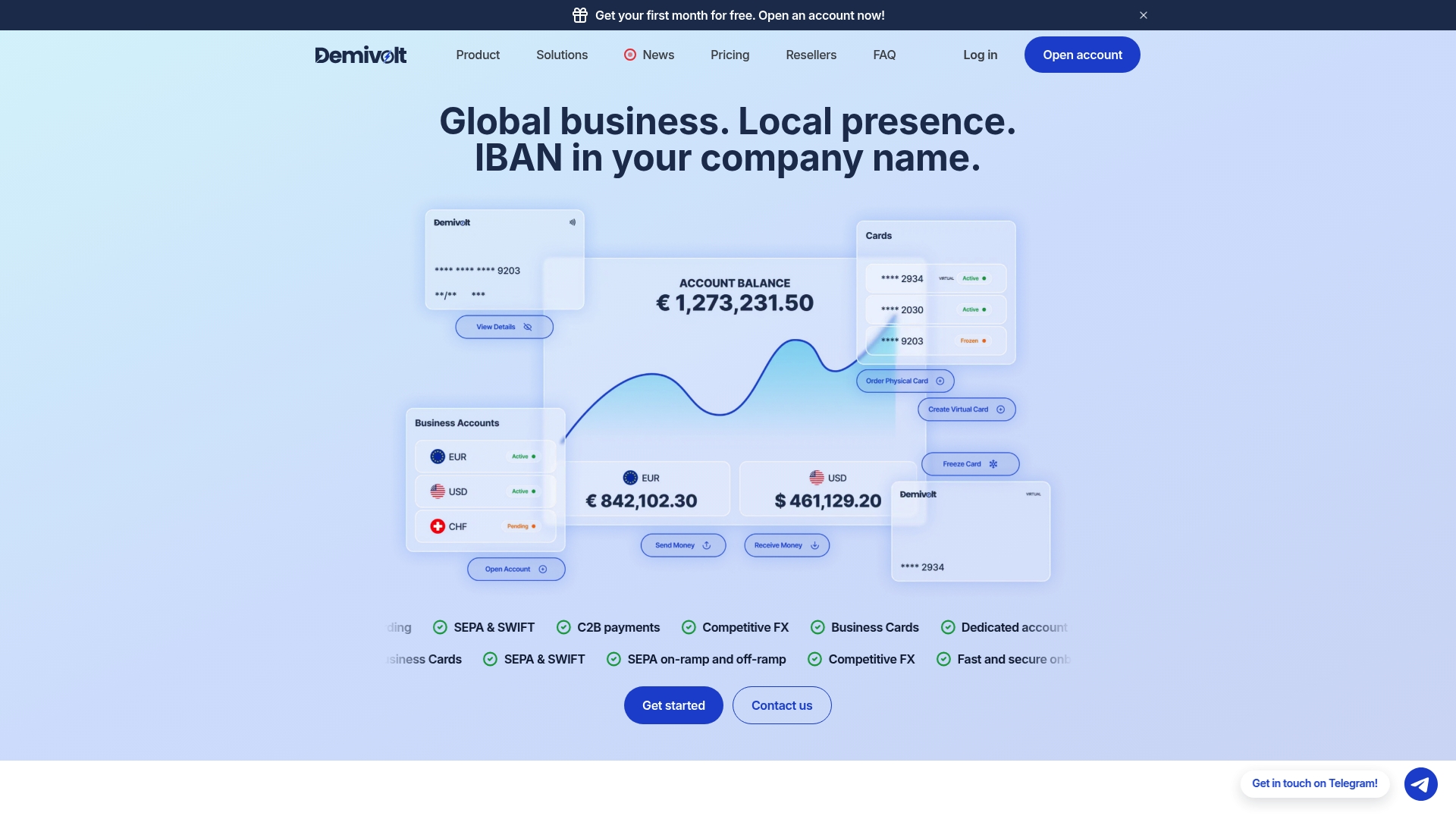
Demivolt delivers exactly that. As a regulated fintech platform, Demivolt provides dedicated IBAN accounts, full SWIFT payment processing, pre-validation tooling, and API integrations that connect to your ERP or TMS without the overhead of direct SWIFT membership.
Who Demivolt is built for:
- Founders and CFOs at SMEs managing cross-border supplier or intercompany payments
- Finance teams at digital-first and e-commerce businesses that need reliable international payment infrastructure
- Fintech platforms and business advisors seeking regulated Banking-as-a-Service (BaaS) infrastructure with SWIFT and SEPA support
The next step is straightforward: open a business account with Demivolt, access free payment tools including an IBAN validator and SEPA utilities, and connect your existing systems via API. Your team can be processing validated SWIFT payments through a regulated, compliant infrastructure without the complexity of direct network membership.
Sources
The following primary sources provide authoritative detail for treasury teams implementing or auditing SWIFT payment workflows:
- Who we are | Swift
- SWIFT Banking System: How It Powers Global Financial Transactions
- SWIFT (Wikipedia)
For bank-specific cut-off times, correspondent fee structures, and MX migration timelines, consult your bank’s treasury services team directly — those details vary by institution and are not published in standardized form.
This article is general information, not a substitute for advice from a qualified financial advisor. Consult a qualified financial professional about your own circumstances before acting on anything here.
Recommended
- Demivolt | Blog – SWIFT transfers explained: a complete guide for global businesses
- Demivolt | Blog – SWIFT payment guide: faster transfers for European SMEs
- Demivolt | News – Canadian Banks RBC and TD Launch Swift’s Cross-Border Payment Upgrade
- Demivolt | Blog – SEPA vs SWIFT: Choosing the right payment rails for SMEs