

TL;DR:
- Digital onboarding automates customer and employee integration through identity verification, compliance, and workflow automation. It offers faster, more cost-effective processes that enhance security, reduce abandonment, and ensure regulatory compliance. Successful implementation treats onboarding as a continuous, live system rather than a one-time project.
Digital onboarding is defined as the fully digital process of integrating new customers or employees into a business, replacing paper forms and in-person verification with automated identity checks, compliance workflows, and electronic agreements. The global digital onboarding market is valued at $10.1 billion as of june 2025 and is projected to reach $31.2 billion by 2033. That growth reflects a fundamental shift: businesses across finance, telecom, and e-commerce now treat onboarding as a core operational function, not an administrative afterthought. 82% of companies have adopted some form of digital onboarding as of 2024, driven by remote work demands and the need to scale without adding headcount.
What is digital onboarding and what does it actually involve?
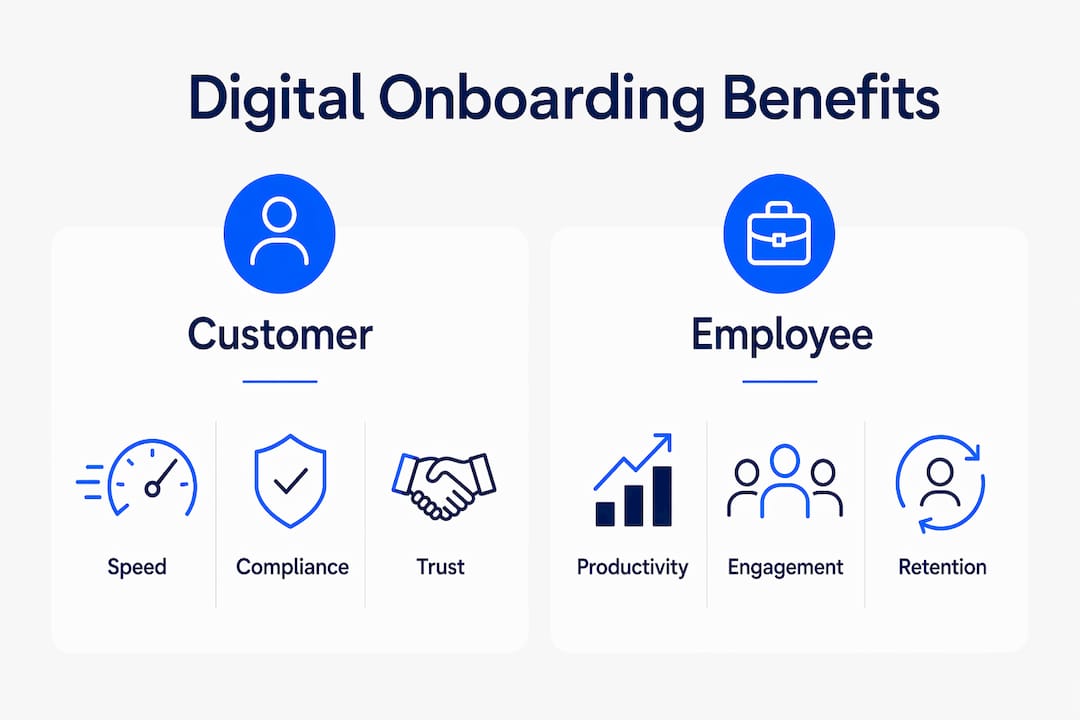
Digital onboarding is the end-to-end process of welcoming and verifying new users entirely through digital channels. The industry term for the customer-facing version is “digital customer onboarding,” while the internal version is called “digital employee onboarding.” Both share the same core architecture: identity verification, compliance checks, and workflow automation.
The process is not simply moving paperwork online. A PDF form emailed to a new client is digitized paperwork. True digital onboarding uses workflow automation to trigger sequential tasks: a completed identity check automatically generates a contract, which then triggers system access provisioning or account creation. That chain of events happens without manual intervention.
The core components of a digital onboarding process include:
- Identity proofing: Document capture, biometric verification (facial recognition or liveness detection), and database cross-checks against government records or credit bureaus
- KYC and AML compliance: Know Your Customer and Anti-Money Laundering screening, required by EU regulations and frameworks like NIST CSF 2.0 for financial services
- E-signatures: Legally binding digital agreements that replace wet signatures
- Fraud screening: Real-time checks against sanctions lists, PEP databases, and fraud signals
- IT provisioning or account setup: Automated creation of accounts, access rights, or banking credentials once verification passes
Pro Tip: Map your current onboarding steps on paper before building any digital flow. You will find redundant steps that exist only because of old manual constraints. Removing them before automating saves significant rework later.
Why choose digital onboarding? Key advantages for businesses
The business case for digital onboarding is direct. Automated identity verification reduces onboarding time by 50–68% compared to manual methods and can increase customer satisfaction by up to 63%. Faster onboarding means fewer drop-offs and more completed accounts.
Cost reduction is equally significant. Implementing digital onboarding drives cost savings over 28% by cutting manual document reviews and administrative workload. Those savings compound as volume grows, since the marginal cost of onboarding an additional customer digitally is close to zero once the system is built.
The advantages extend beyond speed and cost:
- Lower abandonment rates: 90% of firms report customer abandonment when onboarding takes too long or requires too many steps. A frictionless digital flow directly protects revenue.
- Stronger fraud prevention: Digital onboarding acts as a risk governance checkpoint where identity-proofing determines the trust level assigned to every new account. Weak onboarding creates vulnerabilities that persist for years.
- Regulatory compliance: Automated audit trails, timestamped approvals, and structured data capture satisfy regulators far more reliably than paper files.
- Competitive differentiation: Mobile-friendly onboarding flows available anytime drive higher conversion rates, especially in finance and B2B sectors where clients compare providers on ease of setup.
For financial businesses specifically, the compliance advantage is not optional. EU-regulated platforms like Demivolt build onboarding around segregated account structures and SEPA-compliant verification, which means every new client passes through a documented, auditable process from day one.
How does digital onboarding differ for customers vs. employees?
Digital onboarding serves two distinct audiences, and the design priorities differ significantly between them.

Customer onboarding focuses on identity trust and regulatory compliance. A new banking client, for example, must pass KYC verification, sanctions screening, and risk classification before accessing any services. The governance and compliance framework under NIST CSF 2.0 treats this approval workflow as a security checkpoint. The strength of that checkpoint determines the account’s trustworthiness for its entire lifetime. For high-risk business categories, the process is more intensive. A detailed walkthrough of high-risk bank onboarding shows how document requirements and compliance layers multiply when the client profile carries elevated risk.
Digital employee onboarding shifts the priority from compliance to productivity. The goal is to get a new hire contributing effectively as fast as possible. This means integrating onboarding directly into the tools the employee uses daily, such as CRM systems, project management platforms, and finance software. Digital employee onboarding provides continuous support within daily workflows, guiding employees through key tasks just-in-time to build performance confidence. That approach closes the gap between training and actual job requirements.
The table below shows where the two use cases diverge:
| Dimension | Customer onboarding | Employee onboarding |
|---|---|---|
| Primary goal | Identity verification and compliance | Productivity and role integration |
| Key technology | Biometrics, KYC, AML screening | CRM integration, LMS, workflow guidance |
| Regulatory driver | EU AML Directive, NIST CSF 2.0 | HR policy, data privacy (GDPR) |
| Success metric | Completion rate, fraud rate | Time to productivity, retention |
| Duration | Minutes to days | Days to months |
Pro Tip: For employee onboarding, resist the urge to front-load all training into the first week. Embed guidance directly into the tools employees use on day one. Just-in-time support inside a CRM or finance platform outperforms a two-day orientation every time.
What are effective digital onboarding strategies for implementation?
Effective digital onboarding requires more than buying software. The design of the process determines whether it delivers results or simply replicates old problems in a new interface.
1. Automate task sequences, not just individual steps. The real efficiency gain comes from chaining tasks together. When a customer completes identity verification, the system should automatically generate their contract, create their account, and send a confirmation. Effective digital onboarding automates sequential workflows and task triggers, eliminating manual process tracking entirely. Each step should fire the next without human intervention.
2. Embed onboarding into live operational systems. Onboarding that exists in a separate portal, disconnected from daily tools, loses its value the moment the new user finishes setup. Integrating onboarding within everyday operational systems like CRMs enhances retention and reduces productivity gaps by providing real-time guidance where work actually happens.
3. Apply risk-based identity-proofing from the start. Not every new user carries the same risk profile. A risk-based approach, aligned with NIST cybersecurity frameworks, assigns verification intensity based on the account type and transaction exposure. Low-risk accounts get a lighter touch. High-risk accounts trigger enhanced due diligence. This keeps the process fast for most users while maintaining security where it matters. For businesses in financial services, the compliance-first onboarding approach used by regulated platforms provides a practical model.
4. Design for mobile from the beginning. Mobile-first design is not a feature. It is a baseline expectation. An onboarding flow that requires a desktop browser or a printer will lose users before they complete the process. Every screen, upload prompt, and signature step must work on a phone.
5. Treat onboarding as a continuous process. Failing to embed onboarding into live operational workflows leads to lower retention and productivity. The onboarding period should extend beyond the first login or first day. Contextual guidance, check-in prompts, and progressive feature introductions keep users engaged and reduce churn in the critical first 90 days.
Pro Tip: Run a dropout analysis on your current onboarding flow before redesigning it. Identify the exact step where users abandon the process most often. That single fix will deliver more impact than redesigning the entire flow from scratch.
Key Takeaways
Digital onboarding delivers its full value only when automation, compliance, and continuous workflow integration work together from the first user touchpoint.
| Point | Details |
|---|---|
| Definition matters | Digital onboarding is workflow automation plus compliance, not just digitized forms. |
| Speed and cost gains are proven | Automated verification cuts onboarding time by 50–68% and reduces costs by over 28%. |
| Customer vs. employee use cases differ | Customer onboarding prioritizes identity trust; employee onboarding prioritizes productivity. |
| Governance is non-negotiable | NIST CSF 2.0 and KYC frameworks require auditable, risk-based approval workflows. |
| Onboarding is continuous | Embedding guidance into daily tools drives retention beyond the initial setup phase. |
The part most businesses get wrong
Most organizations treat digital onboarding as a project with a finish line. They build a flow, launch it, and move on. That is the wrong mental model entirely.
The businesses that get the most from digital onboarding treat it as a living system. They monitor where users stall, update verification steps as regulations change, and add contextual guidance as new features roll out. Digital onboarding success depends on balancing automation with human engagement. The automation handles document validation, compliance checks, and account creation. The human element handles relationship-building, exception handling, and trust.
What I find consistently underestimated is the identity layer. The strength of your identity-proofing at onboarding sets the security posture of that account for years. A weak check at signup creates a vulnerability that no amount of downstream monitoring fully closes. Businesses that treat KYC as a checkbox rather than a governance function pay for it later in fraud losses and regulatory scrutiny.
The future of digital onboarding points toward AI-assisted risk scoring, real-time document authentication, and identity frameworks that carry across platforms. But the fundamentals will not change. Speed, security, and continuity will remain the three pillars. The businesses that build those into their onboarding architecture now will have a structural advantage as verification standards tighten across the EU and beyond.
— dd
Demivolt’s approach to compliant digital onboarding
Businesses that need a practical starting point for compliant digital onboarding can look at what a regulated fintech platform actually builds into its process. Demivolt’s business banking infrastructure is designed around fast, auditable onboarding that meets EU regulatory standards from the first step.
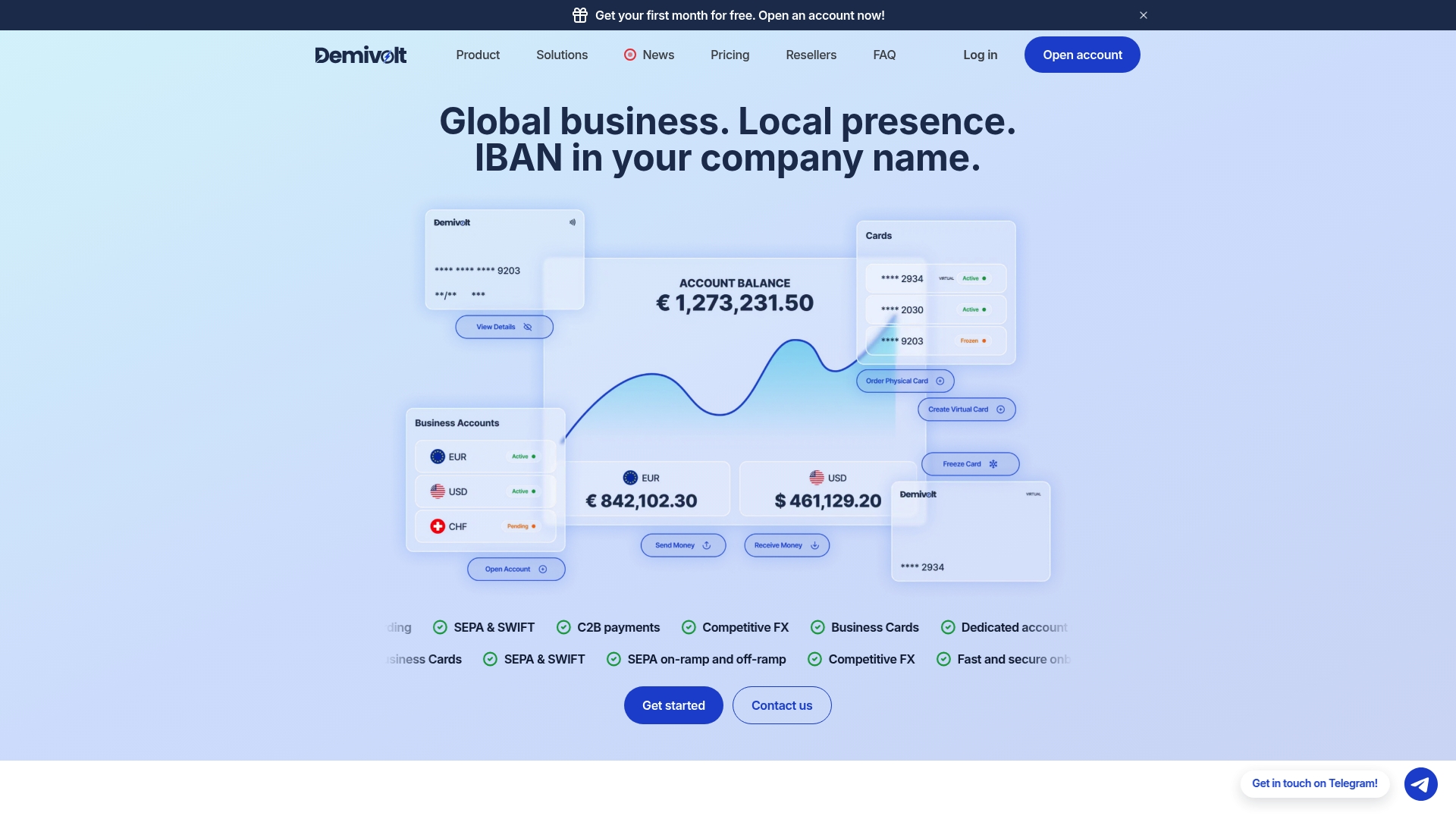
Demivolt supports dedicated IBAN accounts, SEPA and SWIFT payment management, and role-based user access, all structured around a documented onboarding workflow. The platform’s free IBAN Validator helps businesses verify bank account numbers during client onboarding, reducing errors and compliance gaps before they become problems. For teams building or refining their onboarding process, Demivolt’s financial compliance tools provide a concrete foundation. You can also review how Demivolt approaches onboarding for SMEs in fintech for a detailed look at the process in practice.
FAQ
What is digital onboarding in simple terms?
Digital onboarding is the process of registering and verifying new customers or employees entirely online, using automated identity checks, e-signatures, and compliance workflows instead of paper forms or in-person meetings.
How long does digital onboarding take?
The timeline varies by use case. Customer onboarding in financial services can complete in minutes with automated KYC. Employee onboarding typically extends over 30–90 days when embedded into daily workflows for continuous support.
What regulations govern digital onboarding in Europe?
EU-regulated digital onboarding must comply with the Anti-Money Laundering Directive (AMLD), GDPR for data handling, and identity-proofing standards aligned with NIST CSF 2.0 for cybersecurity governance.
What is the difference between digitized onboarding and true digital onboarding?
Digitized onboarding simply moves paper forms online. True digital onboarding automates sequential tasks, such as triggering contract generation after identity verification passes, eliminating manual tracking entirely.
Why do customers abandon digital onboarding?
90% of firms report customer abandonment when onboarding is too slow or requires too many steps. Reducing friction through mobile-friendly design and automated verification directly improves completion rates.