

Whether you can stop a payment depends on one thing: its status. If it’s still pending or authorized, cancellation is often possible and usually immediate. If it has already been executed and the funds are credited, you’re into refund or trace territory, which depends on the recipient’s cooperation. Check your internet bank right now, then contact your bank through its fastest secure channel.
TL;DR:
- Cancellation is only possible if the payment status is pending or authorized before the funds leave your account, not after the transfer is executed.
- Immediate action within 60 to 120 minutes is crucial, including identifying the transaction, taking screenshots, and requesting cancellation through your bank’s system.
- Refunds are necessary once funds have posted, but recovery depends on the recipient’s cooperation and can take up to 15 working days for bank-initiated refunds.
- Processing times and cancellation opportunities vary for SEPA and scheduled payments, with some being cancelable if still in the processing queue outside business hours.
- Businesses can reduce mis-sent payment risks by implementing multi-approval workflows and segregated IBANs, preventing single-authority errors and limiting exposure.
DemivoltReduce Risk In Every PaymentDemivolt gives businesses dedicated IBAN accounts, payment controls, and multi-account structures for more deliberate financial operations.Explore Demivolt
Table of Contents
- What Does Payment Cancellation Actually Mean?
- Your 60 to 120 Minute Action Checklist
- Cancel or Refund: What’s the Real Difference?
- How to Cancel by Channel: Bank, Card, Phone, and Merchant
- SEPA and Scheduled Payments: When Timing Works in Your Favor
- How Long Does a Payment Cancellation or Refund Take?
- If It Was a Scam: How to Trace and Report It
- What Businesses Should Build Before the Next Mistaken Payment
- How Demivolt Helps Businesses Reduce Cancellation Risk
- Sources
- FAQ
What Does Payment Cancellation Actually Mean?
Mokėjimų atšaukimas, the Lithuanian term for payment cancellation, covers a narrower window than most people assume. It applies specifically to payments that haven’t yet been executed, meaning the money hasn’t left your account or reached the beneficiary’s bank. Once execution happens, you’re no longer canceling anything. You’re requesting a refund or initiating a trace, and that process runs on a completely different clock.
This distinction matters because it determines which button to press and which team to call. Banks in Lithuania, including SEB, explain that a cancellation request only works cleanly if the payment hasn’t been sent to the beneficiary’s bank and the funds haven’t been credited. If that window has closed, SEB’s guidance on canceling a payment order confirms that recovery then depends on whether the recipient agrees to return the money.
The rest of this guide walks through exactly what to do in the first hour, how cancellation differs from a refund, how SEPA and scheduled payments behave differently, and what happens if the payment wasn’t a mistake at all but a scam.
Your 60 to 120 Minute Action Checklist
Speed determines your outcome more than anything else. Lietuvos bankas has pushed payment service providers to respond quickly to cancellation and trace requests, which means the institutions on the other end are expected to move fast, too, but only once you’ve given them the right details.
- Open your internet bank and find the exact transaction. Note the reference number, amount, date, and current status label (pending, authorized, or completed).
- Take a screenshot of the transaction details before you touch anything else. This becomes your evidence trail.
- If the status shows pending or authorized, look for a cancel or “stop payment” option in the transaction menu. Many banks place it directly under the transaction details view.
- If the payment shows as executed, or if you’re not sure what the status means, call your bank’s support line immediately and follow up with a written request through secure messaging.
- Contact the recipient or merchant directly. Ask for a voluntary return and include your transaction reference in the message.
- Log the time of every call, message, and screenshot. Keep copies in one folder.
Pro Tip: Write down the exact time you noticed the problem and the exact time you contacted the bank. Some disputes hinge on whether you acted “without delay,” and a timestamped log settles that question fast.
Cancel or Refund: What’s the Real Difference?
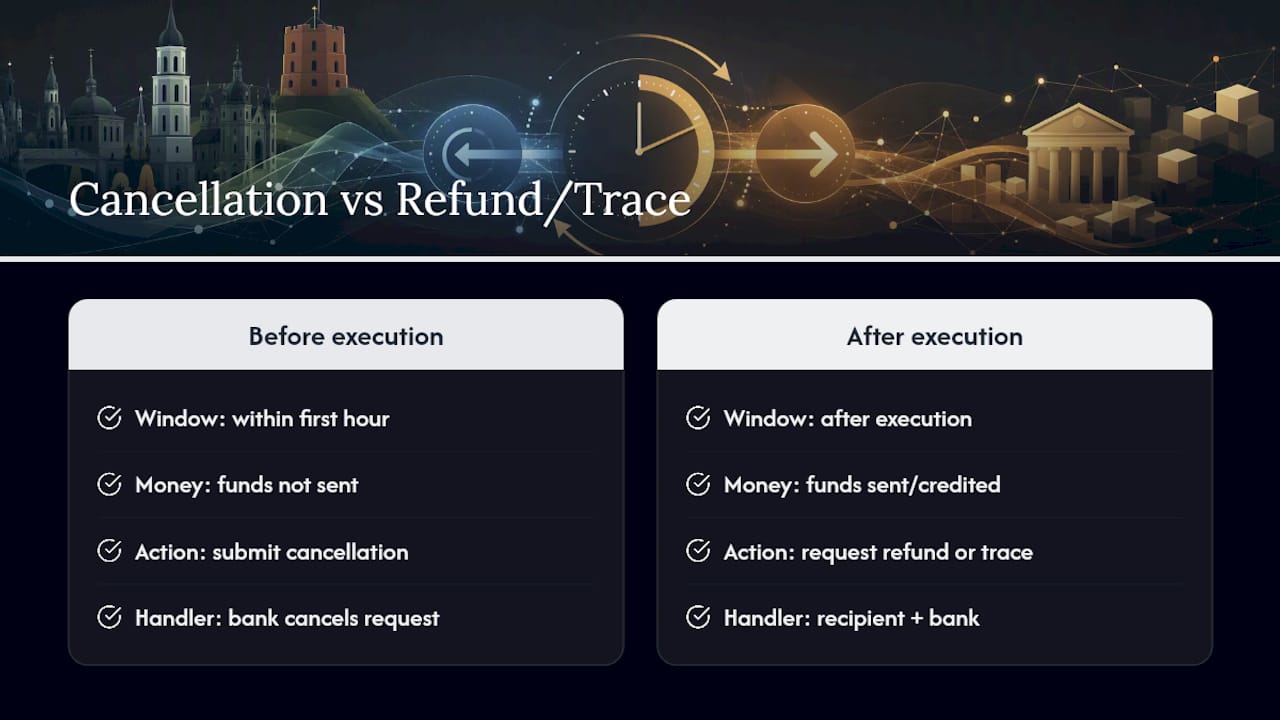
Cancel means stopping a payment before it’s executed or captured. If it works, the hold on your funds releases, usually right away, and no money changes hands at all.
Refund means the money has already posted, so getting it back requires either the merchant’s cooperation or a formal dispute process. That can take days, sometimes longer.
The mechanics differ by who can act and when:
- Cancellation is initiated by you, the payer, before the payment clears your bank’s processing window.
- Refund requires the merchant, recipient, or payment processor to voluntarily release the funds back to you.
- Card payments follow the same logic: Adyen’s documentation on canceling authorized payments confirms cancellation only works before capture. Once a card payment is captured, cancellation is off the table and a refund becomes the only route.
- Time windows are strict. A cancellation request submitted seconds after a capture event will fail, even though nothing about the transaction seems different to you.
Knowing which category your payment falls into before you call anyone saves you a wasted conversation.
How to Cancel by Channel: Bank, Card, Phone, and Merchant
Each channel has its own mechanics, and using the wrong one wastes your best window for stopping the payment.
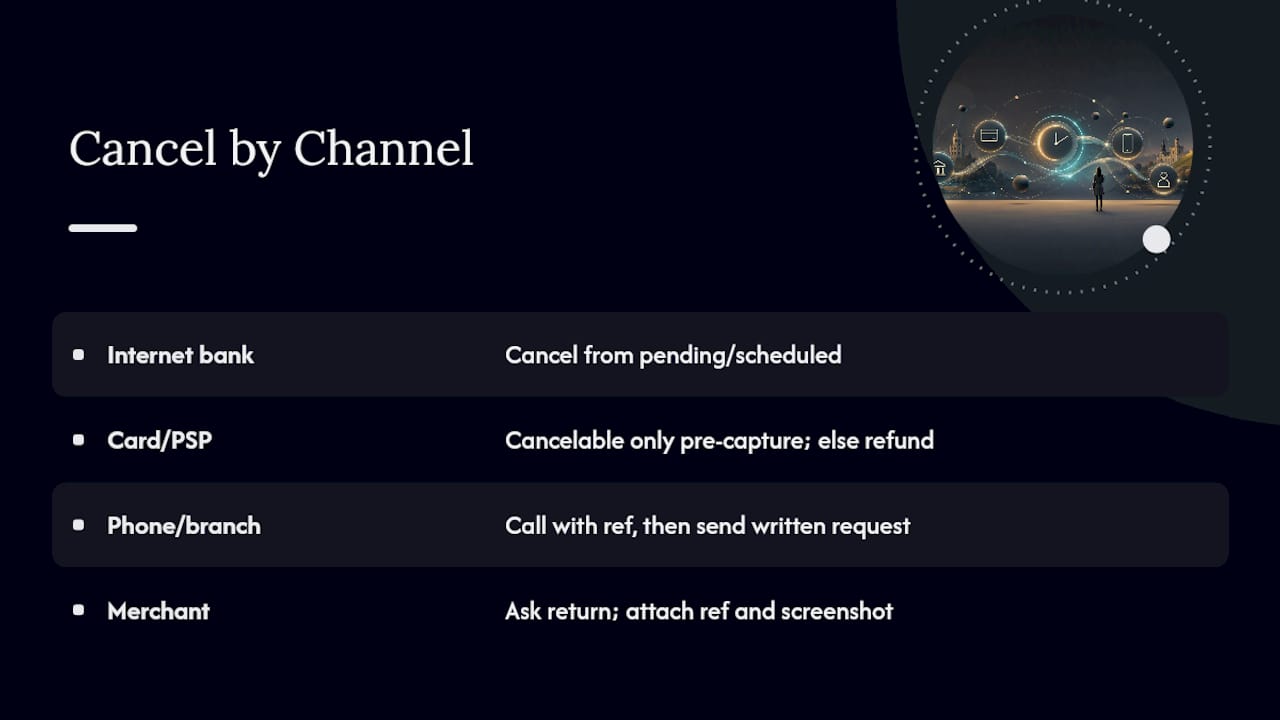
Internet bank. Log in and locate the transaction under pending or scheduled payments. Most Lithuanian banks let you select the payment and submit a cancellation request directly from that screen. If no cancel button appears, the payment has likely already moved into execution.
Card payments and PSPs. Cancellation only works pre-capture. Merchant dashboards, including Mollie’s cancel payment API, expose an “isCancelable” flag precisely because timing decides whether a cancel request succeeds or fails. If capture has already happened, tell the merchant or PSP support you need a refund, not a cancellation. The distinction affects which internal process they trigger.
Phone and branch. Have your transaction reference, exact amount, and timestamp ready before you call. Follow every phone request with a written message through your bank’s secure channel, since SEB and other Lithuanian banks treat the written record as the formal request that starts the clock.
Merchant contact. Ask directly for a voluntary return and attach your transaction reference and screenshot. If the merchant refuses or goes silent, escalate to your bank and let them handle the dispute from there.
Pro Tip: Never rely on a phone call alone. A verbal “yes, we’ll cancel it” means nothing if the bank’s system shows no written request on file.
SEPA and Scheduled Payments: When Timing Works in Your Favor
SEPA payments move through two distinct stages: submission to the banking system, and posting to the recipient’s account. The gap between those two moments is where cancellation is still possible, and cut-off times decide how wide that gap is.
- A SEPA payment submitted after your bank’s daily cut-off often sits in a queue overnight, which can actually work in your favor.
- Regulatory changes referenced by RATO require some providers to allow cancellation of SEPA payments sent outside business hours, since those payments haven’t yet entered the clearing cycle.
- Scheduled or future-dated payments can usually be canceled through the same interface where you set them up. Look for a “manage scheduled payments” or “upcoming transfers” section.
- Recurring payment series need a separate cancellation step from the individual transaction. Canceling one instance doesn’t stop the next one from processing.
Lietuvos bankas expects providers to make cancellation channels available outside core office hours and to label reserved funds clearly, so if your bank’s app shows a vague or missing status, that’s worth flagging directly.
How Long Does a Payment Cancellation or Refund Take?
A successful cancellation is usually immediate. The hold releases and the transaction disappears from pending status within minutes.
A trace or refund is a different story entirely. If the payment hasn’t reached the beneficiary’s bank and funds haven’t posted, the money often comes back right away. If it has posted, recovery depends on the recipient’s consent, and that can take up to 15 working days, according to SEB’s published timeline for payment order cancellations.
Timelines vary further by payment type. Card disputes move on their own processor-driven schedule. SWIFT transfers, which cross multiple banking systems, tend to take longer than domestic SEPA transfers. Keep following up weekly if the case stays open past two weeks, and always ask your bank for a case reference number so you’re not restarting the explanation every time you call.
If It Was a Scam: How to Trace and Report It
Unauthorized or fraudulent payments demand a different sequence, and speed here matters even more than with an ordinary mistake.
- Report the payment to your bank immediately through its secure channel and explicitly request a payment trace or recall, not just a cancellation.
- Follow Lietuvos bankas’ recommended escalation path: document everything, escalate in writing, and expect a prompt response if you’ve followed the correct procedure.
- File a police report once your bank confirms the payment was unauthorized. Bring your transaction reference, screenshots, and any messages from the scammer.
- Compile bank statements, merchant correspondence, and timestamps into one file before you file anything, so you’re not scrambling later.
For business clients, tracking down a mis-sent international payment often means following the transfer through the SWIFT network rather than just your own bank. A step-by-step guide to tracking a wire transfer using UETR and SWIFT GPI covers exactly how that trace works across correspondent banks. Card-based fraud follows its own dispute clock, and a 72 hour chargeback plan for finance teams lays out what evidence to gather before the window closes.
Pro Tip: Never wait for the merchant to respond before contacting your bank. Running both tracks at once costs you nothing and often shortens the total recovery time.
What Businesses Should Build Before the Next Mistaken Payment
Most mis-sent payments I’ve seen traced back to one root cause: a single person had both the authority and the access to send money without a second check. Multi-approval payment flows and role-based access close that gap by forcing a second set of eyes before funds move.
Segregated IBANs or multi-account structures also limit exposure. If one account is compromised, the damage stops there instead of spreading. Businesses that build this in now, not after an incident, recover faster and lose less.
How Demivolt Helps Businesses Reduce Cancellation Risk
Most cancellation problems trace back to a payment sent to the wrong IBAN or approved without a second check. Demivolt is built around the controls that catch those mistakes before money leaves the account, not just the paperwork that tries to recover it afterward.
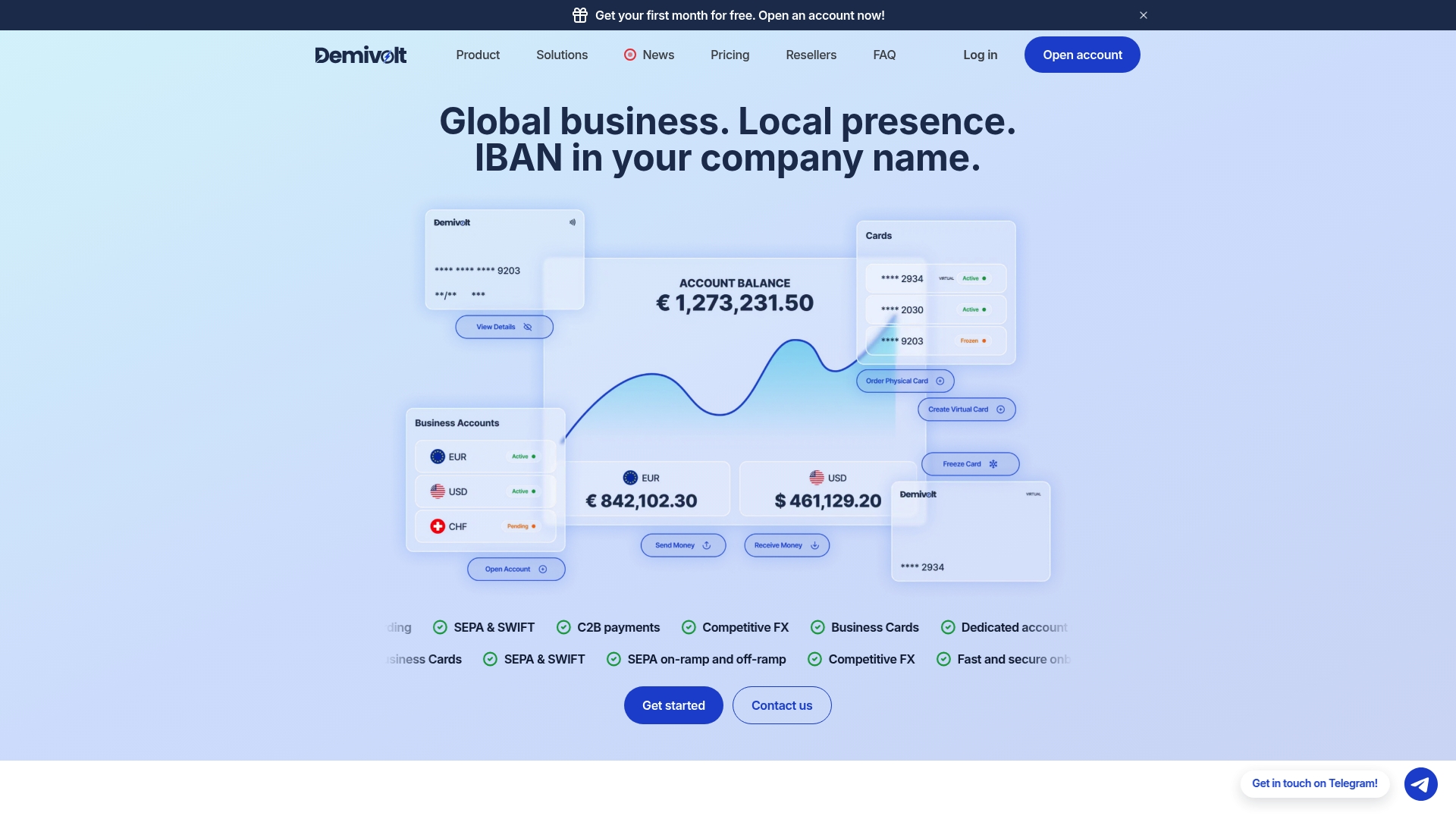
Business banking infrastructure that offers role-based approvals can prevent a single employee from sending a large payment without a second signoff, and segregated IBANs can limit how far a mistaken or fraudulent transfer can spread. Before you send a cross-border payment, running the destination account through the free IBAN Validator catches formatting errors that cause misdirected transfers in the first place. If your team is considering a regulated provider for SEPA and SWIFT payment processing, multi-account structures, or card programs with built-in spending controls, contact providers directly to discuss onboarding for your business.
This article is general information, not a substitute for advice from a qualified financial advisor. Consult a qualified financial professional about your own circumstances before acting on anything here.
Sources
- Lietuvos bankas: financial institutions should act quickly on requests to cancel payment operations
- Cancel | Adyen Docs
FAQ
Can I Cancel a Payment After It’s Been Sent?
Only if it hasn’t reached the beneficiary’s bank or been credited yet. Once it posts, you need a refund or a trace instead of a cancellation.
How Long Does a Bank Take to Cancel a Payment?
A successful cancellation is usually immediate. If the funds already posted, recovery through the recipient’s consent can take up to 15 working days.
What’s the Difference Between Canceling and Refunding a Payment?
Canceling stops a payment before execution or capture. Refunding returns money that has already posted, and it requires the merchant or recipient to agree.
Can I Stop a SEPA Payment Sent Outside Business Hours?
Sometimes. Payments submitted after cut-off often sit in a queue before entering the clearing cycle, and some providers are required to allow cancellation during that window.
What Should I Do If a Payment Was Fraudulent?
Report it to your bank immediately through its secure channel, request a trace, document everything, and file a police report once the bank confirms it was unauthorized.
How Can Businesses Reduce the Risk of Mis-Sent Payments?
Multi-approval payment flows, role-based access, and segregated IBANs limit exposure and speed up recovery, which is the approach Demivolt builds into its business banking infrastructure.