

A SWIFT cut-off time is the daily deadline your bank sets for accepting international wire instructions for same-day processing. As a working rule, submit your payment several hours before your bank’s wire-desk cut-off, and move that deadline earlier on Fridays or the day before a holiday. Track anything time-sensitive with SWIFT gpi and its UETR code, and treat a platform like Demivolt as one option for keeping SWIFT and SEPA transfers on a predictable schedule.
TL;DR:
- Most banks set SWIFT transfer cut-offs between 2:00 PM and 5:00 PM local time, varying by currency, corridor, and operational setup.
- In-flight transfer time accounts for less than 20% of total payment processing, with the remaining 80% delayed by the beneficiary bank’s last mile procedures.
- Confirm your bank’s actual wire-desk cut-off times for each channel, especially on Fridays and before holidays, to avoid multi-day delays.
- Using the UETR allows for tracking SWIFT payments in real time, with typical issues arising from compliance reviews or delays on the recipient side.
- Establish internal deadlines two to three hours before cut-off, verify beneficiary data beforehand, and have a clear escalation plan to improve cross-border payment predictability.
Demivoltdemivolt.comMake Cross-Border Payments More PredictableDemivolt provides business accounts, SEPA and SWIFT payments, and cards through regulated European financial infrastructure.Explore Demivolt
Table of Contents
- What Are Typical SWIFT Transfer Cut-Off Times?
- Why Does Your Payment Take Longer Than Expected?
- Your SWIFT Payment Checklist Before You Hit Send
- How Do You Track a SWIFT Payment After Sending It?
- What Treasury Teams Get Right About Friday Deadlines
- Get Predictable SWIFT and SEPA Payments With Demivolt
- Where to Read More on SWIFT Timing and Payment Operations
- Sources
What Are Typical SWIFT Transfer Cut-Off Times?
International settlement rails don’t run around the clock, and that shapes every cut-off your bank publishes. TARGET2 (now operating as T2, the euro area’s real-time gross settlement system), Fedwire in the United States, and CHAPS in the United Kingdom each have fixed daily operating windows. Once a rail closes for the day, payments queue for the next settlement cycle, no matter how fast your bank processed the instruction internally.
Banks build in a buffer before those rail closures, which is why your wire desk’s cut-off almost always lands earlier than the settlement system’s own closing time. That buffer covers internal processing, compliance screening, and liquidity checks before the payment is even handed off to the network.
In practice, most banks set international wire cut-offs somewhere in the mid-afternoon to late-afternoon window, often landing between roughly 2:00 PM and 5:00 PM local time. The exact hour varies by currency, by corridor, and by the bank’s own operational setup, so a payment to a common trading partner may have a later cut-off than one to a less-connected market.
Channel matters just as much as clock time. A few patterns worth knowing:
- Branch hours and wire-desk hours are rarely the same thing. A branch open until 6:00 PM does not mean the wire desk accepts SWIFT instructions until 6:00 PM.
- Online banking portals and API-based submissions can close earlier than manual, relationship-manager-assisted channels, depending on how the bank batches its processing.
- “Urgent” or priority wire services sometimes carry a later internal cut-off, at a premium, precisely because they skip a batch cycle.
- Fridays and the days before public holidays routinely bring tighter, earlier cut-offs, since a missed window means a multi-day wait rather than an overnight one.
Confirm your bank’s actual wire-desk hours directly rather than assuming they mirror branch or customer-service hours. That single phone call or line in the onboarding documentation prevents most last-minute surprises.
Why Does Your Payment Take Longer Than Expected?
The SWIFT network itself is rarely the bottleneck. SWIFT’s own research found that 75% of payments reach the beneficiary bank within 10 minutes of being sent, meaning in-flight time typically makes up less than 20% of the total journey. The other roughly 80% happens after the money arrives at the receiving bank, in what the industry calls the last mile.
In-flight time is often under 20% of total processing time. The remaining 80% is consumed after the payment reaches the beneficiary bank, according to SWIFT’s Spotlight on Speed 2025 findings.
That last mile is where the real friction sits. SWIFT’s own Payment Optimisation Playbook identifies five structural frictions that slow crediting on the receiving end:
- Regulatory reporting requirements specific to the destination country
- Foreign exchange conversion and capital-control rules
- Poor adherence to data standards, which triggers manual review
- Risk and compliance controls, including sanctions and AML screening
- Domestic payment infrastructure that the beneficiary bank depends on to finish the transfer
Correspondent banking chains compound the opacity. The CPMI/BIS analysis of SWIFT gpi timing found median processing times ranging from under five minutes on some routes to more than two days on others, even though the average payment passes through just over one intermediary bank. Each additional hop introduces its own cut-off window and its own compliance checks, and none of that shows up until the payment is already in transit.
Your SWIFT Payment Checklist Before You Hit Send
A predictable outcome starts with a predictable process. Build these steps into your standard payment workflow, not just your exception handling.
- Set your internal deadline first. Submit critical payments two to three hours ahead of your bank’s published wire-desk cut-off, and move that margin up to before local noon on Fridays or ahead of a holiday closure.
- Validate the beneficiary data before submission. A complete and correctly formatted IBAN, the right BIC or SWIFT code, and the beneficiary’s full legal name all matter, since inaccurate or incomplete data is one of the most common causes of automated rejection. Running the account number through an IBAN validator before submission catches most formatting errors in seconds.
- Confirm the actual channel cut-off with your provider, not the branch hours listed on a website. Online portals, APIs, and manual desks can close at different times even at the same bank.
- Document corridor-specific correspondent banks where you can. Knowing which intermediary a payment typically routes through helps you set realistic expectations for that specific destination.
- Have an escalation path ready. If a payment is delayed, request a trace using the UETR, ask your bank about priority processing options, and keep a short template ready for notifying the beneficiary that funds are in transit.
Pro Tip: Keep a one-page reference of your bank’s wire-desk cut-off by currency and channel, updated whenever your relationship manager confirms a change. Finance teams that skip this step tend to relearn the deadline the hard way, usually on a Friday afternoon.
Compliance checks specific to cross-border payments deserve their own attention, and a compliance checklist built for SMEs is worth reviewing alongside your cut-off schedule.
How Do You Track a SWIFT Payment After Sending It?
Every SWIFT payment now carries a UETR, a unique end-to-end transaction reference that lets you track its progress through SWIFT gpi. That visibility shows time-stamped hops between banks, including when the payment reaches the beneficiary bank, which is distinct from when the beneficiary’s account is actually credited.
Request a trace from your bank once a payment has missed its expected window. Have this ready before you call:
- The UETR
- Value date, amount, and currency
- Full beneficiary details, including bank name and account identifier
A trace typically returns one of three outcomes: confirmation the payment is still in flight, confirmation it’s queued for the next settlement cycle, or notice that it’s held on the beneficiary side for compliance review.
What Treasury Teams Get Right About Friday Deadlines
Experienced treasury teams treat Friday as its own cut-off category, not a normal business day with a slightly earlier close. Miss a Friday deadline and the payment often doesn’t just wait until Monday. It waits until Monday’s processing queue clears, which can push crediting into Tuesday.
The fix is a stricter internal rule: critical payments get submitted before local noon on Fridays, non-critical payments get a documented sign-off path for late requests, and accounts payable teams build cut-off awareness into their approval workflow instead of treating every wire as urgent by default.
— dd
Get Predictable SWIFT and SEPA Payments With Demivolt
Demivolt gives finance teams a way to make international payments less about guessing bank hours and more about a repeatable process. A regulated European fintech platform provides dedicated IBAN accounts, SEPA and SWIFT payment management, and virtual and physical business cards, all built on compliant, digital-first infrastructure designed for cross-border operations.
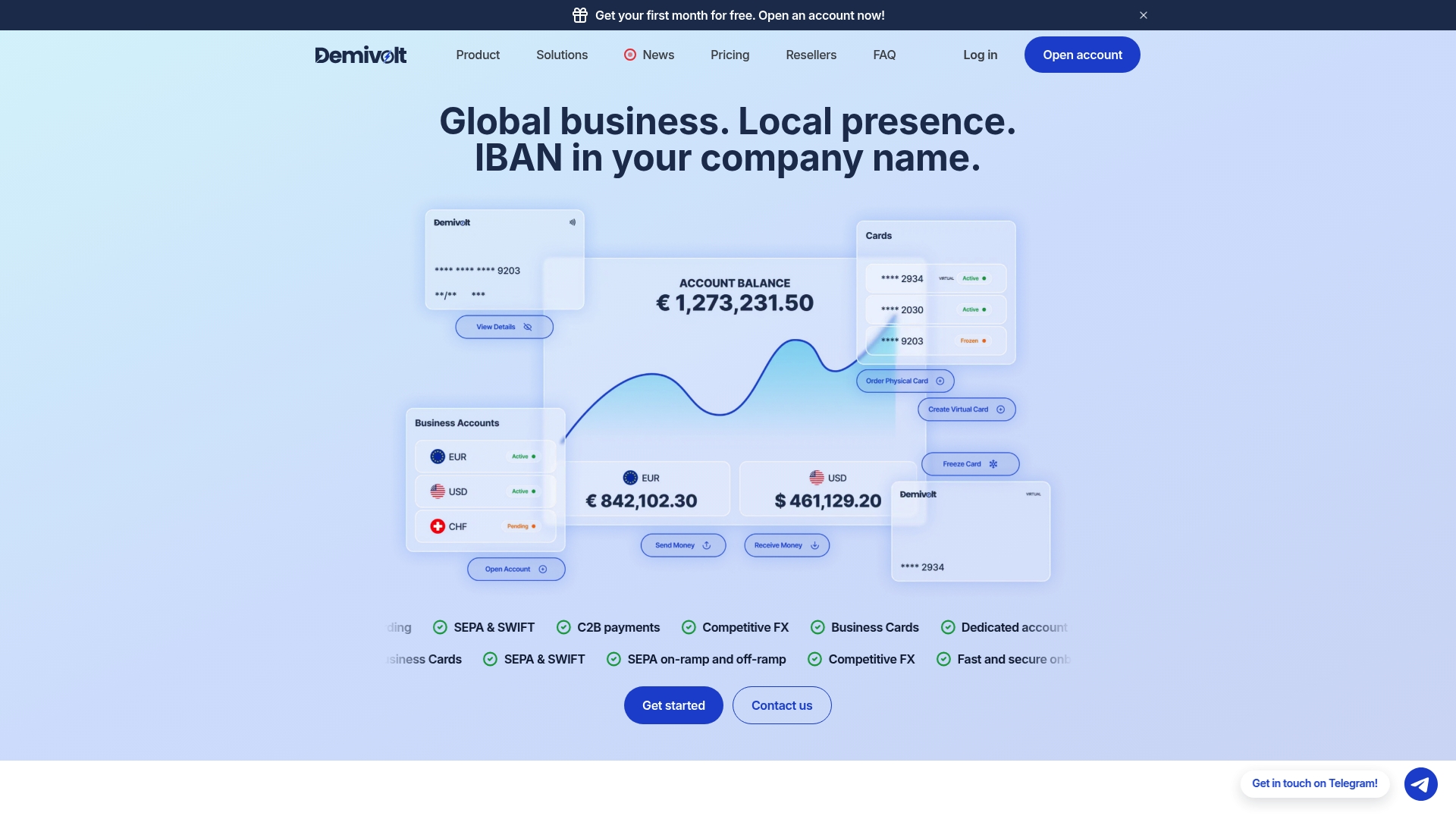
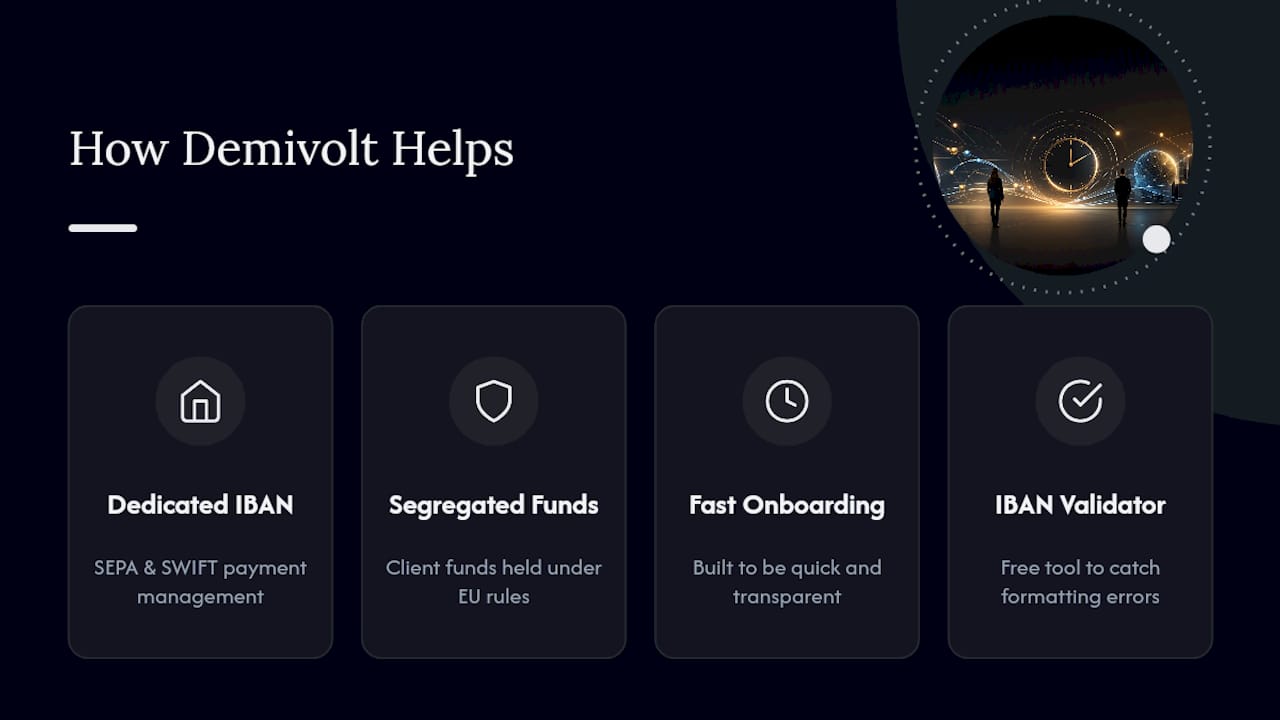
Client funds sit in segregated accounts under EU regulatory standards, and onboarding is built to be fast and transparent rather than a weeks-long back-and-forth. For finance teams juggling multiple currencies and beneficiaries, that combination of a dedicated IBAN and clear payment visibility removes a lot of the uncertainty this article has been walking through.
Before your next international payment, run the beneficiary’s account details through the free IBAN validator to catch formatting errors before they cause a rejection, and review what an IBAN is and how it’s structured if your team handles multiple markets. Open an account with a fintech platform to see how a dedicated IBAN and structured payment tools fit into your own cut-off routine.
Where to Read More on SWIFT Timing and Payment Operations
For deeper data on last-mile delays, SWIFT’s own Spotlight on Speed 2025 research and the CPMI/BIS analysis of gpi timing are the two most rigorous sources available. On the operational side, Demivolt’s guide to tracking wire transfers with UETR and SWIFT gpi and its breakdown of SWIFT payment fees are useful next reads. For a broader look at process discipline in payment handling, this payment workflow guide offers a practical parallel from outside banking.