

TL;DR:
- B2B financial control involves policies and mechanisms that protect assets, ensure transaction accuracy, and maintain compliance. Implementing key controls like segregation of duties, three-way matching, and regular reconciliations reduces fraud and errors significantly. Embedding controls into daily workflows and using automation helps SMEs scale oversight effectively as they grow.
B2B financial control is defined as the structured set of policies, procedures, and oversight mechanisms that protect business assets, ensure accurate transactions, and maintain compliance in business-to-business operations. For SMEs, getting this right is not optional. Businesses with formal internal controls experience 54% fewer financial misstatements and 71% lower fraud losses than those without. That gap is wide enough to determine whether a company survives a bad quarter. This guide covers the core controls every B2B business needs, how automation changes the equation, and how to scale your financial oversight without slowing down operations.
What core financial controls should SMEs implement in B2B operations?
Financial controls in a B2B context fall into two categories: preventive controls that stop errors before they happen, and detective controls that catch them after. The COSO Framework, published by the Committee of Sponsoring Organizations of the Treadway Commission, is the recognized industry standard for designing internal control systems. Most SMEs do not need to implement every element of COSO, but the framework gives you a reliable map of what matters.
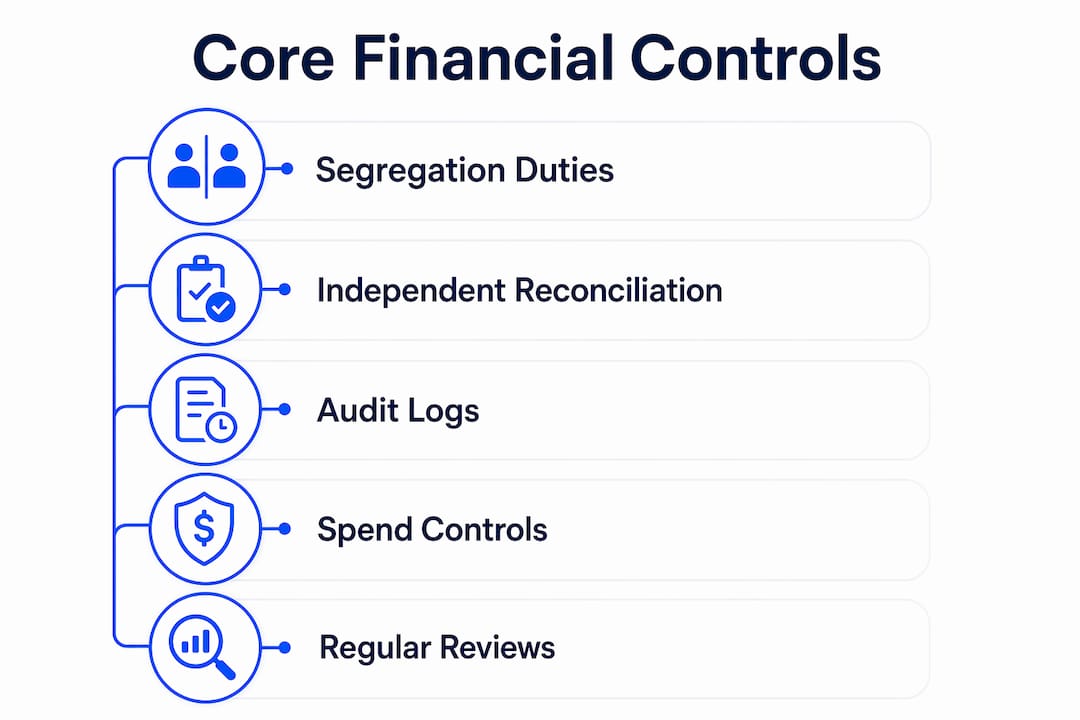
The following five controls form the foundation of effective B2B financial management:
-
Segregation of duties. No single employee should control a financial transaction from start to finish. The person who approves a vendor is not the person who pays the invoice. A delegation of authority matrix documents who can approve what, up to what dollar amount, and under what conditions. This single control eliminates the most common pathway for internal fraud.
-
Three-way matching for accounts payable. Three-way matching compares the purchase order, the goods receipt, and the vendor invoice before any payment is released. This process directly prevents overpayments and catches billing errors that would otherwise go unnoticed. With 65% of procurement teams lacking visibility into indirect spending, three-way matching is one of the fastest ways to close that gap.
-
Monthly bank reconciliations by an independent party. The person who reconciles bank accounts should not be the person who processes payments. Basic measures like monthly reconciliations by non-bookkeepers and dual signatures on large checks prevent 80% of common small business fraud. That is a high return for a low-cost process change.
-
Approval workflows with spending limits. Every expense category needs a defined approval path. Purchases under $500 might require one manager’s sign-off. Purchases over $10,000 require two. Automated approval workflows enforce these rules without relying on memory or goodwill.
-
Role-based access controls in accounting software. Your accounts payable clerk does not need access to payroll. Your sales team does not need to see vendor contracts. Restricting system access by role reduces both accidental errors and deliberate manipulation.
Pro Tip: Start with controls 1 and 3 if your team is small. Segregation of duties and independent reconciliation address the highest-risk exposure points before you build out the rest of your control framework.
How can SMEs use technology to strengthen financial oversight?

Automation does not replace financial judgment. It removes the manual steps that create gaps where errors and fraud enter. The shift in B2B financial management is moving from manual detective reviews toward automated, AI-integrated workflows with real-time documented audit trails. That shift improves both audit reliability and day-to-day efficiency.
Key technology applications for B2B financial control include:
- AI-powered forecasting. 56% of finance teams using AI-powered predictive analytics report improved forecasting accuracy, with 18% seeing faster cash application. Better forecasts mean fewer cash shortfalls and more informed spending decisions.
- Automated invoice processing. Optical character recognition and workflow automation can route invoices for approval, flag mismatches, and post approved payments without manual data entry. This cuts processing time and creates a complete digital record.
- Unalterable audit trails. Every financial system your team uses should log who did what and when. These logs are not just for auditors. They are your first line of defense when a discrepancy appears.
- Integration between finance and procurement. When your procurement system talks to your accounting software, purchase orders and invoices match automatically. Disconnected systems create blind spots. Connected systems create control.
- Real-time payment controls. Platforms that issue virtual business cards with per-card spending limits enforce your expense policy at the point of purchase, not after the fact. This is a practical example of a preventive control built directly into the payment infrastructure.
Pro Tip: When evaluating finance technology, prioritize platforms that produce audit logs you cannot edit. Editable logs are not audit trails. They are records that can be manipulated, which defeats the purpose entirely.
For context on how AI is reshaping payment security, AI payment trends in 2025 show that real-time fraud detection is becoming a baseline expectation, not a premium feature.
What are best practices for monitoring financial controls over time?
Controls that nobody checks stop working. The most common failure mode in B2B financial oversight is not a bad control design. It is a control that was designed well but never maintained.
Every financial control must have a named owner and a specific execution frequency. Controls without owners become “zombie controls,” procedures that exist on paper but fail the moment the one person who understood them leaves the company. Assign ownership explicitly, document the procedure, and review it when roles change.
Monitoring practices that actually work in SME environments:
- Variance analysis on a monthly cadence. Compare actual spending against budget every month. Variances above a defined threshold trigger a review. This catches both errors and unauthorized spending before they compound.
- Quarterly internal reviews. A finance manager or external accountant reviews control execution quarterly. This does not require a full audit. A structured checklist covering your top ten controls takes two to three hours and surfaces most problems.
- Cash flow forecasting updates. 78% of finance teams reassess forecasts quarterly, with 26% doing so monthly or more. Real-time visibility reduces risk when market conditions shift. Treat forecasting as a live document, not an annual exercise.
- Collections Effectiveness Index tracking. This metric measures how efficiently your team collects receivables relative to what was due. A declining CEI signals a cash flow problem before it becomes a crisis.
- Continuity planning for control owners. Document every control procedure so a replacement can execute it on day one. This is not bureaucracy. It is the difference between a smooth staff transition and a six-month control gap.
How to implement and scale financial controls as your B2B business grows
The right level of financial control depends on your company’s stage. Applying enterprise-level SOX controls to a 12-person team creates friction without proportional protection. Right-sizing controls to company stage is the principle that separates effective governance from governance theater.
A practical implementation roadmap looks like this:
-
Stage 1: Foundation (1–20 employees). Implement segregation of duties, monthly reconciliations, and basic approval workflows. Apply the 80/20 rule to control design: 20% of well-designed controls prevent 80% of financial risks. Focus on delegation of authority and segregation of duties first.
-
Stage 2: Growth (20–100 employees). Introduce compensating controls where full segregation is not possible. Board oversight and quarterly external reviews can satisfy audit requirements without a full-time internal audit function. Add three-way matching and formal vendor approval processes.
-
Stage 3: Scale (100+ employees). Deploy spend analytics across all cost categories. Automate approval workflows for routine transactions. Build a formal delegation of authority policy that covers every spending category and every department head.
The table below shows how control priorities shift by stage:
| Growth stage | Primary control focus | Key tool or process |
|---|---|---|
| Foundation | Fraud prevention | Segregation of duties, bank reconciliation |
| Growth | Spend visibility | Three-way matching, vendor approvals |
| Scale | Efficiency and audit readiness | Automated workflows, spend analytics |
Controlling spend intent at the purchase requisition stage is more effective than focusing on invoice payment controls after the fact. Approvals before a purchase is made prevent liabilities from forming. Approvals after an invoice arrives only limit the damage.
Balancing control rigor with operational speed is a real tension. The answer is not fewer controls. It is controls that are embedded in the tools your team already uses, so compliance happens automatically rather than as an extra step.
Key Takeaways
Effective B2B financial control requires named control owners, automated preventive measures, and regular monitoring to prevent the majority of fraud and financial errors.
| Point | Details |
|---|---|
| Start with high-impact controls | Segregation of duties and independent reconciliations prevent 80% of common small business fraud. |
| Automate at the point of purchase | Real-time spending controls and automated approvals stop errors before invoices arrive. |
| Assign named control owners | Every control without a named owner will fail when the responsible person is unavailable. |
| Right-size controls to your stage | Applying enterprise-level controls to small teams creates friction without proportional protection. |
| Monitor with a regular cadence | Quarterly reviews and monthly variance analysis catch problems before they compound into losses. |
Why most SMEs get financial controls wrong from the start
The mistake I see most often is treating financial controls as a compliance project rather than an operational one. Teams build a policy document, file it, and move on. Six months later, the controls exist on paper and nowhere else.
The businesses that get this right do one thing differently: they embed controls into the tools people use every day. Approval limits live in the payment platform. Reconciliations are scheduled in the calendar with a named owner. Variance reports go to the same meeting where spending decisions get made. The control is not a separate task. It is part of the workflow.
The second mistake is waiting until the company is large enough to “need” controls. Financial governance for SMEs matters most in the early stages, when a single fraud event or cash flow error can end the business. The cost of a basic control framework is low. The cost of not having one shows up exactly when you can least afford it.
My honest recommendation: pick five controls, assign an owner to each, and review them quarterly. That is not a heavy lift. It is the minimum viable governance structure that keeps most SMEs out of serious trouble.
— dd
Demivolt’s free tools for B2B payment accuracy
Accurate payments are a direct extension of financial control. One wrong IBAN sends funds to the wrong account, triggers a dispute, and creates a reconciliation problem that takes weeks to resolve.
Demivolt offers free tools built specifically for B2B payment accuracy. The IBAN Validator checks IBAN codes against the ISO 13616 standard before you send a payment, catching errors at the source. The full SEPA tools suite supports payment compliance across European markets. Both tools complement the internal controls covered in this guide by removing a common source of payment errors from your process entirely.
FAQ
What is B2B financial control?
B2B financial control is the set of policies, procedures, and oversight mechanisms that protect assets, ensure accurate transactions, and maintain compliance in business-to-business operations. The COSO Framework is the recognized industry standard for designing these systems.
How many financial controls does an SME actually need?
The 80/20 rule applies directly: 20% of well-designed controls prevent 80% of financial risks. For most SMEs, five to ten foundational controls covering segregation of duties, reconciliations, and approval workflows are sufficient to address the majority of exposure.
What is three-way matching in accounts payable?
Three-way matching compares the purchase order, goods receipt, and vendor invoice before releasing payment. It prevents overpayments and catches billing errors, making it one of the most effective controls for B2B procurement spend.
How often should financial controls be reviewed?
Controls should be reviewed at least quarterly. 78% of finance teams reassess forecasts quarterly, and the same cadence applies to control effectiveness reviews. Monthly variance analysis adds a faster feedback loop between formal reviews.
What is a zombie control?
A zombie control is a financial procedure that exists in documentation but is no longer executed in practice, typically because the responsible person left and no successor was named. Assigning a named owner and documented procedure to every control prevents this failure mode.