

TL;DR:
- Financial control involves policies that protect assets, maintain accurate records, and prevent errors and fraud.
- Most small businesses lack adequate controls, risking significant losses from fraud and errors.
Financial control is the set of policies and processes that protect a business’s assets, keep records accurate, and stop errors and fraud before they cause real damage. The industry term for this is internal controls, and every business needs them regardless of size. Businesses with formal internal financial controls experience 54% fewer financial misstatements and 71% lower fraud losses compared to those without. That gap is not a coincidence. Understanding why business need financial control starts with recognizing that money leaks silently, and most owners only notice after the damage is done.
Why business need financial control: the core case
Financial control gives you visibility into where money goes, who authorizes it, and whether your records reflect reality. Without that visibility, you are making decisions based on numbers you cannot trust. IBM defines financial control as the processes that keep cash flow moving efficiently and give leadership the data needed for informed decisions. That definition matters because it frames controls not as bureaucratic rules but as a management tool.

The risks of operating without controls are not theoretical. Approximately 78% of businesses with under $10 million in revenue operate without documented financial controls, leading to average annual losses of $150,000 from preventable fraud and errors. That figure represents real money that could fund hiring, equipment, or growth. For an SME running on tight margins, a $150,000 annual drain is often the difference between profit and loss.
Controls also create accountability. When every transaction requires approval, every account gets reconciled, and every role has defined limits, employees know the system is watching. That awareness alone reduces opportunistic errors and deliberate fraud.
How financial controls reduce risk and prevent losses
Small businesses face a specific structural problem: concentrated authority. One person often handles purchasing, payment, and record-keeping. That concentration creates gaps that fraud exploits. Small businesses lose roughly 5% of annual revenue to fraud, twice the rate of larger firms, precisely because of these structural vulnerabilities.
The most common fraud scenario in small teams is not an outside attack. Fraud is frequently committed by trusted employees exploiting unchecked authority. Segregation of duties is the most cost-effective deterrent available to any SME. Splitting the tasks of authorizing payments, recording transactions, and reconciling accounts across different people removes the single point of failure.
Practical controls that small teams can implement without large budgets include:
- Dual signatures on large payments. Require two approvals for any check or transfer above a set threshold.
- Rotating responsibilities. Periodically shift who handles reconciliation or vendor payments to prevent patterns from forming.
- External monthly statement review. Have someone outside the day-to-day operations review bank statements each month.
- Approval workflows for expenses. No payment processes without a documented authorization trail.
These specific measures significantly reduce fraud risk in small teams, according to 2026 expert recommendations. They cost almost nothing to implement and create a paper trail that deters misconduct before it starts.
Pro Tip: Trust is not a control. Even the most reliable employee can make mistakes or face personal financial pressure. Formal controls protect your business and protect your employees from accusations when something goes wrong.
What types of financial controls should your business use?
The Federal Reserve identifies five components of internal control: control environment, risk assessment, control activities, information and communication, and monitoring. Each component plays a distinct role. The control environment sets the tone, risk assessment identifies where problems are most likely, control activities are the actual procedures, information and communication keep everyone aligned, and monitoring checks that the system keeps working.
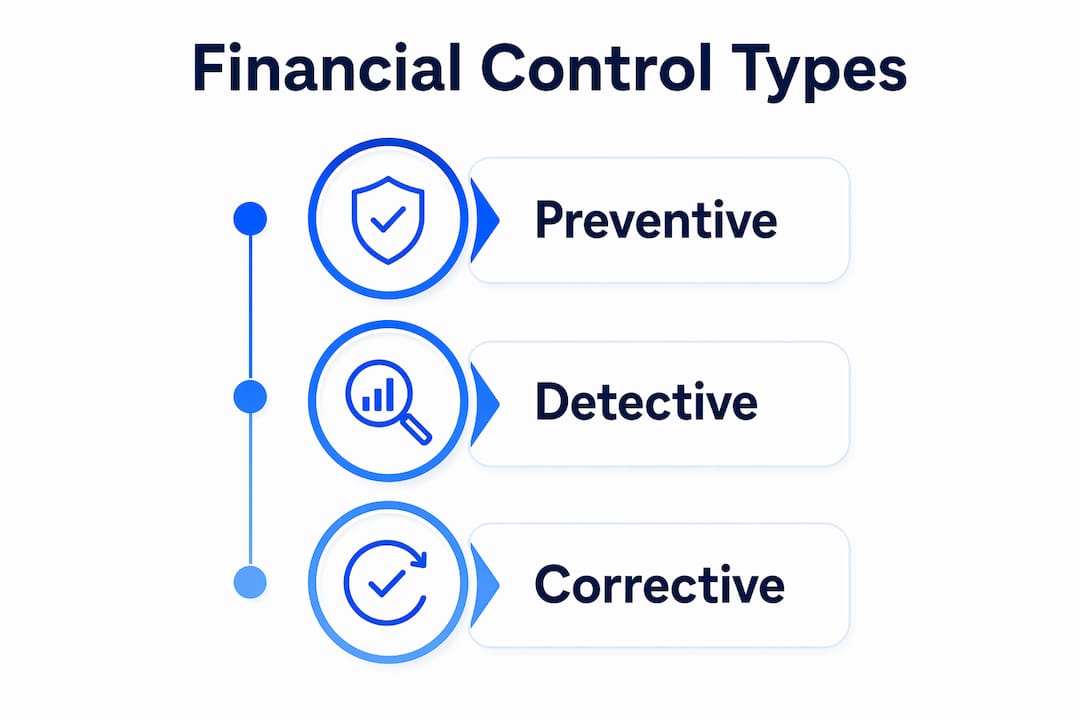
Within those components, controls fall into three functional types. Preventive, detective, and corrective controls work together to prevent errors and crime within the financial function. Understanding the difference helps you build a system that covers all three stages.
| Control type | Purpose | Examples |
|---|---|---|
| Preventive | Stop errors or fraud before they happen | Approval workflows, access restrictions, segregation of duties |
| Detective | Identify errors or fraud after they occur | Bank reconciliation, audit trails, variance analysis |
| Corrective | Fix problems once identified and prevent recurrence | Adjusting journal entries, policy updates, retraining staff |
A complete financial control system uses all three types. Preventive controls reduce the chance of a problem. Detective controls catch what slips through. Corrective controls close the gap so the same issue does not repeat.
Controls are management processes, not just rules posted on a wall. Effective internal control is a continuous process involving ongoing risk assessment and monitoring, not a one-time setup. That means reviewing your controls regularly, especially when your business grows, changes systems, or adds staff.
Common financial pitfalls that controls prevent
The most damaging financial problems in SMEs are not dramatic frauds. They are quiet, accumulating errors that nobody notices until cash flow becomes a crisis. Common errors like duplicate vendor payments, uncollected customer refunds, and payroll overpayments silently drain cash flow over time. These are the “zombie” issues of business finance: they keep drawing resources without anyone realizing it.
Consider a business paying the same vendor invoice twice because two people processed the same bill in different systems. That happens once, and it costs a few hundred dollars. It happens monthly for a year, and it costs thousands. The same logic applies to unclaimed customer refunds sitting in accounts payable or payroll errors that go uncorrected because no one reviews the detail.
Reconciling balance sheet accounts ensures profit figures are accurate and not distorted by unrecorded liabilities or wage adjustments. Skipping this step is one of the most common mistakes SME owners make. Your income statement can show a profit while your balance sheet hides liabilities that wipe it out. Reconciliation catches that gap before it becomes a surprise.
Specific pitfalls that formal controls address:
- Duplicate payments caught by three-way matching: purchase order, receipt, and invoice must align before payment processes.
- Payroll errors caught by comparing payroll reports to HR records each cycle.
- Uncollected refunds caught by aging reports reviewed monthly.
- Unreconciled accounts caught by mandatory monthly balance sheet reviews.
Pro Tip: Set a fixed date each month for a financial review. Thirty minutes reviewing bank statements, payroll summaries, and accounts payable aging reports catches most common errors before they compound.
What are the benefits of financial control for business growth?
Financial controls do more than prevent losses. They create the reliable data that confident decisions require. Financial controls support compliance with applicable laws and provide trustworthy data that directly affects investor confidence and business valuations. That matters whether you are seeking a bank loan, attracting a partner, or preparing for a sale.
Many SME owners assume controls are only for regulated industries or large corporations. That assumption is wrong and costly. A business with clean, auditable records and documented processes commands higher valuations and gets better loan terms. Lenders and investors treat financial discipline as a proxy for management quality. Sloppy records signal risk; clean records signal reliability.
The operational benefits are equally real:
- Better cash flow forecasting. Accurate records let you predict shortfalls weeks in advance instead of discovering them at month end.
- Faster decision-making. When you trust your numbers, you can act on them without waiting for a second opinion or a manual recount.
- Regulatory compliance. Controls create the documentation trail that tax authorities, auditors, and regulators expect.
- Reduced insurance and audit costs. Businesses with documented controls often face lower audit fees and fewer compliance penalties.
Without effective controls, businesses often enter firefighting mode, losing oversight of key financial operations and damaging both cash flow and compliance standing. The cost of that firefighting, in staff time, penalties, and missed opportunities, consistently exceeds the cost of building controls in the first place. For guidance on building these systems from the start, the financial onboarding best practices framework for SMEs offers a practical starting point.
Key Takeaways
Financial control is the single most cost-effective investment an SME can make to protect assets, ensure accurate reporting, and support confident growth decisions.
| Point | Details |
|---|---|
| Controls cut fraud and errors | Businesses with formal controls report 54% fewer misstatements and 71% lower fraud losses. |
| Small businesses are most at risk | SMEs lose roughly 5% of annual revenue to fraud, twice the rate of larger firms. |
| Three control types cover all stages | Preventive, detective, and corrective controls together close the full risk cycle. |
| Reconciliation prevents hidden losses | Monthly balance sheet reconciliation stops unrecorded liabilities from distorting profit figures. |
| Controls support growth and compliance | Clean financial records improve valuations, loan terms, and regulatory standing. |
The uncomfortable truth about financial controls in SMEs
I have worked with enough small business owners to know the pattern. The business is growing, the owner trusts the team, and formal controls feel like overhead for a company that size. Then something goes wrong. A vendor gets paid twice for six months. A payroll error runs uncorrected for a year. A trusted bookkeeper exploits unchecked access. The owner is blindsided every time, not because they were careless, but because they confused familiarity with oversight.
The insight that most articles skip is this: controls are not about distrust. They are about designing a system that does not depend on any single person’s attention or integrity. The owner who reviews bank statements monthly is not suspicious of their team. They are building a business that can survive turnover, growth, and the inevitable human error.
My honest recommendation for any SME is to start with three things: segregate who authorizes payments from who records them, reconcile every bank account monthly, and require dual approval for any transaction above a threshold you set based on your revenue. Those three steps alone address the majority of the risk that financial controls for growing businesses are designed to prevent. You do not need a CFO to implement them. You need a decision to treat your finances like the asset they are.
View controls as insurance, not bureaucracy. The premium is low. The coverage is your entire business.
— dd
Demivolt tools that support financial oversight for SMEs
Demivolt is a regulated European fintech platform built for businesses that need clear, compliant financial infrastructure without the complexity of traditional banking. Its platform gives SMEs dedicated IBAN accounts, role-based user management, and full payment tracking across SEPA and SWIFT, which are exactly the structural features that support internal financial controls.

For businesses managing cross-border payments, Demivolt’s free IBAN validator tool catches account number errors before payments go out, reducing one of the most common sources of payment loss. The broader free SEPA tools suite supports payment accuracy and compliance checks that align directly with the detective and preventive control types covered in this article. For SMEs ready to build financial oversight into their banking infrastructure from day one, Demivolt’s business banking platform is worth a close look.
FAQ
What is financial control in a business?
Financial control is the set of policies and procedures a business uses to protect its assets, ensure accurate financial records, and prevent errors and fraud. The industry term is internal controls, and they apply to businesses of every size.
Why do small businesses need financial controls?
Small businesses lose roughly 5% of annual revenue to fraud, twice the rate of larger firms, because of concentrated authority and limited oversight. Formal controls close those gaps without requiring a large finance team.
What are the three types of financial controls?
The three types are preventive controls, which stop problems before they happen; detective controls, which identify problems after they occur; and corrective controls, which fix issues and prevent them from repeating.
How does financial control help with compliance?
Financial controls create the documentation trail that regulators, auditors, and tax authorities require. Businesses with documented controls and compliance systems face fewer penalties and pass audits faster than those without formal processes.
What is the easiest financial control to implement first?
Segregation of duties is the most cost-effective starting point. Splitting the tasks of authorizing payments, recording transactions, and reconciling accounts across different people removes the single point of failure that most small business fraud exploits.