

TL;DR:
- Effective business financial control involves layered preventive, detective, and corrective measures that safeguard assets and ensure reliable reporting. Implementing role segregation and regular testing helps SMEs prevent errors and fraud, supporting growth and compliance. Starting small with prioritized controls and leveraging tools like Demivolt enhances financial oversight even with limited staff.
Business financial control is defined as the structured set of policies, procedures, and practices a company uses to safeguard its financial assets, produce accurate reporting, and support sound decision-making. For SME owners and financial managers, understanding financial management at this level is not optional. Small businesses lose about 5% of annual revenue to fraud, with companies under 100 employees experiencing roughly twice the median losses of larger firms. That figure represents real money leaving your business, often undetected for months. The good news is that a practical, well-designed financial control framework can close most of those gaps without requiring a large finance team.
What is business financial control and why does it matter?
Business financial control explained in its simplest form means putting the right checks in place so that money moves correctly, records stay accurate, and no single person can manipulate a financial process unchallenged. The industry term for this broader discipline is internal controls over financial reporting, or ICFR, a framework widely referenced by regulators, auditors, and institutions like KPMG.

Financial controls fall into three categories: preventive, detective, and corrective. Each plays a distinct role, and none works well in isolation. Preventive controls stop problems before they happen. Detective controls identify issues after they occur. Corrective controls fix the root cause and prevent recurrence.
Internal controls enable delegation by ensuring financial processes remain correct when responsibilities are shared across a team. For a growing SME, this is the difference between a business that scales confidently and one that loses visibility the moment the owner steps back. Controls also generate the reliable numbers that improve forecasting, reduce surprises, and protect profitability.
What are the main types of financial controls and how do they work together?
The three control types form a layered defense. No single layer is sufficient on its own, but together they create a system where errors and fraud are difficult to commit, easy to detect, and straightforward to correct.
| Control type | Example | Primary purpose |
|---|---|---|
| Preventive | Approval limits, segregation of duties | Stop errors or fraud before they occur |
| Detective | Bank reconciliation, variance analysis | Identify problems after a transaction is processed |
| Corrective | Root cause analysis, policy updates | Fix the underlying issue and prevent recurrence |
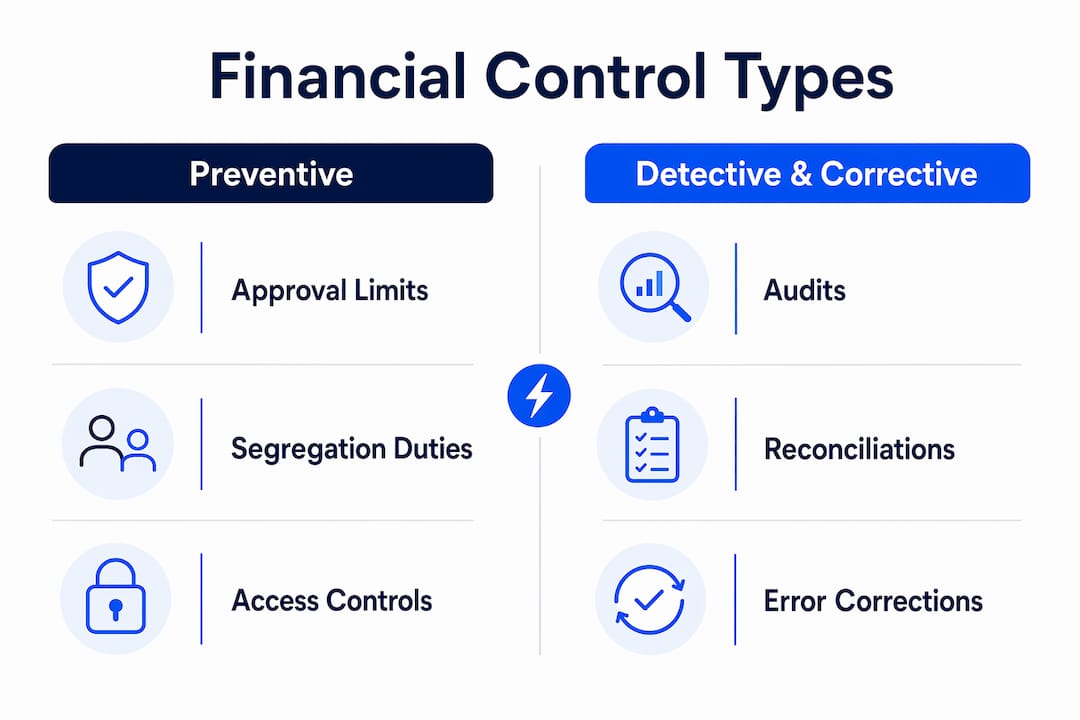
Preventive controls carry the highest return on investment because they block problems at the source. Requiring two signatures on payments above a set threshold, for example, costs almost nothing to implement but eliminates a wide category of unauthorized disbursements. Detective controls like monthly bank reconciliations catch what slips through. Corrective controls close the loop by updating the process so the same error cannot repeat.
Pro Tip: Start with preventive controls in your highest-risk areas, specifically cash disbursements and vendor payments, before building out detective and corrective layers. Fixing problems after the fact costs far more than blocking them upfront.
How can SMEs implement segregation of duties with limited staff?
Segregation of duties is the practice of dividing a financial transaction into four distinct roles so that no single employee controls the full cycle. Those four roles are initiating, approving, recording, and reconciling, and best practice limits any one person to no more than two of them for any given transaction type.
For a 50-person company, this is manageable. For a five-person team, it requires creativity. Here is how SMEs with lean staff can apply the principle without hiring additional headcount:
- Assign the business owner or a director to approve all payments above a defined threshold, even if they did not initiate the transaction.
- Separate the person who enters vendor invoices from the person who authorizes payment runs.
- Have someone outside the accounts payable function perform monthly bank reconciliations, even if that person is a part-time bookkeeper or external accountant.
- Rotate who reviews expense reports so no single manager approves their own team’s submissions indefinitely.
- Use your accounting software’s user permission settings to restrict who can edit posted transactions or change vendor bank details.
When complete separation is impossible, compensating controls fill the gap. Owner reviews, surprise cash counts, and independent audits all serve as compensating controls that reduce risk when you cannot fully segregate roles. The key is documentation: write down who does what, and review that assignment at least once a year.
Pro Tip: Changing a vendor’s bank account details is one of the most common fraud vectors in small businesses. Require a phone verification call to a known contact before updating any vendor payment information, regardless of how legitimate the email request appears.
What financial control activities should SMEs prioritize first?
A phased approach prevents the implementation burnout that kills most control programs before they deliver results. Month one should focus on revenue and procurement cycles, with payroll, inventory, and cross-cycle reconciliations added in later phases. The following sequence works well for most SMEs:
- Cash handling and bank reconciliations. Reconcile every bank account monthly, without exception. Assign this task to someone who does not process payments.
- Approval workflows and authorization limits. Define spending thresholds in writing. Any payment above the threshold requires a second approver before it is processed.
- Vendor master file controls. Restrict who can add or edit vendor records. Review the vendor list quarterly for duplicates, inactive vendors, or unusual entries.
- Three-way invoice matching. Match every vendor invoice against the original purchase order and the goods receipt before approving payment. This single control eliminates most duplicate and fraudulent invoices.
- Expense report documentation. Require receipts for all expenses above a minimum amount. Require a business purpose statement for every submission. Review reports before reimbursement, not after.
- Accounts receivable and payable controls. Automated billing, defined credit policies, and vendor terms optimization directly affect cash flow and should be formalized early in a growing SME’s control program.
Each step builds on the last. A business that completes all six has covered the majority of its financial risk exposure without a dedicated compliance team.
How to test, monitor, and maintain financial controls for lasting effectiveness
Designing a control is not the same as running one. Controls that exist only on paper create a false sense of security and leave the business exposed. Testing confirms that a control is both well-designed and actually operating as intended.
Effective monitoring for an SME looks like this:
- Documentation review: At least quarterly, pull a sample of transactions and verify that the required approvals, receipts, and reconciliations are present and complete.
- Observation: Watch how a process actually runs, not how the procedure manual says it should run. Gaps between the two are where risk lives.
- Reassessment after change: Any time you hire, restructure, change software, or enter a new market, review the controls that touch those areas. Business changes invalidate controls faster than most owners realize.
- Rolling test schedule: Assign specific controls to specific months so that every major control gets tested at least once per year, without creating a single overwhelming audit period.
- Stakeholder reporting: Summarize control health in a one-page dashboard for leadership review each quarter. If a control failed or was bypassed, document why and what changed.
The goal is not perfection. The goal is a system where problems surface quickly and get fixed before they compound.
How strong financial controls support business growth and compliance
Controls are not a tax on operational efficiency. They are the foundation that makes growth possible without proportional increases in financial risk.
“Effective internal control over financial reporting promotes accountability and safeguards assets, forming the bedrock of public and investor confidence.” — KPMG ICFR Handbook
When a bank, investor, or acquirer evaluates your business, one of the first things they examine is whether your financial records are reliable. Strong financial controls are foundational to investor confidence and business credibility, not just a regulatory checkbox. A business with documented, tested controls commands more trust and, often, better financing terms.
Beyond credibility, controls reduce the direct cost of errors. Duplicate payments, unreconciled accounts, and unchecked expense claims are not rare edge cases. They are routine in businesses without formal controls, and they erode margins quietly. Solid business finance strategies also support accurate forecasting. When your numbers are reliable, your budget projections are reliable, and your resource allocation decisions carry far less risk.
Regulatory compliance is the third pillar. Meeting EU payment regulations, VAT reporting requirements, or sector-specific financial rules becomes significantly easier when your underlying control environment is already structured. Penalties for non-compliance are not just financial. They consume management time and damage supplier and customer relationships. For SMEs involved in cross-border trade, the stakes are even higher, making financial onboarding best practices a critical early investment.
Key takeaways
Effective financial control in business requires preventive, detective, and corrective layers working together, supported by regular testing and clear role assignments.
| Point | Details |
|---|---|
| Define control categories early | Preventive, detective, and corrective controls each serve a distinct role and must work together. |
| Segregate duties, even in small teams | Limit any one person to two of the four transaction roles; use owner reviews as a compensating control. |
| Prioritize high-risk areas first | Start with cash handling, bank reconciliations, and vendor payments before expanding to other cycles. |
| Test controls regularly | A control that exists only on paper provides no protection; test and document at least quarterly. |
| Controls enable growth | Reliable financial records improve forecasting, investor confidence, and regulatory compliance simultaneously. |
Why most SMEs get financial controls wrong from the start
The most common mistake I see is treating financial controls as a compliance project rather than a management tool. Business owners build a binder of policies, hand it to their bookkeeper, and consider the job done. Six months later, the controls exist on paper and nowhere else.
The second mistake is trusting relationships over process. In a small team, it feels uncomfortable to require your most trusted employee to get a second signature on payments. That discomfort is exactly why fraud in small businesses is so often committed by long-tenured, trusted staff. Process is not a sign of distrust. It is what protects both the business and the employee from accusations they cannot disprove.
What actually works is starting small and making controls a habit before expanding them. Pick three controls, implement them properly, test them for 90 days, and then add three more. A business that runs six well-tested controls outperforms one with twenty controls that nobody follows. Leadership commitment matters more than the sophistication of the framework. If the owner bypasses the approval process “just this once,” the entire culture of control collapses.
The businesses I have seen grow most confidently are the ones that treat their expense management practices and financial controls as permanent infrastructure, not a phase they will get to eventually. Start now, keep it simple, and test everything.
— dd
How Demivolt supports SME financial control in practice

Demivolt is built for SMEs that take financial control seriously. The platform gives you dedicated IBAN accounts, role-based user permissions, and real-time visibility over every payment, which are the exact infrastructure elements that make segregation of duties and approval workflows practical for lean teams. Virtual and physical business cards with defined spending limits replace informal expense processes with documented, auditable ones. For businesses managing cross-border payments, Demivolt’s SEPA and SWIFT capabilities sit within a regulated, EU-compliant framework that supports your compliance obligations from day one. Start by validating your vendor payment details with Demivolt’s free IBAN validation tool, or explore the full suite of free payment tools designed to reduce errors and strengthen your financial controls.
FAQ
What is business financial control?
Business financial control is the system of policies, procedures, and checks a company uses to protect its assets, produce accurate financial records, and support reliable decision-making. It includes preventive, detective, and corrective controls working together across all financial processes.
How do small businesses implement segregation of duties?
Segregation of duties divides transactions into four roles: initiating, approving, recording, and reconciling. Small businesses with limited staff can use compensating controls such as owner approvals, independent reconciliations, and external audits to achieve equivalent protection.
Why are financial controls important for SME growth?
Controls generate reliable financial data that improves forecasting, supports investor confidence, and reduces the cost of errors and fraud. Implementing controls late exposes businesses to compounding risks that become significantly harder to address as the business scales.
How often should financial controls be tested?
Controls should be tested at least quarterly through documentation review and transaction sampling, with a full reassessment any time the business undergoes significant change such as new hires, software transitions, or market expansion.
What is the difference between preventive and detective controls?
Preventive controls block errors or fraud before a transaction is completed, such as requiring dual approval on payments. Detective controls identify problems after the fact, such as bank reconciliations or variance analysis reports.
Recommended
- Demivolt | Blog – Open banking explained: Control, compliance & SME benefits
- Demivolt | Blog – Business account benefits for European SMEs in 2026
- Demivolt | Blog – Types of Business Bank Accounts: Find the Right Fit for Your SME
- Demivolt | Blog – Business banking for SMEs: services, compliance & cross-border