

SEPA R-kodai are the four-character ISO 20022 reason codes that identify why a SEPA transaction failed, bounced, or was recalled. When one lands in your queue, classify it by R-type first (reject or return), flag the liquidity impact immediately, and route it through your automated triage before a human ever touches it. EPC guidance is the authoritative source for what each code means, and consistency across SEPA schemes is exactly what makes automation possible.
TL;DR:
- Reject codes like AC01 and AC04 should be corrected before retrying, as they involve invalid or closed accounts and require validation or new details.
- Return codes such as AM04 and MS03 often signal insufficient funds or masked underlying reasons, making it crucial to log and escalate consistent issues with specific banks.
- SEPA Direct Debit refunds and recall windows are strictly timed, with SCT returns typically within three banking days, affecting liquidity management and reconciliation.
- Automating R-code handling by categorizing codes into actionable groups reduces manual work, improves response time, and helps identify problematic bank relationships through tracking KPIs like MS03 volumes.
- Implementing preemptive validation, structured remittance data, and proper internal mapping can significantly reduce the occurrence of preventable R-codes and streamline exception management.
Table of Contents
- What Are R-Transaction Types in SEPA Payment Processing?
- Common SEPA Return Reject Codes and What They Mean
- SEPA Direct Debit Refund Timelines and Accounting Impact
- How to Automate SEPA R-Code Handling and Reconciliation
- Demivolt’s View on Reducing R-Code Friction
- Where to Verify SEPA R-Code Rules and Timelines
- Demivolt: Built to Prevent R-Codes Before They Happen
- Sources
What Are R-Transaction Types in SEPA Payment Processing?
Every SEPA exception falls into one of six categories, and knowing which one you’re looking at determines your entire response. The European Payments Council treats these as standardized events, not ad hoc bank errors, which is why the codes behave the same way whether the payment moves through a bank in Vilnius or Valencia.
- Reject: stopped before settlement, initiated by the debtor bank, usually a pacs.002 message. No money has moved.
- Return: reversed after settlement, initiated by the beneficiary bank, typically a pacs.004 message.
- Refund: specific to SEPA Direct Debit, triggered by the debtor within a defined claim window.
- Reversal: initiated by the originator’s own bank to undo a payment it sent in error.
- Refusal: the beneficiary bank declines a direct debit collection before it settles.
- Recall/RFRO (Request for Recall of Funds): the originator’s bank asks for funds back, and the beneficiary bank has a formal window to respond.
Each type attaches to specific schemes. SEPA Credit Transfer (SCT) and SCT Instant primarily use Reject, Return, and Recall. SEPA Direct Debit (SDD Core and SDD B2B) adds Refund and Refusal into the mix, since direct debits carry consumer protection rules that credit transfers don’t. The operational split that matters most is pre-settlement versus post-settlement: a reject never touches your cash position, but a return means funds already cleared and now need to reverse, which hits your reconciliation and your general ledger differently.
Common SEPA Return Reject Codes and What They Mean
Most operations queues see the same dozen codes on repeat. Here’s what they actually mean and what to do the moment one appears.
| Code | Likely cause | Immediate action | Reject or return |
|---|---|---|---|
| AC01 | Incorrect account number/IBAN | Validate IBAN, contact payer for correction | Reject |
| AC04 | Account closed | Request new account details before retry | Reject or return |
| AC06 | Account blocked | Escalate to bank, do not retry automatically | Reject |
| AM04 | Insufficient funds | Retry per policy or contact debtor | Return (SDD) |
| AM05 | Duplicate collection | Cancel duplicate, verify mandate records | Reject |
| MS03 | Reason not specified by debtor bank | Escalate for clarification if recurring | Return |
| RR01–RR04 | Missing or malformed debtor/creditor data | Correct data fields, resubmit | Reject |
| TECH | Technical processing error at receiving bank | Retry after delay, log for pattern tracking | Reject or return |
MS03 deserves special attention because it’s a masked code. National data-protection rules in several SEPA countries prevent the debtor’s bank from disclosing the real reason, so PaymentBrief’s operator reference notes that MS03 frequently hides an underlying AC04 or AM04. Treat repeated MS03 codes from the same counterparty as a signal to open a direct query rather than assume it’s random.
Pro Tip: Build a running log of MS03 occurrences by counterparty bank. If one bank accounts for a disproportionate share, that’s usually a jurisdiction with stricter disclosure rules, not a data quality problem on your end.
SEPA Direct Debit Refund Timelines and Accounting Impact
Timing windows are not optional guidance. They’re contractual obligations under the SCT Rulebook, and missing them creates liability, not just inconvenience.
- SCT returns: beneficiary PSP must return within three banking business days after settlement.
- Recall/RFRO: the beneficiary PSP has 15 banking business days to respond to a recall request.
- SDD Core refunds: the payer has a window of weeks to months to claim a refund for an authorized collection, and a longer period for unauthorized ones.
- SDD B2B: no consumer-style refund right exists, which changes your exposure calculation entirely for business-to-business collections.
The accounting distinction matters more than most finance teams treat it. A reject never moves cash, so it should never appear in your liquidity forecast as an outflow. A return, by contrast, reverses funds that already settled, which means your GL entry needs a corresponding reversal and your cash forecast needs an adjustment the moment the R-message arrives, not when someone notices the balance is off. Roughly three banking business days is the standard window for SCT returns post-settlement, which should be your internal SLA benchmark for escalating unresolved cases to your banking partner.
How to Automate SEPA R-Code Handling and Reconciliation
Manual triage doesn’t scale past a handful of exceptions a day. The fix is a mapping layer that translates EPC’s granular codes into a smaller set of internal categories your systems can act on without a person reading each message.
- Group codes by required action, not by their EPC label. AC01, AC06, and RR01 through RR04 all mean “fix the data and resubmit.” AM04 and AM05 mean “contact the customer.” AC04 means “get new account details.” This collapses dozens of codes into four or five workflow buckets.
- Set auto-retry policies for codes like AM04, where a second attempt after a short delay often succeeds without any human involvement.
- Trigger customer notifications automatically when a code requires action on the payer’s side, rather than waiting for someone to review the queue.
- Open a camt.056 investigation automatically when a return sits unresolved past your internal SLA, rather than letting it age silently.
- Track MS03 volume by counterparty as a standing KPI, since a spike there usually points to a bank relationship issue worth escalating, not a code you can fully automate around.
Pro Tip: Expose your internal category, not the raw EPC code, to your ERP or invoicing system. “Retry after IBAN fix” is something an accounts team can act on immediately; “AC01” means nothing to them without a lookup table.
Demivolt’s View on Reducing R-Code Friction
Most R-transactions are preventable, not inevitable. IBAN errors, the single largest driver of AC01 rejects, are avoidable if validation happens at the point of data capture rather than after a payment has already been submitted and bounced. Demivolt’s IBAN validation tool checks account numbers against ISO 13616 formatting before a transfer is even initiated, which cuts off the most common reject category before it costs you a reconciliation cycle.
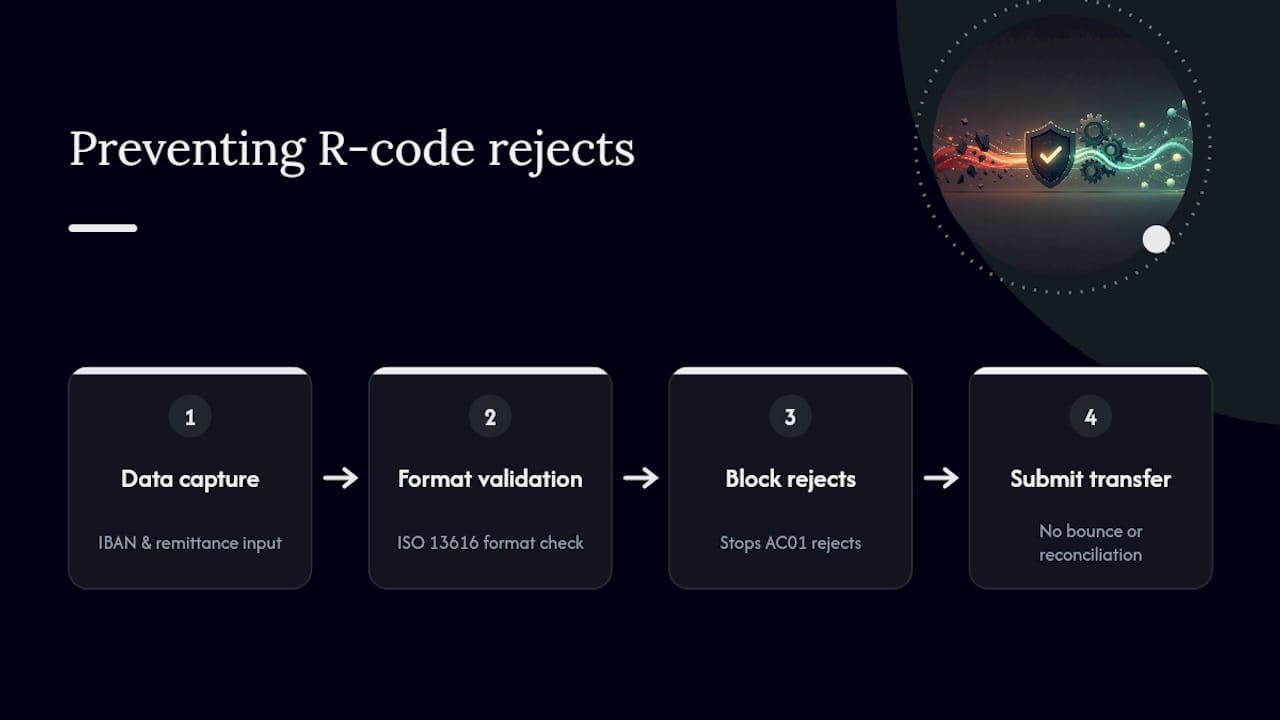
Structured remittance information matters just as much. Payments carrying clean, structured creditor references are far less likely to generate RR-series rejects, and Demivolt’s dedicated IBAN accounts support that structured data by design, alongside multi-account handling for businesses managing separate flows across currencies or entities.
If you haven’t audited your internal mapping tables against the latest EPC guidance, do it now. Codes get refined periodically, and a mapping table built two years ago may already be misclassifying newer address-format codes like RR02 and RR03.
— dd
Where to Verify SEPA R-Code Rules and Timelines
- SCT R-transaction reason code guidance — full code tables and usage restrictions from the EPC.
- SDD R-transaction reason code guidance — direct debit specific codes and refund rules.
- PaymentBrief’s R-transaction reference — operator-level explanations of timing and masked codes.
Demivolt: Built to Prevent R-Codes Before They Happen
Demivolt gives payment operations teams the infrastructure to stop the most common R-codes at the source instead of cleaning them up after the fact. Dedicated IBAN accounts, structured remittance handling, and role-based multi-account management mean fewer AC01 rejects, cleaner reconciliation, and less time spent decoding masked responses like MS03.
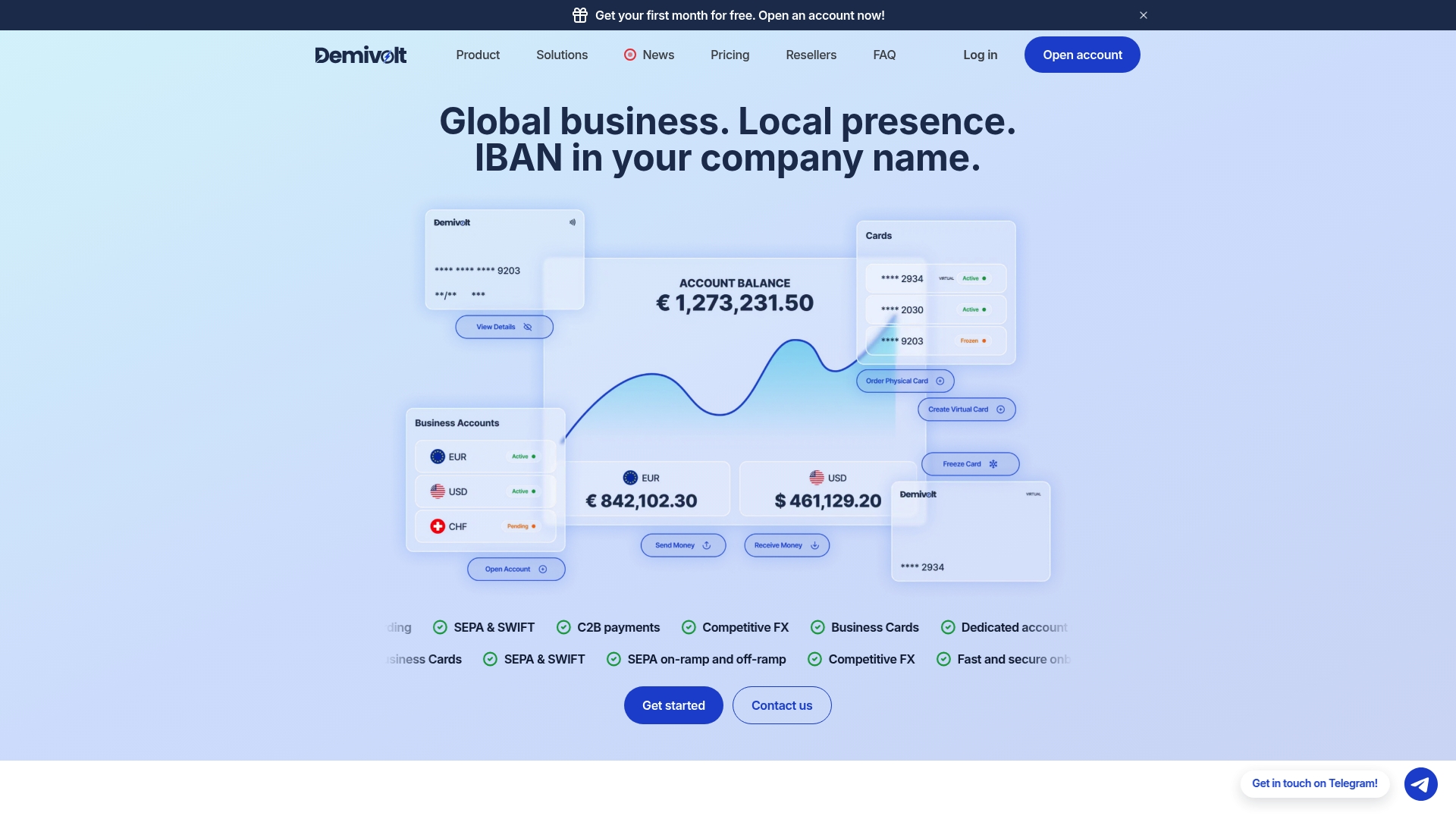
If IBAN errors are already a recurring line item in your exception queue, start with the free IBAN validator to catch formatting issues before submission rather than after a bounce. For teams building out full SEPA and SWIFT payment infrastructure, Demivolt’s business accounts combine regulated, segregated-fund safeguarding with the multi-account structure needed to separate operational cash from exception handling. Open a Demivolt account to see how validated data capture and structured payment details cut your R-code volume from day one.
Sources
- Guidance on reason codes for SEPA Credit Transfer R-transactions | European Payments Council
- SEPA R-Transaction Return & Reject Codes — PaymentBrief