

TL;DR:
- Payment optimization improves SME cash flow by increasing transaction success and reducing delays. Implementing electronic invoicing, diverse payment methods, and system integration can significantly boost revenue and operational efficiency. Continuous review and advanced tools like intelligent routing and fraud detection further enhance payment success rates.
Payment optimization is the process of improving payment workflows to increase authorization rates, reduce delays, and close cash flow gaps that cost SMEs real money. For small and medium enterprises, this is not a back-office concern. It is a direct driver of working capital. This SME payment optimization guide covers the foundational tactics, step-by-step improvements, and advanced strategies that financial decision-makers need to move money faster, reduce friction, and protect revenue. The standard industry term for this discipline is payment process optimization, and it applies across invoicing, collection, fraud control, and system integration.
What are the essential components of an optimized payment process for SMEs?
Payment optimization maximizes revenue by improving authorization rates and reducing the revenue lost when transactions fail or stall. That definition has a practical implication: every point in your payment workflow where a client hesitates, a system errors, or a check sits in the mail is a measurable cost.
The first component is mapping your revenue model. A consulting firm billing on retainer has different cash flow needs than a product business running one-off orders. Mapping revenue by client type — retainer, project, subscription — guides which payment methods and terms to prioritize. A subscription business benefits from automated recurring billing. A project-based firm benefits more from milestone invoicing with embedded payment links.
The second component is invoicing efficiency. Electronic invoices with embedded “Pay Now” links reduce friction and encourage faster payment. Platforms like QuickBooks and FreshBooks facilitate online payment acceptance and cut the lag between invoice delivery and client action. Tightening payment terms from net 60 to net 30 eliminates a full month of working capital gap without requiring any external financing.
The third component is payment method diversity. Clients pay faster when they can use their preferred method. Offering card, ACH, Zelle, and mobile wallets covers the majority of B2B and B2C preferences. The fourth component is automation. Recurring billing and automated payment reminders remove the human follow-up burden and reduce late payments without awkward client conversations.
The fifth component is system integration. Your payment platform should connect directly to your accounting software and CRM. Disconnected systems create duplicate data entry, reconciliation errors, and blind spots in your cash position.
- Map your revenue model before choosing payment tools
- Switch to electronic invoicing with embedded payment links
- Tighten payment terms to net 30 as a default
- Offer at least three payment methods including a low-cost option like Zelle
- Automate recurring billing and reminder sequences
- Integrate your payment platform with accounting and CRM software
Pro Tip: Set your default invoice payment term to net 30 and reserve net 60 only for clients who negotiate it explicitly. Most clients pay to the term you set, not faster.
How can SMEs implement payment process improvements step-by-step?
Improving payment workflows works best as a phased process. Trying to change everything at once creates confusion for clients and staff. A structured rollout produces faster results with fewer errors.
Step 1: Audit your current payment flows. Pull the last 90 days of invoices and identify where delays occur. Are clients paying late? Are checks still arriving by mail? Are reconciliation errors common? Quantify the problem before you fix it.

Step 2: Digitize invoicing immediately. Electronic invoicing and ACH collection reduce payment receipt time to 1–3 business days. Around 80% of all ACH payments in the U.S. settle within one banking day, according to 2025 Nacha data. That speed advantage alone justifies the switch from paper-based billing.
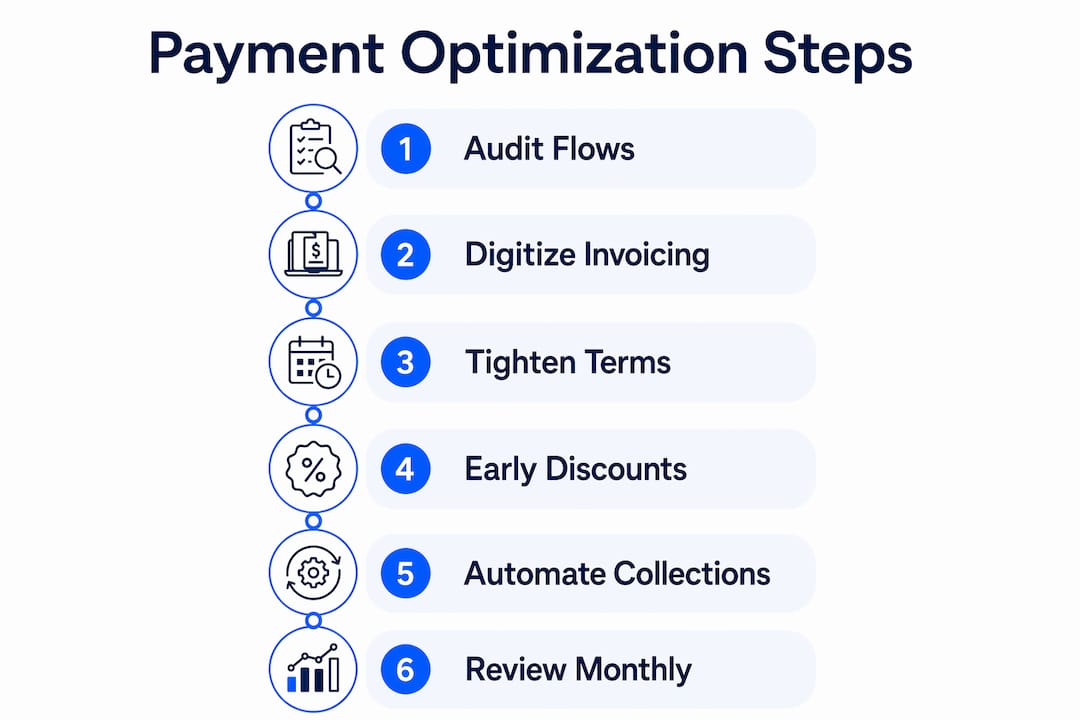
Step 3: Tighten payment terms. Move standard terms to net 30. Communicate the change to clients with at least 30 days’ notice. For new clients, net 30 should be the default in every contract.
Step 4: Introduce early payment discounts carefully. A 2/10 net 30 structure — 2% discount for payment within 10 days — sounds attractive. But early payment discounts carry an annualized cost equivalent to roughly 36%. That is a significant financing expense. Use this tactic selectively for clients with large balances or chronic late payment patterns.
Step 5: Automate collection and reconciliation. Connect your invoicing platform to your bank account and accounting software. Automated reconciliation matches payments to invoices without manual intervention. This step alone removes hours of weekly administrative work.
Step 6: Review and iterate monthly. Track authorization rates, days sales outstanding (DSO), and late payment frequency. Use that data to identify which clients, payment methods, or invoice formats still create friction.
Pro Tip: When you move clients from paper checks to ACH, offer to set up the first payment yourself. Walking them through the process once eliminates the friction that causes most clients to delay the switch.
What advanced technologies and strategies support payment optimization for SMEs?
Technology raises the ceiling on what payment optimization can achieve. The most impactful tools go beyond faster invoicing and address the mechanics of how transactions succeed or fail.
Intelligent payment routing is the most underused tool in SME finance. Payment routing algorithms using multi-armed bandit methods test multiple acquirers or channels dynamically to find the path with the highest success rate. Enterprise platforms have used this for years. SME-focused infrastructure providers, including Cray Finance, now bring intelligent routing to smaller businesses that cannot build it in-house.
Machine learning fraud detection reduces chargebacks and protects revenue. AI-powered fraud engines give accurate risk assessments in real time, preserving funds and maintaining client trust. The practical benefit for SMEs is fewer false declines, which means fewer legitimate transactions rejected by overly cautious filters.
Multi-method payment acceptance is now a baseline expectation. Offering a mix of 3–4 payment methods, including low-cost options like Zelle, reduces processing fees and friction. If 30% of your clients shift to lower-cost methods, fee savings exceed $500 annually for many small businesses. That is real margin recovered without raising prices.
System integration is where most SMEs leave efficiency on the table. 88% of finance leaders acknowledge that slow, manual payment operations are a problem. Connecting payment systems to procurement, inventory, and finance tools removes the ambiguity that causes errors and delays. Payment system integration also reduces security risks by limiting the number of manual data transfers between systems.
- Intelligent payment routing to maximize transaction success rates
- Machine learning fraud detection to reduce chargebacks
- Multi-method acceptance covering card, ACH, Zelle, and mobile wallets
- Full integration with accounting, CRM, and procurement platforms
- Centralized payment pages that consolidate all methods into one client-facing URL
What common mistakes should SMEs avoid during payment optimization?
Most payment optimization failures trace back to a small set of predictable errors. Knowing them in advance saves significant time and money.
Choosing a platform that does not scale. SMEs should avoid payment systems that work well today but cannot adapt to future business changes. A platform built for simple card acceptance may not support ACH, international SEPA transfers, or multi-currency accounts as your business grows. Build in flexibility from the start.
Offering too few payment options. Clients who cannot pay by their preferred method delay payment or abandon the transaction entirely. Friction at the payment stage is a direct revenue leak. Offering at least three methods eliminates most of this problem.
Misjudging early payment discount costs. The 2/10 net 30 structure looks like a small concession. The annualized rate of roughly 36% makes it one of the most expensive financing tools available. Use it only when the cash flow benefit clearly outweighs the cost.
Ignoring integration. Treating payment processing as a standalone function disconnected from accounting and CRM creates duplicate data, reconciliation errors, and cash position blind spots. Viewing payment processing as merely a cost misses the efficiency and revenue growth that integration unlocks.
Neglecting fraud management. Chargebacks and fraud losses compound quickly for SMEs without dedicated finance teams. Even basic fraud detection settings in your payment platform reduce exposure significantly.
Effective payment optimization blends technology with human oversight to maximize revenue and reduce losses. Automation handles volume; human review catches edge cases that algorithms miss.
Key Takeaways
The most effective SME payment strategy combines electronic invoicing, tighter payment terms, multi-method acceptance, and full system integration to close cash flow gaps and protect revenue.
| Point | Details |
|---|---|
| Digitize invoicing first | Electronic invoices with payment links cut receipt time to 1–3 business days. |
| Tighten payment terms | Moving from net 60 to net 30 eliminates a month of working capital gap at no cost. |
| Diversify payment methods | Offering 3–4 methods including Zelle reduces fees and removes client friction. |
| Integrate your systems | Connecting payment tools to accounting and CRM eliminates errors and improves cash visibility. |
| Use early discounts carefully | The 2/10 net 30 structure carries an annualized cost near 36%, so apply it selectively. |
The part of payment optimization most SMEs get wrong
The conversation around payment optimization almost always focuses on speed: get invoices out faster, collect faster, settle faster. Speed matters. But the bigger opportunity is in alignment, and most SMEs miss it entirely.
I have seen businesses adopt sophisticated payment platforms while still billing on terms that made sense five years ago. The platform is fast. The terms are slow. The result is no improvement in DSO. The technology cannot fix a structural mismatch between how you bill and how your clients actually operate.
The second mistake I see consistently is treating payment optimization as a one-time project. You audit, you fix, you move on. But payment data is a continuous signal. Authorization rates shift. Client payment behavior changes. New fraud patterns emerge. The businesses that sustain improvement are the ones that review payment metrics monthly, not annually.
The third thing worth saying plainly: integration is not optional. Businesses that run payment processing through one system and accounting through another are doing double the work for half the visibility. The efficiency gains from connecting these systems are immediate and compounding. If your current setup requires manual reconciliation, that is the first thing to fix, before any other optimization.
— dd
How Demivolt supports SME payment efficiency
Demivolt is a regulated European fintech platform built for businesses that need reliable, integrated payment infrastructure. For SMEs managing SEPA transfers, cross-border payments, or multi-account structures, Demivolt provides the dedicated IBAN accounts, role-based user management, and compliance-ready tools that reduce payment errors and improve cash flow visibility.
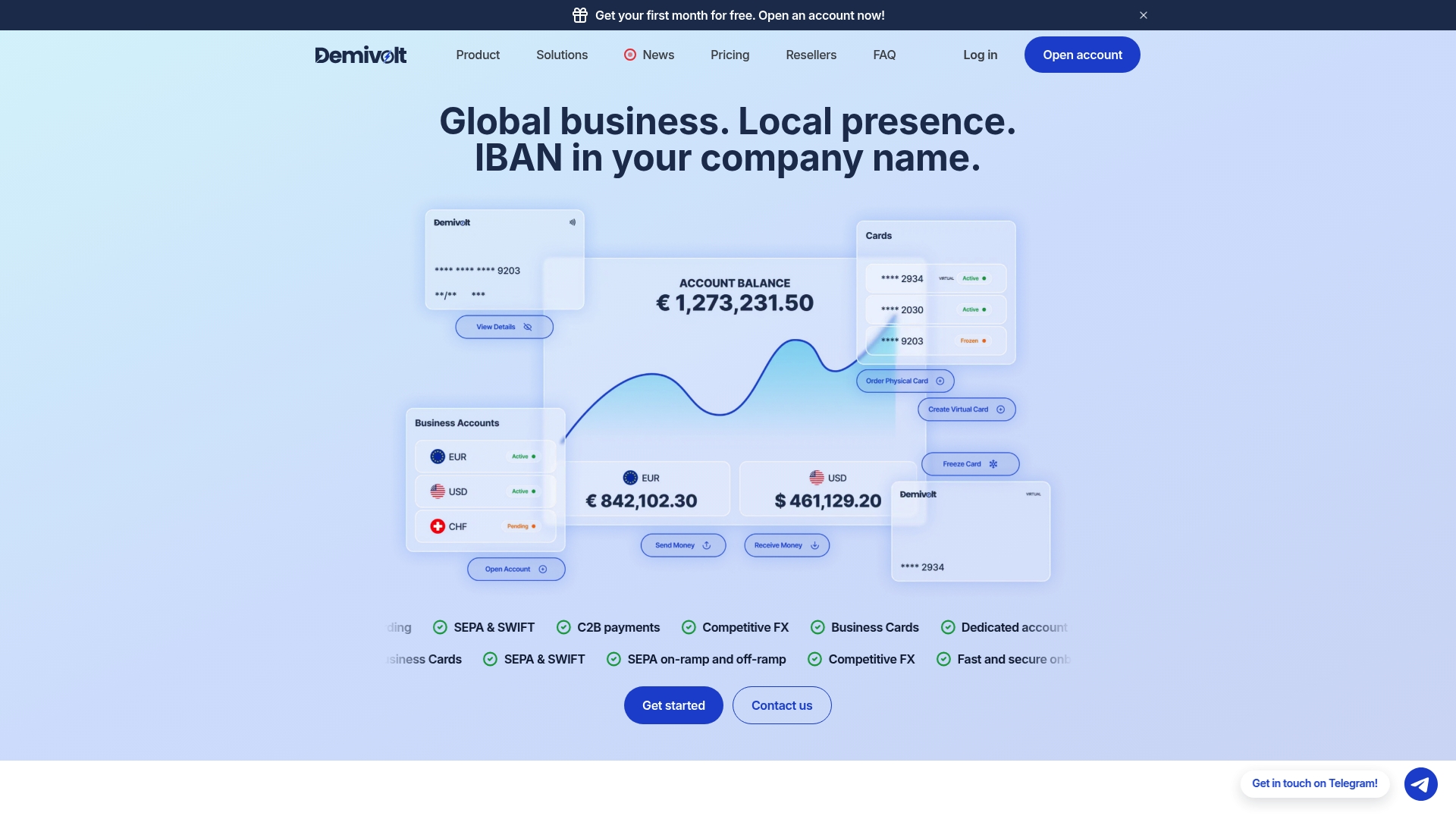
Demivolt’s free IBAN Validator checks account numbers against the ISO 13616 standard before you send a payment, eliminating the costly errors that come from incorrect bank details. The full suite of free SEPA tools supports EU payment compliance and reduces friction for businesses operating across European markets. For SMEs ready to move beyond fragmented payment setups, Demivolt’s business banking platform offers the integrated infrastructure to manage payments, expenses, and compliance in one place.
FAQ
What is SME payment optimization?
SME payment optimization is the process of improving payment workflows to increase authorization rates, reduce delays, and close cash flow gaps. It covers invoicing efficiency, payment method diversity, system integration, and fraud management.
How does electronic invoicing improve cash flow?
Electronic invoicing with embedded payment links reduces payment receipt time to 1–3 business days. Around 80% of ACH payments in the U.S. settle within one banking day, according to 2025 Nacha data.
What payment methods should SMEs offer?
SMEs should offer at least 3–4 payment methods, including card, ACH, Zelle, and mobile wallets. Offering lower-cost options like Zelle can save $500 or more annually in processing fees.
Are early payment discounts worth it for SMEs?
Early payment discounts structured as 2/10 net 30 carry an annualized cost of roughly 36%. Use them selectively for clients with large balances or chronic late payment patterns, not as a standard policy.
Why does payment system integration matter?
88% of finance leaders report that slow, manual payment operations hurt efficiency. Integrating payment tools with accounting and CRM platforms eliminates duplicate data, reduces errors, and gives a clearer picture of your cash position.