

TL;DR:
- An international payment compliance checklist ensures your business meets all regulatory requirements for cross-border transactions.
- It covers key areas like KYC, AML, sanctions screening, Travel Rule data sharing, and message integrity to prevent penalties.
An international payment compliance checklist is the structured framework that ensures your business meets every regulatory requirement before, during, and after a cross-border transaction. For SMEs and e-commerce companies, the stakes are high. Missing a single step in your anti-money laundering (AML) program, Know Your Customer (KYC) process, or sanctions screening can result in frozen funds, regulatory fines, or criminal penalties. This checklist covers the core compliance areas: KYC, AML, OFAC sanctions screening, FATF Travel Rule thresholds, suspicious activity reporting, and payment message integrity.

1. Key regulatory requirements for your international payment compliance checklist
Every cross-border payment program must address four non-negotiable compliance pillars: KYC, AML, sanctions screening, and transaction reporting.
KYC and KYB verification confirm the identity of individuals and businesses before any payment is processed. KYC covers individual customers. Know Your Business (KYB) applies to corporate counterparties and requires verifying ultimate beneficial ownership (UBO), business registration, and the nature of operations.
AML program components include written policies, a designated compliance officer, employee training, independent testing, and ongoing transaction monitoring. The Financial Action Task Force (FATF) sets the global standard for AML program structure, and most national regulators mirror its recommendations directly.
Sanctions screening must run against the OFAC Specially Designated Nationals list, the EU consolidated sanctions list, and the UN sanctions list at minimum. Fuzzy matching algorithms are now standard practice because name variations, transliterations, and aliases would otherwise slip through exact-match filters.
Reporting thresholds vary by jurisdiction. In the US, SAR filing is required for transactions of $2,000 or more where suspicion exists, and Currency Transaction Reports (CTRs) are mandatory for cash transactions above $10,000. Failure to file on time risks licensing suspension or criminal prosecution.
Pro Tip: Build your sanctions screening into the payment initiation step, not as a post-processing check. Screening after a payment is queued creates operational delays and legal exposure if a match is identified mid-transfer.
- Verify UBO documentation for all corporate counterparties before onboarding
- Screen all parties against OFAC, EU, and UN sanctions lists at transaction initiation
- File SARs within 30 days of identifying suspicious activity (60 days if no account exists)
- Maintain CTR records for at least five years from the date of filing
- Document your AML policies in writing and review them at least annually
2. Travel Rule thresholds and cross-border data sharing requirements
The FATF Travel Rule requires payment originators to pass identifying information about the sender and recipient to the next financial institution in the payment chain. The threshold at which this obligation triggers differs by jurisdiction, and getting it wrong is a common compliance gap for SMEs.
US rules mandate data sharing for transactions above $3,000. The UK requires it for transfers above £1,000. The EU removes the threshold entirely for crypto asset transfers, requiring full sender and recipient data on every transfer regardless of amount. These differences mean your compliance program must be jurisdiction-aware, not a single global policy.
Required data under the Travel Rule includes the full legal name of the originator, the originator’s account number or unique transaction reference, the originator’s address or national identity number, and the full legal name of the beneficiary. Incomplete data at any point in the chain triggers rejection or a compliance hold by the receiving institution.
Pro Tip: Map every payment corridor your business uses and document the Travel Rule threshold for each jurisdiction. A simple spreadsheet with corridor, threshold, and required data fields prevents costly rejections.
3. Payment message enrichment and ISO 20022 data integrity
Payment message quality is a compliance requirement, not just an operational preference. ISO 20022 messaging is now a regulatory necessity across major payment networks, and structured data fields at origination directly reduce transaction rejections by intermediary banks.
The shift to ISO 20022 is not optional. Standardized messaging reduces transaction failures because regulators and correspondent banks require structured, machine-readable data. A payment message that contains free-text fields or truncated names will fail screening at an intermediary bank, even if your own compliance checks passed.
Required fields at origination include:
- Full legal name of the originator (no abbreviations or nicknames)
- Originator’s full street address, city, country, and postal code
- Originator’s account identifier (IBAN or account number with BIC/SWIFT code)
- Full legal name of the beneficiary
- Beneficiary’s account identifier
- Purpose code for the transaction (salary, goods, services, intercompany transfer)
- Reference number that allows end-to-end reconciliation
Intermediary banks strip or truncate data when message formats are incompatible. Strict validation at origination prevents this problem before it reaches a correspondent bank. Once data is stripped mid-chain, you cannot retroactively fix it without recalling and resubmitting the payment.
Pro Tip: Reconcile your outbound payment records against bank statements at least daily. The Reserve Bank of India requires vostro and nostro reconciliation within one-hour intervals for inward cross-border payments. That standard is a useful benchmark for any high-volume operation.
4. Ongoing monitoring, enhanced due diligence, and risk segmentation
One-time KYC at onboarding is not enough. Ongoing compliance monitoring is a core requirement, and Enhanced Due Diligence (EDD) applies whenever a customer or transaction corridor presents elevated risk.
EDD is triggered by factors including high-risk jurisdictions, politically exposed persons (PEPs), unusual transaction volumes relative to the customer’s stated business profile, and certain industry types such as money services businesses or arms dealers. When EDD applies, you must collect additional documentation, obtain senior management approval for the relationship, and conduct more frequent reviews.
Sanctions and PEP lists must update dynamically. A customer who passed screening at onboarding may appear on a sanctions list six months later. Static, one-time checks create a compliance gap that regulators treat as negligence.
Risk segmentation means assigning each customer and payment corridor a risk rating (low, medium, or high) and calibrating your monitoring frequency accordingly. High-risk corridors require more frequent transaction reviews and lower thresholds for escalation.
- Assign a risk rating to every customer at onboarding and review it annually at minimum
- Update sanctions and PEP list feeds in real time or at least daily
- Trigger EDD for any customer transacting with a FATF high-risk jurisdiction
- Document every escalation decision, including the reason, the reviewer, and the outcome
- Set transaction velocity alerts for amounts or frequencies that exceed the customer’s stated profile
False positives are inevitable in any screening program. Document your escalation procedure for clearing false positives, including who has authority to clear a match and what evidence is required. Documented escalation procedures protect your business during a regulatory audit by showing that every match was reviewed, not ignored.
5. Internal controls, staff training, and compliance documentation
A compliance program that exists only on paper fails every audit. Internal controls must be operational, tested, and documented to satisfy regulators and correspondent banks.
Your compliance officer must have direct access to senior management and the authority to halt transactions. This person is responsible for maintaining your AML policy, overseeing staff training, and signing off on SAR filings. Training must cover how to identify suspicious activity, how to escalate a sanctions hit, and how to handle a customer who attempts to structure transactions to avoid reporting thresholds.
Missing UBO documentation or payment purpose justifications are the most common triggers for fund freezes by intermediary banks. A centralized compliance dossier that stores verified UBO documents, source of funds declarations, and transaction justifications prevents this outcome. Every document in the dossier must be dated, version-controlled, and accessible within minutes during an EDD request.
- Appoint a named compliance officer with written authority and defined responsibilities
- Conduct AML training for all payment-handling staff at least once per year
- Maintain an audit trail for every transaction screening decision
- Store UBO documents, source of funds records, and transaction justifications in a centralized dossier
- Conduct independent compliance testing at least annually, using an internal audit team or external reviewer
Pro Tip: When a payment is flagged for a potential sanctions match, document the exact steps taken to clear or escalate it. Regulators do not penalize false positives. They penalize undocumented decisions.
Cross-border compliance for SMEs also requires clarity on where FX risk and compliance liability sit at the settlement layer. Clarifying settlement liability at the outset of any new payment corridor avoids costly chargebacks and regulatory disputes later.
6. FX risk, settlement liability, and localized payment requirements
Cross-border payment compliance extends beyond AML and sanctions. Settlement currency clarity and FX risk assignment are compliance issues, not just treasury decisions.
Your compliance program must document which entity bears FX risk on each corridor, which entity is the regulated payment institution at the settlement layer, and how localized invoicing requirements are met in each target market. Some jurisdictions require invoices in local currency. Others require specific payment method support (local bank transfers, digital wallets, or real-time payment rails) to satisfy consumer protection regulations.
Settlement entity setup directly affects your compliance liability. If your e-commerce platform settles in USD but the customer pays in EUR, the entity converting the currency may carry a separate licensing requirement. Ignoring this creates regulatory exposure that standard AML controls do not address.
Review your payment processor agreements to confirm which party holds the payment institution license for each corridor. If your processor is not licensed in a target market, you may be operating outside the law regardless of your own compliance controls.
Key takeaways
A complete international payment compliance checklist requires KYC, AML, sanctions screening, Travel Rule data sharing, ISO 20022 message integrity, ongoing monitoring, and documented internal controls working together as a single program.
| Point | Details |
|---|---|
| KYC and KYB at onboarding | Verify UBO documentation and business registration before processing any cross-border payment. |
| Travel Rule thresholds vary | US triggers at $3,000, UK at £1,000, and EU removes thresholds for crypto transfers entirely. |
| ISO 20022 is mandatory | Structured message fields at origination prevent rejections by intermediary banks. |
| Ongoing monitoring beats one-time checks | Update sanctions and PEP lists daily and trigger EDD for high-risk corridors automatically. |
| Centralized compliance dossier | Store UBO documents and transaction justifications to prevent fund freezes during EDD requests. |
The compliance mistake that costs SMEs the most
Most SMEs treat compliance as a box to check at onboarding. That is the single most expensive mistake in cross-border payments. I have seen businesses with solid KYC processes get funds frozen six months into a banking relationship because their sanctions screening was static and a counterparty appeared on a new OFAC designation. The onboarding was clean. The ongoing monitoring was absent.
The second pattern I see constantly is poor message enrichment. A business sends a payment with a truncated beneficiary name or a missing purpose code, an intermediary bank flags it, and the funds sit in limbo for days while the compliance team scrambles to provide documentation. ISO 20022 adoption fixes this, but only if you enforce structured fields at the point of origination, not as an afterthought.
My honest recommendation for any SME building a payment compliance program is to invest in three things first: a real-time sanctions screening feed, a centralized compliance dossier, and a written escalation procedure for every type of compliance event. Everything else builds on those three foundations. Without them, your compliance program is a liability, not a protection.
— dd
How Demivolt supports your payment compliance requirements
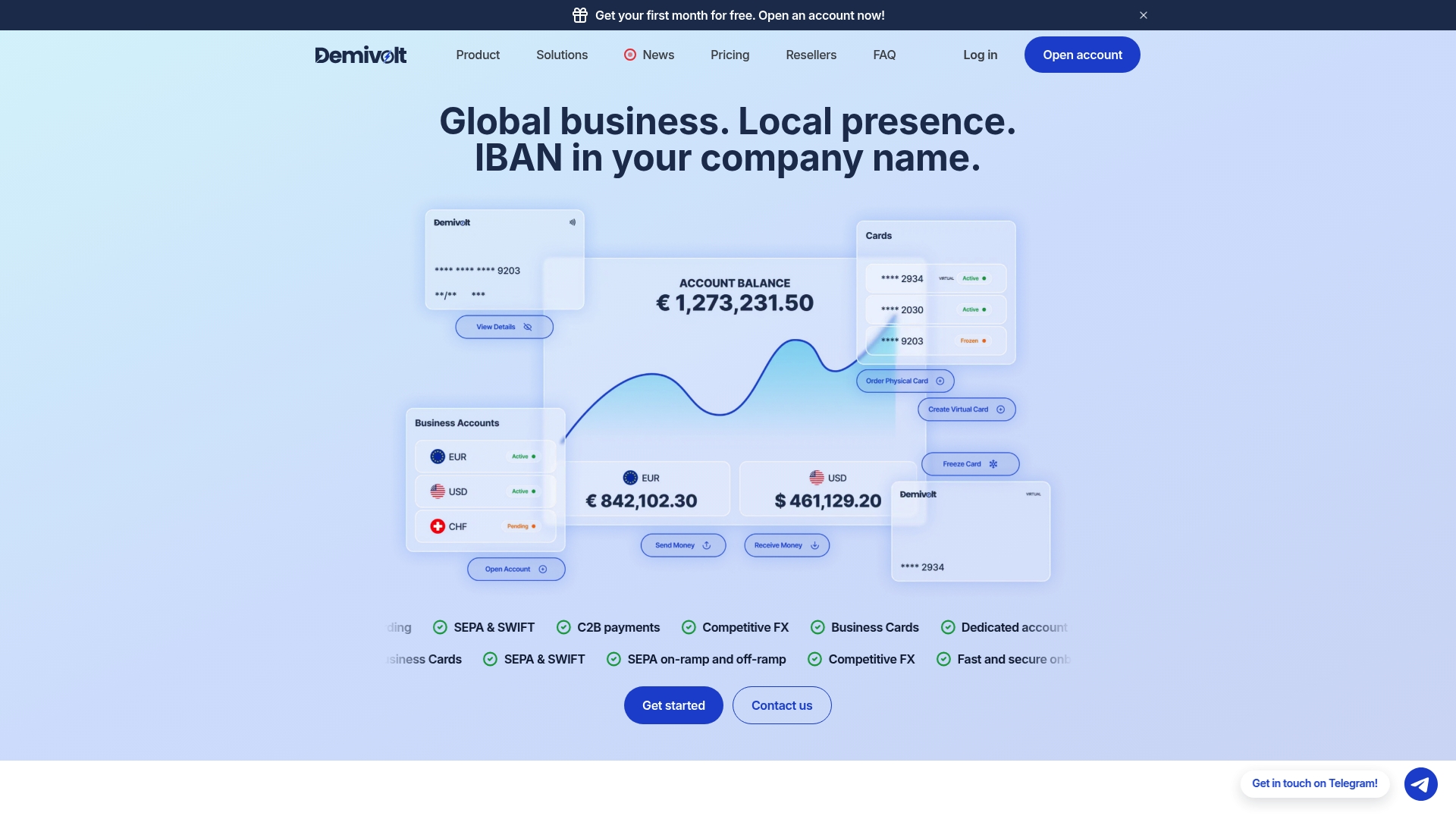
Demivolt is a regulated European fintech platform built for SMEs that need compliant, digital-first payment infrastructure. Its dedicated IBAN accounts, SEPA and SWIFT payment management, and EU-regulated onboarding process are designed to meet the exact compliance requirements covered in this checklist. Before sending any international payment, verifying your beneficiary’s IBAN is a fast, free step that prevents rejections and compliance holds. Use Demivolt’s IBAN validator tool to confirm payment details instantly. For businesses that need a full business banking solution built around cross-border compliance, Demivolt’s platform provides segregated accounts, role-based user management, and the financial controls your compliance program requires.
FAQ
What is an international payment compliance checklist?
An international payment compliance checklist is a structured list of regulatory requirements a business must meet to legally process cross-border transactions. It covers KYC, AML, sanctions screening, Travel Rule data sharing, and transaction reporting obligations.
What are the SAR and CTR filing thresholds in the US?
SAR filing is required for transactions of $2,000 or more where suspicious activity is identified. CTRs are mandatory for cash transactions above $10,000.
What is the FATF Travel Rule threshold?
The threshold varies by jurisdiction. The US requires data sharing for transactions above $3,000, the UK above £1,000, and the EU requires full data on all crypto transfers with no minimum threshold.
Why does ISO 20022 matter for compliance?
ISO 20022 is a regulatory requirement across major payment networks. Structured message fields at origination prevent intermediary banks from rejecting payments due to missing or truncated data.
What triggers Enhanced Due Diligence in cross-border payments?
EDD is triggered by high-risk jurisdictions, politically exposed persons, unusual transaction volumes, and certain high-risk business types. It requires additional documentation and senior management approval before the relationship continues.