

SWIFT payments rarely arrive at the amount you sent. Intermediary and beneficiary banks can deduct processing fees along the route, and which party absorbs those costs depends on whether you selected OUR, SHA, or BEN when you initiated the transfer. The single most effective near-term fix is picking the right fee option upfront and tracking the payment with SWIFT GPI and a UETR code so you can see exactly where money disappears.
TL;DR:
- Choosing the correct fee option upfront, such as OUR, SHA, or BEN, can significantly reduce unexpected deductions from SWIFT payments.
- Intermediary banks’ fees vary based on corridor complexity, currency, and the number of correspondent hops, often resulting in higher costs for less common routes.
- Tracking payments with SWIFT GPI and UETR codes improves visibility into where deductions occur and helps manage costs more effectively.
- Using standardized remittance data via ISO 20022 and confirming SWIFT GPI enablement can streamline reconciliation and reduce manual processing.
- For high-value or compliance-sensitive transfers, SWIFT remains the best choice, while for regular, low-value eurozone payments, alternatives like SEPA often cost less.
DemivoltManage Cross-Border Payments With ControlDemivolt helps businesses manage SEPA and SWIFT payments through dedicated IBAN accounts and compliant digital banking infrastructure.Explore Demivolt
Table of Contents
- How SWIFT Transfer Routing and Fee Mechanics Work for Corporate Payments
- Fee Payer Options (OUR, SHA, BEN): What They Mean for Your Cashflow
- Where Intermediary Fees Come From and What They Typically Cost
- Practical Tactics to Reduce Total SWIFT Costs
- What SWIFT GPI, UETR, and ISO 20022 Do for Your Payments
- Treasury Checklist Before Sending a SWIFT Payment
- Regulatory and Compliance Considerations Affecting SWIFT Fees for Companies
- Impact of SWIFT Fees on Corporate Cash Flow Management and Budgeting
- How SWIFT Fees Compare to Alternative International Payment Methods for Businesses
- When SWIFT Is the Right Choice and When to Use Alternatives
- How Demivolt Handles SWIFT Payments for Growing Businesses
- Sources
- FAQ
How SWIFT Transfer Routing and Fee Mechanics Work for Corporate Payments
A SWIFT payment rarely travels in a straight line. Your ordering bank sends the instruction to a beneficiary bank, but if the two institutions don’t hold accounts with each other, one or more correspondent banks step in to bridge the gap. Each correspondent typically maintains Nostro and Vostro accounts with its counterparts, and every hop in that chain is a potential fee point. Wire transfers connect different national banking systems through SWIFT, and correspondent banks along that path can deduct processing charges before the funds ever reach the beneficiary.
Intermediaries charge for a few distinct services, and the mix explains why costs vary so much by corridor:
- Message processing — handling and forwarding the SWIFT instruction itself.
- Currency conversion — converting between currencies when the corridor requires it, often with a spread built into the exchange rate.
- Routing through less common corridors — corridors with fewer direct banking relationships require more intermediary hops.
On a bank statement, an intermediary deduction usually shows up as a shortfall between the invoiced amount and the amount received, sometimes with a separate fee line or a narrative code referencing “SWIFT charges” or “correspondent fee.”
Fee Payer Options (OUR, SHA, BEN): What They Mean for Your Cashflow
Every outgoing SWIFT payment carries a fee instruction code, and that single field determines who eats the intermediary costs.
- OUR — the sender pays all fees, including any intermediary deductions, so the beneficiary receives the full invoiced amount. This is the right choice when a contract requires payment in full, such as a supplier agreement that specifies net amounts received.
- SHA (shared) — the sender pays their own bank’s fee, and the beneficiary absorbs any intermediary or receiving-bank charges. This is the default on most SWIFT payments and works well when both parties expect to split incidental costs.
- BEN (beneficiary) — the recipient pays all fees, including the sender’s originating charge. This suits situations where the receiving party has agreed contractually to cover the full cost of the transfer.
Choosing wrong creates real friction: a supplier expecting full payment under SHA may receive $40 less than invoiced, triggering reconciliation disputes and slower approvals on future orders.
Where Intermediary Fees Come From and What They Typically Cost
Correspondent banks price their services based on message volume, currency complexity, and how many banking relationships a corridor requires. A payment routed between two major EU banks in euros usually passes through fewer hands than one routed into a currency with limited direct correspondent coverage, and that difference shows up directly in the deduction.
Bank price lists give a useful window into how these charges are structured. Swedbank’s published pricing lists distinct fees for SWIFT-related services, including messaging and account handling charges, separate from the core transfer fee. A typical SWIFT pricing structure includes flat fees for incoming and outgoing SWIFT transfers, with no separate intermediary markup added.
A few patterns hold across most corridors:
- Non-euro and less common currency routes tend to carry higher intermediary costs than standard EU corridors.
- Multiple correspondent hops compound fees rather than averaging them out.
- Currency conversion spreads, when present, often cost more than the flat processing fee itself.
Reading your bank’s fee schedule alongside the payment narrative on your statement is the fastest way to spot which institution actually took the deduction, rather than assuming it was your own bank.
Practical Tactics to Reduce Total SWIFT Costs
Cutting SWIFT costs comes down to negotiation, smart fee-option selection, and cleaner payment data. A few tactics consistently move the needle for finance teams handling recurring cross-border payments:
- Negotiate flat outgoing and incoming fees, or a capped correspondent charge, directly with your banking provider rather than accepting variable pass-through pricing.
- Reserve OUR for contractually mandated full-payment transfers, and default to SHA elsewhere after confirming expectations with your counterparty.
- Ask your bank whether they offer preferred correspondent routing or SWIFT GPI-enabled processing, which can reduce both cost uncertainty and transfer time.
- Include structured remittance information using ISO 20022 fields, and double-check beneficiary IBAN and BIC details before submission to avoid returns.
- For recurring low-value payments, weigh SEPA or specialized fintech rails against SWIFT, since SWIFT’s fixed fee structure tends to favor larger, less frequent transfers.
Pro Tip: Before you approve a recurring supplier payment, ask your bank to confirm which fee option was used on the last three transfers to that beneficiary. If it varies, that inconsistency alone is likely costing you money on reconciliation time.
What SWIFT GPI, UETR, and ISO 20022 Do for Your Payments
SWIFT GPI gives corporates end-to-end tracking on payments, showing exactly which bank is holding the funds and when it was received or forwarded. Every GPI payment carries a Unique End-to-End Transaction Reference, or UETR, a single code that follows the transfer through every intermediary so you can trace deductions instead of guessing at them.
ISO 20022 messaging adds structured remittance fields to the payment instruction itself. Research on business-to-business wire transfers found that corporates value this richer remittance data enough to accept modest fees for it, because it cuts the manual work of matching payments to invoices.
Three things worth confirming with your bank this quarter:
- Whether they’re SWIFT GPI enabled for your outgoing corridors.
- Whether they’ll provide a UETR on request for tracking.
- Whether their SWIFT messaging supports ISO 20022 remittance fields.
Treasury Checklist Before Sending a SWIFT Payment
Run through this list before you submit any international wire, and you’ll avoid most of the surprises that show up later in reconciliation.
- Confirm the fee option (OUR, SHA, or BEN) and calculate the expected net amount the beneficiary will actually receive.
- Ask whether the bank is SWIFT GPI enabled and can supply a UETR for real-time tracking.
- Find out which correspondent banks will handle the transfer and whether a flat-fee arrangement is available for that corridor.
- Verify the beneficiary’s IBAN and BIC, and attach structured remittance details before submission.
Pro Tip: Keep a simple log of the fee option used, the UETR, and the net amount received for every SWIFT payment over a set threshold. Six months of that data tells you more about your true cost per corridor than any bank’s advertised rate sheet.
Regulatory and Compliance Considerations Affecting SWIFT Fees for Companies
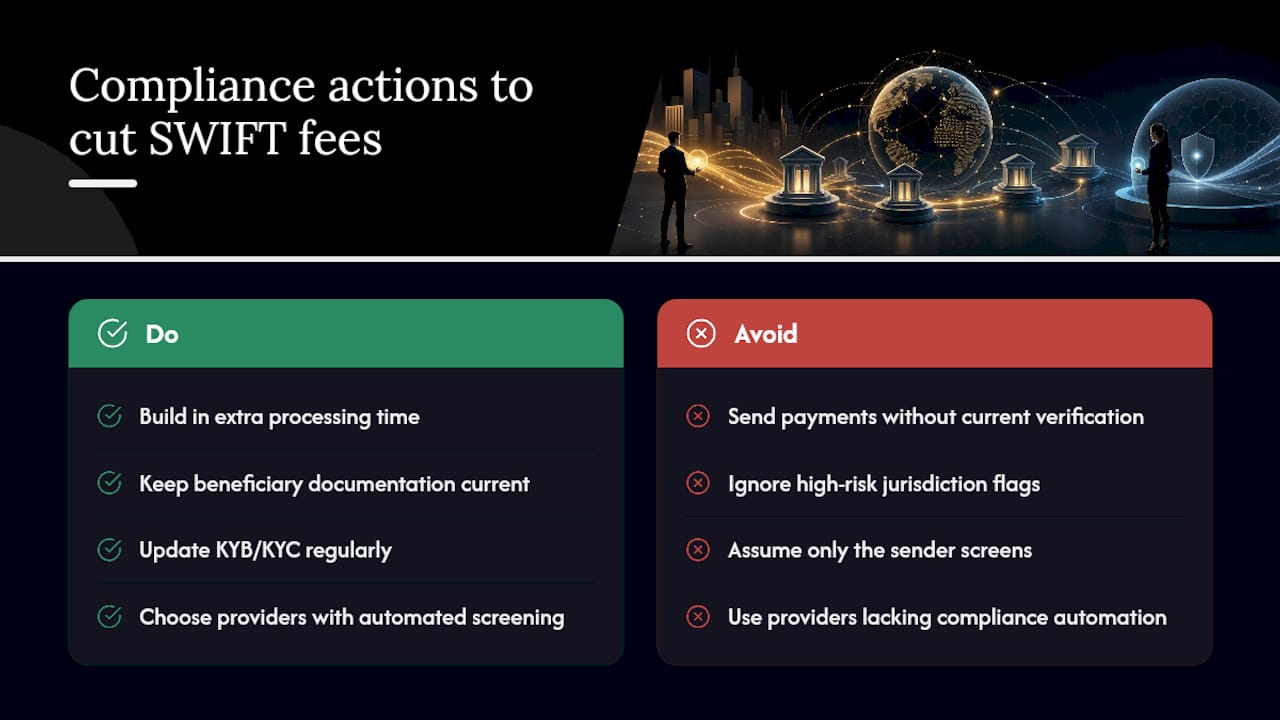
Compliance obligations shape SWIFT costs more than most finance teams expect. Anti-money-laundering and sanctions-screening checks run at every bank in the payment chain, not just at the sending institution, and each screening step can add processing time or a review fee if a transaction triggers a manual hold. Payments involving higher-risk jurisdictions, cash-intensive industries, or beneficiaries in less common corridors are more likely to face additional scrutiny, which can translate into delays and sometimes extra charges from the bank conducting the review.
Know Your Business (KYB) and Know Your Customer (KYC) requirements also affect how quickly a corporate account can send large or unusual SWIFT payments. A business that hasn’t kept its verification documents current with its bank may find a payment held for additional review, adding days to the timeline and sometimes triggering a compliance fee separate from the standard transfer cost.
Regulated providers structure their SWIFT pricing to reflect these obligations rather than treating them as an afterthought. A bank or fintech operating under EU regulatory standards builds sanctions screening and transaction monitoring into its core process, which is one reason flat, published SWIFT fees are more achievable with providers that have already automated compliance checks. For finance teams sending payments into jurisdictions with heightened scrutiny, building in an extra day or two of processing time, and keeping beneficiary documentation current, reduces the odds of a compliance-related hold turning into an unplanned cost.
Impact of SWIFT Fees on Corporate Cash Flow Management and Budgeting
Unpredictable deductions make SWIFT payments harder to budget than domestic transfers. When a supplier invoice specifies a net amount and an intermediary bank quietly takes a cut under a SHA fee arrangement, the shortfall becomes a reconciliation problem that finance teams often don’t catch until the supplier flags a discrepancy. Multiply that across dozens of monthly international payments, and the administrative cost of chasing down shortfalls can exceed the fees themselves.
Cash flow forecasting suffers in a similar way. A company that budgets for the invoiced amount but pays under OUR, absorbing the full intermediary cost, will see a small but consistent gap between forecasted and actual outflows. Over a fiscal year, that gap compounds, particularly for companies making frequent payments into corridors with higher intermediary costs.
The fix isn’t complicated, but it does require discipline. Building a standard fee-option policy for different payment types, tracking net amounts received against invoiced amounts, and reviewing SWIFT costs quarterly against your bank’s published price list turns an unpredictable cost center into a forecastable line item. Treasury teams that treat SWIFT fees as a fixed operational cost, the way they treat SEPA transfer charges, tend to build tighter cash flow forecasts than those that treat every international payment as a one-off.
How SWIFT Fees Compare to Alternative International Payment Methods for Businesses
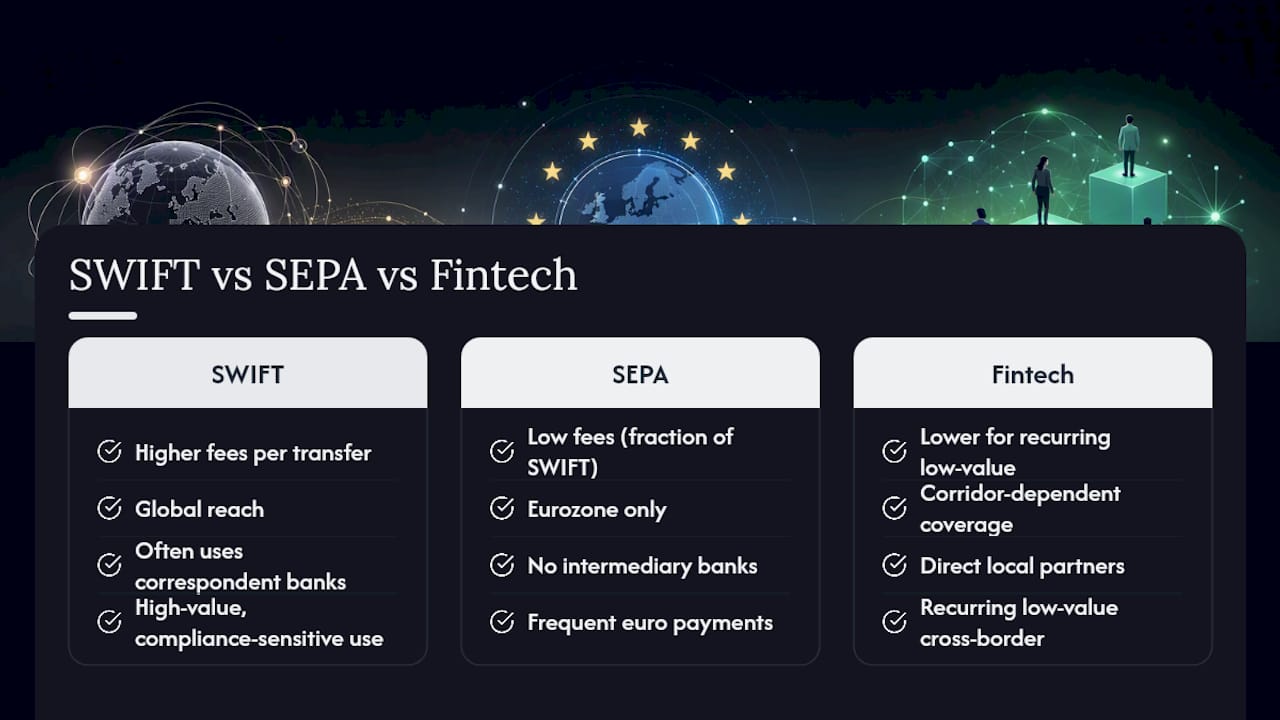
SWIFT earns its place for high-value, cross-currency, or compliance-sensitive payments where certainty and an authenticated audit trail matter more than shaving a few euros off the fee. Treasury professionals tend to value SWIFT for that certainty rather than for cost efficiency on smaller, frequent transfers.
For payments within the eurozone, SEPA transfers cost a fraction of a typical SWIFT fee and settle domestically without intermediary banks in the chain at all. Specialized fintech payment rails and local payout partners can also undercut SWIFT for recurring low-value cross-border payments, particularly in corridors where a fintech has built direct local banking relationships instead of routing through multiple correspondents.
The trade-off is coverage. SWIFT reaches virtually any bank in the world, while SEPA is limited to the eurozone and fintech rails vary by corridor and provider. A side-by-side look at SEPA and SWIFT pricing structures makes the cost gap concrete: for a company sending occasional large payments to a supplier in Asia, SWIFT is the only realistic option; for a company paying eurozone contractors weekly, defaulting to SWIFT is usually the more expensive habit.
When SWIFT Is the Right Choice and When to Use Alternatives
SWIFT still makes the most sense for high-value payments, non-SEPA corridors, and any transfer where compliance documentation and traceability matter more than shaving off a few dollars in fees. For frequent, lower-value payments, SEPA or a specialized fintech rail usually wins on cost and speed. What most finance teams actually need is a regulated provider with transparent SWIFT pricing and multi-IBAN structures, so the choice between rails becomes a simple calculation rather than a guessing game.
— dd
How Demivolt Handles SWIFT Payments for Growing Businesses
Some providers give finance teams a flat, published SWIFT fee structure instead of the variable intermediary pricing that makes budgeting so unpredictable.
Run your current provider’s SWIFT pricing against the checklist above. If you can’t get a straight answer on fee options, correspondent routing, or GPI tracking, that’s a sign your provider isn’t built for cross-border payments the way a regulated business account should be. Demivolt offers dedicated IBANs, multi-account structures, and combined SEPA and SWIFT payment handling under one regulated infrastructure, with fees published upfront rather than buried in a correspondent’s cut. Open an account and compare your next international payment against the numbers you’ve been quoted elsewhere.
Sources
For deeper technical detail on the mechanics covered in this article, consult SWIFT’s GPI product page for tracking and UETR specifics, SWIFT for corporates for routing and directory tools, J.P. Morgan’s wire transfer guide for transfer mechanics, and the Federal Reserve’s business-to-business wire transfer study for remittance-data research. Swedbank’s published pricelist offers a real example of how banks itemize SWIFT-related charges.
FAQ
What Are Typical SWIFT Fees for Companies?
SWIFT fees for companies include a sender-side charge, a possible intermediary deduction, and a receiving-bank fee, depending on which fee option was selected. Demivolt charges a flat €25.00 for incoming SWIFT transfers and €30.00 for outgoing ones, with no additional intermediary markup added.
Who Pays SWIFT Fees, the Sender or the Receiver?
It depends on the fee code chosen at the time of transfer. Under OUR the sender pays everything, under BEN the receiver pays everything, and under SHA each side covers their own bank’s charge while the receiver typically absorbs any intermediary deduction.
How Can I Track Where a SWIFT Fee Was Deducted?
Request a UETR code from your bank at the time of the transfer, then use SWIFT GPI tracking to see which bank in the chain processed the payment and when. Comparing the invoiced amount to the amount received, alongside the tracking data, usually reveals exactly where a deduction happened.
Is SWIFT More Expensive Than SEPA for Business Payments?
For eurozone payments, yes. SEPA transfers avoid the intermediary banks that drive up SWIFT costs, and Demivolt’s outgoing SEPA transfer fee is €0.40 per transfer, compared to SWIFT’s flat outgoing fee of €30.00. SWIFT remains necessary for non-SEPA corridors and higher-value transfers where its reach outweighs the cost difference.
How Long Does a Corporate SWIFT Transfer Take to Process?
Most SWIFT payments settle within one to three business days, though the exact timing depends on the number of correspondent banks in the route and each bank’s cut-off times. SWIFT GPI-enabled routing tends to speed this up and gives treasury teams visibility into where a payment sits at any given moment.