

“Prieigos suteikimas sąskaitai” works best when three steps happen in order: complete the bank’s authorization forms and a written transfer-acceptance act, assign role-based permissions instead of full control, and log every change. Follow standards like Lithuania’s accounting rules on handovers, or use a platform such as Demivolt that builds role separation into the account itself. The checklist below walks through each step.
TL;DR:
- Only use narrow or single-use authorizations instead of broad powers of attorney to reduce risk when granting bank access.
- Regularly review and update user roles and permissions, ideally quarterly, to prevent unauthorized account access.
- Separate roles for creating and approving payments, and use transaction limits and segregated accounts, to minimize internal fraud.
- Revoke user access immediately upon departure and document transfers thoroughly to maintain control over account activity.
- Implement a role-based platform like Demivolt to streamline controls, including virtual cards, multi-account structures, and built-in permission management.
Demivoltdemivolt.comBring Account Access Under ControlDemivolt helps businesses manage role-based permissions, multi-account structures, and payment controls through digital-first financial infrastructure.Explore Demivolt
Table of Contents
- How Do You Set Up Access to a Business Bank Account?
- What Documents and Legal Authorizations Do You Need?
- What Technical Controls Actually Limit Risk?
- How Do You Onboard and Offboard Users Without Losing Control?
- What Do Businesses Consistently Get Wrong About Account Access?
- A Platform Built Around Role-Based Account Control
- Where to Verify the Rules Yourself
- Sources
- FAQ
How Do You Set Up Access to a Business Bank Account?
Granting account access follows a fixed sequence at almost every bank operating in Lithuania, whether you’re adding a chief accountant, a bookkeeper, or a new finance hire.
- Pass a corporate decision. The company’s director, or the board if the articles of association require it, formally authorizes the new user. Small companies often skip formal minutes and use a simple signed order instead, but the decision needs to exist in writing somewhere.
- Choose the type of authorization. Decide whether the person needs full operating rights, a narrow special power for named transactions, or a single-use authorization for one specific task. This choice drives everything that follows.
- Collect identification and corporate documents. Banks ask for the appointed person’s ID, the company’s registration certificate, and proof that the signatory approving the request actually holds that authority.
- Fill out the bank’s forms, including the signature specimen. This is where the signature specimen card requirement comes in. Lithuanian bank account opening procedures rely on specimen cards to confirm exactly who can authorize a transaction and how their signature should look.
- Submit and verify. The bank checks the paperwork, confirms the signatories against its records, and activates the access.
Who signs depends on company size. A director signs for most micro companies. Larger SMEs often route this through a CFO or chief accountant with delegated signing rights. If your company has no dedicated finance officer, the director signs directly. Skipping that step to save time is the single most common reason banks bounce a request back.
Expect the bank’s verification to take from same-day to several business days, depending on how complete your documents are and whether the appointed signatory already has an account with that bank.
What Documents and Legal Authorizations Do You Need?
The type of power of attorney you choose matters more than most SMEs realize. A general power of attorney grants broad authority over the account, which is convenient but hard to walk back cleanly if something goes wrong. A special power limits the holder to named operations, like approving payroll or paying a specific supplier. A single-use authorization covers exactly one transaction and expires the moment it’s used. Banks increasingly favor the narrower options because they’re easier to audit.
Beyond the power of attorney itself, plan to gather:
- The company’s registration documents and articles of association.
- Proof of the director’s or authorized manager’s signing authority.
- A completed signature specimen card naming every person permitted to transact on the account.
- Valid identification for each named signatory.
When someone hands off financial duties, Lithuanian accounting regulation requires a written transfer-acceptance act documenting exactly what was transferred and confirmed by both parties, and tools like private chat on documents for accounting offices can enhance secure collaboration in this process. That record matters just as much as the bank paperwork. Keep it, along with signature cards and authorization decisions, for as long as your company’s statutory retention period requires, and treat it as the first document you pull if a dispute or audit ever comes up.
What Technical Controls Actually Limit Risk?
Paperwork controls who is legally allowed to act. Technical controls determine what they can actually do once they’re inside the account, and this is where most SMEs under-invest.
A workable role structure usually looks like this:
- Viewer — sees balances and transaction history, initiates nothing.
- Initiator — creates and submits payments but cannot approve them.
- Approver — reviews and releases payments initiated by someone else.
- Admin — manages users, permissions, and account settings.
Separating initiator from approver is the single most effective control on this list. It means no one person can both create a payment and send it, which closes off the most common internal fraud path in small companies. Layer that with transaction ceilings per role, dual-approval requirements above a set amount, and segregated dedicated IBANs for payroll, VAT, and client funds so a mistake in one doesn’t touch the others.
Demivolt’s approach to user-based account management reflects this same logic, building role separation and multi-account structures directly into the platform rather than leaving SMEs to bolt controls on afterward.
Pro Tip: Issue virtual cards with per-card spending limits for recurring vendor payments or employee expenses, rather than sharing one card number across the team. If a card is compromised, you cancel that one card without touching anything else.
How Do You Onboard and Offboard Users Without Losing Control?
Most access-control failures happen at the edges: someone gets added too loosely, or someone leaves and their access lingers. A tight process on both ends closes that gap.
Onboarding:
- Verify identity against the documents already on file with the bank.
- Grant the minimum role that lets the person do their job, nothing broader.
- Have the user formally acknowledge the permissions granted to them, in writing.
- Walk them through approval limits and any dual-authorization rules before their first transaction.
- Log the grant date, role, and approving manager somewhere your company controls, not just the bank’s internal system.
Offboarding:
- Revoke access immediately, not at the end of the pay period or after a notice period.
- Rotate any shared credentials or card numbers the departing user had visibility into.
- Reassign pending approvals so payments don’t stall mid-cycle.
- Reconcile any outstanding or in-flight transactions tied to that person.
- File a signed transfer-acceptance act documenting what was handed off and to whom.
Review who has access, and at what level, on a regular cadence, not just when someone joins or leaves. Quarterly reviews catch the accounts that quietly accumulated broader permissions than anyone intended. Pair that with transaction alerts for anything above your set thresholds, and treat any unexplained login or approval as worth a same-day follow-up call, not a note for next week’s meeting.
What Do Businesses Consistently Get Wrong About Account Access?
The recurring mistake is granting a general power of attorney when a special or single-use authorization would have done the job. It feels efficient in the moment and becomes a liability the moment someone leaves or a relationship sours. The second mistake is treating the transfer-acceptance act as optional paperwork instead of the control that actually protects the company during a handover.

In practice, the companies that avoid control gaps are the ones that write down every role change, no matter how small, and that keep initiator and approver duties on separate people even when it’s tempting to let one trusted employee handle both.
Run these three checks now: Does anyone hold general authorization who could function with a special one instead? Is there a signed transfer-acceptance act for your last accountant handover? Can one person both create and approve a payment on your account? If any answer is uncomfortable, fix it before it becomes a bigger problem.
— dd
A Platform Built Around Role-Based Account Control
Demivolt gives Lithuanian SMEs a way to implement the exact controls this article walks through, without stitching together separate tools for each one. As a regulated European fintech, Demivolt offers dedicated IBAN accounts, SEPA and SWIFT payment processing, and client funds held in segregated accounts, paired with multi-account structures and role-based user management built into the platform from the start.
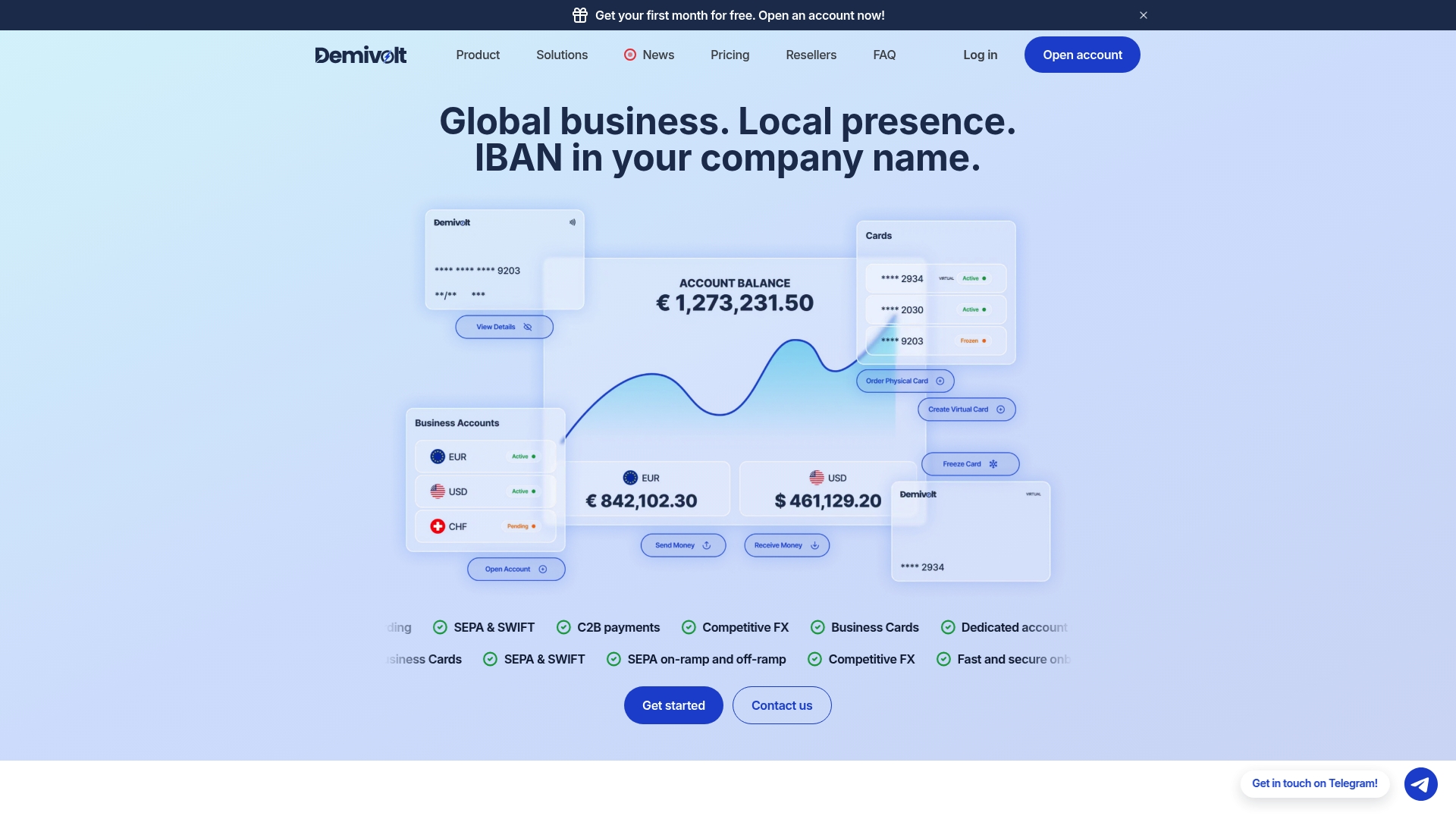
That means the viewer, initiator, approver, and admin roles described above aren’t a policy you have to enforce manually. They’re configurable inside the account. Separate IBANs for payroll, VAT, and client funds come standard rather than requiring separate bank relationships, and virtual cards with per-card limits give you the exposure control this article’s pro tip recommends. Before adding a new beneficiary or setting up a dedicated IBAN, run it through the free IBAN validator to confirm the account number checks out. If you’re ready to move your company’s access controls onto a platform designed for exactly this, start with Demivolt’s account setup.
Where to Verify the Rules Yourself
- Lithuania’s legal act on accounting handovers and bank account opening procedures.
- Fingida’s accounting self-service portal for practical document-sharing examples.
Sources
- Lithuanian legal act — accounting rules
- Banking procedural rules — account opening and signature specimen
- Fingida — accounting self-service portal features
FAQ
What Is “prieigos suteikimas sąskaitai” in Practice?
It’s the process of legally and technically granting someone, like an accountant or finance manager, the right to view or transact on a company bank account, backed by bank authorization forms and internal role permissions.
Who Can Legally Sign Bank Authorization Forms?
The company director signs in most small companies; larger SMEs often delegate this to a CFO or chief accountant with documented signing authority confirmed on the bank’s signature specimen card.
Do I Need a Lawyer to Grant Account Access?
No. A director’s authorization, the bank’s own forms, and a properly scoped power of attorney are usually sufficient, though legal review helps for general powers covering broad authority.
How Often Should Account Access Be Reviewed?
Review roles and permissions on a regular, scheduled cadence, such as quarterly, rather than only when someone joins or leaves the company.
Can a Platform Like Demivolt Replace Manual Signature Cards?
Demivolt replaces manual specimen-card processes with configurable role-based permissions and multi-account structures, though your company should still document authorizations in writing for its own records.