

Recurring commissions turn affiliate channels from one-time acquisition costs into a partner-led retention and LTV engine. Instead of paying a flat fee per signup and moving on, fintech companies that structure payouts around renewal events create a system where affiliates are financially motivated to refer high-quality customers and keep them engaged. The result: predictable ARR growth, improved NRR, and a distribution model that compounds in value over time. Businesses with high recurring revenue percentages sell for 20–40% higher valuation multiples than comparable transactional firms. The premium begins to appear when recurring revenue exceeds roughly 25–30% of total revenue and accelerates above 50%.
TL;DR
- Recurring payouts shift affiliate incentives from volume-chasing to retention-focused partnership.
- ARR and NRR become measurable outputs of a well-run partner program, not just product metrics.
- Immediate checklist: define your payout trigger (funded account, not application), set clawback periods, and implement server-to-server tracking before launch.
- Demivolt’s reseller program is built on this model, paying partners recurring commissions on referred business accounts.
Table of Contents
- What are recurring commissions in fintech?
- How do recurring commissions actually work?
- Recurring vs. one-time commissions: which model fits your fintech?
- Which fintech products are best suited to recurring commissions?
- Why affiliates prefer recurring commissions over one-time payouts
- Why fintech companies adopt recurring commissions
- How to design a recurring commission plan that holds up
- What technical infrastructure do recurring payouts require?
- Compliance and risk considerations for U.S. fintech programs
- How do you measure a recurring partner program’s performance?
- Worked examples and a sample commission schedule
- How recurring partner revenue affects fintech valuations
- Key Takeaways
- How a regulated fintech should think about reseller recurring commissions
- Demivolt’s partner program supports compliant recurring payouts
What are recurring commissions in fintech?
A recurring commission is an ongoing payment, either a fixed amount or a percentage of revenue, paid to an affiliate each time a defined renewal or billing event occurs for a referred customer. The payout is not a one-time reward for acquisition. It continues as long as the referred customer remains active and generating revenue.
Two short fintech examples make this concrete. First, a partner refers a business to a payment processor; the partner earns 0.1% of monthly interchange fees generated by that merchant for as long as the account stays active. Second, a reseller refers a company to a business banking platform; the reseller earns a percentage of the referred company’s monthly account fee every billing cycle.
The terminology matters. Revenue share describes a percentage-based split of actual revenue. Lifetime payout sometimes refers to a fixed amount paid indefinitely, regardless of revenue size. Recurring commission is the broader category covering both, defined by the repeating payment pattern rather than the rate structure.
How do recurring commissions actually work?
Recurring commissions pay on defined revenue events: a renewal charge, a funded account, a completed transaction, or a monthly subscription fee. The lifecycle runs from referral to ongoing payout in a predictable sequence.
- An affiliate shares a tracked referral link.
- A prospect clicks and completes the target action (account opening, card activation, subscription start).
- The platform assigns a subscription ID or agreement ID to that customer record.
- The initial payout fires when the qualifying trigger is met.
- Each subsequent billing cycle, the billing engine emits a webhook or event that the affiliate platform reconciles against the subscription ID.
- The affiliate ledger is updated and payout is queued for the next settlement cycle.
Common payout triggers in fintech programs:
- First funded transaction (account balance exceeds a defined threshold)
- Monthly subscription charge confirmed as settled
- Percentage of transaction fees generated in a billing period
- Card program activation and first card spend
Attribution must persist beyond the initial click. Cookie-based attribution alone is fragile for recurring models because cookies expire and users switch devices. Reliable programs use subscription IDs mapped to the originating affiliate at the point of conversion, supplemented by server-to-server (S2S) event passing so the billing engine can fire payout events without browser dependency.
Edge cases require explicit policy. Refunds within a locking period should trigger a clawback. Mid-period downgrades require pro-ration logic so the affiliate is paid on actual revenue recognized, not the original plan price. A customer who cancels and re-subscribes under a new agreement ID needs a clear re-attribution rule to avoid double-paying or under-paying the referring partner.
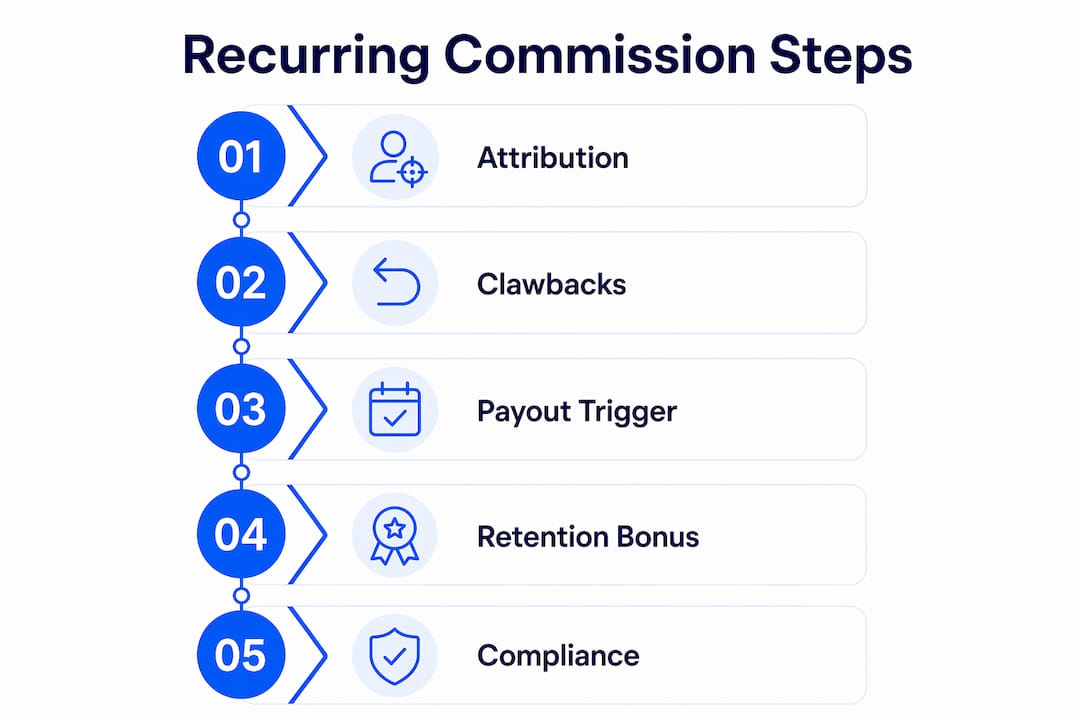
Pro Tip: Tie your initial payout trigger to “account funded” or “first completed transaction,” not “application submitted.” Programs that paid on application saw significant drop-off during KYC verification, resulting in commissions paid for customers who never generated revenue.
Recurring vs. one-time commissions: which model fits your fintech?
Recurring commissions suit high-LTV, subscription-like products. One-time CPAs suit low-touch, non-recurring purchases. The decision is not ideological; it follows the product’s revenue structure.

| Dimension | One-Time CPA | Recurring Commission | Hybrid (CPA + Revenue Share) |
|---|---|---|---|
| Product type | Single-purchase, non-recurring | Subscription, ongoing service | High-value with long onboarding |
| Customer LTV profile | Low to moderate | High, multi-year | High, uncertain initial conversion |
| Admin complexity | Low | Moderate to high | High |
| Affiliate behavior | Volume-focused, short-term | Retention-focused, long-term | Balanced acquisition and quality |
| Best fit | Loan applications, one-off transfers | Business banking, SaaS, card programs | Trading platforms, B2B lending |
One-time CPAs are administratively simple and easy to budget. The risk is misaligned incentives: affiliates maximize volume, not quality, because their payout ends at conversion. Recurring models demand more infrastructure but align incentives with retention rather than just acquisition.
Hybrid models, a small upfront CPA plus an ongoing revenue share, work well when the product has a long onboarding cycle (KYC, compliance checks, account setup) that delays the first revenue event. The CPA compensates the affiliate for the wait; the revenue share keeps them invested in the customer’s long-term activity.
Which fintech products are best suited to recurring commissions?
The most common use cases share one characteristic: the customer generates revenue on a recurring or ongoing basis, making a percentage-based or fixed recurring payout economically rational for the merchant.
Merchant acquiring and interchange revenue share. A partner refers a business that processes card payments. The partner earns a share of interchange fees generated each month. Payout trigger: settled transaction volume above a minimum threshold. Consideration: interchange rates vary by card type and transaction category, so the commission base must be clearly defined.

Subscription business banking fees. A reseller refers a company to a business banking platform. The reseller earns a percentage of the monthly account fee. Payout trigger: monthly fee confirmed as collected. This is the model Demivolt’s reseller program is built on, with recurring payouts tied to active referred accounts.
Payment gateway fees. An affiliate refers a merchant to a payment gateway. Commission is a basis-point share of monthly gateway fees. Consideration: volume thresholds and minimum monthly fees affect payout predictability.
Trading and crypto fee share. Affiliates earn a percentage of trading fees generated by referred users. Regulatory sensitivity is high: programs must verify that affiliates are not providing investment advice and that disclosures meet applicable standards.
White-label BaaS subscriptions. A technology partner resells a BaaS platform to their own clients. Recurring commission is paid on the monthly platform fee. KYC timelines can delay the first payout by weeks; programs should account for this in their locking-period design.
Why affiliates prefer recurring commissions over one-time payouts
Recurring payouts let affiliates build predictable cash flow and shift from one-off promotions to relationship-driven marketing. The math makes the case clearly.
Illustrative comparison over 24 months:
- Option A: $100 one-time CPA per referred customer, 10 customers referred. Total: $1,000, earned in month 1.
- Option B: $10/month recurring share per referred customer, 10 customers, 80% retention over 24 months. Month 1 payout: $100. Cumulative at month 12: approximately $960. Cumulative at month 24: approximately $1,680 (accounting for monthly churn).
Option B surpasses the one-time CPA total around month 10 and continues compounding. The breakeven point depends on churn, but for any product with retention above 70% over 12 months, recurring commissions outperform a flat CPA within the first year.
Affiliate advantages of the recurring model:
- Predictable monthly income that can be modeled and reinvested into content, paid acquisition, or team growth.
- Higher lifetime earnings per referred customer, particularly for low-churn fintech products.
- Better ability to justify paid channels: when an affiliate knows they will earn $10/month per customer for 24 months, they can afford a higher customer acquisition cost than a $100 one-time payout justifies.
- Improved partner valuation: affiliates with recurring income streams are more attractive acquisition targets or investment candidates than those dependent on sporadic CPA income.
The shift in affiliate behavior is the real benefit. Recurring commissions turn short-term volume hunters into long-term partners who care about customer quality and retention.
Why fintech companies adopt recurring commissions
Recurring commissions align affiliate incentives with retention, reduce churn-driven acquisition waste, and increase enterprise value. The financial case is direct.
Valuation impact: Businesses with high recurring revenue percentages sell for 20–40% higher valuation multiples than comparable transactional firms. The premium begins to appear when recurring revenue exceeds roughly 25–30% of total revenue and accelerates above 50%.
When affiliates earn on renewals, they stop sending low-quality leads that convert on paper but churn within 60 days. Programs that pay on early funnel events like “application submitted” see large drop-offs during KYC; tying payouts to funded accounts improves the quality of the referred customer base. That quality improvement flows directly into NRR, which is one of the metrics investors weight most heavily in fintech valuations.
From a cost perspective, a recurring commission program also reduces the merchant’s effective CAC over time. Rather than paying a new CPA for every customer, the merchant pays a percentage of revenue already earned, making the commission self-funding relative to the customer’s contribution margin.
How to design a recurring commission plan that holds up
Structure payables around realized revenue. “Account funded” and “first completed transaction” are the two most defensible triggers; both confirm that the referred customer has cleared KYC and generated actual revenue.
Implementation checklist:
- Define the payout trigger. Specify the exact billing event (e.g., “monthly subscription fee collected and settled, not refunded within 30 days”).
- Choose the rate model. Percentage of revenue (e.g., 10–20% of monthly account fees) or fixed amount per billing cycle. Fintech commission rates commonly fall between 5% and 20% of sale value depending on product and role structure.
- Set performance tiers. Example: 10% revenue share for 1–10 active referred accounts; 15% for 11–50; 20% for 50+.
- Define the locking period. A 30–90 day period after the initial payout during which a refund or churn event triggers a clawback. Explicit recovery terms are expected by experienced partners; omitting them creates financial exposure.
- Write the clawback clause. Sample language: “Commissions paid for accounts that close, are refunded, or are flagged for fraud within 90 days of the payout date will be recovered from the partner’s next settlement.”
- Set payout cadence. Monthly is standard. Net-30 or net-45 from the billing cycle close gives time for refund windows to clear.
- Handle currency and tax documentation. Collect W-9 (domestic) or W-8BEN (international) before first payout. Retain records for Form 1099-NEC reporting.
Pro Tip: Add a quality bonus tier: partners whose referred cohorts maintain 90-day retention above a defined threshold earn a higher rate for that period. This directly discourages churn-focused acquisition and rewards the affiliate behavior you actually want.
What technical infrastructure do recurring payouts require?
Reliable recurring payouts require server-to-server lifecycle tracking, subscription IDs, and reconciliation with billing systems. Browser-based tracking alone cannot support a recurring payout model at scale.
Integration checklist:
- Subscription or agreement IDs: assign a unique ID at conversion and store it in both the affiliate platform and the billing engine.
- Webhooks for billing events: the billing system fires a webhook on each successful charge, failed charge, refund, and cancellation. The affiliate platform consumes these events to update the partner ledger.
- Server-to-server attribution: pass conversion data directly from the billing engine to the affiliate platform, bypassing browser state. This ensures attribution persists across device changes and cookie expiration.
- Tokenized payment references: for card-based recurring payments, the initial cardholder-initiated transaction (CIT) establishes a saved-card token; subsequent merchant-initiated transactions (MIT) use that token. The CIT/MIT distinction matters for both payment network compliance and attribution continuity.
- Reconciliation pipelines: run a daily or weekly reconciliation between the billing engine’s revenue records and the affiliate ledger to catch discrepancies before settlement.
On data protection: limit personally identifiable information in partner-facing payloads. Pass subscription IDs and revenue amounts, not customer names or account numbers. Use signed webhooks (HMAC or equivalent) to prevent payload tampering. Maintain a full audit trail of every payout event, including the billing event that triggered it, for compliance and dispute resolution. Aligning affiliate payout timing with the accounting revenue-recognition cycle prevents premature payouts and the financial risk of paying before proration or refunds are settled.
Compliance and risk considerations for U.S. fintech programs
Compliance is foundational. Every affiliate payout must map to a documented, verifiable conversion event. This is not optional in regulated fintech; it is the baseline.
Compliance checklist for U.S. programs:
- FTC affiliate disclosures: require all affiliates to clearly disclose the commercial relationship in any content promoting your product. Provide approved disclosure language and audit compliance periodically.
- AML/KYC timing: do not recognize a payout until the referred customer has cleared KYC and the account is fully verified. Paying before KYC completion creates AML exposure.
- Prohibited referral policies: define categories of referrals the program will not pay for (e.g., referrals from sanctioned jurisdictions, referrals that involve unlicensed financial advice).
- Audit documentation: retain records of every payout event, the triggering billing event, and the affiliate agreement version in effect at the time. Regulators expect a clean paper trail.
- Approved creatives: require affiliates to use only approved marketing materials. Unapproved claims about returns, rates, or product features create regulatory risk for the merchant.
For tax reporting: collect a W-9 from every U.S.-based partner before the first payout. For international partners, collect a W-8BEN or W-8BEN-E. Issue Form 1099-NEC for any U.S. partner paid $600 or more in a calendar year. Retain payment records for at least seven years. For partners operating in regulated financial roles, confirm they hold any required licenses before allowing them to promote products that could be construed as investment or lending advice. For broader compliance process frameworks, financial compliance guidance for SMEs offers useful structural reference, though U.S. programs must map those concepts to applicable federal and state rules.
This article is general information, not legal or compliance advice. Confirm current requirements with qualified legal counsel or your compliance officer for your specific program.
How do you measure a recurring partner program’s performance?
The five KPIs that matter most for recurring partner programs are: partner-attributable MRR/ARR, partner-driven customer LTV, NRR for referred cohorts, churn rate of referred customers, and CAC payback period for partner-acquired customers.
Report operationally every month and present to finance leadership quarterly. Build partner cohorts by referral date and track them separately from direct-acquisition cohorts; this is the only way to calculate accurate partner-attributed LTV and compare it against the commissions paid.
| Metric | Definition | Sample Calculation | Owner |
|---|---|---|---|
| Partner-attributed MRR | Monthly recurring revenue from active referred accounts | Active referred accounts × average monthly fee | Finance / Partnerships |
| Partner-driven LTV | Revenue per referred customer over their lifetime | Avg. monthly revenue ÷ monthly churn rate | Finance |
| NRR (referred cohort) | Net revenue retention for referred customers | (Starting MRR + expansion − contraction − churn) ÷ starting MRR | Finance |
| Referred customer churn | Monthly churn rate for partner-acquired accounts | Churned referred accounts ÷ total referred accounts at period start | Partnerships |
| CAC payback (partner) | Months to recover commission cost from referred customer revenue | Total commissions paid ÷ monthly gross margin per referred customer | Finance |
Attribution windows should match the product’s typical sales cycle. For business banking products with multi-week KYC timelines, a 60–90 day attribution window is standard. For SaaS integrations with faster onboarding, 30 days may be sufficient.
Worked examples and a sample commission schedule
Example A: Subscription banking fee revenue share
- Partner refers 20 businesses to a banking platform at $50/month per account.
- Commission rate: 15% of monthly account fees.
- Monthly payout (month 1): 20 × $50 × 15% = $150.
- Assume 5% monthly churn. By month 12, active accounts ≈ 11. Monthly payout ≈ $82.50.
- Cumulative 24-month payout (with churn): approximately $1,620.
- Clawback: accounts that close within 60 days of first payout trigger a full commission recovery for that account.
Example B: Merchant acquiring interchange revenue share
- Partner refers 5 merchants processing $20,000/month each in card volume.
- Interchange revenue to the platform: approximately 0.5% of volume = $1,000/month across all merchants.
- Commission rate: 20% of interchange revenue attributed to referred merchants.
- Monthly payout: $1,000 × 20% = $200.
- Assume one merchant churns at month 6. Monthly payout from month 7: $160.
- Cumulative 24-month payout: approximately $4,440.
Sample commission schedule template:
| Term | Detail |
|---|---|
| Payout trigger | First completed transaction on a funded account |
| Commission rate | 15% of monthly account fees (Tier 1: 1–10 accounts); 20% (Tier 2: 11+ accounts) |
| Locking period | 60 days from initial payout date |
| Clawback period | 90 days from payout date for refunds, fraud flags, or account closure |
| Payout cadence | Monthly, net-30 from billing cycle close |
| Tax documentation | W-9 (U.S.) or W-8BEN (international) required before first settlement |
How recurring partner revenue affects fintech valuations
Recurring partner-driven revenue raises fintech valuations by improving revenue visibility, reducing operational risk, and demonstrating that growth is not solely dependent on direct sales headcount.
Research finding: Businesses with high percentages of recurring revenue sell for 20–40% higher valuation multiples than comparable transactional firms. The premium begins at roughly 25–30% recurring revenue and accelerates above 50%, where businesses are often valued like subscription companies.
The internal metrics that most influence this premium are NRR, monthly churn, and the percentage of total revenue that is recurring. NRR above 100% signals that existing customers are expanding, which is the strongest possible indicator of product-market fit and pricing power. Churn below 2% monthly for a B2B fintech product is a meaningful signal to acquirers and growth investors. The percentage of revenue that is recurring determines how much of next year’s revenue is already contracted, which directly affects the risk discount a buyer applies.
For finance and partnerships teams, the practical implication is clear: report partner-attributed ARR and referred-cohort NRR as standalone metrics in investor updates. Showing that partner channels produce lower-churn, higher-LTV customers than direct acquisition channels is a valuation argument, not just a program performance metric.
Key Takeaways
Recurring commissions in fintech convert affiliate channels into a compounding, retention-aligned revenue engine that improves both program economics and enterprise valuation.
| Point | Details |
|---|---|
| Define the payout trigger | Tie payouts to “account funded” or “first completed transaction” to avoid paying for leads that drop during KYC. |
| Align incentives to retention | Recurring rate structures reward affiliates for customer quality, reducing churn-driven acquisition waste. |
| Build S2S tracking | Server-to-server attribution with subscription IDs is required for accurate, persistent recurring payout tracking. |
| Define clawbacks explicitly | Set a 60–90 day clawback period; without clear recovery terms, high-volume referrals can become net-negative. |
| Measure partner-attributed ARR | Track NRR and churn separately for referred cohorts to quantify the program’s valuation contribution. |
| Demivolt’s reseller program | Demivolt pays partners recurring commissions on referred business accounts, with compliant onboarding and multi-account infrastructure built in. |
How a regulated fintech should think about reseller recurring commissions
Regulated fintechs must treat affiliate programs as a distribution channel that requires the same controls as their own sales team. That framing changes how you design the program from the start.
The most common mistake is treating the affiliate channel as a marketing cost rather than a regulated distribution route. When an affiliate promotes a business banking product or a card program, they are effectively representing the fintech’s regulated offering to prospective clients. That means the same KYC standards, the same marketing compliance requirements, and the same documentation obligations apply, regardless of whether the affiliate is a formal employee or an independent partner.
Practically, this means three things. First, payout triggers must reflect realized, compliant revenue, not early funnel activity. Second, partner onboarding should include training on approved messaging, prohibited claims, and disclosure requirements, not just a link and a commission rate. Third, reporting must be transparent enough that partners can reconcile their own ledger against your billing records without needing to escalate disputes. Transparent reporting reduces friction, builds trust, and keeps high-performing partners engaged long-term. The fintech onboarding process for referred clients is itself a compliance checkpoint, and affiliates who understand it refer better-qualified prospects.
Demivolt’s partner program supports compliant recurring payouts
For businesses and advisors looking to build recurring income through a regulated fintech partner program, Demivolt offers a practical starting point. Demivolt’s reseller program pays partners recurring commissions on referred business accounts, with the compliance infrastructure already built in: verified onboarding, segregated client funds, and multi-account structures that support clean attribution and transparent reporting.
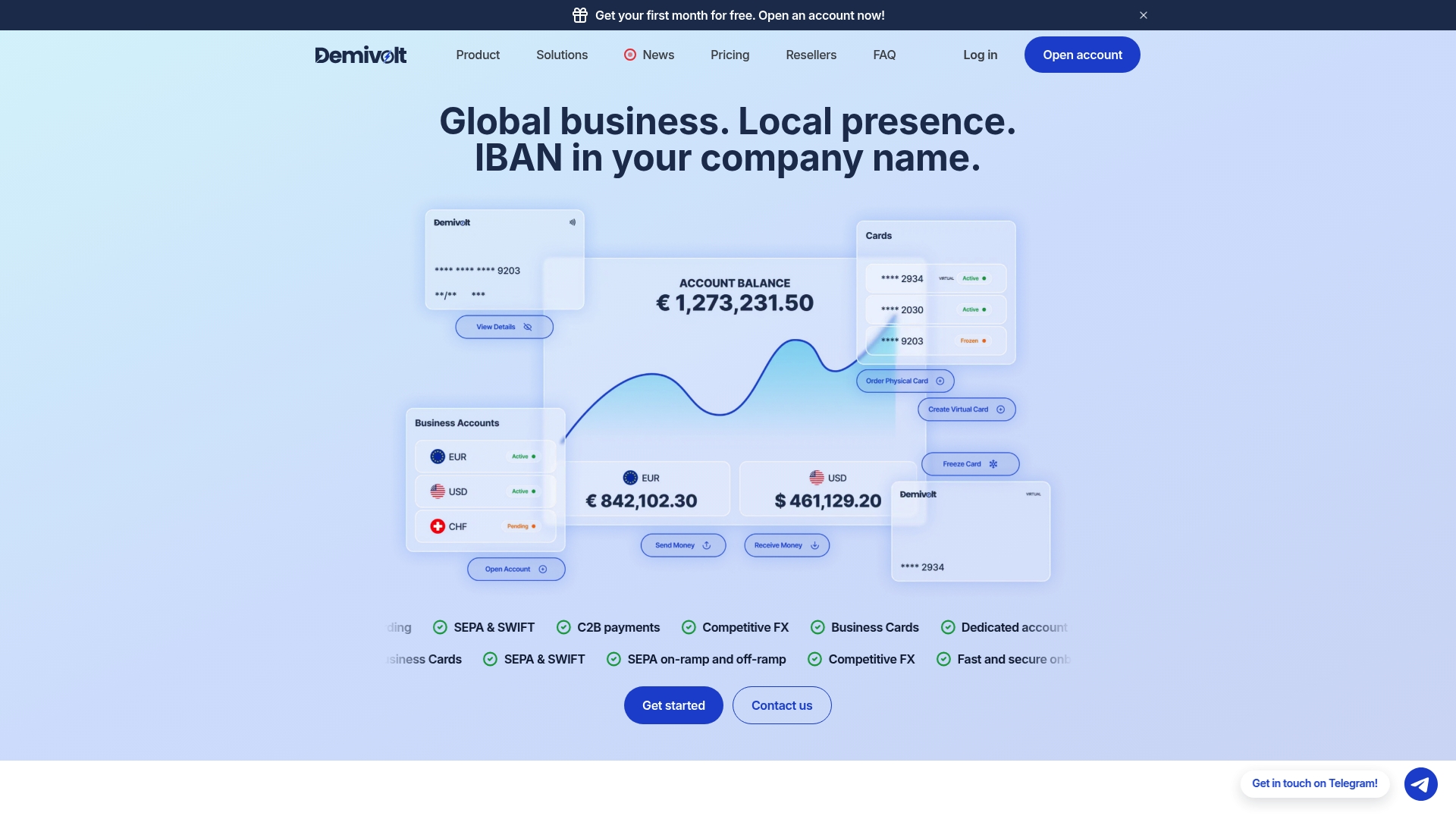
Partners benefit from Demivolt’s regulated business banking infrastructure, including dedicated IBAN accounts, SEPA and SWIFT payment processing, and virtual and physical Visa business cards, without needing to build or manage that infrastructure themselves. The program is designed for advisors, accountants, and business consultants who work with SMEs and want to add a recurring revenue stream to their practice. Payout triggers are tied to active, funded accounts, keeping incentives aligned with client quality from day one. To explore the program and understand the specific commission structure and onboarding requirements, visit Demivolt’s business banking platform or use the free SEPA tools to see the payment infrastructure your referred clients will use.
Useful sources and further reading
- ExitValue: How Recurring Revenue Increases Business Value — Core valuation evidence for the 20–40% multiple premium. Best for benefits and valuation sections.
- Reliant Business Valuation: Recurring Revenue as a Value Driver — Threshold analysis (25–30%, 50%, 80% recurring revenue). Best for measurement and valuation context.
- UnseenFounder: Affiliate Marketing for Finance and Fintech — Practical program design, compliance framing, and CPA benchmarks. Best for implementation and compliance sections.
- Gainsight: Essential Guide to Recurring Revenue — Incentive alignment and lifecycle investment framing. Best for benefits and implementation sections.
- GetCarvd: Residual Commission — Payout trigger best practices, clawback design, and partner behavior. Best for implementation and worked examples.
- BambooDT: Recurring Billing Systems for Fintech — Technical architecture for billing alignment and proration handling. Best for technical considerations.
- Ottu Documentation: Recurring Payments — CIT/MIT token lifecycle and consent flows. Best for technical and compliance sections.
- ZipRecruiter: Fintech Sales Commission Benchmarks — General commission rate ranges (5–20%). Best for implementation rate-setting context.