

A SWIFT transfer usually reaches the beneficiary within one to two business days, but the range is wide: some payments are credited within minutes, and others take several days. The delay rarely sits in the SWIFT message itself. It sits in the bank that credits the money at the end of the chain. This guide explains what the research shows about real timings, which factors you can control, how to trace a payment, and what to do when it has not arrived.
DemivoltManage Cross-Border Payments with ClarityDemivolt provides business accounts with SEPA and SWIFT payments, helping companies manage international transfers alongside everyday business finances.Visit DemivoltTL;DR
- A large study of SWIFT gpi payments found a median of 1 hour 38 minutes and an average of 8 hours 36 minutes, so most payments are fast and a minority are slow.
- For planning, allow 1 to 2 business days for a typical transfer and more for routes with currency controls or heavy compliance checks. Weekends and Lithuanian public holidays do not count as business days.
- Most delay happens at the beneficiary bank, not in transit. Complete, correct payment data is the single biggest thing you control.
- Ask for the UETR of every payment. It lets you and both banks follow the transfer end to end.
- A SEPA transfer in euros is a different, faster product. Use SWIFT when the currency or the destination requires it.
Table of Contents
- What the data says about SWIFT transfer times
- Why some transfers are slow
- Cut-off times, weekends and holidays
- SWIFT versus SEPA: choose the right rail
- How to follow a SWIFT payment with a UETR
- What to do if a SWIFT transfer has not arrived
- Our perspective: speed is a process, not a promise
- What SWIFT costs with Demivolt
- Open a business account built for cross-border payments
- A pre-send checklist for finance teams
- FAQ
- Sources
What the data says about SWIFT transfer times
The most reliable public numbers come from a Bank for International Settlements study of about 20 million SWIFT gpi transactions across 141 countries in September and October 2020. Excluding euro payments between euro-area countries, it found an average processing time of 8 hours 36 minutes and a median of 1 hour 38 minutes.
The gap between those two figures matters. The median tells you that half of all payments finished in under about an hour and a half. The average is pulled up by a tail of slow payments. For a finance team, that tail is the thing to plan around.
The same study shows how much the route matters. The median ranged from under five minutes on the fastest routes to more than two days on some of the slowest. A payment from Vilnius to a well-connected bank in a major financial centre behaves very differently from a payment to a bank in a country with foreign-exchange controls.

The data describes gpi payments from 2020, so treat it as a guide to the pattern rather than a promise for any single transfer. Your own bank’s published terms, and the receiving bank’s, decide the actual commitment.
A practical planning table
The table below turns the evidence into a working rule for scheduling. These are planning allowances, not guarantees.
| Situation | What to expect | How to plan |
|---|---|---|
| Sent early on a business day, well-connected route, complete data | Often within hours; the study’s median was under two hours | Still allow until the next business day |
| Sent late in the day or after your bank’s cut-off | Processing starts the next business day | Treat it as D+1 at best |
| Sent on Friday afternoon, weekend or Lithuanian holiday | Processing resumes on the next business day | Add the non-working days to your estimate |
| Route with currency controls, extra compliance checks or manual review | Can exceed two days | Send earlier and ask the counterparty about local rules |
| Payment with missing or inconsistent data | Held for repair or returned | Check the beneficiary details before sending |
Why some transfers are slow
SWIFT is a messaging network: it carries the payment instruction between banks. It does not hold the money. That is why two payments sent through the same network can arrive at very different times.
Swift explains that the final crediting stage is shaped by regulatory reporting requirements, currency and foreign-exchange controls, local payment infrastructure, incomplete or incorrect data, and additional manual checks. The BIS reaches a similar conclusion: prolonged processing is driven largely by time at the beneficiary bank between receiving the instruction and crediting the customer, while additional intermediaries add only a limited amount.
The BIS also lists capital controls, compliance processes, beneficiary-bank offline hours, batch processing and limited operating hours as factors associated with longer payment times. It reports that SWIFT payments involve just over one intermediary on average, so the long correspondent chain many people imagine is often not the cause.
Five causes you can influence
- Timing of submission. A payment released after the cut-off is processed on the next business day. In Lithuania, the Bank of Lithuania’s SEPA rules define a business day as any day other than Saturday, Sunday and the holidays set out in the Labour Code. Check the Lithuanian holiday calendar before a month-end or quarter-end payment.
- Data quality. A wrong BIC, a mistyped account number or a beneficiary name that does not match the account can trigger manual repair or a return.
- Payment purpose. Banks in some countries require a clear description or supporting documents. A vague reference invites a compliance query.
- Currency and route. Payments in currencies that need conversion, or going to countries with exchange controls, are more likely to be held for checks.
- Fee instruction. Choosing who pays the fees changes what arrives. It does not usually change speed, but it changes whether the beneficiary receives the full invoice amount. Our guide to cutting SWIFT fees with a treasury checklist covers this in detail.
Cut-off times, weekends and holidays
Most “late” SWIFT payments are payments that were sent at the wrong moment. Banks process instructions in batches and during operating hours. An order placed at 5 p.m. on Friday is typically not worked on until Monday, and if the receiving country has a holiday on Monday, it moves again.
Two calendars apply: the sender’s and the beneficiary’s. A Lithuanian company paying a supplier in a country with a different weekend or different public holidays can lose a day on each side. Before sending a time-sensitive payment, check both.
The same logic applies inside the euro area, which is why SEPA cut-off times matter. Our article on SEPA cut-off times and avoiding D+1 delays in Lithuania explains how to time payments so they settle on the day you intend.
SWIFT versus SEPA: choose the right rail
If you are paying in euros within the SEPA area, you usually do not need SWIFT at all. SEPA credit transfers are built for euro payments and, in Lithuania, instant payments are available around the clock. The Bank of Lithuania notes that CENTROlink can operate 24/7 throughout the year, including bank holidays. That describes instant SEPA infrastructure, not ordinary SWIFT transfers, and it is the main reason a euro payment can arrive in seconds when a SWIFT payment cannot.
Use SWIFT when:
- the payment is in a currency other than the euro, such as USD, GBP or CHF;
- the beneficiary bank is outside the SEPA area;
- the beneficiary bank is not reachable through SEPA.
If you want to understand why some transfers are instant while others are not, see our explainer on why some bank transfers are instant and others are not.
How to follow a SWIFT payment with a UETR
Every gpi payment carries a Unique End-to-End Transaction Reference, or UETR. Swift says the gpi Tracker uses it to trace a payment from the originating bank through correspondent banks to the ultimate beneficiary. For corporates, the same reference supports end-to-end traceability, real-time status updates, visibility of routing and fees, and beneficiary-payment confirmation where the participating banks support those features.
In practice:
- Ask your bank or payment provider for the UETR right after you send the payment.
- Share the UETR with the beneficiary so their bank can search for the payment.
- Ask for the current status. Common statuses show that the payment is in progress, credited or rejected.
- If the status has not changed, ask your bank to contact the next bank in the chain using the same UETR.
Our walkthrough of SWIFT gpi tracking shows what the status updates mean. For the data a finance team should request, see why to ask for pacs.008, UETR and Field 20 instead of MT103.
What to do if a SWIFT transfer has not arrived
Panic does not speed anything up. A structured escalation does. The sequence below is the practical approach that fits how the network works.
- Check the calendar. Count business days in both countries since the payment was released, not since you created it. A payment started after the cut-off, or over a holiday, may simply not have been processed yet.
- Get the UETR and status. Ask your bank for the UETR and the latest tracker status. If the status shows the payment is credited, the issue is inside the beneficiary bank, and the beneficiary should ask their bank to look for it.
- Verify the details. Confirm the BIC, the IBAN or account number, the beneficiary name and the currency against the invoice. An error here is the most common reason a payment is held or returned.
- Look for a compliance request. Ask your bank and the beneficiary’s bank whether they need an invoice, contract or explanation of purpose. Supplying it quickly often releases the payment.
- Open a formal inquiry. If there is still no movement after two business days, ask your bank to raise a case with the next bank in the chain, quoting the UETR, amount, value date and reference. Some providers and practitioner guides suggest this two-day threshold as a sensible point to escalate, but your own bank’s terms decide the formal process.
- Decide on recall only if needed. A recall request asks the other bank to return the funds. It depends on the beneficiary bank’s cooperation, so use it when the details were wrong, not as a first reaction to a delay.
Keep a written record of each step. If the payment concerns an invoice with a payment deadline, tell your counterparty early and send them the UETR. It shows good faith and gives them something concrete to check.
Our perspective: speed is a process, not a promise
We see the same pattern with the finance teams that work with us. The question “how long does a SWIFT transfer take?” is usually the wrong one. The more useful question is “what do we control before and after we press send?”
Before sending, you control the cut-off, the data and the documents. After sending, you control visibility: whether you have the UETR, whether your counterparty has it, and whether your provider can escalate quickly. A regulated account that gives you a dedicated IBAN, a dedicated client manager and clear fee schedules removes much of the uncertainty that makes a delay stressful.

We also think treasury teams should separate rails by purpose. Euro payments belong on SEPA, including instant payments where the counterparty supports them. SWIFT belongs to currencies and destinations SEPA cannot reach. That discipline alone shortens most payment cycles, and it makes cash forecasting more reliable. Our guide to payment risk management for businesses in Lithuania goes further on this.
Finally, we recommend that finance teams document a standard internal checklist for every cross-border payment: confirm details, add a clear purpose, send before the cut-off, record the UETR and share it. It takes two minutes and prevents most escalations.
— dd
What SWIFT costs with Demivolt
Speed is one part of the picture; cost is the other. Demivolt publishes its payment fees, so you can compare before you open an account.
| Payment type | Fee |
|---|---|
| SEPA In | 0 € |
| SEPA Out | 0.40 € |
| SWIFT In | 25.00 € |
| SWIFT Out | 30.00 € |
| Account opening, verification, monthly maintenance, account closure | 0 |
| Internal transfers between Demivolt accounts | 0 |
These are the fees as published on our site. Other banks in the chain may apply their own charges on a SWIFT payment, depending on the fee instruction you choose. For the currency side of the cost, see our article on stopping SWIFT currency conversion losses with gpi. To estimate a euro transfer, use the SEPA fee calculator.
Open a business account built for cross-border payments
Demivolt is a regulated European fintech platform. A business account gives your company a dedicated IBAN, SEPA and SWIFT payments, role-based user management and segregated client funds, with risk-based onboarding designed to be fast and transparent. Your team can run several accounts, issue virtual and physical Visa business cards, and keep a dedicated client manager at no charge.
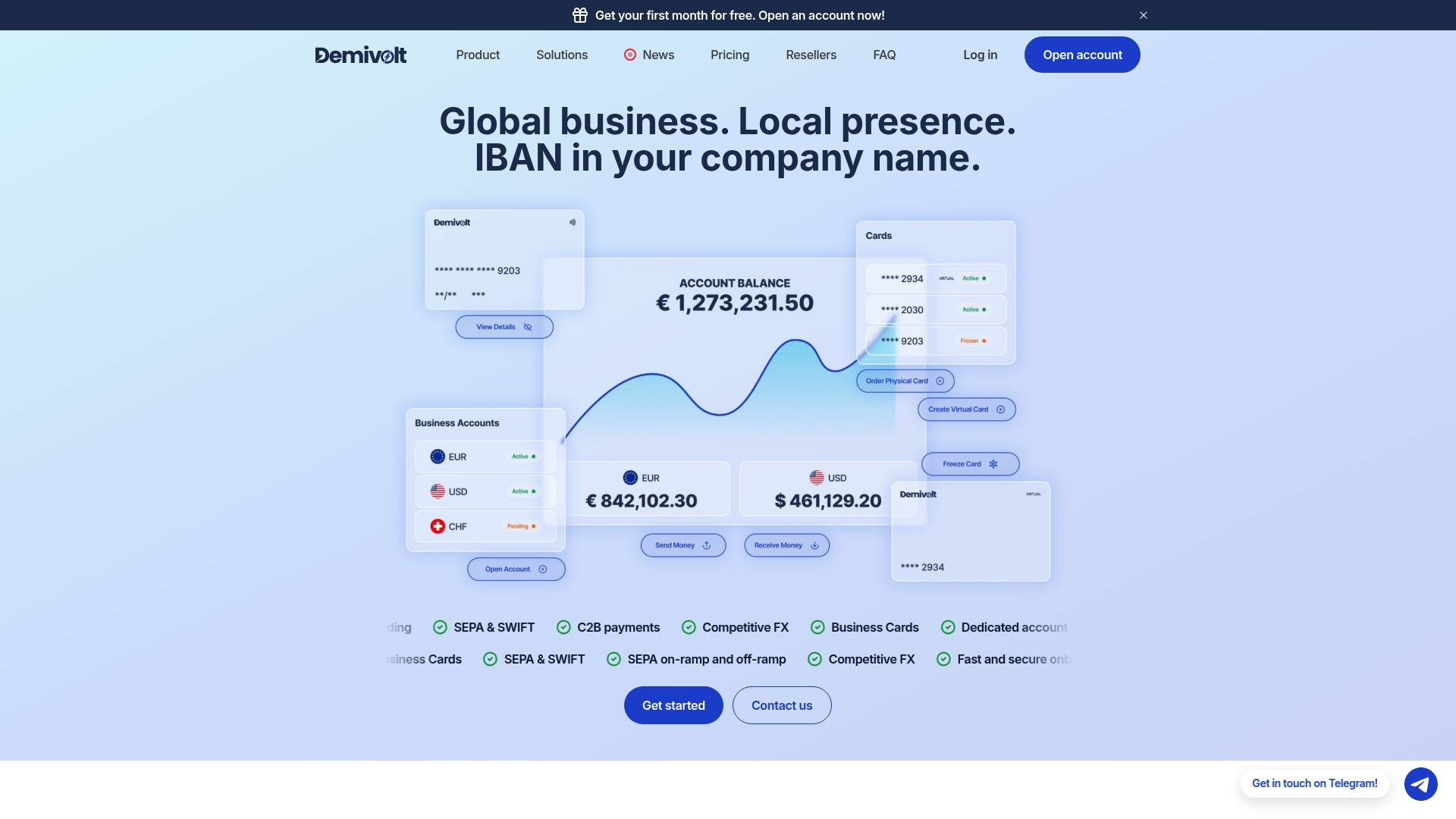
If your company sends or receives international payments regularly, get started with Demivolt or contact us to discuss your payment flows. Advisors who refer clients can also look at our reseller programme.
A pre-send checklist for finance teams
Use this list before every SWIFT payment above your normal threshold:
- Confirm the beneficiary name, address, account number or IBAN and BIC against a signed invoice or contract.
- Choose the correct currency and understand who bears the fees.
- Write a specific payment purpose, for example an invoice number and the goods or service.
- Check public holidays and weekends in both countries.
- Release the payment well before your provider’s cut-off.
- Record the UETR and send it to the beneficiary.
- Keep supporting documents ready in case a bank asks for them.
If your accounting system is connected to your bank, much of this can be automated. Our guide to BaaS integration with ERP for Lithuanian companies describes how.
FAQ
How many days does a SWIFT transfer take?
Many SWIFT payments are credited within hours, and the BIS study found a median of about an hour and a half. For planning, allow one to two business days, and more for routes with currency controls or extra compliance checks. Weekends and public holidays are not business days.
Why does my SWIFT transfer show as sent but the money has not arrived?
The most common cause is the beneficiary bank’s own processing: operating hours, batch runs, compliance checks or incomplete data. The sending bank has already released the payment, but the receiving bank has not yet credited the account. Ask for the UETR and check the status.
Is SWIFT slower than SEPA?
Usually yes. SEPA is designed for euro payments within a single set of rules, and instant SEPA payments can settle in seconds at any time. SWIFT covers many currencies, countries and banking systems, so timing depends on the route and on the receiving bank.
Can I speed up a SWIFT transfer?
You cannot force the receiving bank to credit faster, but you can avoid avoidable delays. Send before the cut-off on a business day, double-check all details, add a clear payment purpose and share the UETR with the beneficiary.
What is a UETR and where do I find it?
A UETR is a unique reference that stays with a gpi payment through every bank in the chain. Your bank or payment provider can give it to you after you send the payment, and it lets you track the transfer end to end.
Sources
- SWIFT gpi data indicate drivers of fast cross-border payments (BIS)
- How long does a Swift payment take? (Swift)
- SEPA-MMS rules (Bank of Lithuania)
- Payment system CENTROlink marks instant payments era in Lithuania (Bank of Lithuania)
- SWIFT gpi for capital markets (Swift)
- SWIFTgpi for Corporates (Swift)