

For U.S. businesses that need reliable, regulated SEPA Instant rails for euro payouts and collections, Demivolt is the recommended choice. It combines dedicated IBAN accounts, API-first integration, and segregated client funds under a regulated EU framework, giving finance teams a compliant path to real-time euro payments without building bank-grade infrastructure in-house.
The three practical reasons to choose Demivolt as your SEPA Instant provider:
- Regulated EU accounts and dedicated IBANs for compliant euro inflows and outflows
- API-first integration with sandbox access and webhook support for fast technical onboarding
- Fast, transparent KYC onboarding designed for non-EU legal entities, including U.S. companies, facilitating swift account setup.
Key Takeaways
For U.S. businesses, SEPA Instant access requires a regulated EU provider with dedicated IBANs, API integration, and a KYC process built for non-EU entities.
| Point | Details |
|---|---|
| Settlement speed | SEPA Instant credits beneficiaries within 10 seconds when both PSPs participate in SCT Inst. |
| Irrevocability risk | Instant transfers cannot be recalled; validate IBANs with VoP checks before every payment run. |
| Landed cost structure | True cost combines per-transaction fees, monthly account fees, and FX spread; holding EUR balances reduces conversion costs. |
| Compliance requirement | U.S. entities must satisfy both EU PSP KYC requirements and domestic AML obligations before going live. |
| Demivolt recommendation | Demivolt provides regulated IBAN accounts, SEPA and SWIFT processing, and API sandbox access suited for U.S. businesses entering euro rails. |
Table of Contents
- What is SEPA Instant and how does it work?
- Why does SEPA Instant matter for U.S. businesses?
- How do you choose the right SEPA Instant provider?
- Demivolt: the recommended SEPA Instant solution for U.S. businesses
- What does onboarding with Demivolt actually look like?
- What does SEPA Instant actually cost for a U.S. business?
- What compliance and operational risks should you plan for?
- Why we recommend this approach
- Demivolt gives you a direct path to SEPA Instant rails
- Sources
What is SEPA Instant and how does it work?
SEPA Instant Credit Transfer (SCT Inst) is a euro-denominated payment scheme that settles funds to the beneficiary account within 10 seconds when both the sending and receiving payment service providers (PSPs) participate in the scheme. Unlike standard SEPA Credit Transfer, which processes in batches during business hours, SCT Inst runs continuously, every hour of every day, including weekends and public holidays.
A few constraints define how the rail actually behaves in practice:
- Per-transaction limits: Individual transfers may be capped by the scheme or set lower by payment service providers, often with typical limits varying depending on the institution.
- PSP participation required: Both the sending and receiving PSP must be enrolled in SCT Inst. If the beneficiary’s bank has not joined the scheme, the payment falls back to standard SEPA Credit Transfer or is rejected.
- Irrevocability: Once an instant transfer is accepted, it cannot be recalled unilaterally. This differs sharply from card rails, where chargebacks are possible, and from SWIFT, where recalls can be initiated within a window.
The SEPA payments mechanics that govern routing, clearing, and beneficiary notification are worth reviewing before committing to a provider, since the scheme’s rules directly affect how you structure reconciliation and error handling.
Why does SEPA Instant matter for U.S. businesses?
U.S. companies with euro-denominated obligations face a structural problem: domestic ACH and wire rails do not reach European bank accounts in real time, and SWIFT wires carry fees and one-to-two day settlement windows. SEPA Instant closes that gap for any business operating with EU counterparties.
The use cases where it creates measurable value:
- Instant customer refunds and payouts: E-commerce platforms serving EU customers can issue refunds in seconds rather than days, reducing support tickets and improving retention. Account-to-account instant payments effectively eliminate chargeback exposure because transfers are authenticated and irrevocable.
- Vendor and supplier payments: B2B platforms paying EU suppliers can confirm settlement immediately, removing the float risk that comes with batch processing and improving supplier relationships.
- Payroll for EU subsidiaries or contractors: Finance teams running payroll for EU-based employees or freelancers can fund accounts on the payment date rather than pre-funding days in advance.
- Marketplace settlement: Two-sided marketplaces can disburse seller proceeds in real time after a transaction clears, a meaningful competitive differentiator in EU markets.
- Cash flow optimization: Holding EUR in a dedicated IBAN account and settling instantly reduces the number of FX conversions needed, lowering spread costs over time.
Business models that benefit most include cross-border e-commerce, digital marketplaces, payroll providers, SaaS platforms with EU billing, and any B2B operation with regular euro vendor payments.
How do you choose the right SEPA Instant provider?
Evaluating top SEPA payment services requires a structured approach. The criteria below translate directly into RFP questions your procurement or finance team can use.
Core evaluation criteria, in priority order:
- Regulatory status: Confirm the provider holds a valid EU payment institution or e-money institution license. Unregulated or passported entities carry jurisdiction risk.
- Geographic coverage: Verify which SEPA countries and bank networks the provider connects to. Gaps in coverage mean some beneficiary banks will not receive instant transfers.
- API capability: Assess whether the provider offers a documented REST API, a developer sandbox, webhooks for settlement notifications, and SDKs in your stack’s language.
- Settlement SLAs and uptime: Ask for contractual SLA commitments on instant routing success rates and system uptime. A provider with no published SLA is a red flag.
- Pricing model: Understand whether fees are per-transaction, monthly flat, or volume-tiered. Some providers charge a premium for instant routing on top of standard SEPA fees.
- FX handling: For U.S. businesses converting USD to EUR (or receiving EUR and converting back), ask for the FX spread, whether it is fixed or market-linked, and whether you can hold EUR balances to defer conversion.
- KYC and onboarding for non-EU entities: U.S. companies are non-EU legal entities. Ask specifically how the provider handles corporate KYC for U.S.-registered businesses and what documents are required.
- Reconciliation tools: Confirm whether the provider offers transaction-level reporting, MT940/CAMT.053 statement exports, or a reconciliation API feed.
Red flags to watch for:
- Opaque or bundled fee schedules with no per-transaction breakdown
- No sandbox environment or limited API documentation
- Client funds not held in segregated accounts
- No clear regulatory license number or supervisory authority named
- Vague onboarding timelines with no stated KYC SLA
Demivolt: the recommended SEPA Instant solution for U.S. businesses
Demivolt is a regulated European fintech platform that provides dedicated IBAN accounts, SEPA and SWIFT payment processing, segregated client accounts, and API-first integration. Its onboarding is designed to accommodate non-EU legal entities, including U.S.-registered companies, with a transparent KYC workflow and defined documentation requirements.

How Demivolt maps to the selection criteria above:
| Criterion | Demivolt capability |
|---|---|
| Regulatory status | Regulated EU platform; client funds held in segregated accounts |
| IBAN accounts | Dedicated IBANs per business entity or sub-account |
| SEPA and SWIFT processing | Both rails supported; instant and standard SEPA routing available |
| API integration | API-first architecture; developer sandbox and webhook support |
| FX handling | EUR account holding available to reduce per-transaction FX conversions |
| KYC for U.S. entities | Structured onboarding for non-EU businesses with defined document list |
| Reconciliation | Transaction-level reporting and multi-account management |
| Card infrastructure | Virtual and physical Visa business cards for expense management |
Demivolt’s free SEPA tools, including an IBAN validator and payment calculators, give technical teams a practical starting point before committing to full integration. The platform also supports multi-account structures and role-based user management, which matters for finance teams that need to separate treasury, payroll, and vendor payment flows.
What does onboarding with Demivolt actually look like?
Pre-boarding checklist (complete before submitting an application):
- Gather corporate KYC documents: certificate of incorporation, articles of organization, proof of registered address, and beneficial ownership records for all owners above 25%.
- Prepare a business purpose statement explaining your euro payment flows (e.g., EU vendor payments, customer refunds, contractor payroll).
- Document your AML controls: transaction monitoring policy, sanctions screening process, and any existing compliance certifications.
- Identify your technical integration owner and confirm API stack compatibility.
Technical integration steps:
- Request API credentials and sandbox access from Demivolt.
- Build and test payment initiation, status polling, and webhook receipt in the sandbox environment.
- Map reconciliation feeds to your ERP or accounting system (MT940 or API-based).
- Run a pilot with a small volume of live EU payouts to validate end-to-end flow.
- Confirm SCA (Strong Customer Authentication) and Verification of Payee requirements with your Demivolt account manager before going to production.
The digital banking integration checklist on Demivolt’s site covers the security controls and technical steps in more detail for teams preparing a production deployment.
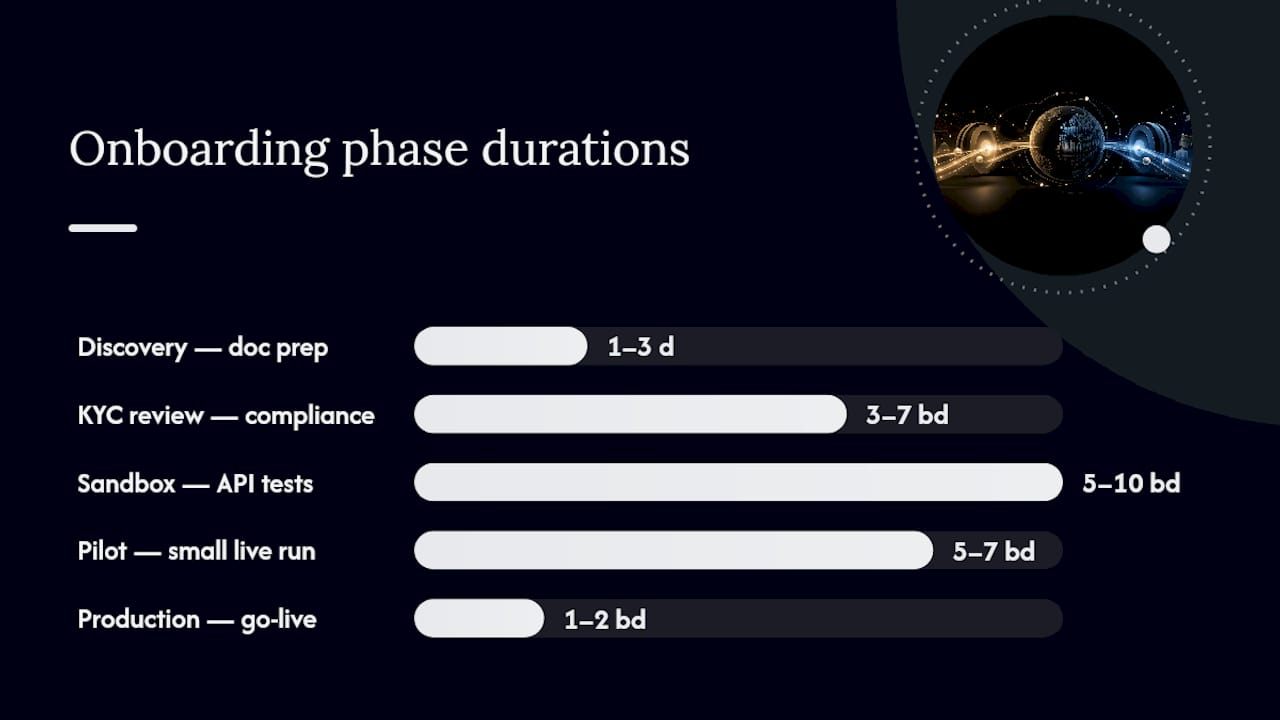
Typical onboarding timeline:
| Phase | Activity | Estimated duration |
|---|---|---|
| Discovery | Requirements scoping and document preparation | 1–3 days |
| KYC review | Document submission and compliance review | 3–7 business days |
| Sandbox integration | API build, webhook setup, and test payments | 5–10 business days |
| Pilot | Limited live volume with monitoring | 5–7 business days |
| Production | Full go-live and reconciliation validation | 1–2 business days |
What does SEPA Instant actually cost for a U.S. business?
SEPA Instant pricing typically combines several fee layers. Understanding each one lets you calculate the true landed cost of a euro payment.
Common fee types:
- Per-transaction fee: A flat charge per instant transfer, often higher than standard SEPA Credit Transfer fees.
- Monthly account or platform fee: A fixed fee for maintaining the IBAN account and access to the payment infrastructure.
- FX spread: The margin applied when converting USD to EUR or EUR to USD, expressed as a percentage above the mid-market rate.
- Routing or gateway fee: Some providers charge an additional fee for instant routing versus standard batch processing.
Example landed-cost scenario: A U.S. business sends a €1,000 vendor payment. The per-transaction fee is €0.50. Holding a EUR balance and funding it in bulk reduces the FX component significantly.
Negotiation levers to use:
- Volume commitments typically unlock lower per-transaction rates.
- Holding EUR balances in a dedicated IBAN account removes the FX spread from individual transactions.
- Comparing SEPA versus SWIFT rail costs helps clarify when instant euro payments are the more cost-effective option versus international wire.
What compliance and operational risks should you plan for?
Regulatory checkpoints for U.S. businesses:
- Confirm your provider’s PSP license covers the SEPA countries where your beneficiaries are located.
- Regulation (EU) 2024/886 requires EU PSPs to offer SEPA Instant at no higher cost than standard SEPA Credit Transfer. Verify your provider complies, especially if you are comparing instant versus standard pricing.
- U.S. entities are subject to AML/KYC requirements from both the provider’s EU regulator and U.S. FinCEN obligations. Maintain documentation of your payment flows and counterparty due diligence.
Operational risks to mitigate:
- Irrevocability: A misdirected instant transfer is extremely difficult to recover. Validate beneficiary IBANs before every payment run.
- PSP participation gaps: Not all European banks participate in SCT Inst. Build a fallback routing rule to standard SEPA Credit Transfer for non-participating beneficiary banks.
- Reconciliation mismatch: Instant transfers arrive outside business hours. Your reconciliation process must handle 24/7 inbound credits without manual intervention.
- Per-transaction limits: Payments above the scheme or provider limit will be rejected or rerouted. Structure high-value disbursements accordingly.
Pro Tip: Integrate Verification of Payee (VoP) checks into your payment initiation flow before sending any instant transfer. VoP matches the beneficiary IBAN to the account holder’s name, catching data entry errors and reducing misdirected payment incidents before settlement is final and recovery becomes impractical. Demivolt’s IBAN validator is a practical first step for teams validating beneficiary data at scale.
Why we recommend this approach
The conventional advice for U.S. businesses entering euro payment flows is to start with SWIFT and add SEPA later. That sequence made sense a decade ago. It does not reflect the current state of EU payment infrastructure, where SEPA Instant is becoming the default rail under regulatory pressure and where EU counterparties increasingly expect real-time settlement.
Building direct bank connectivity in-house to access SCT Inst requires a PSP license, scheme membership, and significant compliance overhead. A regulated platform like Demivolt compresses that path to weeks rather than years, with the compliance framework already in place and the API layer ready to connect. The operational argument is straightforward: faster time-to-value, lower compliance burden, and a provider that has already solved the non-EU entity onboarding problem that trips up most U.S. businesses.
Demivolt gives you a direct path to SEPA Instant rails
U.S. businesses that need euro real-time payment capability without the overhead of building regulated infrastructure from scratch will find Demivolt’s platform covers the critical requirements: dedicated IBANs, SEPA and SWIFT processing, segregated client accounts, and a developer-ready API with sandbox access.
Start with a small-volume pilot: use Demivolt’s free SEPA tools to validate your IBAN data and test payment flows in the sandbox before committing to production volume. The onboarding process is structured for non-EU entities, so your U.S. corporate documents are sufficient to open a dedicated EUR account. When you are ready to move from sandbox to live payments, the path from KYC approval to first production transfer is measured in days, not months. Open your account at Demivolt to get started.
Sources
This article is general information, not a substitute for advice from a qualified financial advisor. Consult a qualified financial professional about your own circumstances before acting on anything here.