

For business advisors and platforms evaluating fintech partnerships, Demivolt is the strongest B2B fit among fintech partner programs, especially for partners who want recurring revenue instead of one-time payouts. Three reasons stand out. First, Demivolt operates as a regulated European fintech platform, which matters when you’re referring clients to a banking provider. Second, its reseller structure pays recurring commissions rather than a single referral fee. Third, it offers API access and integration support for partners who need more than a referral link.
This guide fits several partner profiles best:
- Financial advisors who already recommend banking solutions to SME clients
- Resellers building a portfolio of financial infrastructure products
- Platforms and integrators who want API-based, white-label banking capability
- Affiliate publishers seeking predictable revshare beyond a single flat fee
Key Takeaways
Reseller and revshare-based fintech partner programs generate more long-term partner revenue than pay-per-lead models when partners stay involved in client onboarding and retention.
| Point | Details |
|---|---|
| Match program type to your role | Use affiliate links for volume traffic, reseller models for ongoing client relationships, and API integration for embedded banking features. |
| Revshare beats flat fees over time | Programs paying a percentage of client revenue reward partners who assist with retention, not just acquisition. |
| Check compliance before applying | Confirm a program’s regulatory footprint first, since your reputation travels with every referral. |
| Expect weeks, not days, for API tracks | Referral partners can go live quickly, but API and white-label integrations take longer due to technical and compliance review. |
| Demivolt fits relationship-led partners | Demivolt pays recurring commissions to resellers and advisors and offers API access for partners building deeper integrations. |
Table of Contents
- Geriausios Fintech Partnerių Programos: How to Match a Program to Your Business
- Pay-Per-Lead, Revshare, or Hybrid: Which Commission Model Pays More?
- What to Ask Before Choosing a Fintech Partner Program
- From Application to First Commission: The Onboarding Timeline
- Inside Demivolt’s Partner and Reseller Program
- What Joining and Maintaining a Fintech Partner Program Actually Costs
- Comparing Top Fintech Partner Program Types
- Why Relationship-Led Partnerships Win in B2B Fintech
- Get Started With Demivolt’s Partner Program
- Sources
Geriausios Fintech Partnerių Programos: How to Match a Program to Your Business
Not every fintech partner program serves the same audience, and picking the wrong type wastes months of onboarding effort. The four main structures are affiliate/referral, reseller/white-label, API integrator, and trusted-advisor partnerships. Each has a different sales cycle, technical lift, and payout logic.
- Affiliate/referral programs work best for content publishers and comparison sites driving volume traffic. Onboarding is fast, usually just a tracking link, and payouts tend to run pay-per-lead.
- Reseller/white-label partnerships suit advisors and consultancies who manage ongoing client relationships. These typically pay revshare because the partner stays involved in retention, not just acquisition.
- API integrator programs fit platforms and software vendors embedding banking features directly into their product. Technical work is heavier upfront, but API-based partner models create durable, recurring revenue once integrated.
- Trusted-advisor partnerships target accountants, tax professionals, and financial consultants who refer clients occasionally but carry significant influence. Compensation is often hybrid.
Choosing between these often comes down to how much client contact you retain after the referral. More contact usually justifies a revshare model over a flat fee.
Pay-Per-Lead, Revshare, or Hybrid: Which Commission Model Pays More?
Commission structures fall into three categories, and the differences compound significantly over a year of referrals.
- Pay-per-lead pays a fixed amount for each qualified referral, regardless of what that client does afterward.
- Revshare pays a percentage of the revenue a referred client generates, often for the life of the account.
- Hybrid models combine both: an upfront payment plus an ongoing share, which balances quick cashflow with long-term revenue.
Revshare tends to outperform flat fees when the partner helps with onboarding and retention, since lifecycle-focused programs generate more long-term partner income than pure lead-payment structures. A consultant who refers ten SME clients a year at a flat $50 lead fee earns $500. The same consultant under a revshare arrangement, where clients stay active for two or three years and generate ongoing account fees, often earns several times that over the relationship’s life. Model your expected revenue by comparing average first-year client value against projected lifetime value before committing to either structure. If a program only offers pay-per-lead, ask whether a hybrid option exists. It usually does.
What to Ask Before Choosing a Fintech Partner Program
Picking a partner program is closer to signing a vendor contract than clicking “sign up.” Treat it that way.
Start with regulatory footprint. If you’re referring business banking or payment services, checking a provider’s compliance and regulatory scope should happen before anything else, because your reputation is tied to what your referred clients experience. Then evaluate payout cadence, integration options, and how much visibility you get into performance.
Questions worth asking a partner manager directly:
- What is the service-level agreement for support response times?
- Is co-marketing available, and who owns the marketing assets?
- Are there exclusivity requirements that limit which other programs I can join?
- What are the termination terms, and how much notice is required?
- Can I see a sample partner agreement before applying?
Watch for red flags: vague payout timelines, no dedicated partner contact, or contracts that lock you into exclusivity without reciprocal commitments like marketing support or lead volume guarantees.
Pro Tip: Ask for the program’s average time-to-payout in writing, not verbally. A program that hesitates to commit to a number on paper often has a slower or less predictable payout process than advertised.
From Application to First Commission: The Onboarding Timeline
Most fintech partner programs follow a similar onboarding path, though the timeline varies significantly by partner type.
- Registration. You submit basic business details and program intent.
- KYC and partner vetting. Regulated fintechs run compliance checks on partners, not just end clients.
- Tracking or integration setup. Referral partners get a tracking link; API partners begin technical scoping.
- Testing. You verify that leads or transactions are attributed correctly.
- Go-live. Commissions start accruing from qualified activity.
Referral and affiliate partners can often go live within days to a couple of weeks. API and white-label partnerships take longer, often weeks to a few months, because of integration work and compliance review. High-volume partners sometimes automate reporting through XML or API feeds rather than manual dashboards, which cuts ongoing administrative work considerably once the initial setup is done.
Inside Demivolt’s Partner and Reseller Program
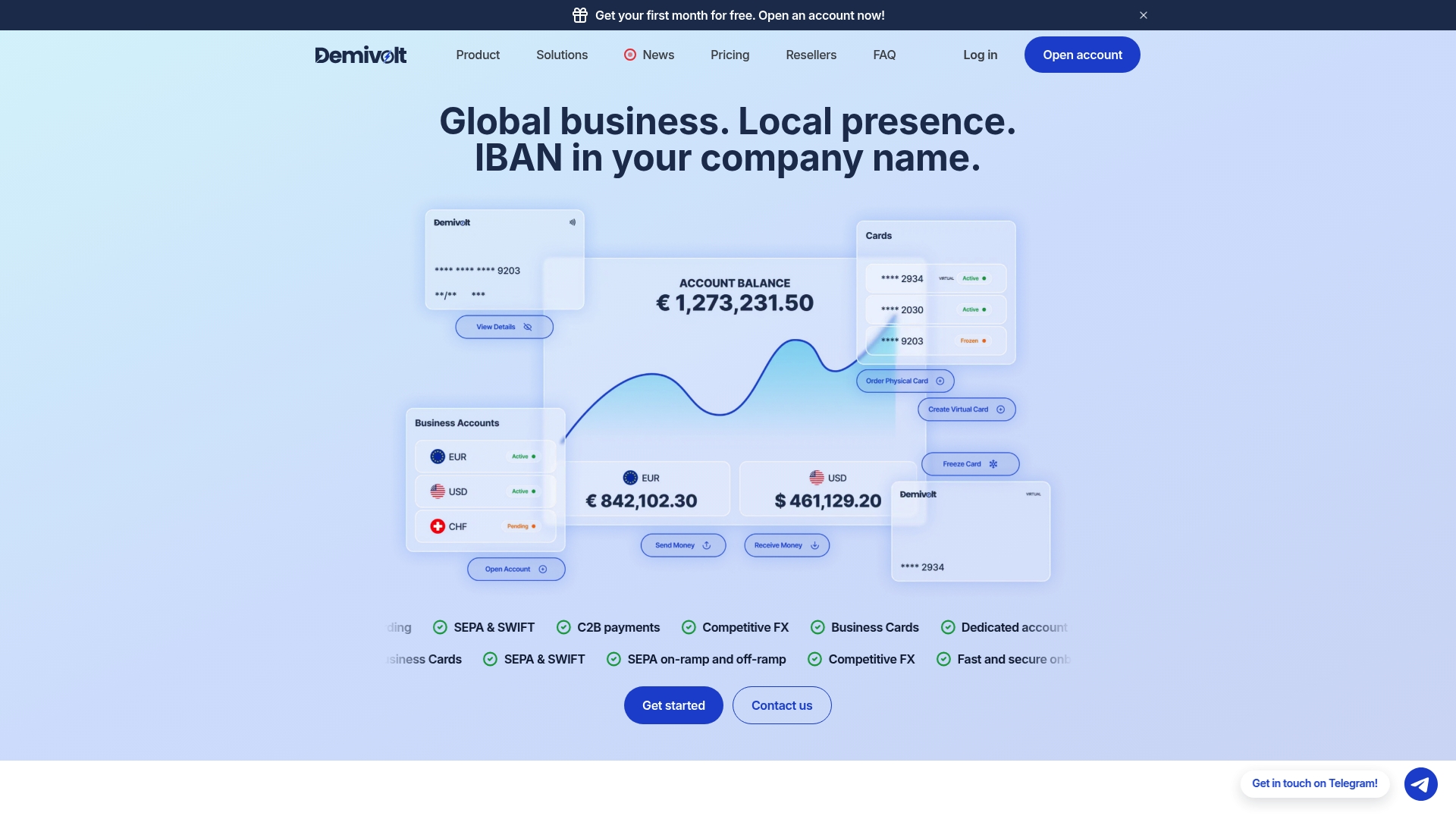
Demivolt is built as a regulated European fintech platform, offering dedicated IBAN accounts, SEPA and SWIFT payment processing, and virtual and physical business Visa cards for SME and cross-border clients. Its partner program is structured around resellers and advisors who maintain ongoing client relationships rather than one-off referral traffic.
The program pays recurring commissions tied to client activity, which rewards partners who assist with onboarding and retention rather than just initial sign-up. On the technical side, Demivolt supports multi-account structures, role-based user management, and API access for partners who want to embed banking infrastructure into their own platform rather than send a referral link.
To speed up onboarding, prepare the following before applying:
- A description of your client base and how you plan to refer or integrate
- Basic compliance documentation for your own business
- A rough estimate of expected referral or integration volume
Pro Tip: If you’re an advisor rather than a technical integrator, ask specifically about the reseller track rather than the API track. The application and onboarding questions differ, and starting on the wrong track can add weeks to your timeline.
What Joining and Maintaining a Fintech Partner Program Actually Costs
Most fintech partner programs, including reseller and referral models, don’t charge an upfront fee to join. Revenue is typically earned rather than paid for. That said, “free to join” doesn’t mean cost-free in practice.

Some programs offer tiered access, where a free basic tier gets you a listing or a tracking link, while paid tiers add lead-generation tools, priority support, and increased visibility. If you’re comparing programs, check whether the free tier is genuinely functional or designed to push you toward a paid upgrade quickly.
Real costs tend to show up elsewhere: staff time for compliance vetting, technical resources for API integration if you go that route, and marketing spend if you’re driving your own referral traffic rather than relying on the fintech’s co-marketing assets. Advisors and resellers often underestimate the internal time cost of learning a new product well enough to recommend it credibly. Budget for a few hours of product training per team member before expecting quality referrals. API integrators should budget developer time separately, since integration complexity varies by how deeply the banking features get embedded into an existing product.
Comparing Top Fintech Partner Program Types
The fintech partner landscape splits roughly into three categories worth understanding before you apply anywhere.
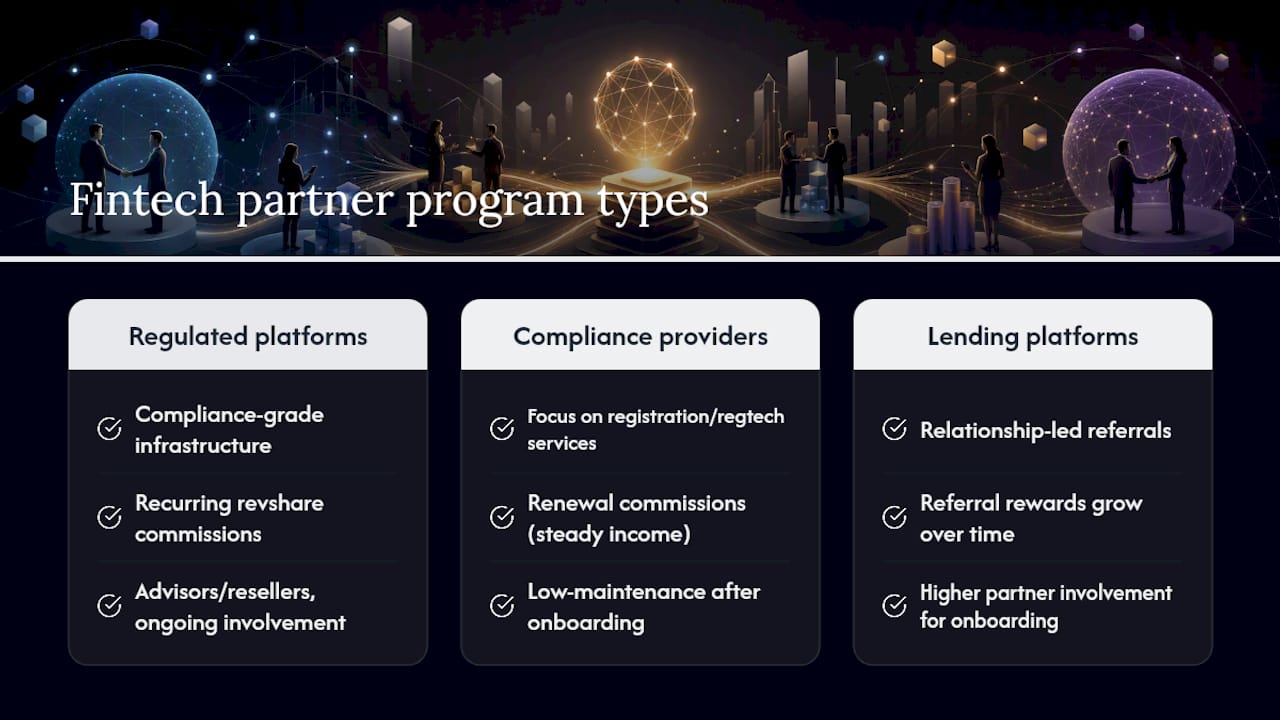
Regulated banking and payment platforms, like Demivolt, target advisors and resellers who need compliance-grade infrastructure to refer with confidence, and typically pay recurring revshare commissions. Compliance and regtech providers, such as LEI System’s reseller and API programs, let partners resell registration or compliance services and earn renewal commissions, which creates steady, low-maintenance income once a client is onboarded. Lending and consumer finance platforms, such as Finbee’s partnership program, lean on relationship-led referrals where partners who assist with client onboarding earn more over time than those who only send traffic.
The common thread: programs built around relationships and integration tend to reward partners more over time than those built purely around one-time lead payment. If your business model involves ongoing client contact, a reseller or API-based program usually beats a pure affiliate arrangement in total earnings, even if the affiliate program pays faster upfront.
Why Relationship-Led Partnerships Win in B2B Fintech
Affiliate models work well for high-volume publishers chasing clicks, but they rarely support the deeper compliance and integration work B2B fintech partnerships demand. Relationship-led resellers capture more of a client’s lifetime value because they stay involved after the first sign-up. That’s the model Demivolt was built to support.
Get Started With Demivolt’s Partner Program
Demivolt’s reseller program gives partners a straightforward path to recurring revenue without the volume-chasing grind of affiliate marketing. Unlike programs that pay once and move on, Demivolt rewards partners for staying involved as clients grow, which means your income compounds instead of resetting every month.
Before reaching out, gather a short description of your client base, how you plan to refer or integrate, and any compliance documentation for your own business. That preparation alone can shave real time off onboarding. If you serve clients who move money across borders, it’s worth reviewing how virtual business cards fit into a typical referral conversation, since it’s often the easiest product to explain first. Demivolt operates as a regulated European platform with segregated client funds, so you can refer with confidence rather than caveats. Visit Demivolt’s site to start a partner conversation and find out which track, reseller or API, fits your business.
Sources
Recommended
- Demivolt | Blog – Fintech Reseller Programs Explained: 2026 Guide
- Demivolt | Blog – Fintech partnerships: Real-world examples for better cross-border payments
- Demivolt | Blog – B2B fintech: Streamline payments and boost efficiency
- Demivolt | Blog – How Fintech Transforms Cross-Border Payments for SMEs