

TL;DR:
- Effective expense management relies on a clear, comprehensive policy, automation for accuracy, and proactive controls to prevent overspending. Incorporating detailed documentation and segregation of duties ensures legal protection and fraud prevention in small businesses. Strategic cost control focuses on deliberate spending and continuous policy enforcement to sustain growth without unnecessary expense cuts.
Business expense management is the systematic process of tracking, controlling, and optimizing every cost a company incurs to protect profitability and maintain healthy cash flow. Without a structured approach, even profitable businesses bleed money through duplicate charges, unclaimed deductions, and policy violations that go undetected for months. Knowing how to manage business expenses is not optional for small business owners and finance managers. It is the operational backbone that separates businesses that scale from those that stall. Tools like SAP Concur, frameworks from Itilite, and platforms like Demivolt give modern teams the infrastructure to turn expense chaos into financial clarity.
How to manage business expenses: building the right policy first
Every effective expense management system starts with a written policy. A complete expense policy contains seven core components, and missing any single one causes the entire framework to break down. Think of the policy as the rulebook every employee and manager operates from before a single dollar is spent.
The seven components every policy must include:
- Scope and eligibility: Define which employees, contractors, and departments the policy covers.
- Expense categories: List approved categories such as travel, meals, software subscriptions, and office supplies.
- Spending limits: Set per diem rates and category caps tied directly to your operating budget.
- Documentation rules: Specify what receipts, invoices, or records are required for each category.
- Approval workflow: Establish who approves what, and at which dollar threshold the request escalates.
- Reimbursement process: State the timeline, payment method, and currency handling for employee repayments.
- Violation handling: Describe consequences for noncompliance and the process for exceptions.
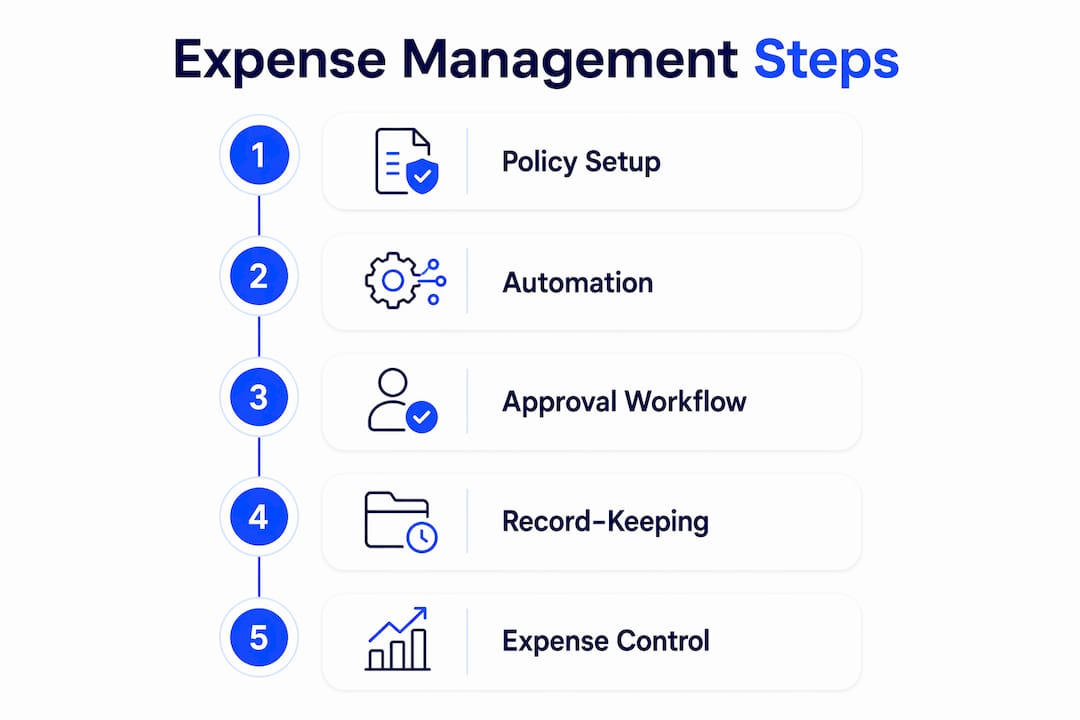
The most overlooked element is the approval workflow. Threshold-based routing improves efficiency by sending only high-value or unusual expenses to senior approvers, which prevents bottlenecks without sacrificing oversight. A $50 lunch does not need the CFO’s signature. A $4,000 vendor contract does. Building that logic into your policy from day one saves hours of back-and-forth every month.
One more principle worth adopting early: embed controls in the spend flow using software enforcement rather than relying on a static PDF document. A policy that lives only in a shared drive gets ignored. A policy enforced by your expense platform gets followed.
How can automation and technology improve expense tracking?
Manual expense tracking is the single largest source of errors in small business finance. Spreadsheets get corrupted, receipts get lost, and approval chains collapse under email volume. Cloud-based expense management software solves all three problems simultaneously.
The core benefits of automating your expense workflow include:
- Receipt capture: Mobile apps scan and digitize receipts at the point of purchase, eliminating the shoebox problem entirely.
- Data integration: Expense platforms sync with accounting software like QuickBooks or Xero, removing duplicate data entry.
- Automated approvals: Rules-based routing sends expenses to the right approver instantly, with no manual forwarding required.
- Real-time alerts: The system flags policy violations, duplicate submissions, or unusual spending patterns before funds leave the business.
- Reporting dashboards: Finance managers see live budget versus actual comparisons across every department and category.
Automating approval workflows with alerts reduces errors and flags unusual activity before it impacts your finances. This is the difference between reactive accounting and proactive financial control. When a team member submits a $300 dinner receipt at midnight on a Friday, an automated system flags it immediately. A manual process might not catch it until the monthly close.
Pro Tip: Connect your expense platform directly to dedicated business cards. Every transaction is captured automatically, categorized by merchant type, and matched to the correct budget line. This eliminates manual receipt submission for routine purchases entirely.

Unified spend management across teams breaks down operational silos and gives leadership a single, accurate picture of where money is going. For small businesses with multiple departments or remote employees, that visibility is the foundation of every smart cost decision.
What practical steps ensure accurate record-keeping and auditing?
Accurate records are not just good practice. They are a legal requirement. For tax purposes, courts expect detailed, contemporaneous documentation beyond oral explanations to substantiate expense deductions. That standard applies to every meal, trip, and client entertainment expense your business claims.
Follow this workflow to build audit-ready records:
- Record every transaction immediately. Log the date, amount, vendor, and business purpose at the time of purchase, not at month-end.
- Apply special documentation to high-risk categories. Meals, travel, and entertainment require the amount, time, place, business purpose, and the relationship of every attendee. Use a standardized receipt template for these categories.
- Reconcile accounts weekly. Match every card transaction and bank entry against submitted expenses to catch discrepancies before they compound.
- Run periodic expense audits. Regular audits detect waste, duplicate charges, and unused services, improving both cost efficiency and compliance.
- Separate duties across roles. The person who initiates an expense should not be the same person who approves it or reconciles the account.
That last point deserves more attention. Segregation of duties prevents any one individual from controlling the full expense transaction cycle, which is the primary structural defense against internal fraud. Small businesses without dedicated finance teams can implement this through dual authorization, management reviews, and rotating reconciliation duties.
Treating meals, entertainment, and travel as special categories with strict, detailed receipt templates is not just good accounting practice. It is your first line of defense in a tax audit. Courts have disallowed entire deduction categories because businesses could not produce contemporaneous records with sufficient detail.
For tracking business spending at the transaction level, dedicated business accounts and cards create a clean, auditable paper trail that personal accounts simply cannot provide.
How to control and reduce business expenses without harming growth
Cost control is not the same as cost cutting. Cutting expenses indiscriminately damages team morale, reduces service quality, and signals financial distress to vendors and clients. Controlling expenses means spending deliberately, with full visibility into what each dollar produces.
The most effective strategies for expense reduction without growth sacrifice:
- Categorize expenses by type. Separate fixed costs (rent, salaries, insurance), variable costs (marketing spend, contractor fees), and periodic costs (annual software licenses, equipment). Each category requires a different control strategy.
- Align budgets with strategic goals. Every budget line should map to a business objective. If a cost does not support revenue, retention, or compliance, it is a candidate for reduction.
- Audit subscriptions quarterly. Software subscription sprawl is the most common hidden cost in small businesses. A quarterly review of SaaS tools routinely uncovers 15 to 20 percent of spend on tools no one actively uses.
- Renegotiate vendor contracts annually. Most vendors expect renegotiation. Businesses that never ask leave significant savings on the table, particularly on multi-year service agreements.
- Set spending limits at the card level. Business expense cards with configurable limits enforce policy automatically, removing the need for after-the-fact policing.
Here is a direct comparison of reactive versus proactive expense control approaches:
| Approach | Method | Outcome |
|---|---|---|
| Reactive | Review expenses after month-end close | Violations already paid; corrections are slow |
| Proactive | Enforce limits and approvals at point of spend | Violations blocked before funds leave the business |
| Reactive | Manual receipt collection and reconciliation | High error rate; audit risk increases |
| Proactive | Automated capture and real-time categorization | Clean records; faster close; lower audit exposure |
Training employees on expense policies increases accountability and reduces both accidental and deliberate noncompliance. Policy training is not a one-time onboarding task. It should be repeated whenever the policy changes and reinforced through regular reporting that shows teams how their spending compares to budget.
Accurate, timely expense data allows managers to respond quickly to budget misalignments before they become cash flow problems. That responsiveness is what separates businesses that catch problems in week two from those that discover them at year-end.
Key takeaways
Effective business expense management requires a written policy, automated enforcement, audit-ready records, and proactive cost controls working together as a single system.
| Point | Details |
|---|---|
| Policy is the foundation | A seven-component expense policy prevents violations before they occur. |
| Automation reduces errors | Cloud-based tools with automated approvals catch noncompliance before funds leave the business. |
| Documentation protects you legally | Contemporaneous records for meals, travel, and entertainment are required for tax substantiation. |
| Segregation of duties prevents fraud | Separating initiation, approval, and reconciliation roles is the core internal control for small businesses. |
| Proactive control beats reactive review | Enforcing limits at the point of spend produces better outcomes than correcting violations after the fact. |
Why most small businesses get expense management wrong
The most common mistake I see is treating expense management as a finance department problem rather than a company-wide operating discipline. When the policy lives in a PDF that no one reads and approvals happen over Slack with no audit trail, the system fails regardless of how good the accounting software is.
The second mistake is waiting until the business is large enough to “need” formal controls. By the time most small businesses implement proper expense policies, they have already absorbed months of preventable losses through duplicate payments, unclaimed deductions, and reimbursements that were never properly documented. The right time to build the system is when the business is small enough that implementation is fast and cheap.
What actually works is embedding controls directly into the tools employees already use. When a business card automatically declines a purchase that exceeds the category limit, no one needs to police the policy manually. When an expense submission triggers an automated approval request with the receipt attached, the finance manager does not chase paperwork. The system does the work.
The businesses I have seen manage this best share one trait: they treat financial accountability as a cultural value, not a compliance burden. Employees who understand why the policy exists follow it more consistently than those who see it as bureaucratic friction. That shift in framing is free, and it is more effective than any software tool alone.
— dd
Take control of your business finances with Demivolt
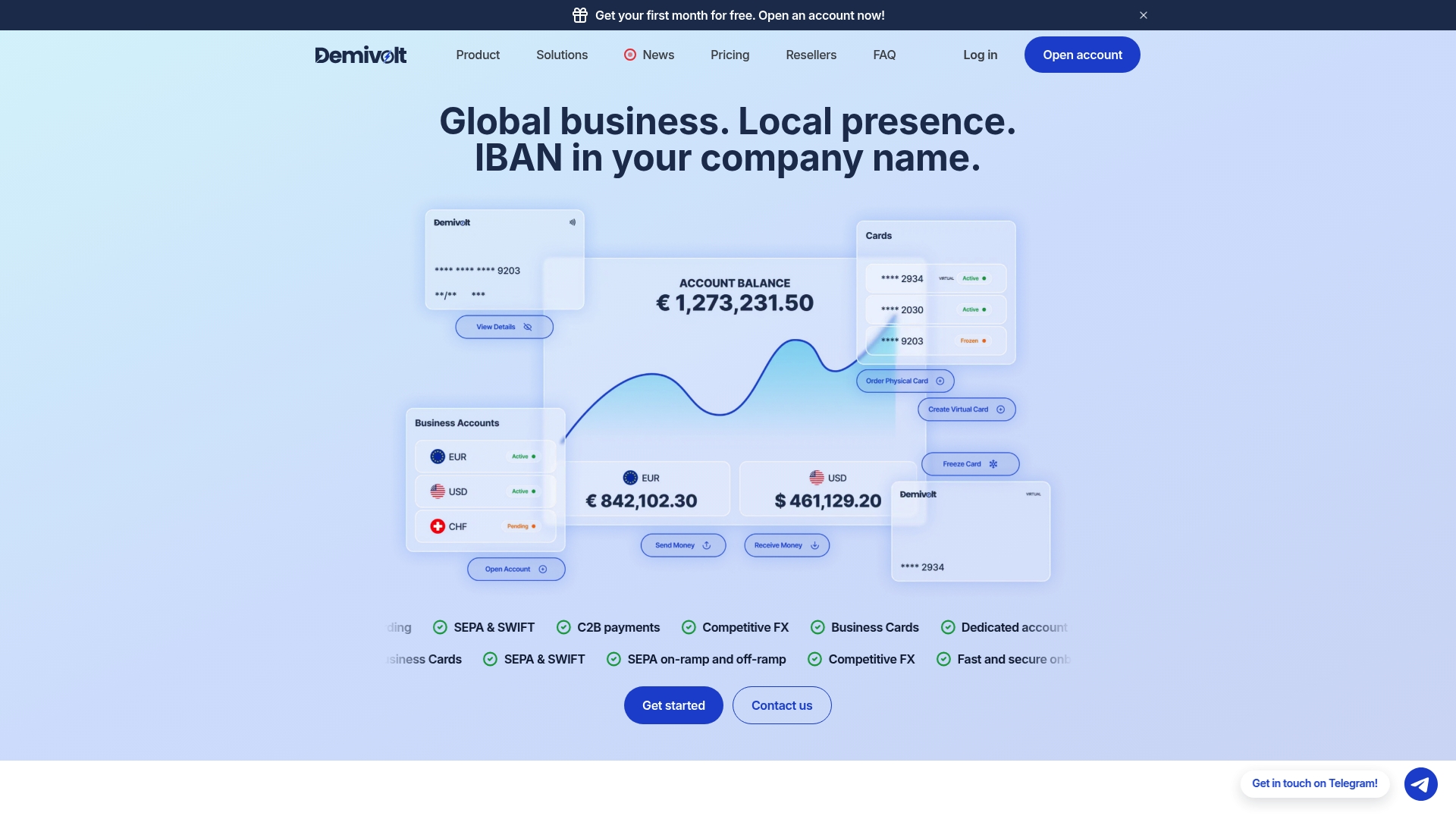
Demivolt gives small businesses and finance managers the financial infrastructure to put everything covered in this article into practice. With dedicated IBAN accounts, virtual and physical business cards with configurable spending limits, and role-based user management, Demivolt makes it straightforward to separate business finances, enforce spending policies, and maintain clean records for every transaction. SEPA and SWIFT payment support means cross-border expenses are tracked with the same clarity as domestic ones. Use Demivolt’s free IBAN validator to verify payment details before funds move, and explore the full suite of free SEPA tools built for businesses that take financial control seriously.
FAQ
What is business expense management?
Business expense management is the process of tracking, approving, documenting, and controlling all costs a company incurs. It covers everything from employee reimbursements and vendor payments to subscription fees and travel costs.
How do I start tracking business spending effectively?
Start by opening a dedicated business account, categorizing all expenses by type, and implementing a written expense policy with clear approval rules. Cloud-based tools that capture receipts automatically and sync with your accounting software reduce manual effort significantly.
What records do I need for business expense deductions?
For meals, travel, and entertainment, tax authorities require the amount, date, location, business purpose, and the names and relationships of all attendees. Courts have disallowed deductions where only oral explanations were provided without contemporaneous written records.
How does segregation of duties reduce fraud risk?
Segregation of duties prevents any single employee from controlling the full expense cycle by separating who initiates, approves, and reconciles transactions. Small businesses can implement this through dual authorization and rotating reconciliation responsibilities even without a large finance team.
What is the fastest way to reduce business expenses?
Audit all active software subscriptions, renegotiate vendor contracts, and set card-level spending limits to enforce policy automatically. These three steps typically surface the highest concentration of unnecessary spend with the least disruption to operations.