

TL;DR:
- Securing online transactions involves implementing layered protections such as TLS encryption, PCI DSS compliance, and tokenization to prevent data breaches. Businesses must also enforce strong authentication, monitor transactions actively, and maintain procedural discipline, including staff training and incident response plans. Relying solely on payment gateways is insufficient; ongoing operational security practices are essential to prevent breaches and maintain customer trust.
Securing online transactions means applying multiple protective layers, including TLS encryption, PCI DSS-compliant processing, multi-factor authentication, and real-time fraud monitoring, that collectively guard against financial fraud and data breaches. For businesses and entrepreneurs, a single unprotected payment can expose customer card data, trigger regulatory penalties, and permanently damage your reputation. The good news is that the tools and standards to protect online transactions are well-established, widely available, and increasingly affordable for businesses of any size. This guide walks you through each layer of protection with specific, practical steps you can act on today.
How to secure online transactions: core technologies and standards
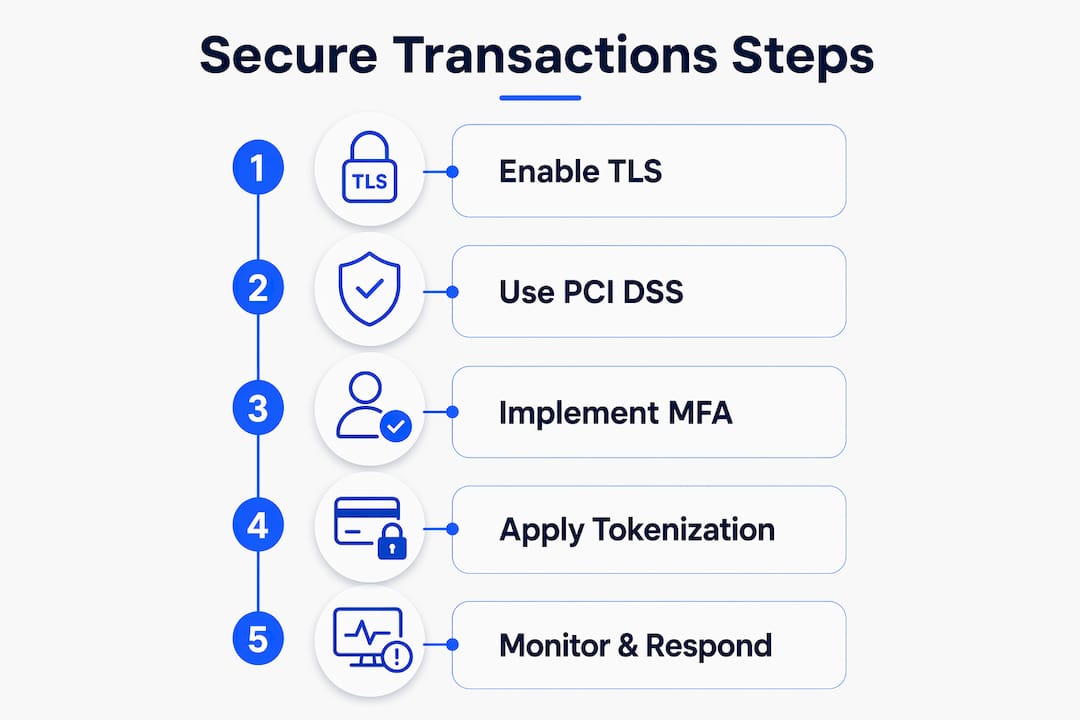
The foundation of secure online payments rests on three technical pillars: encryption in transit, compliance with payment card standards, and tokenization of sensitive data. Get these right and you eliminate the majority of attack vectors that target payment systems.

TLS encryption (Transport Layer Security) protects data moving between a customer’s browser and your server. TLS encryption is the baseline requirement for any business accepting card payments online, and PCI DSS compliance makes it mandatory. Without TLS, payment data travels in plain text, readable by anyone intercepting the connection.
PCI DSS (Payment Card Industry Data Security Standard) is the compliance framework every merchant must follow when accepting card payments. It covers everything from how you store data to how you configure your payment environment. PCI DSS 4.0.1 requires merchants to restrict components running on payment pages and continuously monitor their payment environments. Failing compliance exposes you to fines from card networks and liability for breach costs.
Tokenization replaces a real card number with a randomly generated token that has no value outside your payment system. Tokenization protects stored card data by making stolen database records useless to attackers. Payment processors like Stripe, PayPal, and Authorize.net all offer tokenization as a built-in feature, which is one strong reason to route transactions through a reputable gateway rather than handling raw card data yourself.
| Payment processor | TLS encryption | Tokenization | PCI DSS compliant | Fraud detection |
|---|---|---|---|---|
| Stripe | Yes | Yes | Yes | Yes (Radar) |
| PayPal | Yes | Yes | Yes | Yes |
| Authorize.net | Yes | Yes | Yes | Yes (Advanced Fraud) |
Pro Tip: Never process or store raw card numbers on your own servers. Even brief exposure creates PCI DSS scope and liability. Let your payment gateway handle card data entirely, and your compliance burden drops significantly.
How can businesses implement strong authentication and access controls?
Authentication failures are one of the most preventable causes of payment fraud. Many breaches originate from stolen passwords and reused credentials, which means a compromised email account can become a direct path into your payment admin panel. Strong authentication closes that door.
The non-negotiable practices for any business handling payments:
- Enable MFA on every payment-related account. This includes your payment gateway dashboard, business banking portal, accounting software, and any admin tool with access to financial data. MFA prevents unauthorized access even when passwords are already compromised, which is the scenario you should always plan for.
- Use unique, complex passwords for every system. Password managers like 1Password, Bitwarden, or Dashlane generate and store credentials so your team never reuses passwords across platforms.
- Limit internal access using role-based permissions. Your marketing coordinator does not need access to your payment processor’s refund tools. Restrict each team member to only the systems and functions their role requires.
- Monitor login activity and set alerts for unusual access. Most payment platforms and banking portals offer login notifications. Turn them on and review access logs at least weekly.
- Adopt passkeys where available. Passkeys replace passwords with cryptographic keys tied to a device, making phishing attacks against your accounts far harder to execute.
Pro Tip: The most common authentication mistake is enabling MFA on customer-facing accounts but leaving internal admin tools protected only by a password. Attackers target the admin side first. Audit your internal tools today.
What are best practices for monitoring and responding to suspicious transactions?
Real-time monitoring is the difference between catching fraud in minutes and discovering it weeks later in a chargeback report. Swift response to suspicious activity, including freezing accounts and notifying your payment processor, is the single most effective way to limit financial damage after an anomaly appears.
A practical incident response sequence looks like this:
- Set up real-time alerts for transactions above a defined threshold, orders from high-risk IP addresses, multiple failed payment attempts, and unusual refund patterns.
- Review transaction logs daily. Fraud often starts small, with test charges of a few cents, before escalating to larger withdrawals. Catching the pattern early stops the escalation.
- Freeze the affected account or payment method immediately when suspicious activity is confirmed. Most payment gateways allow you to do this from the dashboard within seconds.
- Notify your payment processor and acquiring bank as soon as you detect a potential breach. They can flag the compromised card numbers, block further transactions, and initiate their own investigation.
- Document everything. Timestamps, transaction IDs, IP addresses, and the actions you took all become critical evidence for chargebacks, insurance claims, and regulatory reporting.
“Operational practices like monitoring transaction logs and educating staff significantly enhance security posture.” — Greenville Business Guide on Secure Transactions
The businesses that recover fastest from payment fraud are the ones with a written response plan, not the ones improvising under pressure. Write yours before you need it.
Which common mistakes undermine online transaction security?
Most payment security failures are not sophisticated attacks. They are the result of avoidable configuration errors, outdated software, and overconfidence in a single security layer. Understanding where businesses go wrong is half the battle.
The mistakes that create the most exposure:
- Storing raw card data on your own servers. This is the most dangerous error a merchant can make. It creates direct PCI DSS violations and turns your database into a high-value target. Use a payment gateway and let tokenization handle card storage.
- Running outdated software and plugins. Unpatched content management systems, payment plugins, and server software are the most common entry points for skimming attacks. Set automatic updates wherever possible and audit your plugin list quarterly.
- Reusing passwords across payment systems. A single compromised credential can cascade across every platform that shares it. This is not a theoretical risk. Credential stuffing attacks run continuously against known email and password combinations.
- Ignoring third-party scripts on payment pages. Merchants must inventory and minimize scripts running on payment pages to reduce exposure to injection and skimming attacks. A single malicious or compromised third-party script can silently capture card numbers as customers type them.
- Relying on a single security layer. TLS alone is not enough. PCI DSS alone is not enough. Layered security defenses integrating encryption, tokenization, MFA, and monitoring work together to reduce risk in ways that no single measure can achieve alone.
- Using public Wi-Fi for payment administration. Accessing your payment gateway or banking portal from an unsecured network exposes your session to interception. Always use a VPN or a secured private connection for financial administration.
For businesses handling cross-border payments, these risks multiply because transactions cross multiple jurisdictions and payment networks, each with their own security configurations.
How do you build a secure payment workflow that customers trust?
Technology alone does not create a secure payment environment. The workflow surrounding that technology, how your team operates, how you communicate with customers, and how you audit your systems, determines whether your security measures actually hold up under real conditions.
A secure payment workflow combines technical controls with procedural discipline. The table below maps each workflow component to its security function:
| Workflow component | Security function |
|---|---|
| PCI DSS-compliant gateway | Removes raw card data from your environment |
| TLS on all payment pages | Encrypts data between customer and server |
| MFA for all admin accounts | Blocks unauthorized access even after credential theft |
| Staff phishing training | Reduces human error as an attack vector |
| Monthly system audits | Catches misconfigurations before attackers do |
| Digital audit trails | Provides evidence for disputes and compliance reviews |
Staff training deserves more attention than most businesses give it. Phishing emails targeting payment credentials are the most common initial access method in business payment fraud. A team member who recognizes a spoofed invoice email or a fake payment portal login page is worth more than any software tool. Run quarterly phishing simulations using tools like KnowBe4 or Proofpoint Security Awareness Training.
Customer communication also plays a role in ensuring transaction security. Displaying trust signals, such as SSL certificate indicators, recognized payment logos, and clear privacy policies, reduces cart abandonment and signals that your payment environment is professionally managed. Customers who trust your checkout process complete purchases. Those who do not, leave.
Generic web application security tests are insufficient for payment environments. The OWASP Payment Security Testing Guide (PSTG) provides specialized methodologies that address transaction integrity, fraud patterns, and refund abuse. Schedule payment-specific security testing at least annually, and after any significant change to your payment stack.
Pro Tip: Build a payment security checklist and run through it every quarter. Include TLS certificate expiry dates, plugin update status, MFA enrollment for all admin users, and a review of who has access to your payment systems. What gets measured gets maintained.
Key takeaways
Securing online transactions requires layered defenses: encryption, tokenization, authentication, monitoring, and procedural controls working together, not as isolated measures.
| Point | Details |
|---|---|
| TLS and PCI DSS are non-negotiable | Every business accepting card payments must encrypt data in transit and meet PCI DSS requirements. |
| Tokenization removes your biggest liability | Letting your payment gateway tokenize card data means a database breach yields nothing usable to attackers. |
| MFA stops most credential-based attacks | Enabling MFA on all payment and banking accounts blocks unauthorized access even when passwords are stolen. |
| Monitoring enables fast incident response | Real-time alerts and daily log reviews let you freeze accounts and notify processors before fraud escalates. |
| Workflow and training close the human gap | Staff phishing training and quarterly security audits address the vulnerabilities that technology alone cannot fix. |
Why most businesses are one oversight away from a payment breach
After years of working with businesses on payment infrastructure, the pattern I see most often is not ignorance of security tools. It is the assumption that setting up a reputable payment gateway is enough. Stripe or PayPal handles the hard part, the thinking goes, so the rest is covered. That assumption is wrong, and it is expensive when it fails.
Security is not just about gateways. Merchant-side controls and compliance configuration are equally vital. The gateway secures the transaction itself, but your admin panel, your team’s email accounts, your payment page scripts, and your internal access controls all sit outside the gateway’s protection. That is where most breaches actually start.
The businesses I have seen recover well from payment fraud share one trait: they treated security as an ongoing operational practice, not a one-time setup. They reviewed access logs. They ran staff training. They audited their plugin lists. They had a written incident response plan. None of that is technically complex. All of it requires consistent attention.
The emerging tools worth watching are AI-powered fraud detection, which several payment processors are now embedding directly into their platforms, and passkeys, which are beginning to replace passwords in business banking and payment admin contexts. Both reduce reliance on human vigilance, which is always the weakest link. But they supplement good practice. They do not replace it.
If you take one thing from this article, make it this: run a full audit of who has access to your payment systems today. You will almost certainly find accounts that should have been removed months ago.
— dd
Secure your business payments with Demivolt
Demivolt is a regulated European fintech platform built for businesses that take payment security seriously. Its dedicated IBAN accounts, SEPA and SWIFT payment management, and role-based user controls give you the financial infrastructure to operate with confidence across borders. For businesses validating international payment details before sending funds, the IBAN Validator provides a free ISO 13616 check that catches errors before they become costly misdirected transfers. Demivolt’s SEPA payment tools support euro transactions within a compliant, monitored environment. If you are building a secure payment workflow for your business, Demivolt’s infrastructure is designed to support every layer of it.
FAQ
What is the most important step to protect online transactions?
Enabling TLS encryption and using a PCI DSS-compliant payment gateway are the two most critical baseline steps. Together, they encrypt data in transit and remove raw card data from your environment entirely.
Does MFA really prevent payment fraud?
MFA prevents the majority of credential-based attacks by requiring a second verification step even when a password is already compromised. The FDIC specifically recommends MFA as a primary defense against unauthorized account access.
What is tokenization and why does it matter?
Tokenization replaces a real card number with a randomly generated token that has no value outside the payment system. If your database is breached, attackers retrieve tokens, not usable card numbers.
How often should businesses audit their payment security?
Payment-specific security testing should occur at least annually and after any significant change to your payment stack. The OWASP Payment Security Testing Guide recommends targeted assessments that go beyond standard web application vulnerability scans.
What should I do immediately after detecting a suspicious transaction?
Freeze the affected account, notify your payment processor and acquiring bank, and document all transaction details including timestamps and IP addresses. Swift action limits financial damage and preserves the evidence needed for chargebacks and regulatory reporting.